 Frese di precisione,Utensili da taglio per la lavorazione CNC di ogni materiale

A 6 flute end mill is mainly used for controlled side milling, fresatura di profili, fresatura di contorni, semifinitura, e rifinitura. Its six cutting edges provide frequent cutting contact, which can support good tool rigidity, stable wall machining, and a smoother finishing pass.
Tuttavia, more flutes leave less space for chip evacuation. Therefore, a standard six-flute cutter is usually not the best choice for deep full-width slotting, sgrossatura pesante, or aggressive cutting in materials that produce large chips.
In pratica, a six-flute tool works best when surface quality and cutting stability matter more than maximum material removal.
Cos'è un 6 Fresa per flauto?
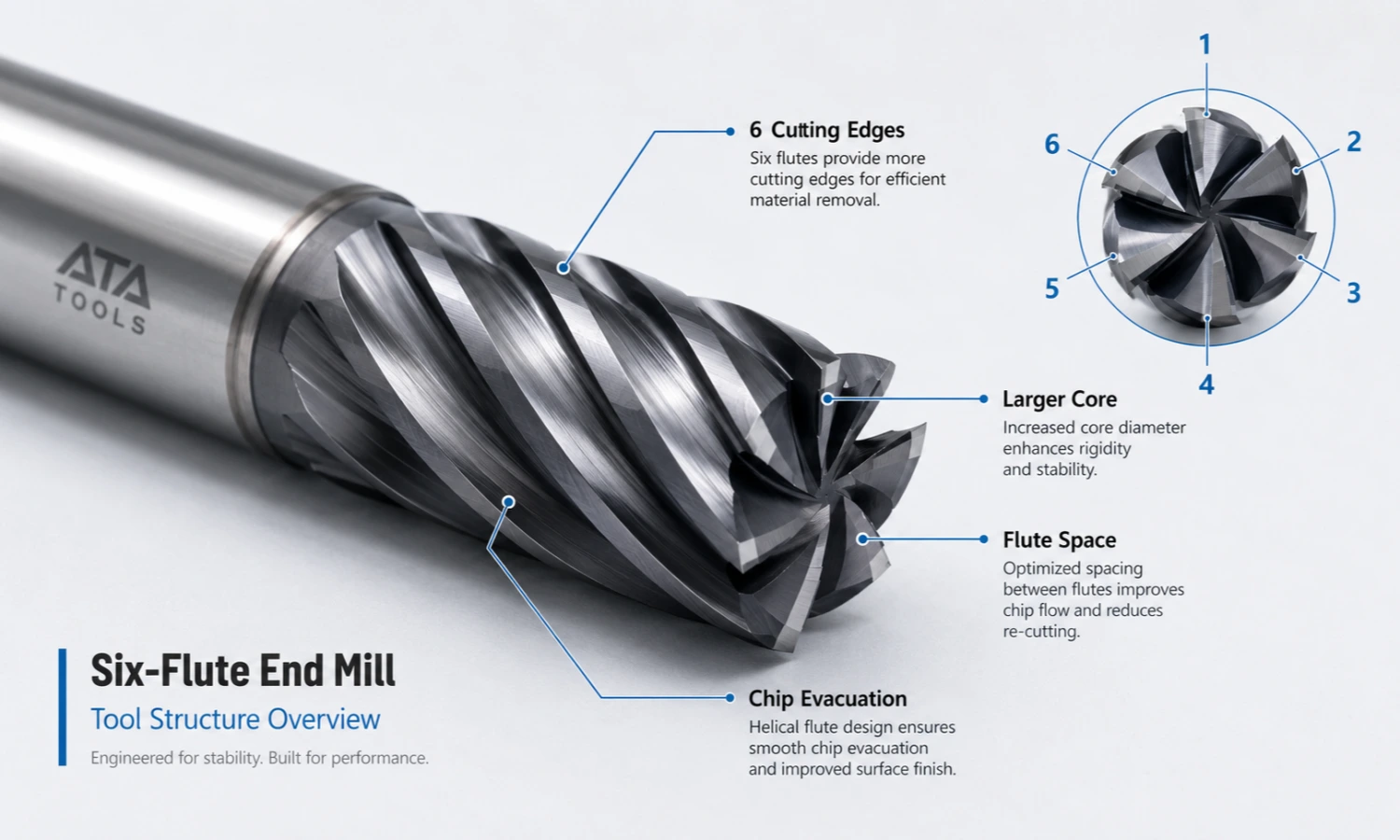
A 6 flute end mill has six cutting edges around its cutting section. Each spindle revolution brings six cutting edges into contact with the workpiece.
Compared with a cutter that has two or four flutes, a six-flute design normally has a larger tool core and smaller flute spaces. The larger core can support tool rigidity, while the additional cutting edges can spread the cutting action across more teeth.
The main trade-off is chip evacuation. Smaller flute spaces hold fewer chips, so the cutter needs controlled engagement and a clear path for chips to leave the cutting area.
Per questo motivo, six-flute tools usually perform better in side cutting and finishing than in deep slotting or heavy roughing.
For a general explanation of milling cutter types and structures, leggi il nostro end mill cutter guide.
Main Uses of a 6 Fresa per flauto
The best applications involve controlled chip volume, stable machine conditions, and a need for good wall quality or surface finish.
Fresatura laterale e di profilo
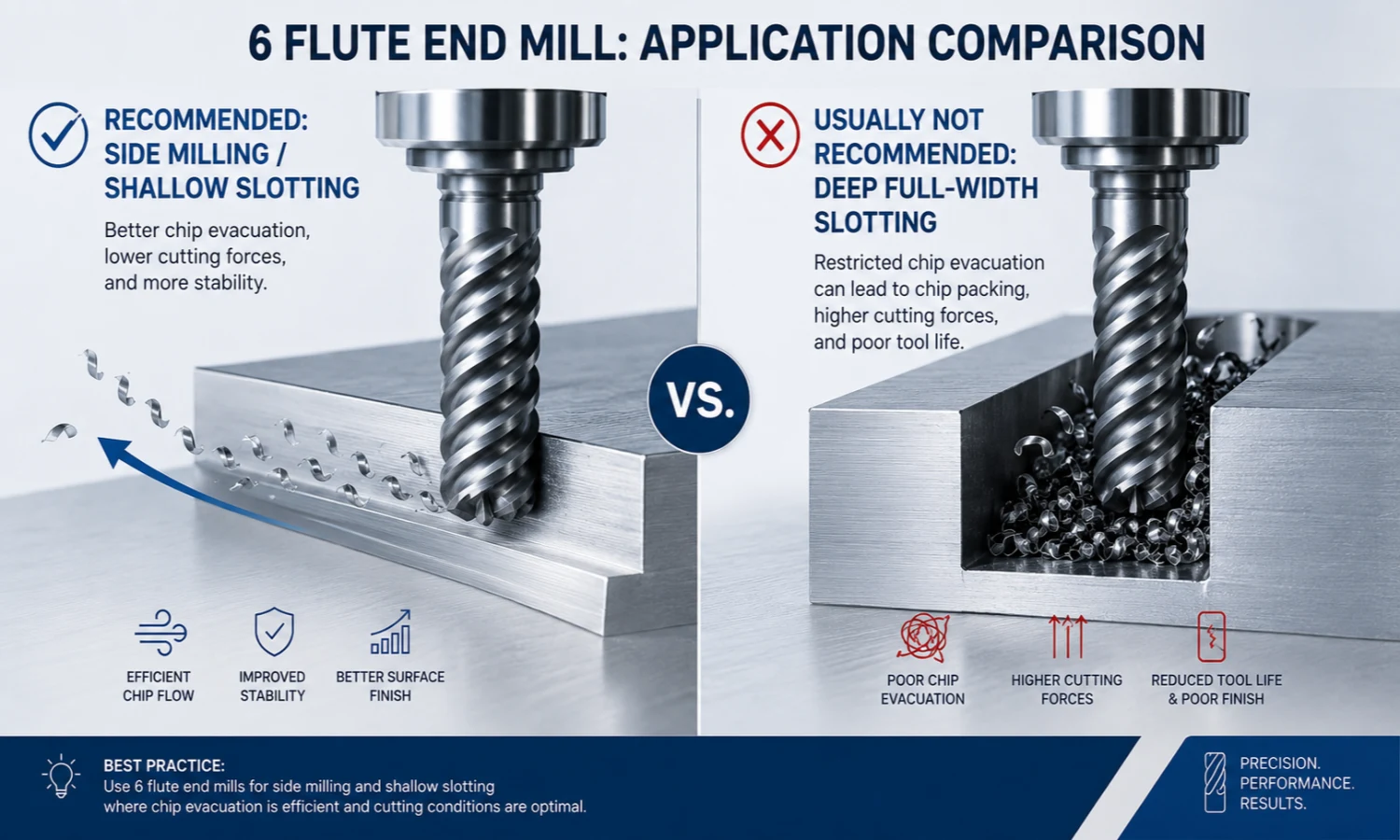
A six-flute cutter works well for side milling because only part of the tool diameter normally engages with the workpiece. This leaves more room for chips to escape than full-width slotting does.
Typical uses include straight side walls, spalle, profili esterni, and precision component features. The extra cutting edges can also support stable tool contact when the radial cutting width remains controlled.
Still, the result depends on more than flute count. Eccentricità dell'utensile, condizione del titolare, rigidità della macchina, larghezza di taglio, and tool overhang all affect side-wall quality.
Contour Milling
Contour milling involves following a curved or irregular workpiece profile. A rigid six-flute tool can support consistent contact as it moves along the contour.
This makes the design useful for mold components, tooling parts, machinery components, and other precision profiles. Tuttavia, a long tool overhang or unstable holder can still create vibration.
Therefore, the tool should remain as short as the application allows, especially when machining steep or deep contours.
Semifinitura
Semi-finishing removes the material left after roughing and prepares the surface for the final pass.
A six-flute tool suits this stage when the remaining stock is controlled. The additional cutting edges can distribute the cutting action and help maintain consistent wall geometry.
Before using six flutes, make sure that the roughing operation has not left an uneven or excessive allowance. Large and irregular stock can overload individual cutting edges.
Finissaggio
Finishing is one of the most common 6 flute end mill applications.
More cutting edges can leave finer cutting marks when the speed, foraggio, percorso utensile, and machine setup match the material. Di conseguenza, six-flute cutters are often selected for finishing straight walls, profili, spalle, and precision surfaces.
Tuttavia, flute count alone does not guarantee a specific surface roughness. Holder accuracy, esaurimento dell'utensile, condizione della macchina, workpiece stability, parametri di taglio, and tool wear also influence the final surface.
Shallow Slotting and High-Speed Machining
A six-flute cutter can machine shallow slots when the chips can leave the cutting area effectively. Light slotting may work well, especially when the axial depth and chip volume remain low.
Deep full-width slotting is different. In tal caso, the cutter stays surrounded by material, while the smaller flute spaces must carry all chips out of the slot. Chip packing and heat can then increase quickly.
Six-flute tools can also support high-speed machining, but high spindle speed alone is not enough. The full setup must control heat, esaurire, vibrazione, ed evacuazione truciolo.
Quick Application Guide
| Operazione di lavorazione | General Suitability | Considerazione principale |
|---|---|---|
| Fresatura laterale | Raccomandato | Use controlled radial engagement |
| Fresatura del profilo | Raccomandato | Check holder accuracy and tool overhang |
| Contour Milling | Raccomandato | Maintain a rigid setup |
| Semifinitura | Raccomandato | Keep the remaining stock consistent |
| Finissaggio | Raccomandato | Control runout and cutting parameters |
| Scanalatura poco profonda | Conditional | Make sure chips can leave the slot |
| Scanalatura profonda a tutta larghezza | Usually Not Recommended | Limited flute space restricts chip evacuation |
| Sgrossatura pesante | Usually Not Recommended | Lower flute counts provide more chip space |
Which Materials Are Suitable for a 6 Fresa per flauto?
The correct choice depends on the workpiece material, durezza, operazione di taglio, rigidità della macchina, condizione del liquido di raffreddamento, and tool design.
A tool made for steel should not automatically be used for aluminum or titanium. Even when the flute count stays the same, the cutting-edge geometry and other tool features may need to change.
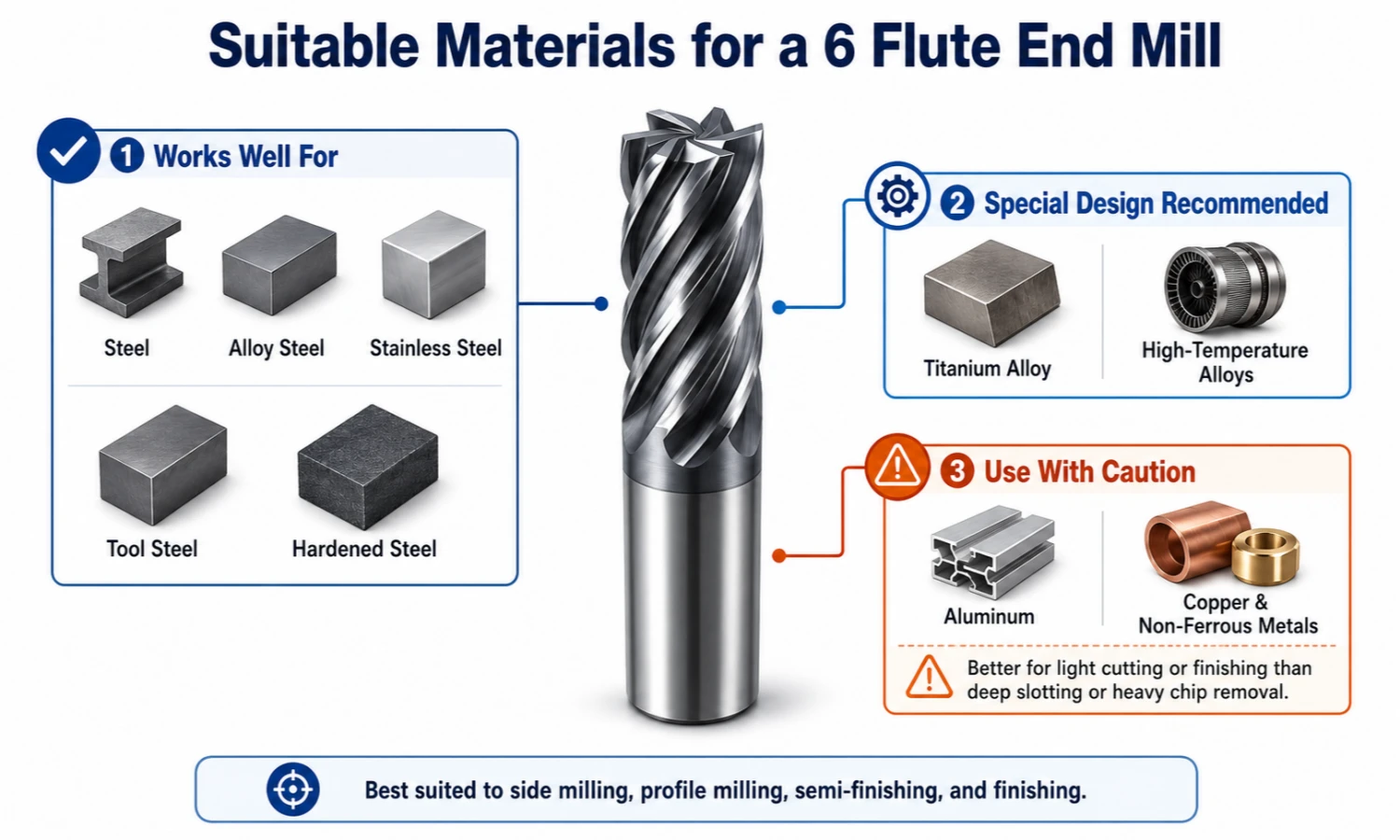
Acciaio e acciaio legato
Steel and alloy steel are common application areas for six-flute tools.
The cutter can handle controlled side milling, fresatura di profili, semifinitura, and finishing when its carbide grade, geometria di taglio, and coating match the material hardness.
Six flutes are especially useful when the operation requires stable walls or a clean finishing pass. Al contrario, heavy roughing generally needs more chip space.
Acciaio inossidabile
A six-flute cutter can machine 304, 316, and other stainless steel grades. Tuttavia, stainless steel can generate heat and may work-harden if the cutting action becomes unstable.
Therefore, the cutter must maintain a consistent cut. The cutting geometry, rivestimento, refrigerante, velocità, and feed should all match the stainless steel grade and machining operation.
A six-flute design usually makes more sense for controlled side cutting and finishing than for deep slotting in stainless steel.
Tool Steel and Hardened Steel
Six-flute tools can also machine tool steel, acciaio pretemprato, and hardened steel when the tool series matches the material hardness.
Harder materials need suitable carbide grades, forza del bordo, rivestimenti, and cutting geometry. Di conseguenza, one standard cutter should not be treated as a universal solution for every hardness range.
For hardened materials, stable machine conditions and low tool runout become even more important.
Titanium and Difficult-to-Machine Materials
A specially designed six-flute tool may suit titanium and other difficult-to-machine materials.
Tuttavia, controllo del calore, carico di taglio, forza del bordo, mandata del liquido refrigerante, and tool overhang require careful attention. Standard steel-cutting geometry may not provide the best result.
Before choosing the cutter, review the exact titanium grade, operazione di lavorazione, profondità di taglio, metodo del refrigerante, e lo stato della macchina.
Può a 6 Fresa per flauto in alluminio tagliato?
Sì, but only when the cutter uses a suitable geometry for aluminum and the operation does not create excessive chip volume.
Aluminum often produces larger and more adhesive chips than steel. Therefore, deep slots and heavy roughing usually work better with two or three flutes because they provide larger flute spaces.
A six-flute tool may still suit light side milling or finishing in aluminum when it has sharp cutting edges, effective chip control, and enough space to evacuate chips.
Quando dovresti scegliere a 6 Fresa per flauto?
Choose a six-flute cutter when most of the following conditions apply:
- Surface finish matters more than maximum material removal.
- The operation involves side milling, profilazione, semifinitura, o rifinitura.
- La macchina e il supporto garantiscono una buona rigidità.
- The radial cutting width remains controlled.
- The tool overhang stays reasonably short.
- Chips can leave the cutting area effectively.
- The cutter design matches the workpiece material and hardness.
These conditions help the tool use its main strengths: rigidità, frequent cutting contact, and consistent wall machining.
Quando è a 6 Flute End Mill Not the Best Choice?
More cutting edges do not make a cutter suitable for every operation. In some applications, the reduced flute space becomes a greater concern than tool rigidity.
Scanalatura profonda a tutta larghezza
Durante l'esecuzione di scanalature a tutta larghezza, the cutter engages material across its full diameter. Chips must travel through the flute spaces and out of the slot.
Because a six-flute design has smaller flute spaces, chips may collect inside a deep slot. Ciò può aumentare il calore, carico di taglio, and the risk of edge damage.
Per scanalature profonde, a lower flute count usually provides safer chip evacuation.
Sgrossatura pesante
Heavy roughing removes a large amount of material. Di conseguenza, it produces more chips and places higher loads on the cutter.
A two-flute, three-flute, four-flute, or dedicated roughing tool often provides more space for chip flow. The best choice depends on the material and roughing strategy.
Materials That Produce Large Chips
Soft materials such as aluminum can produce large or adhesive chips during aggressive cutting.
In queste condizioni, a high-flute-count cutter may pack chips inside the flutes. A lower flute count normally handles heavy aluminum cutting more effectively.
Unstable Setups and Long Tool Overhang
A six-flute design can provide good core rigidity, but it cannot correct every setup problem.
Sbalzo lungo, worn holders, high runout, weak workholding, or an unstable machine can still cause vibration and cutting marks. In severe cases, they may also contribute to edge chipping.
Therefore, reduce the overhang and check the complete setup before changing flute count.
What Is the Main Disadvantage of a High-Flute-Count End Mill?
The main disadvantage of a high-flute-count end mill is reduced flute space.
As flute count increases, each flute usually has less room to carry chips. This can make chip evacuation more difficult, especially during deep slotting, sgrossatura pesante, or high material removal.
If chips cannot leave the cutting area, they may be cut again or packed between the tool and workpiece. Di conseguenza, heat and cutting pressure can increase.
The correct flute count must balance three factors:
- Evacuazione truciolo
- Rigidità dell'utensile
- Qualità della superficie
A six-flute tool may provide better rigidity and finishing stability, while a lower-flute cutter may handle large chip volumes more effectively.
4 Flauto o 6 Fresa per flauto?
A four-flute end mill is usually the more versatile option. It offers a practical balance between chip space, rigidità dell'utensile, e finitura superficiale.
A six-flute tool is more specialized. It normally suits controlled side milling, semifinitura, and finishing when stable contact and wall quality matter more than maximum chip evacuation.
The final choice depends on the workpiece material, profondità di taglio, impegno radiale, rigidità della macchina, e obiettivo della lavorazione.
For a detailed two-tool comparison, Leggere 4 flauto contro 6 fresa a candela a flauto.
For a broader flute-count overview, Leggere 2 flauto contro 4 flauto contro 6 fresa a candela a flauto.
Domande frequenti
"6 Flauti" significa a 6 Diametro di taglio mm?
No. “6 flute” refers to the number of cutting edges.
The cutting diameter is a separate tool dimension. A six-flute cutter can have many different cutting diameters.
Può a 6 Flute End Mill Be Used for Deep Slotting?
A standard six-flute cutter is usually not the first choice for deep full-width slotting.
Its smaller flute spaces can restrict chip evacuation. A lower-flute cutter normally provides more room for chips to leave the slot.
È un 6 Flute End Mill Good for Stainless Steel?
Sì, especially for controlled side milling, fresatura di profili, semifinitura, e rifinitura.
Tuttavia, the cutter geometry, rivestimento, refrigerante, velocità, and feed must match the stainless steel grade and machining operation.
Conclusione
Cos'è un 6 fresa per flauto utilizzata per? It is mainly used for controlled side milling, fresatura di profili, fresatura di contorni, semifinitura, e rifinitura.
Its main strengths are tool rigidity, stable cutting contact, wall quality, and finishing performance. Its main limitation is reduced chip space.
Therefore, avoid treating six flutes as the best option for every job. Scanalatura profonda a tutta larghezza, sgrossatura pesante, unstable setups, and large-chip operations usually benefit from fewer flutes.
For standard and custom tool options, visualizza il nostro 6 fresa in metallo duro con scanalatura.