 精密フライスカッター,あらゆる材料を加工するCNC用の切削工具

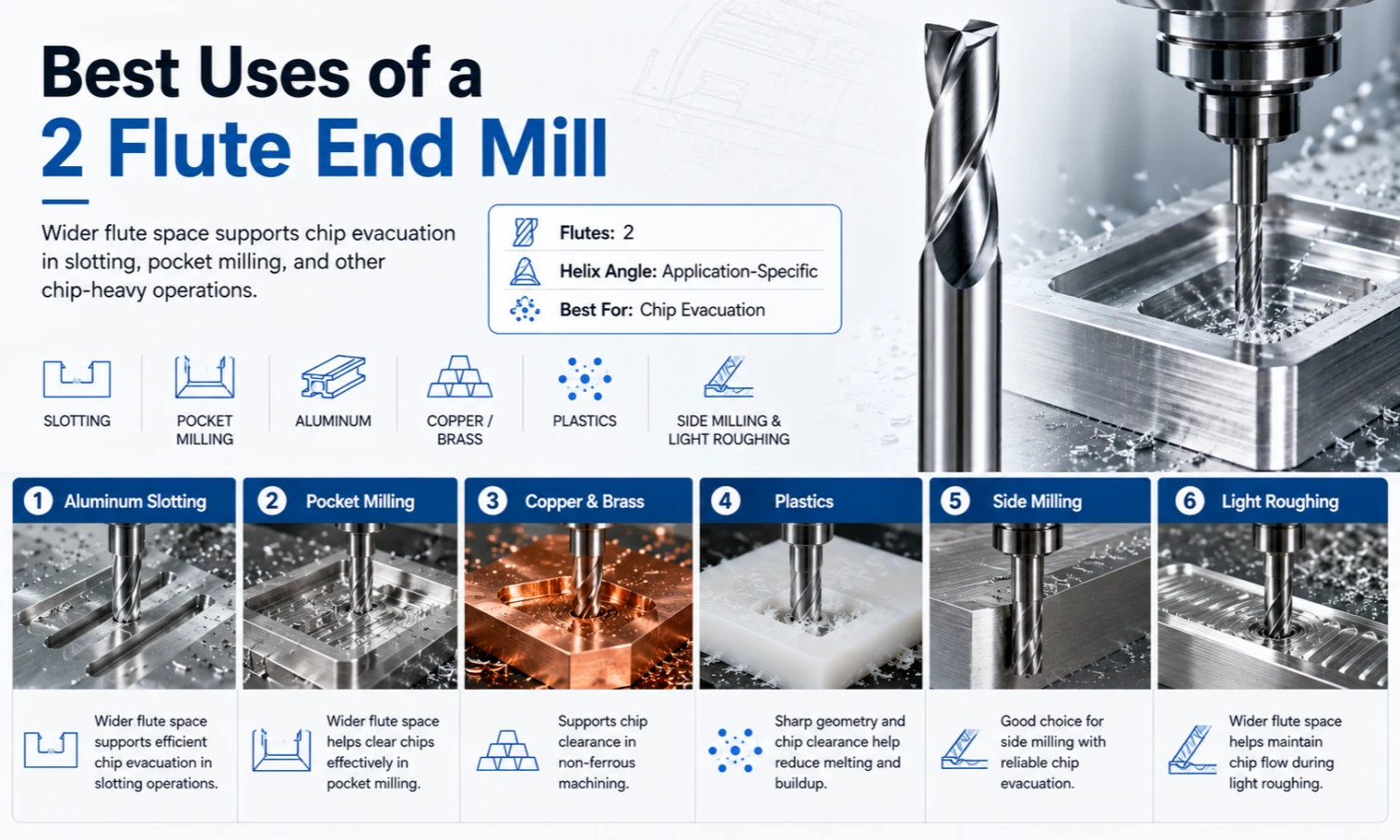
A 2 flute end mill is commonly used for aluminum machining, full-width slotting, ポケットフライス加工, 側面フライス加工, and light roughing. It is also suitable for copper, brass, selected plastics, and other applications where chip evacuation is a priority.
The two cutting edges leave relatively wide flute grooves. したがって, the cutter provides more space for chips than many higher-flute-count tools. This can help reduce chip packing during closed or high-chip-volume operations.
しかし, two flutes are not automatically the best choice for every job. The correct tool still depends on the workpiece material, 切断作業, 工具のかみ合わせ, 必要な仕上げ, 機械剛性, 及び切りくずの除去方法.
簡単な回答
とは何ですか 2 に使用されるフルートエンドミル?
典型的な用途には以下が含まれます::
- Aluminum slotting
- ポケットフライス加工
- Full-width slot cutting
- Side milling in non-ferrous materials
- Light roughing
- Copper and brass machining
- Selected plastic machining
- Operations where chips are difficult to remove
A two-flute cutter is especially useful when flute space and chip evacuation matter more than increasing the number of cutting edges. 対照的に, a higher flute count may be preferred when greater core strength, more cutting contacts, or a fine surface finish is the main requirement.
What Is a 2-Flute End Mill?
A two-flute end mill has two helical cutting edges and two flute grooves along the cutter body. These grooves form part of the cutting edge and also provide space for chips to leave the cutting zone.
Compared with many four-flute or six-flute tools of the same diameter, a two-flute design normally provides more flute space. 結果として, it is often considered for materials that produce large chips and for operations where the cutter is surrounded by the workpiece.
Flute count is only one part of the tool design. カッター径, 刃の長さ, コアの強さ, ねじれ角, エッジの準備, コーティング, and end geometry also affect performance.
Best Uses of a 2-Flute End Mill at a Glance
| 応用 | Why Two Flutes Can Help | 重要な条件 |
|---|---|---|
| Aluminum slotting | Provides more chip space | Sharp geometry and reliable chip removal |
| 全幅スロッティング | Helps clear a high chip volume | Suitable cutting depth and coolant or air delivery |
| ポケットフライス加工 | Reduces the risk of chip packing | Pocket depth and entry method must be considered |
| 銅と真鍮 | Supports chip clearance | Alloy grade and burr requirements affect selection |
| プラスチック | Provides space for chip removal | Plastic type and heat control are important |
| 側面フライス加工 | Can suit many non-ferrous applications | Radial engagement and surface finish must be checked |
| Light roughing | Supports chip-heavy material removal | Machine rigidity and tool reach remain important |
Main Uses of a 2-Flute End Mill
アルミ加工
Aluminum machining is one of the most common applications for a 2 フルートエンドミル.
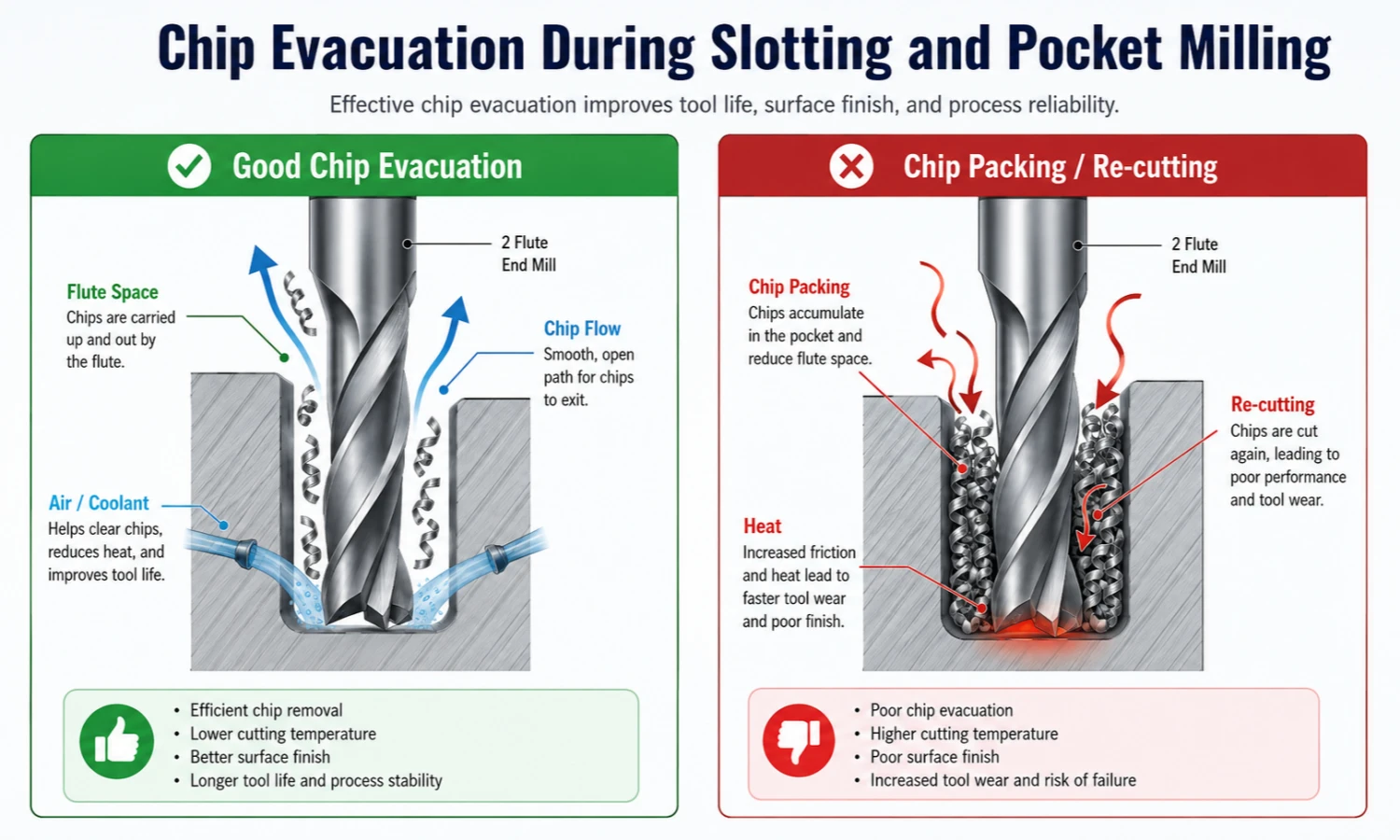
多くのアルミニウム合金は、比較的大きな切りくずや連続した切りくずを生成します。. If those chips remain inside a slot or pocket, they may be re-cut or compressed against the workpiece. これにより熱が増加する可能性があります, cause built-up edge, and reduce cutting stability.
A suitable aluminum cutter often uses:
- 鋭い刃先
- 滑らかまたは研磨されたフルート表面
- Adequate flute space
- An uncoated design or a suitable low-friction coating
- An application-specific helix angle
- 信頼できるエア, ミスト, またはクーラントの配送
Two flutes provide useful chip space, but flute count alone does not guarantee good aluminum performance. The complete tool geometry should match the alloy, 工具径, 切込み深さ, 機械の状態, そして必要な仕上げ.
全幅のスロット加工
全幅スロッティングでは、カッターが材料の全直径にわたってかみ合うため、大量の切りくずが生成されます。.
加えて, the slot walls restrict the paths available for chip evacuation. Chips can remain below or around the cutter, especially during deeper cuts.
A two-flute tool can help because the wider flute grooves provide more space for chips. それにもかかわらず, stable slotting also depends on:
- スロットの深さ
- カッター径
- 刃長さ
- 工具オーバーハング
- Coolant or air access
- 機械剛性
- ワーククランプ
- 切断パラメータ
深いスロット用, use only the flute length and overall reach required by the feature. Excessive tool extension can increase deflection and chatter.
ポケットミーリング
Pocket milling combines material removal with restricted chip flow. したがって, the tool must cut efficiently while chips leave the enclosed area.
A two-flute cutter is often considered for aluminum pockets, rough pocket machining, and other applications where chip packing creates problems.
しかし, pocket depth and entry method also affect tool selection. A shallow open pocket creates different conditions from a deep closed pocket. 同じく, side engagement after entry may require a different strategy from the initial pocket start.
When chips remain inside the pocket, improve air or coolant delivery before increasing the cutting load.
Copper and Brass
Copper and brass are both non-ferrous materials, but they do not machine in the same way.
Pure copper can be ductile and may produce long chips or burrs. Meanwhile, different brass alloys may produce shorter chips and require different edge preparation.
これらの材料については、, a two-flute cutter can support chip clearance. しかし, the exact tool should also reflect:
- 材質グレード
- Burr requirements
- Surface-finish target
- Tool engagement
- カッター径
- Coolant or lubrication method
Sharp cutting geometry is especially important when rubbing or material adhesion is a concern.
Plastics and Selected Composite Materials
Two-flute cutters are also used for selected engineering plastics because the flute space helps remove chips from the cutting zone.
Plastic machining may create problems such as:
- Melting
- Rubbing
- Chip wrapping
- Edge tearing
- Burr formation
- Material deformation
The correct geometry depends on whether the plastic is soft, rigid, filled, reinforced, or heat sensitive. したがって, one general cutter should not be treated as suitable for every plastic.
Application-specific tool geometry may also be used for selected composite materials. しかし, composites vary widely, and some require specialized compression, diamond-cut, coated, or abrasive-resistant cutters.
Side Milling and Light Roughing
A 2 flute end mill can perform side milling, プロファイリング, and light roughing when the tool matches the material and engagement.
側面フライス加工時, chips usually have more space to leave than during full-width slotting. したがって, flute space may be less restrictive. 工具剛性, ラジアルかみ合い, dimensional accuracy, and surface finish may become more important.
For light roughing in aluminum or other non-ferrous materials, a two-flute design can support efficient chip removal. しかし, heavy roughing may require a dedicated roughing geometry, chipbreaker profile, or another flute count.
Do not select the cutter only because the operation is described as “roughing.” Review the chip volume, 切込み深さ, machine power, ツールリーチ, and required material-removal rate.
Why Two Flutes Work Well in Chip-Heavy Operations
More Flute Space
カッターの刃先とコアの間のスペースは限られています.
When the number of flutes increases, the available flute grooves normally become smaller unless the complete tool geometry is changed. フルート2本付き, more space can be allocated to chip formation and evacuation.
This is useful during:
- 全幅スロッティング
- Deep pocket machining
- アルミ加工
- Plastic cutting
- その他の大量チップ処理
しかし, more flute space can also mean a different core structure. したがって, the required rigidity should be considered together with chip evacuation.
Chip Evacuation and Built-Up Edge
Good chip evacuation helps prevent chips from being cut repeatedly.
Re-cutting can increase:
- Cutting temperature
- 工具の摩耗
- Cutting-edge damage
- 表面マーク
- Chip welding
- Built-up edge
- Machine load
Aluminum and other ductile materials may adhere to the cutting edge when heat, 摩擦, or lubrication conditions are unsuitable.
A sharp cutter with suitable flute surfaces can help. 加えて, correctly directed air, ミスト, or coolant can remove chips before they collect inside the feature.
What Flute Count Cannot Tell You
Flute count does not independently determine:
- 切削負荷
- 工具剛性
- Plunge capability
- Maximum cutting depth
- Suitable workpiece material
- 必要な表面仕上げ
- Safe spindle speed
- 送り速度
- 工具寿命
例えば, two tools with the same flute count may have different core diameters, ねじれ角, end geometries, コーティング, 超硬グレード.
For a broader explanation of flute geometry and selection, 私たちのを読んでください end mill flute design and chip evacuation guide.
Can a 2-Flute End Mill Plunge?
Some center-cutting two-flute end mills support ramping, ヘリカルエントリー, pocket starting, or controlled plunge entry.
しかし, two flutes do not automatically mean that the cutter can plunge vertically. The end cutting edges must reach the tool center, and the entry method must suit the material and cutter design.
Straight plunging also creates different cutting loads and chip-flow conditions from side milling. したがって, ランピング, ヘリカルエントリー, or pre-drilling may provide better control in deeper or more demanding applications.
詳しいご案内については, 読む can a 2 flute end mill plunge.
When Is a 2-Flute End Mill Not the First Choice?
Fine Finishing With Light Engagement
During light finishing, chip volume may be low. In that situation, large flute grooves may be less important than the number of cutting contacts and the stability of the cutter.
A higher-flute-count tool may support a finer or more consistent finish in some applications. しかし, the result still depends on runout, 工具形状, 機械剛性, ラジアルかみ合い, および切断パラメータ.
A two-flute cutter can still produce a good surface when the tool and process are correctly controlled.
Applications Requiring Greater Core Strength
Deep features, long overhangs, high cutting pressure, or unstable setups may require greater tool rigidity.
A cutter with a stronger core may reduce deflection. しかし, increasing the flute count is not the only solution. カッター径, フルートの深さ, 刃の長さ, 工具材料, ホルダーの状態, and machine rigidity also affect strength.
Steel and Heat-Resistant Materials
A two-flute tool is not limited to aluminum or plastics. Some steel slotting applications may also use two or three flutes when chip evacuation is difficult.
しかし, steel side milling, 中仕上げ, or finishing may use four or more flutes when chip space is sufficient and additional cutting contacts are useful.
Stainless steel and heat-resistant materials also require careful control of heat, 加工硬化, 工具のかみ合わせ, コーティング, そしてエッジの強度.
For a focused comparison, 読む 2 フルートエンドミル vs 4 フルート.
How to Decide Whether Two Flutes Fit the Operation
Before selecting a two-flute cutter, review the complete machining condition.
Ask the following questions:
- Does the operation create a high chip volume?
- Is the cutter performing full-width slotting?
- ポケットは深いですか、それとも密閉されていますか?
- Is chip evacuation limited?
- Does the material tend to form built-up edge?
- Is the required finish more important than flute space?
- Is the tool overhang longer than necessary?
- 機械と治具のセットアップは厳格ですか?
- Can air, ミスト, or coolant reach the cutting zone?
- 操作にはセンターカット形状が必要ですか??
Choose two flutes when chip space is a major requirement and the cutter structure suits the operation.
Choose another flute count when chip evacuation is already stable and the process needs more cutting contacts, greater core strength, or a different balance between roughing and finishing.
For broader selection guidance, 読む 比較する 2, 4, and 6 フルートエンドミル.
よくある質問について 2 Flute End Mill Uses
Is a 2-Flute End Mill Only for Aluminum?
No. Aluminum is a common application, but two-flute cutters are also used for copper, brass, selected plastics, 側面フライス加工, スロッティング, ポケット, and other operations where chip evacuation is important.
The exact tool geometry should match the workpiece and cutting conditions.
Is a 2-Flute End Mill Suitable for Full-Width Slotting?
はい, a suitable two-flute cutter is commonly used for full-width slotting, 特にアルミニウムやその他の非鉄材料の場合.
The wider flute grooves provide space for chips. しかし, スロットの深さ, クーラントの供給, ツールリーチ, and machine rigidity must also be considered.
Can a 2-Flute End Mill Be Used for Side Milling?
はい. A two-flute tool can perform side milling and profiling.
側面フライス加工時, ラジアルかみ合い, 工具剛性, required accuracy, and surface finish may become more important than maximum flute space.
Can a 2-Flute End Mill Machine Steel?
はい, some two-flute end mills can machine steel, particularly during slotting or other operations where chip evacuation is restricted.
しかし, the correct choice depends on the steel grade, 切込み深さ, カッターの形状, コーティング, 機械剛性, そして冷却方法.
Can a 2-Flute End Mill Plunge?
Some center-cutting two-flute cutters can support controlled plunging, ランピング, またはヘリカルエントリー.
Always confirm the end geometry before programming axial entry.
Does a 2-Flute Cutter Always Produce a Rougher Finish?
No. Surface finish depends on more than flute count.
工具振れ, cutting-edge quality, 歯当たりの送り, ラジアルかみ合い, 機械の安定性, material condition, and toolpath all affect the finished surface.
When Should I Choose Three or Four Flutes Instead?
Consider three or four flutes when chip evacuation remains stable and the operation needs more cutting contacts, greater rigidity, or higher finishing potential.
Three flutes may provide a balance between chip space and edge count. Four flutes may suit some steel machining, 側面フライス加工, and finishing operations.
関連ガイド
For additional product and application information, 訪問:
が必要です 2 Flute End Mill for Your Application?
あなたのワーク材料を私たちに送ってください, 機械加工作業, required cutter size, 描画, リファレンスモデル, 現在のツール情報, and quantity when available. We will review the known requirements and help confirm a suitable standard or custom tool direction.
当社の標準とカスタムをご覧ください 超硬ソリッド 2 フルートエンドミル オプション.
電子メール: sales@cutterbest.com