 Cortadores de fresagem de precisão,Ferramentas de corte para usinagem CNC de todos os materiais

Ao comparar um 2 flauta vs. 3 fresa de topo de flauta para alumínio, comece com a operação de usinagem.
Escolha uma fresa de topo de 2 canais para canais profundos, desbaste pesado, ou alto volume de cavacos faz com que o escoamento de cavacos seja a principal preocupação. Seus espaços de canal maiores proporcionam aos cavacos de alumínio mais espaço para sair da área de corte.
Escolha uma fresa de topo de 3 canais quando a qualidade da parede lateral, estabilidade do perfil, semi-acabamento, ou terminar é mais importante. A aresta de corte adicional pode proporcionar um engate mais consistente e melhor rigidez em um design de fresa comparável.
Nenhuma das contagens de flautas se adapta a todos os trabalhos de alumínio. Profundidade do slot, engate radial, alcance da ferramenta, condição de titular, refrigerante ou jato de ar, percurso, e os requisitos de superfície podem alterar a escolha final.
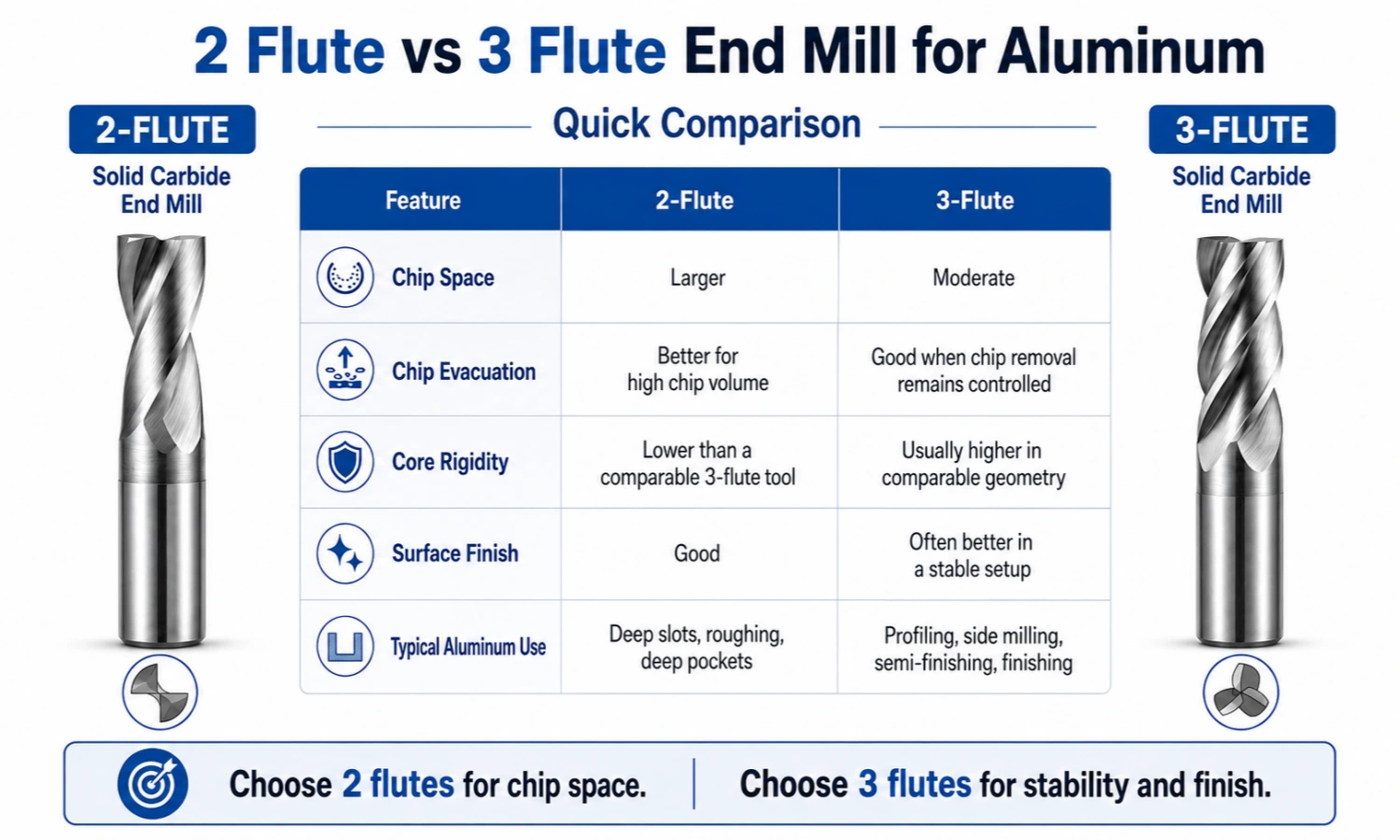
Comparação Rápida: 2 Flauta vs. 3 Fresa de topo de flauta para alumínio
| Fator de seleção | 2-Fresa de topo de flauta | 3-Fresa de topo de flauta |
|---|---|---|
| Espaço para fichas | Maior | Moderado |
| Evacuação de chips | Melhor para alto volume de chips | Bom quando a remoção de cavacos permanece controlada |
| Rigidez central | Menor que uma ferramenta comparável de 3 canais | Geralmente mais alto em geometria comparável |
| Slotting profundo de largura total | Geralmente preferido | Adequado sob condições controladas |
| Desbaste Pesado | Geralmente preferido | Melhor para remoção moderada |
| Fresamento lateral | Adequado | Muitas vezes preferido |
| Acabamento de superfície | Bom | Muitas vezes melhor em uma configuração estável |
| Uso típico de alumínio | Slots profundos, desbaste, bolsos fundos | Perfil, fresagem lateral, semi-acabamento, acabamento |
Escolher 2 canais quando o espaço para cavacos e a remoção segura de cavacos são as prioridades. Escolher 3 flautas ao cortar estabilidade, qualidade da parede lateral, e terminar o potencial importa mais.
Estas são recomendações iniciais, regras não fixas. A configuração completa da usinagem ainda afeta o resultado.
Por que a contagem de flautas é importante na usinagem de alumínio
Espaço de chips e evacuação de chips
O alumínio geralmente produz grandes, macio, ou chips contínuos. Quando esses chips permanecem dentro de um slot ou bolso, o cortador pode recortá-los. Os cavacos também podem aderir à aresta de corte ou arranhar a superfície usinada.
Uma fresa de topo de 2 canais proporciona espaços de canais maiores. Ela normalmente lida com grandes volumes de cavacos com mais facilidade do que uma fresa de 3 canais comparável.
Esta vantagem torna-se importante em slots profundos de largura total e compartimentos fechados, onde os chips têm espaço limitado para escapar.
Uma ferramenta de 3 canais ainda oferece espaço útil para cavacos. No entanto, o percurso, refrigerante, explosão de ar, e o engate de corte deve ajudar os cavacos a saírem da zona de corte.
Rigidez central e deflexão da ferramenta
Em designs comparáveis, uma fresa de 3 canais geralmente tem mais material de núcleo do que uma fresa de 2 canais. O núcleo mais forte pode reduzir a deflexão da ferramenta durante fresamento lateral e perfilamento.
A deflexão inferior ajuda o cortador a manter uma posição de parede mais consistente. Também pode melhorar a precisão do perfil e reduzir a variação visível da parede.
A contagem de flauta não pode corrigir uma configuração fraca. Alcance excessivo da ferramenta, excentricidade do suporte, má fixação, ou condições instáveis da máquina ainda podem causar vibração e alterações dimensionais.
Use o comprimento de ferramenta mais curto e prático e uma fixação estável da ferramenta antes de confiar na contagem de canais para melhorar o resultado.
Engajamento de ponta e acabamento superficial
Uma fresa de topo de 3 canais cria três encontros de corte por rotação em vez de dois.
Em condições estáveis, o engate adicional pode suportar paredes laterais mais lisas e um acabamento mais consistente. Esta é uma das razões pelas quais fresas de três canais são frequentemente selecionadas para perfilamento, semi-acabamento, e acabamento.
A superfície final também depende:
- Alimentação por dente
- Excentricidade da ferramenta
- Geometria da borda
- Desgaste da ferramenta
- Condição do titular
- Rigidez da máquina
- Engajamento radial
- Fornecimento de refrigerante ou ar
Uma contagem mais alta de canais pode melhorar o potencial de acabamento, mas não garante um resultado de superfície específico.
Quando escolher uma fresa de topo de 2 canais para alumínio
Slotting profundo de largura total
Escolha uma fresa de topo de 2 canais quando a ranhura for profunda, o envolvimento de largura total é necessário, e chips têm espaço limitado para escapar.
Durante a abertura de largura total, ambos os lados da fresa permanecem acoplados ao material. Os cavacos devem passar pelas canais antes de sair do slot.
Um design de dois canais oferece mais espaço para o fluxo de cavacos. Geralmente é a escolha inicial mais segura quando o empacotamento de cavacos apresenta um risco maior.
O refrigerante ou o jato de ar continuam importantes. Uma fresa de 2 canais não consegue compensar o engate excessivo ou a má remoção de cavacos.
Desbaste pesado e alto volume de cavacos
Escolher 2 canais quando o alto volume de cavacos e a evacuação segura dos cavacos são mais importantes do que o acabamento final da parede.
O desbaste pesado remove mais material e produz mais cavacos. Espaços maiores nos canais podem reduzir o risco de recorte de cavacos e bloqueio dos canais.
O cortador ainda deve corresponder à máquina, titular, comprimento da ferramenta, e carga de corte. O envolvimento excessivo pode sobrecarregar qualquer cortador.
Fresamento de bolsões profundos
Bolsões profundos e fechados podem prender cavacos ao redor da ferramenta. Uma fresa de topo de 2 canais costuma ser uma escolha inicial prática para essas condições.
Uma entrada em rampa, entrada helicoidal, ou percurso adaptativo pode reduzir o engajamento de corte. Forte jato de ar ou refrigerante também pode afastar os cavacos do fundo do bolsão.
Para ranhuras profundas, desbaste, e usinagem de alumínio com alto volume de cavacos, veja nosso 2 Fresa de topo de flauta.
Quando escolher uma fresa de topo de 3 canais para alumínio
Fresamento lateral e perfilamento
Escolha uma fresa de topo de 3 canais quando o corte lateral estável e a qualidade consistente da parede são mais importantes do que o espaço máximo do canal.
Durante o fresamento lateral, apenas parte do diâmetro da fresa pode entrar em contato com a peça de trabalho. O escoamento de cavacos geralmente é mais fácil do que durante o escatelamento de largura total.
A terceira aresta de corte pode proporcionar um encaixe mais consistente durante o fresamento de parede reta, perfil externo, contorno interno, e acabamento de borda.
Semiacabamento e Acabamento
Escolher 3 canais quando a consistência da superfície e o acabamento da parede lateral são os objetivos principais.
Uma ferramenta de três canais pode fornecer um engate mais suave do que algumas fresas de 2 canais. Funciona melhor quando a configuração da máquina permanece estável e o balanço da ferramenta permanece sob controle.
Um cortador de 3 canais não corrigirá automaticamente:
- Excesso excessivo
- Arestas de corte desgastadas
- Má fixação
- Alimentação instável
- Alcance excessivo da ferramenta
- Engate radial incorreto
Verifique estas condições antes de alterar a contagem de canais.
Slotting e Pocketing controlados
Uma fresa de topo de 3 canais pode lidar com canais rasos ou controlados quando o percurso da ferramenta e o escoamento de cavacos são adequados.
Engajamento mais leve, corte encenado, uma entrada em rampa, uma entrada helicoidal, ou um percurso adaptativo pode reduzir a quantidade de material envolvido de uma vez.
Para canais mais profundos de largura total ou desbaste pesado, comece com uma ferramenta de 2 canais. Os espaços maiores dos canais proporcionam uma margem mais ampla para remoção de cavacos.
Para fresamento lateral, perfil, semi-acabamento, e acabamento, veja nosso 3 Moinho de topo plano de carboneto de flauta para alumínio.
Para mais detalhes sobre aplicações de três canais, leia nosso guia de aplicação do cortador de três canais.
Regras de decisão: 2 Flauta ou 3 Flauta para Alumínio?
Regra 1: Comece com volume de chips e acesso a slots
Comece com um cortador de 2 canais quando:
- O slot é profundo
- O envolvimento de largura total é necessário
- O bolso está fechado
- Os chips têm espaço limitado para escapar
- Espera-se um alto volume de chips
Uma fresa de 3 canais torna-se mais prática quando a área de corte é aberta e o percurso da ferramenta permite que os cavacos saiam livremente.
Regra 2: Defina o objetivo principal de usinagem
Escolher 2 canais quando a remoção de material e evacuação de cavacos são as prioridades.
Escolher 3 flautas quando a operação se concentra em:
- Qualidade da parede lateral
- Consistência do perfil
- Semiacabamento
- Acabamento
- Corte lateral estável
O objetivo principal da usinagem deve orientar a escolha inicial.
Regra 3: Revise o alcance da ferramenta e a rigidez da configuração
O longo alcance da ferramenta aumenta o risco de deflexão. Use a ferramenta prática mais curta e melhore a fixação antes de alterar a contagem de canais.
Não use canais adicionais como substitutos da fixação estável da ferramenta.
Se a configuração permanecer fraca, uma fresa de 3 canais ainda pode vibrar ou produzir dimensões inconsistentes. Revise o esgotamento do suporte, alcance da ferramenta, engate radial, e rigidez da máquina juntas.
Regra 4: Verifique o líquido refrigerante, Explosão de ar, e percurso
A contagem de flautas é apenas uma parte do controle de cavacos.
Explosão de ar forte, fornecimento de refrigerante adequado, e um percurso de ferramenta que evita o envolvimento excessivo pode melhorar o escoamento de cavacos. Estas condições podem permitir que uma fresa de 3 canais conclua o rasgo controlado com sucesso.
Se as fichas continuarem a acumular, reduzir o envolvimento, melhorar a remoção de cavacos, ou mude para uma ferramenta de 2 canais.
Regra 5: Combine geometria de borda e tratamento de superfície
A usinagem de alumínio geralmente se beneficia de arestas de corte vivas e fluxo suave de cavacos.
A geometria da fresa e o tratamento de superfície devem corresponder:
- Classe de alumínio
- Operação de usinagem
- Método de refrigeração
- Risco de adesão de chips
- Vida útil necessária da ferramenta
- Requisito de superfície
Não escolha uma fresa apenas pela contagem de canais ou pelo nome do revestimento. O design completo da ferramenta deve corresponder à aplicação.
Contagem de flautas recomendada por operação de alumínio
| Operação de alumínio | Escolha inicial recomendada | Razão Principal |
|---|---|---|
| Ranhura profunda em largura total | 2 Flautas | Mais espaço para chips |
| Desbaste pesado | 2 Flautas | Melhor evacuação de cavacos |
| Fresamento de bolsões profundos | 2 Flautas | Remoção de cavacos mais fácil |
| Ranhura controlada rasa | 2 ou 3 Flautas | Depende da profundidade e do controle de cavacos |
| Fresamento lateral | 3 Flautas | Melhor estabilidade e qualidade da parede |
| Fresamento de perfil e contorno | 3 Flautas | Engajamento mais consistente |
| Semiacabamento | 3 Flautas | Espaço de cavacos e rigidez equilibrados |
| Acabamento | 3 Flautas | Melhor potencial de acabamento |
Estas são escolhas iniciais, em vez de regras absolutas. Diâmetro da ferramenta, comprimento da flauta, alcance geral, rigidez da máquina, refrigerante, e a estratégia de corte pode mudar a decisão final.

Sinais de que a contagem ou configuração da sua flauta pode estar errada
| Problema observável | Possível causa | Resposta Prática |
|---|---|---|
| Pacote de chips dentro do slot | Espaço de canal insuficiente ou remoção fraca de cavacos | Melhorar o ar ou refrigerante, reduzir o envolvimento, ou considere 2 flautas |
| Lascas são recortadas e arranham a superfície | Os cavacos permanecem na zona de corte | Ajuste o percurso da ferramenta e melhore o escoamento de cavacos |
| O alumínio adere à vanguarda | Má remoção de cavacos, borda desgastada, ou tratamento de superfície inadequado | Verifique a lubrificação, condição de borda, e superfície da flauta |
| As paredes laterais mostram marcas de vibração | Alcance excessivo, fixação fraca, ou envolvimento instável | Encurte o balanço e melhore a rigidez |
| As dimensões variam durante o perfil | Deflexão ou desvio da ferramenta | Verifique o titular, acabar, carga de corte, e alcance da ferramenta |
| O acabamento permanece inconsistente | A configuração ou os parâmetros estão instáveis | Revise o sistema de corte completo antes de alterar a contagem de canais |
Esses problemas nem sempre significam que a contagem da flauta está errada.
Mudando de 2 flautas para 3 flautas não corrigirão desvio excessivo. Da mesma maneira, mudando para 2 canais não resolverão o fornecimento fraco de refrigeração se os cavacos permanecerem presos dentro de um bolsão.
Comece com o problema visível. Verifique o fluxo de cavacos, alcance da ferramenta, fixação, carga de corte, e condição da ferramenta antes de selecionar outra fresa.
Erros comuns ao selecionar uma fresa de topo de alumínio
Escolhendo apenas pela contagem de flautas
A contagem de flautas não descreve completamente um cortador.
Duas ferramentas com o mesmo número de canais podem usar tamanhos de núcleo diferentes, profundidades de flauta, geometrias de borda, comprimentos, e tratamentos de superfície.
Compare o projeto completo da ferramenta e as condições de usinagem.
Usando mais flautas para compensar uma configuração fraca
Mais canais podem melhorar a rigidez em designs de fresas comparáveis. No entanto, eles não podem reparar um suporte fraco, esgotamento excessivo, má fixação, ou balanço excessivo da ferramenta.
Corrija a configuração primeiro. Em seguida, selecione a contagem de canais de acordo com o volume do cavaco e os requisitos de superfície.
Tratando as recomendações como regras absolutas
Um cortador de 3 canais pode usinar ranhuras, e um cortador de 2 canais pode fazer acabamento em alumínio.
As recomendações neste guia descrevem opções práticas de partida:
- 2 flautas para mais espaço para cavacos
- 3 canais para engate mais estável e melhor potencial de acabamento
O resultado final depende da configuração completa da usinagem.
Frequently Asked Questions
É 2 Flauta ou 3 Flauta Melhor para Alumínio?
Uma fresa de topo de 2 canais geralmente é melhor para canais profundos, desbaste pesado, e operações onde é necessário espaço máximo de chip.
Uma fresa de topo de 3 canais geralmente é melhor para fresamento lateral, perfil, semi-acabamento, e acabamento ao cortar a estabilidade e a qualidade da parede são mais importantes.
Uma fresa de topo de 3 canais é boa para ranhuramento de alumínio?
Sim. Uma fresa de 3 canais pode funcionar para canais de alumínio rasos ou controlados quando o escoamento de cavacos permanece eficaz.
Para canais mais profundos de largura total ou desbaste pesado, um cortador de 2 canais é geralmente a escolha inicial mais segura.
Qual fresa de topo oferece melhor acabamento em alumínio?
Uma fresa de topo de 3 canais geralmente oferece melhor potencial de acabamento porque cria mais engajamentos de corte por rotação e pode oferecer melhor rigidez.
Acabar, alimentar, desgaste da ferramenta, fixação, estabilidade da máquina, e o engate radial também afetam a superfície final.
Uma fresa de topo de 2 canais pode ser usada para acabamento de alumínio?
Sim. Um afiado, cortador estável de 2 canais pode dar acabamento em alumínio.
Quando a consistência da parede lateral e o acabamento superficial são as prioridades, um cortador de 3 canais costuma ser a melhor escolha inicial.
Precisa de ajuda para escolher entre 2 and 3 Flautas?
Escolhendo entre 2 and 3 flautas depende do tipo de alumínio, operação de usinagem, profundidade do slot, alcance da ferramenta, método de controle de chip, e acabamento superficial necessário.
Envie-nos o material da peça, dimensões necessárias, profundidade do slot ou bolso, quantidade, e qualquer desenho disponível ou informações atuais do cortador.
Não tenho certeza de qual contagem de flauta escolher? Envie suas necessidades por e-mail para sales@cutterbest.com, e analisaremos se uma ferramenta de 2 ou 3 canais corresponde melhor à aplicação.