 Freze de precizie,Scule de tăiere pentru prelucrarea CNC a fiecărui material

Un freză laterală vs freză cu cap decision is not simply about which tool can cut a slot. Both tools can machine some overlapping features, but neither is automatically the better choice.
În acest ghid, a side milling cutter mainly refers to a disc-type side or side-and-face cutter with bore or arbor mounting. It does not simply mean an end mill performing a side-milling toolpath.
The practical choice depends on feature access, required width, adâncimea de tăiere, ajunge, machine and toolholding rigidity, and whether the job needs a dedicated operation or a flexible multi-operation CNC process.
Freză laterală vs Freză de capăt: Comparație rapidă
Use this table as a starting point rather than an absolute selection rule.
| Factor | Freză laterală | Freză de capăt |
|---|---|---|
| Typical structure | Disc-type cutter | Shank-type cutter |
| Typical mounting | plictisit / arbor mounting | End mill toolholder |
| Typical strengths | Accessible grooves, sloturi, umerii, și caracteristici laterale | Sloturi, buzunare, profiluri, contururi, and mixed features |
| Enclosed-feature access | Depends strongly on side access and cutter clearance | Generally more adaptable |
| Closed-end slots | Usually limited by access and cutter geometry | Often the stronger starting choice |
| Width strategy | Fixed, selectat, adjustable, or custom depending on design | Tool diameter plus programmed toolpath and compensation |
| Setup flexibility | More dependent on cutter and arbor arrangement | Generally easier in mixed CNC workflows |
| Starting point | Dedicated, side-accessible feature | General or mixed-feature CNC machining |
When comparing a side milling cutter vs end mill, groove width, adâncime, lungime, acces, condiţiile maşinii, and operation frequency all affect the decision. Side-and-face cutters and end mills therefore have overlapping applications rather than a simple “better or worse” relationship.
Freză laterală vs Freză de capăt: Diferențele cheie
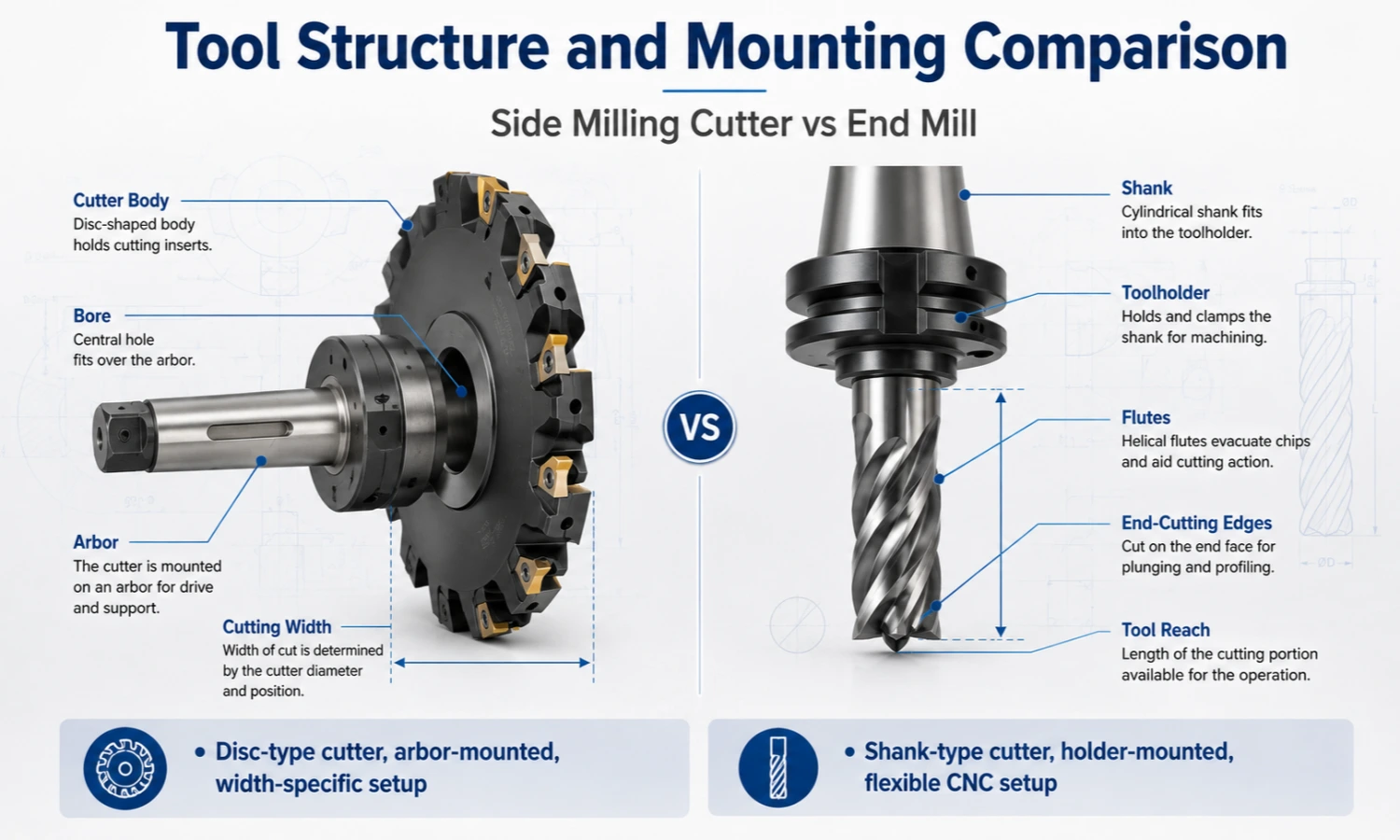
1. Tool Structure and Mounting
The most visible difference is the cutter structure.
A typical side milling cutter has a disc-shaped body with a central bore. It mounts on an arbor or another compatible interface. Ca urmare, diametrul tăietorului, lățimea de tăiere, bore size, arbor position, and clearance around the workpiece can all affect access.
CutterBest’s Side Milling Cutter product range includes disc-type indexable configurations with cutter bodies and replaceable carbide inserts. plictisit, lățimea de tăiere, aranjament de inserare, and mounting can also be reviewed according to the actual machining requirement.
An end mill uses a shank held in a suitable toolholder. Depending on the machine and application, the holding system may use a collet, hydraulic chuck, shrink-fit holder, milling chuck, or another compatible interface.
Prin urmare, shank-mounted end mills generally fit standard CNC machining workflows more readily. Cu toate acestea, rigiditatea suportului, a alerga afară, tool extension, and spindle condition still influence cutting stability.
2. Open-Ended Grooves vs Closed-End Slots: Tool Access
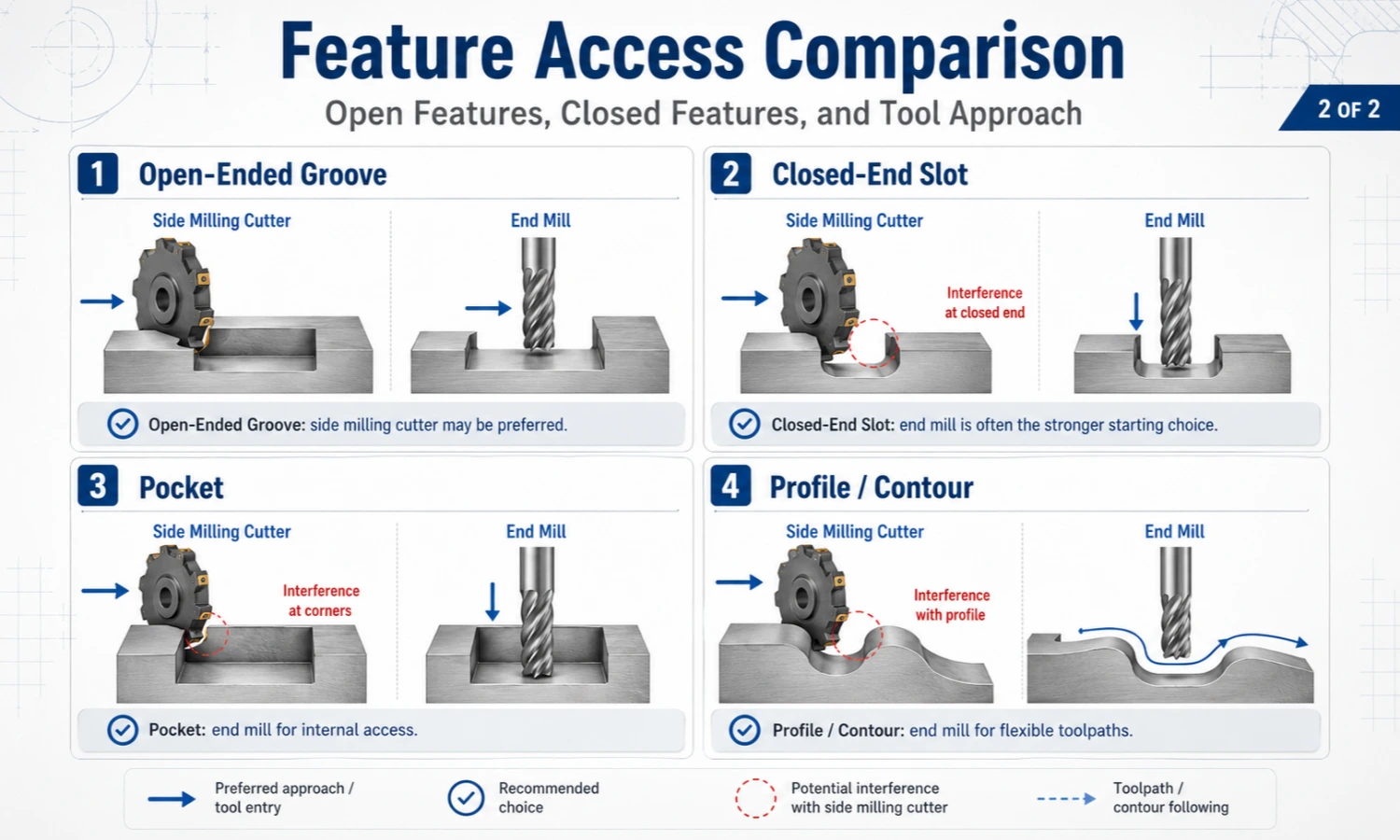
Tool access is often more important than the name of the machining operation.
For an open-ended or side-accessible groove, a disc-type side milling cutter may be a strong starting option. Cu toate acestea, the cutter body and arbor need sufficient clearance.
An open groove does not automatically require a side cutter. An end mill can also be practical when the setup favors vertical access, the feature is relatively accessible, or the same tool must perform other operations.
Closed-end slots create a different access condition. Depending on the feature and entry strategy, the tool may need end-cutting capability or a suitable ramping or helical-entry method.
Prin urmare, an end mill is generally the stronger starting choice for closed-end slots and enclosed features when its geometry supports the intended entry and cutting strategy. Sandvik’s groove-milling guidance similarly distinguishes open-slot applications for side-and-face cutters from closed-slot applications that require an end-milling solution.
3. Adâncimea de tăiere, Ajunge, Rigidity, and Chip Evacuation
A disc cutter should not automatically be described as rigid while an end mill is described as flexible. Rigidity depends on the complete machining system.
For a side milling cutter, important factors include:
- diametrul tăietorului;
- arbor diameter and support;
- cutter position;
- reţinere de muncă;
- groove depth;
- starea mașinii;
- evacuare cip.
For an end mill, considera:
- diametrul sculei;
- lungimea flautului;
- overall reach;
- holder type;
- surplusul sculei;
- angajarea de tăiere;
- machine and fixture rigidity.
A long end mill with excessive overhang can deflect or vibrate. Pe de altă parte, a poorly supported arbor or unsuitable disc-cutter setup can also lose stability.
Prin urmare, a deep or long groove should not automatically be assigned to either tool. Compare access, ajunge, cutter support, reţinere de muncă, and chip removal before making the decision. Contopirea sculei, rigiditate, forțe de tăiere, abatere, vibratie, and chip evacuation are all relevant considerations in slot milling.
4. Groove Width Strategy, Control, and Repeatability
Groove width is an important selection factor, but it requires careful comparison.
A side milling cutter can be selected with a cutting width suited to the target groove width. Depending on the cutter design, the width may be fixed, adjustable, insert-configured, spacer-based, or made to a custom specification.
Cu toate acestea, adjustable width is not a universal feature of every disc cutter. Specific arbor-mounted slot-milling systems are designed with adjustable cutting widths, while other cutters use a fixed or application-specific configuration.
With an end mill, the feature may be machined in one pass or with multiple programmed passes, depending on tool diameter and required slot width.
Final dimensions can also be affected by:
- a alerga afară;
- devierea sculei;
- uzura sculei;
- machine positioning;
- reţinere de muncă;
- cutter compensation.
Prin urmare, cutter width does not automatically guarantee finished groove accuracy.
A cutter configured around the target width can simplify width control in some repeated operations. Cu toate acestea, both tool concepts can produce controlled dimensions when the complete machining process is stable.
5. Enclosed Features, buzunare, Profiles, and Complex Toolpaths
End mills generally offer greater flexibility when the part contains enclosed or varied features.
Typical operations can include:
- closed-end slots;
- pockets and cavities;
- frezare laterală;
- profilare;
- conturarea;
- internal features;
- multiple compatible operations in one CNC program.
CutterBest’s current End Mill page also covers slotting, profilare, buzunare, frezare laterală, conturarea, and finishing as typical end-milling operations.
Cu toate acestea, not every end mill geometry supports every cutting strategy. Geometrie de tăiere centrală, design flaut, diametru, lungimea de tăiere, and machining conditions affect whether a particular end mill can plunge, ramp, interpolate, or perform full-slot cutting.
For available freza de freza opțiuni, see the relevant product page.
6. Setup Flexibility, Process Repeatability, and Production Needs
A dedicated side-milling setup becomes more attractive when the same accessible groove or side feature repeats across a production run and the cutter configuration matches the required width, ajunge, and approach.
În contrast, an end mill may be more practical when the CNC program contains several feature types.
De exemplu, one suitable tool may perform compatible slotting, frezare laterală, buzunare, sau operații de profilare fără a introduce o altă configurație dedicată de tăiere.
Această versatilitate este unul dintre motivele pentru care frezele sunt utilizate pe scară largă în prelucrarea generală CNC.
Cu toate acestea, aceasta nu înseamnă că frezele laterale aparțin numai producției de masă sau frezele aparțin doar lucrărilor de prototip. Fiecare instrument poate fi utilizat în diferite volume de producție. Alegerea mai bună depinde dacă lucrarea beneficiază mai mult de un proces dedicat sau de flexibilitatea de prelucrare.
Când este o freză laterală o alegere puternică de pornire?
Repetat, Caneluri accesibile lateral cu o lățime definită
O freză laterală merită luată în considerare atunci când o canelură este accesibilă din lateral și are o lățime țintă clar definită.
This becomes more relevant when the same feature repeats across a production run because the cutter configuration can be selected around the machining requirement.
Before choosing the cutter, verifica:
- side access;
- cutter-body clearance;
- arbor clearance;
- adâncimea de tăiere;
- required width;
- configurarea mașinii.
For available freză laterală configurations, see the relevant product page.
Accessible Side Features and Shoulders
Disc-type side and side-and-face cutters can also suit accessible side surfaces, umerii, and step features when the geometry provides enough approach space.
Cu toate acestea, shoulder machining is not automatically a side-cutter application. Freze de capăt, indexable shoulder mills, and other cutter types may also be suitable.
Prin urmare, check the required 90-degree geometry, ajunge, stabilitatea peretelui, finish requirement, and cutter access before making the selection.
Dedicated or Repeated Machining Operations
A dedicated cutter may become more attractive when a repeated operation benefits from a specific diameter, lățimea de tăiere, aranjament de montaj, or cutter geometry.
In aceasta situatie, the question is not only whether an end mill poate cut the feature.
În schimb, consider whether a dedicated cutter can make the complete machining process easier to control.
For changing parts or occasional operations, the additional setup may offer little advantage. For a repeated feature with stable geometry, cu toate acestea, a dedicated configuration may deserve further review.
When Is an End Mill a Strong Starting Choice?
Closed-End Slots, buzunare, and Internal Features
An end mill is generally a stronger starting point when the cutter must work inside an enclosed feature.
A closed-end slot requires a suitable entry strategy and end-cutting capability. A pocket requires internal tool movement, while other internal features introduce additional access and interference restrictions.
Acest lucru face adesea ca frezele montate pe tijă să fie mai adaptabile în configurațiile verticale ale centrelor de prelucrare CNC.
Profiles, Contururi, și Geometrie complexă
Familiile de freze frontale oferă, de asemenea, o flexibilitate largă a traseului sculei pentru profile și contururi.
Un program CNC poate ghida o freză cu cap în jurul geometriei externe sau interne, mai degrabă decât să se bazeze pe abordarea cu lățime fixă sau acces lateral a unui freza cu disc..
Diferitele geometrii ale frezei suportă cerințe diferite de conturare. Cu toate acestea, o freză cu capăt plat, moara cu cap bilă, instrument de nas de taur, moara conică, și frezele cu distanță lungă nu îndeplinesc aceeași sarcină pur și simplu pentru că toate aparțin familiei de freze.
Prelucrare CNC flexibilă cu operații multiple
O freză cu cap devine deosebit de utilă atunci când o unealtă adecvată poate efectua mai multe operații compatibile, îndeplinind totuși cerințele de prelucrare.
De exemplu, procesul poate include:
- sloting;
- frezare laterală;
- profilare;
- buzunare.
În acest caz, an end mill may reduce dedicated tool changes and simplify the CNC workflow.
This flexibility is particularly useful when the part contains multiple features rather than one repeated groove or side feature.
Side Milling Cutter or End Mill by Machining Task
Use the following table as a practical starting point, not an absolute rule.
| Machining Task | Starting Choice | Important Condition |
| Closed-end slot | End mill | Requires a suitable entry and end-cutting strategy |
| Pocket or enclosed feature | End mill | More flexible internal toolpaths |
| Profile or contour | End mill | Suits programmed contour paths |
| Deschide, side-accessible groove | Side milling cutter may be preferred | Confirm arbor clearance, width, and approach |
| Repeated groove with controlled target width | Side milling cutter may be preferred | Depends on cutter configuration and setup |
| General slot in mixed-feature CNC work | End mill often preferred | Especially when also machining pockets or profiles |
| Side surface or shoulder | Depends | Check geometry, ajunge, stabilitatea peretelui, and finish |
| Deep or long groove | Depends | Compare access, surplomba, support, rigiditate, și evacuarea așchiilor |
| Custom groove geometry | Depends | Dedicated tooling may be considered if the process justifies it |
If the main requirement is a broad flat or datum surface rather than a groove, buzunar, or side feature, the selection question changes. See our guide to side milling vs face milling for that comparison.
Can an End Mill Replace a Side Milling Cutter?
Sometimes, but not always.
An end mill can replace a side milling cutter when it can reach the feature, generate the required geometry, and meet the dimensional, stabilitate, finish, and cycle-time requirements.
Cu toate acestea, replacement is a process decision, not only a geometry decision. În practică, the side milling cutter vs end mill choice should be based on the complete machining setup rather than groove depth or tool type alone.
Consider:
- groove width and depth;
- open or enclosed access;
- raza necesara;
- arbor or holder rigidity;
- reţinere de muncă;
- evacuare cip;
- production repetition;
- other operations on the same part.
If an end mill requires excessive reach or an inefficient toolpath, a dedicated side cutter may deserve consideration. Pe de altă parte, if a disc cutter creates access problems or adds unnecessary setup, the end mill may remain the more practical solution.
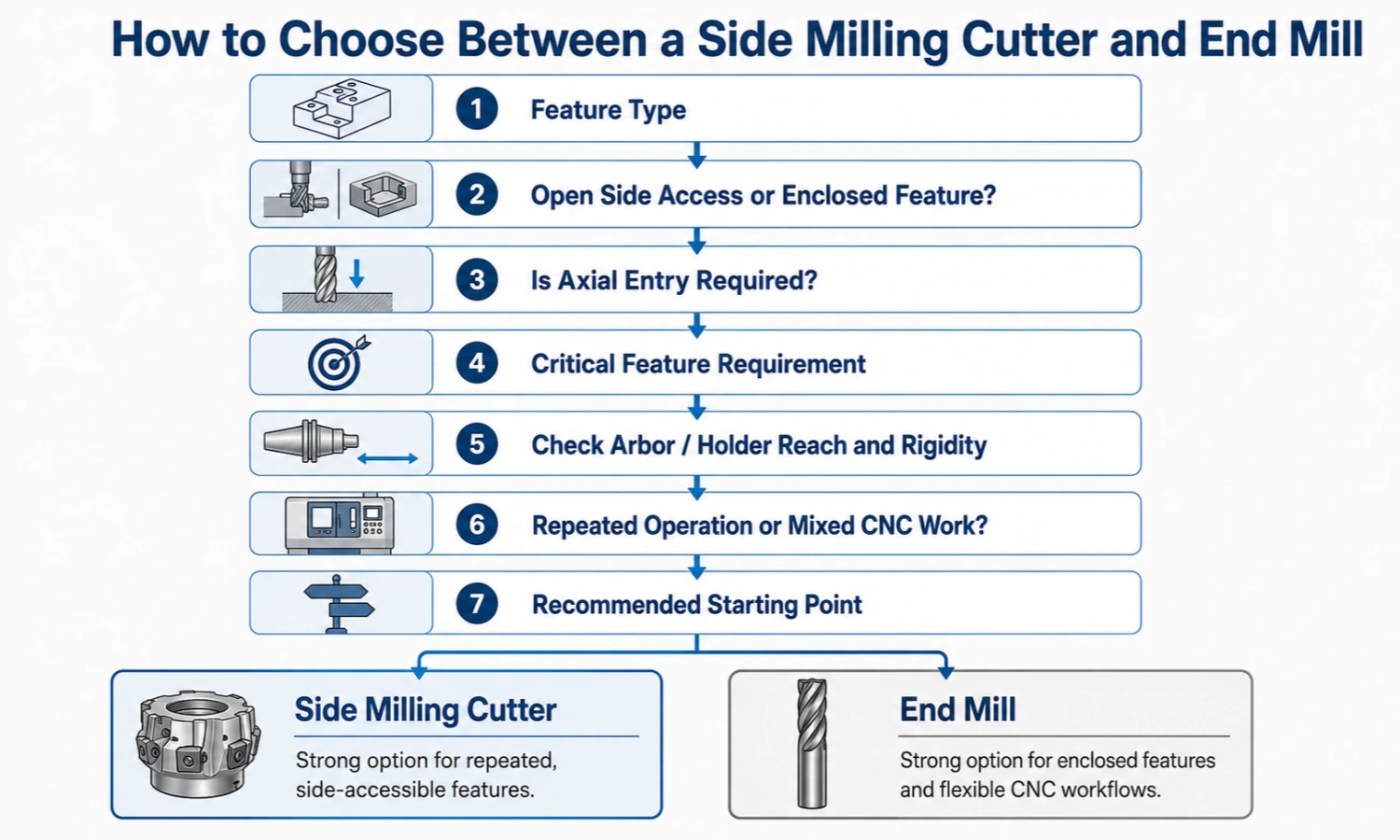
How to Choose Between a Side Milling Cutter and End Mill
Pas 1: Identify the Feature
Start with the drawing, not the tool.
Is the feature an open groove, closed-end slot, buzunar, umăr, suprafata laterala, or profile?
The feature geometry immediately helps narrow the available cutter options.
Pas 2: Check Tool Access
Următor, determine how the cutter can physically reach the feature.
Ask:
- Is side access available?
- Is axial entry required?
- Is there enough space for the cutter body?
- Is there enough arbor or holder clearance?
- Will the fixture or workpiece interfere with the cutter?
A cutter that cannot approach the feature correctly is not a practical option.
Pas 3: Identify the Critical Feature Requirement
Do not focus on tool type before identifying what matters most on the drawing.
The critical requirement may include:
- groove width;
- adâncime;
- wall geometry;
- corner condition;
- finish;
- atingerea instrumentului;
- repeatability;
- cycle requirement.
The cutter concept should support the feature that controls the machining decision.
Pas 4: Check Machine, Toolholding, and Rigidity
Evaluate the complete cutting system.
For a side milling cutter, review the arbor, plictisit, cutter position, machine interface, fixture, and available clearance.
For an end mill, review holder type, surplomba, lungimea de tăiere, diametru, spindle condition, and workholding.
In both cases, suport stabil și materie de evacuare eficientă a așchiilor.
Pas 5: Luați în considerare flexibilitatea prelucrării și repetarea producției
in sfarsit, luați în considerare modul în care operațiunea se potrivește întregului proces de producție.
Dacă aceeași caracteristică accesibilă lateral este repetată pe parcursul unei serii de producție, o freză laterală dedicată poate oferi o opțiune practică de proces.
Dacă piesa se schimbă frecvent sau o unealtă CNC trebuie să prelucreze mai multe caracteristici compatibile, o freză cu cap poate oferi o mai mare flexibilitate.
Alegerea de pornire ar trebui să se potrivească piesei complete, maşină, înființat, și cerințele de producție – nu doar freza cu cea mai lungă listă de aplicații.
FAQ
Poate fi folosită o freză cu cap pentru frezarea laterală?
Da. Frezele cu capat au muchii tăietoare periferice și sunt utilizate în mod obișnuit pentru frezarea laterală. Cu toate acestea, angrenare radială adecvată, atingerea instrumentului, rigiditatea suportului, geometria flautului, and cutting conditions depend on the application. Excessive overhang or an unstable setup can increase deflection and vibration.
Can an End Mill Replace a Side Milling Cutter?
Sometimes. An end mill can be a practical replacement when it can reach the feature and meet the required geometry, quality, stabilitate, and cycle time. A dedicated side cutter may still make sense when cutting width, side access, montare, or a repeated operation creates a stronger process case.
Which Cutter Is Better for Closed-End Slots and Pockets?
An end mill is generally the stronger starting choice because it can provide the required axial and internal access when the selected geometry supports the intended entry and cutting strategy. The final choice still depends on feature geometry, ajunge, și condițiile de prelucrare.
Which Cutter Is Better for Deep or Long Grooves?
It depends. Compare groove access, diametrul tăietorului, atingerea instrumentului, arbor or holder support, rigiditatea mașinii, reţinere de muncă, și evacuarea așchiilor. Numai adâncimea canelurii nu este un motiv suficient pentru a selecta automat un tip de tăietor.
O freză laterală oferă întotdeauna o precizie mai bună a lățimii fantei??
Nu. Un tăietor configurat în jurul lățimii țintă poate simplifica controlul lățimii în unele aplicații, dar precizia finală depinde încă de starea frezei și de uzură, montare, a alerga afară, capacitatea mașinii, reţinere de muncă, devierea sculei, și condițiile de tăiere.
Alegerea între o freză laterală și o freză de capăt începe cu caracteristica piesei și accesul disponibil la scule. Dacă aveți nevoie de ajutor pentru a revizui o anumită aplicație, trimite desenul tău, materialul piesei de prelucrat, dimensiunile canelurii sau fantului, toleranţă, informații despre mașină, și cerințele de producție să sales@cutterbest.com pentru o revizuire a selecției tăietorului.