 Freze de precizie,Scule de tăiere pentru prelucrarea CNC a fiecărui material

Frezele conice sunt instrumente de frezat CNC utilizate pentru prelucrarea unghiurilor de tragere, pereții laterali conici, cavitățile de mucegai, profile profunde, caneluri înguste, și caracteristici prelucrate detaliate. Spre deosebire de o freză standard dreptă, diametrul de tăiere crește treptat de la vârf spre tijă.
Ca urmare, unealta poate urmări suprafețele înclinate, oferind în același timp mai mult sprijin în spatele vârfului mic de tăiere. Cu toate acestea, freza corectă depinde în continuare de unghiul de conicitate, diametrul vârfului, geometria finală, materialul piesei de prelucrat, adâncimea de tăiere, și starea mașinii.
Acest ghid explică pentru ce sunt folosite frezele conice, cum funcționează diferitele tipuri, și cum să selectați un instrument potrivit pentru fabricarea matriței, gravare, frezarea profilului, și alte aplicații CNC.
Ce este o freză conică?
O freză conică este o freză cu o secțiune de tăiere care devine treptat mai mare de la vârf spre tijă. Instrumentul poate avea un capăt plat, nas de minge, raza colțului, sau profil de tăiere personalizat.
Manufacturers often use these tools when a part includes angled walls, draft angles, tapered grooves, cavități profunde, or small details that cannot be machined efficiently with a straight cutter.
The main dimensions usually include:
| Tool Feature | Description |
| Taper angle | The angle formed by the tapered cutting section |
| Tip diameter | The smallest cutting diameter near the tool tip |
| Maximum cutter diameter | The largest diameter of the cutting section |
| Lungimea flautului | The length of the cutting edges |
| Lungime totală | The complete tool length from tip to shank end |
| Diametrul tijei | The diameter held by the tool holder |
| End geometry | Flat end, nas de minge, radius end, or custom form |
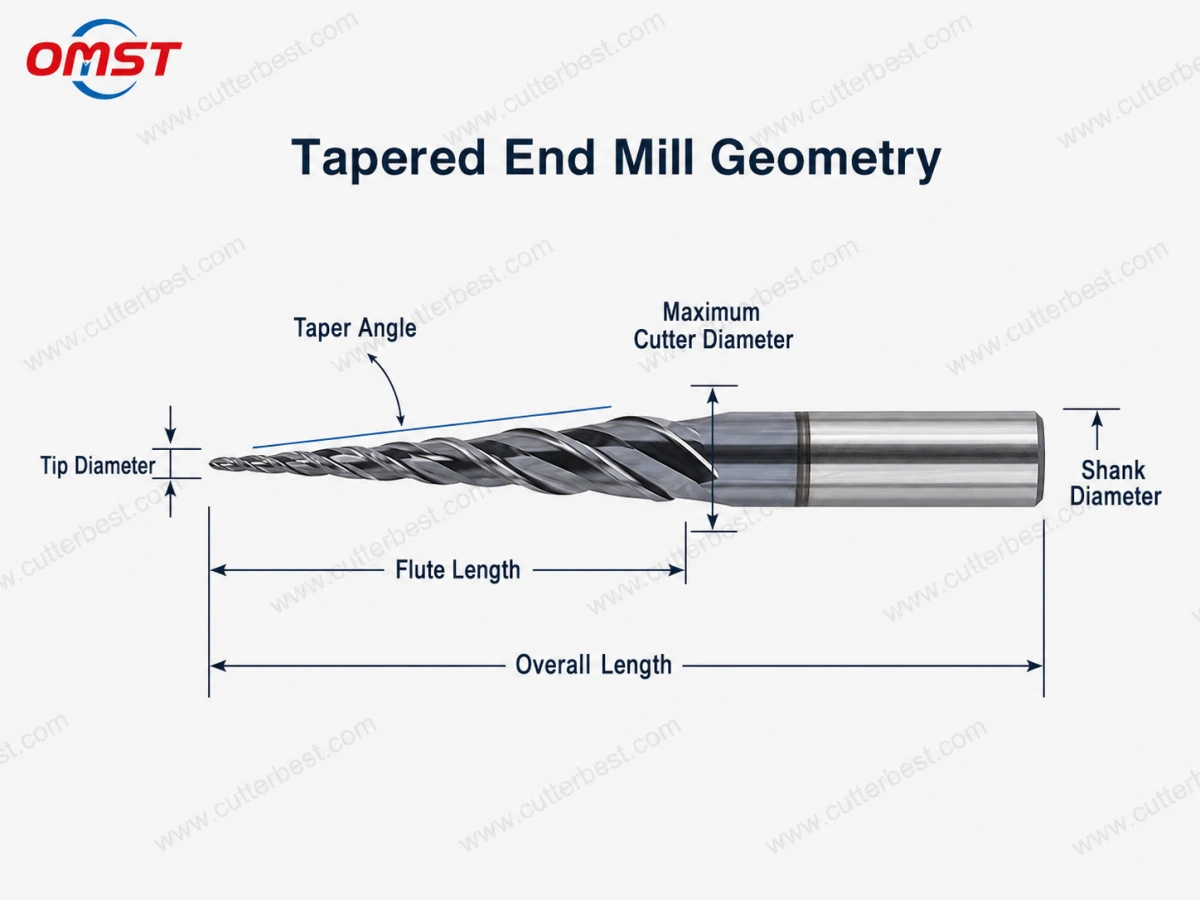
Before ordering a cutter, confirm whether the drawing shows a single-side taper angle or a total included angle. Altfel, the finished profile may not match the part design.
Pentru ce sunt folosite frezele conice?
Tapered end mills are used for CNC operations that require angled surfaces, gradually changing wall profiles, small cutting tips, or improved support during long-reach machining.
Their most common applications include mold making, draft-angle milling, tapered groove cutting, deep-cavity machining, 3D conturare, gravare, and custom profile production.
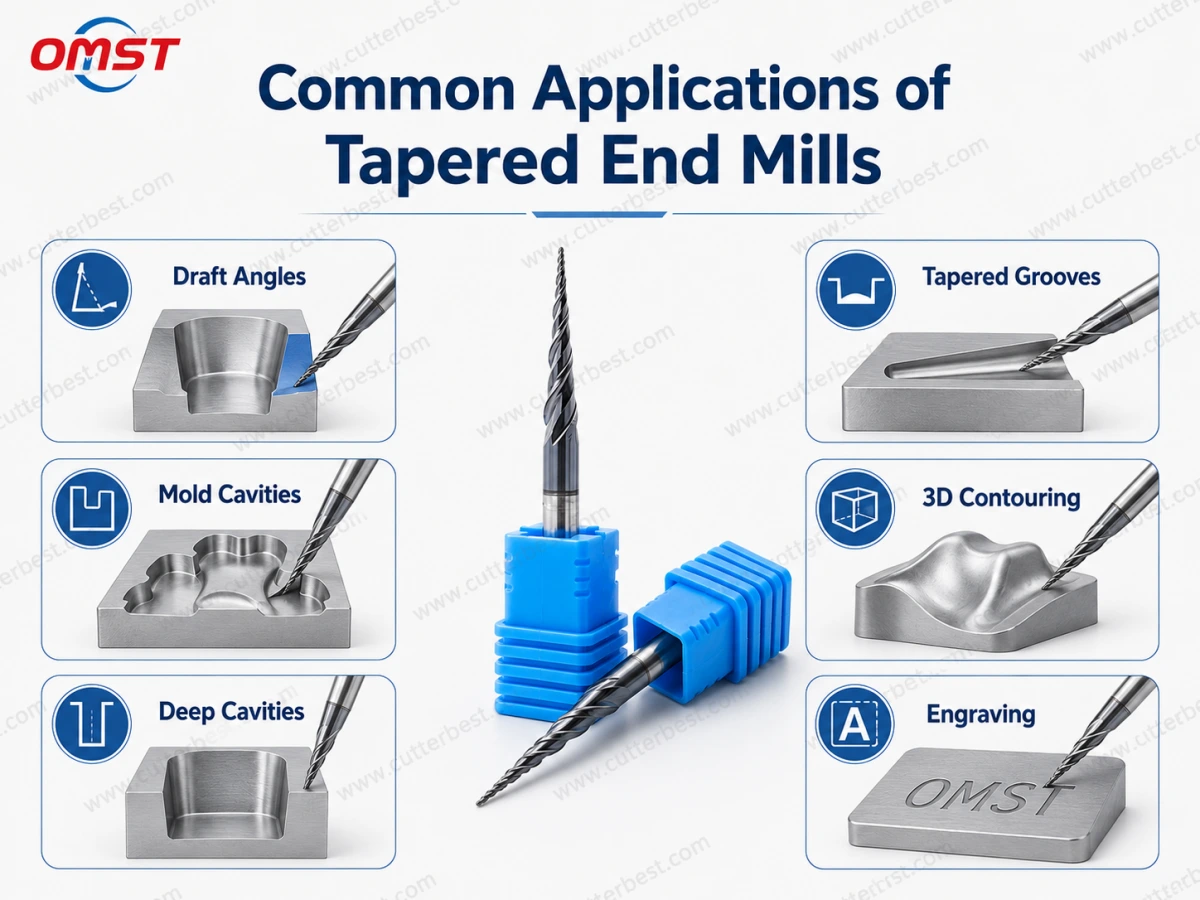
Machining Draft Angles and Tapered Sidewalls
Many molds, moare, and machined components include draft angles. These angles help molded parts release more easily and allow designers to create non-vertical walls.
A tapered end mill can machine the required angle directly when the cutter geometry matches the drawing. Prin urmare, the tool is often used for:
- Mold draft walls
- Tapered pockets
- Angled sidewalls
- Sloped profiles
- Non-parallel surfaces
Cu toate acestea, unghiul tăietorului trebuie confirmat cu atenție. Chiar și o mică diferență între unghiul sculei și desen poate afecta geometria finală a peretelui.
Prelucrare cu cavități matrițe și matrițe
Cavitățile mucegaiului conțin frecvent zone adânci, pereți înclinați, suprafete curbate, și tranziții detaliate. Este posibil ca o freză standard standard să nu atingă aceste caracteristici în mod eficient, mai ales când cavitatea devine îngustă lângă fund.
Un tăietor conic poate oferi un vârf de tăiere mic, menținând în același timp o secțiune transversală mai mare mai aproape de tijă. în consecinţă, poate oferi o rigiditate mai bună decât o unealtă dreaptă cu un diametru și o rază de vârf similare.
Aplicațiile comune de matriță și matriță includ:
- Cavități de matriță de injecție
- Matrite de turnare sub presiune
- Mole de formare
- Prelucrare cu electrozi
- Finisare de perete
- Profile detaliate ale cavității
Pentru cavități curbate și suprafețe 3D, un design conic cu nas sferic este adesea selectat.
Prelucrare cu cavitate adâncă și cu rază lungă
Cavitățile adânci necesită o rază suplimentară a sculei. Totuşi, creșterea lungimii sculei poate crește, de asemenea, vibrațiile și deformarea.
Pentru că o unealtă conică devine mai groasă spre tijă, poate oferi mai mult sprijin în spatele zonei de tăiere. Această geometrie poate îmbunătăți stabilitatea în timpul operațiilor ușoare de profilare și finisare.
Performanța reală depinde încă de:
- Tip diameter
- Taper angle
- Lungimea flautului
- Contopirea sculei
- Execuție de rulare a suportului de scule
- Rigiditatea mașinii
- Material piesa de prelucrat
- Parametrii de tăiere
Un design conic nu înlocuiește o configurație adecvată de prelucrare. Prin urmare, utilizați cea mai scurtă lungime practică a sculei ori de câte ori este posibil.
Caneluri conice și profile speciale
Canelurile conice au pereți neparaleli, astfel încât acestea nu pot fi produse întotdeauna cu o freză standard dreptă într-o singură operație.
Se poate folosi o freză conică pentru:
- Fante conice
- Caneluri unghiulare
- Profile în formă de V
- Caracteristici speciale ale formei
- Componente CNC personalizate
- Piese de mașină nestandardizate
When the groove has a special angle or profile, a custom tool may reduce the number of machining steps.
3D Contouring and Curved Surfaces
A tapered ball nose end mill combines a tapered cutting section with a rounded tip. This tool is suitable for curved surfaces, 3D contururi, si finisarea matritei.
Aplicațiile tipice includ:
- Finisarea cavității matriței
- Curved component surfaces
- 3D profile milling
- Complex die shapes
- Transition surfaces
- Sculptured parts
The ball radius, unghi de conicitate, and tool path must work together. în plus, a small step-over is normally required when a finer surface finish is needed.
For curved surfaces and 3D profiles that require tapered geometry, vezi noastre freză de capăt conică.
Engraving and Fine Detail Machining
Micro tapered end mills are often used for small details, narrow features, fine engraving, and miniature mold components.
A small tip can enter tight areas. Meanwhile, the tapered body supports the tool behind the cutting edge.
These tools may be used for:
- Fine lettering
- Small mold details
- Narrow channels
- Decorative profiles
- Precision engraving
- Miniature components
Cu toate acestea, micro cutters are sensitive to runout and excessive cutting load. Prin urmare, ținerea uneltelor, spindle condition, and cutting parameters must be checked carefully.
Common Tapered End Mill Applications
The following table summarizes several common uses:
| Aplicație | Suitable Cutter Type | Main Selection Point |
| Draft-angle machining | Tapered flat end mill | Match the taper angle to the drawing |
| Finisarea cavității matriței | Tapered ball nose end mill | Confirm radius, ajunge, și cerințele de suprafață |
| Tapered groove milling | Flat-end or custom tapered cutter | Check groove width and wall angle |
| Deep-cavity profiling | Rigid carbide tapered end mill | Minimize overhang and control cutting load |
| Fine engraving | Micro tapered end mill | Control runout and tip diameter |
| Curved 3D surfaces | Tapered ball nose cutter | Select suitable radius and step-over |
| Custom profiles | Cutter conic cu formă personalizată | Furnizați un desen complet și informații despre material |
De ce să folosiți o freză conică?
O freză conică nu este necesară pentru fiecare operație de frezare. Cu toate acestea, oferă câteva avantaje practice atunci când piesa de prelucrat conține caracteristici înclinate sau greu accesibile.
Rigiditate îmbunătățită în aplicații cu distanță lungă
O freză mică cu capăt drept cu o lungime mare de tăiere se poate deforma sub presiunea de tăiere. Prin comparație, o unealtă conică are mai mult material în spatele vârfului mic.
Ca urmare, secțiunea transversală în creștere poate ajuta la îmbunătățirea rigidității în timpul operațiunilor adecvate de finisare și frezare a profilului.
Încă, rigiditatea depinde de configurația completă. Diametrul sculei, calitate de carbură, starea titularului, adâncimea de tăiere, și trebuie luată în considerare și stabilitatea mașinii.
Acces mai bun la zonele înclinate și înguste
Vârful mic poate intra în zone înguste, în timp ce muchiile de tăiere conice urmează un perete înclinat. Prin urmare, o freză poate atinge caracteristici care altfel ar necesita mai multe operații sau trasee speciale de scule.
Acest lucru este util în special în cavitățile mucegaiului, piese detaliate, și caneluri conice.
Prelucrarea directă a unghiului de perete necesar
Când unghiul tăietorului se potrivește cu designul piesei, muchia de tăiere conică poate prelucra direct unghiul complet al peretelui.
Acest lucru poate simplifica traseul sculei și poate îmbunătăți consistența profilului. Cu toate acestea, unghiul trebuie verificat înainte de producție deoarece desenele pot folosi definiții diferite de unghi.
Finisarea stabilă a profilelor conice
O unealtă conică adecvată poate asigura un contact stabil de-a lungul unui profil înclinat. în plus, designul și acoperirea corectă a canelului pot îmbunătăți evacuarea așchiilor și rezistența la uzură.
Pentru cel mai bun rezultat, parametrii de tăiere trebuie validați printr-o tăiere de probă controlată înainte de producția completă.
Common Types of Tapered End Mills
Different end geometries are selected for different workpiece features.
Tapered Flat End Mills
A tapered flat end mill has a flat cutting tip. It is commonly used for:
- Flat-bottom tapered grooves
- Angled sidewalls
- Draft profiles
- Mold features
- Fante conice
This design is suitable when the bottom surface must remain relatively flat.
For this flat-end tapered geometry, vezi noastre freză cu capăt pătrat conic.
Tapered Ball Nose End Mills
A tapered ball nose end mill has a rounded cutting tip. Este folosit în principal pentru:
- Suprafețe curbate
- 3D contururi
- Cavități de mucegai
- Complex profiles
- Surface finishing
Because the tip is rounded, the tool can follow curved tool paths more smoothly than a flat-end cutter.
Tapered Radius End Mills
A tapered radius end mill includes a corner radius between the tool bottom and side cutting edges.
The radius can strengthen the cutting corner and produce a smooth transition between the bottom and sidewall. Prin urmare, this type may be used for semi-finishing, mold profiles, and filleted features.
For tapered cutting geometry with a flat end and R transition, vezi noastre freza de capat cu raza coltului conic.
Micro Tapered End Mills
Micro tapered cutters have a very small tip diameter. They are used for detailed profiles, narrow features, gravare, and miniature cavities.
Since the tip is small, runout control is critical. Even limited runout can increase uneven cutting loads and shorten tool life.
Custom Form Tapered Cutters
Some components require a non-standard taper angle, diametrul vârfului, lungimea flautului, or cutting profile. În aceste cazuri, the manufacturer can produce a custom cutter according to the drawing.
Cutterbest can review standard and non-standard tapered cutter requirements. Vizualizați custom tapered cutter product page for available geometry, acoperire, și opțiuni OEM.
Tapered End Mill vs Straight End Mill
Tapered and straight end mills are used for different machining requirements. A straight end mill maintains a constant cutting diameter, while a tapered cutter gradually increases in diameter toward the shank.
| Punct de selecție | Freză conică | Straight End Mill |
| Geometrie de tăiere | Tapered cutting section | Constant cutting diameter |
| Main application | Draft angles, tapered walls, and special profiles | Pereți drepti, buzunare, și sloturi |
| Deep reach | Increasing section may improve rigidity | Rigidity depends strongly on diameter and reach |
| Mold machining | Suitable for draft walls and special cavities | Suitable for general pockets and vertical walls |
| End options | Flat end, nas de minge, rază, sau personalizat | Flat end, nas de minge, rază, and other standard types |
| Dimensiuni principale | Taper angle, diametrul vârfului, and reach | Cutter diameter and cutting length |
| Customization | Often customized for angle and profile | Often selected from standard diameters and lengths |
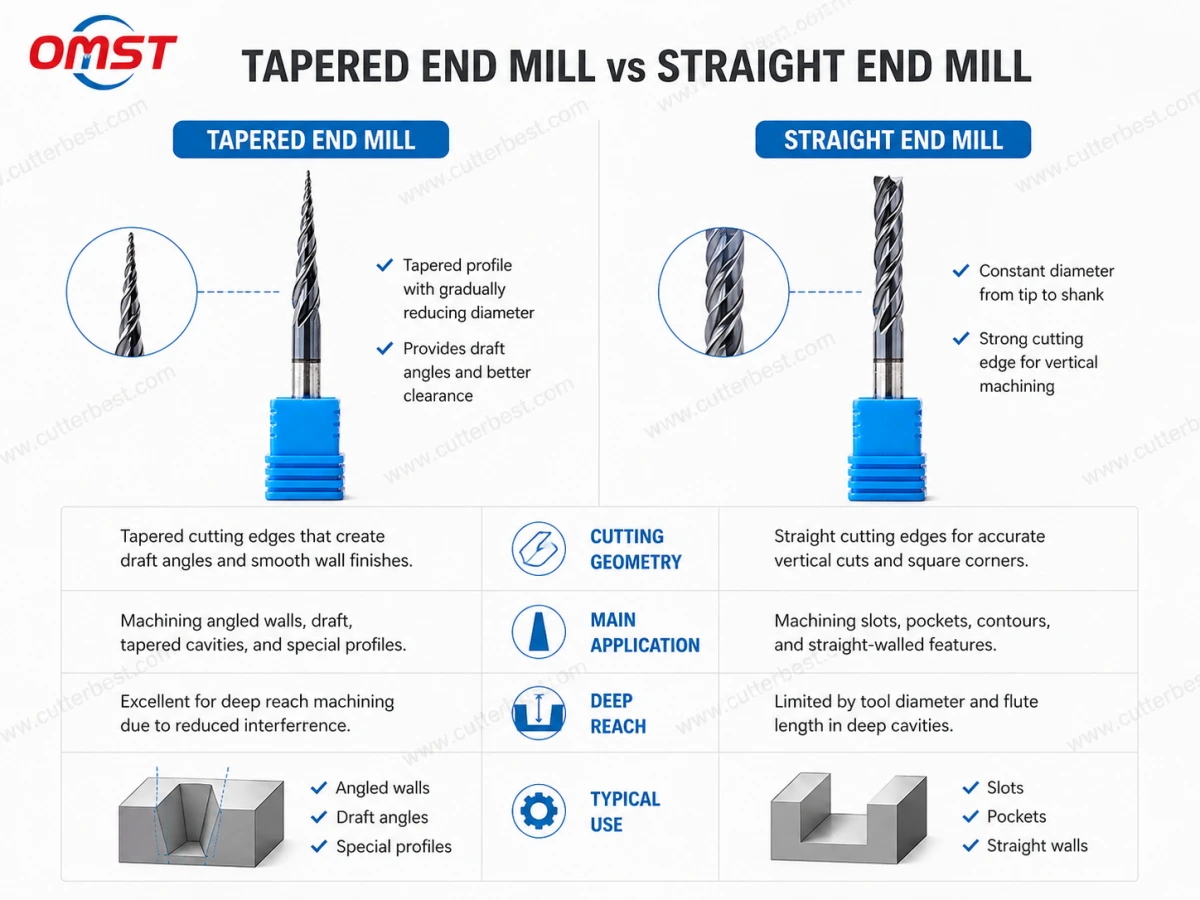
A tapered tool is usually preferred when the wall angle is part of the component design. În contrast, o freză cu capăt drept este în mod normal selectată pentru fante generale, buzunare, pereții laterali verticali, și frezarea profilului standard.
Cum să alegi o freză conică
Selectarea unui tăietor numai după diametrul vârfului nu este suficientă. Trebuie revizuite geometria completă și condițiile de prelucrare.
Confirmați unghiul conic necesar
Primul, verificați desenul și confirmați cum este specificat unghiul.
Unele desene arată unghiul pe o parte a instrumentului. Altele arată unghiul complet inclus. Prin urmare, acest detaliu ar trebui confirmat înainte de producție.
De asemenea, verificați dacă peretele final necesită:
- O conicitate constantă
- Un unghi de pescaj
- O tranziție curbă
- Un profil deosebit
- O toleranță la unghiul peretelui
Selectați vârful și diametrele maxime de tăiere
Diametrul vârfului afectează cea mai mică caracteristică pe care o poate prelucra unealta.
Un pont mai mic poate introduce detalii fine. Cu toate acestea, it is also more sensitive to vibration, a alerga afară, and excessive cutting load.
The maximum cutter diameter must also fit the cavity opening and part geometry.
Choose the Correct End Geometry
The workpiece shape determines whether a flat end, nas de minge, radius end, or special profile is required.
| Workpiece Feature | Suggested End Geometry |
| Flat-bottom tapered slot | Tapered flat end |
| Curved mold cavity | Tapered ball nose |
| Filleted transition | Tapered radius end |
| Fine engraving | Micro tapered cutter |
| Non-standard form | Custom profile cutter |
Check the Flute Length and Tool Reach
Use the shortest flute length and overall length that can safely reach the machining area.
A longer tool increases access. Cu toate acestea, it may also increase vibration and deflection. Prin urmare, unnecessary tool extension should be avoided.
The holder should also grip as much of the shank as practical without contacting the workpiece.
Match the Flute Design to the Workpiece Material
Different materials require different cutting-edge and flute designs.
De exemplu, aluminum usually needs sharp edges and sufficient chip space. Prin contrast, steel machining often requires stronger cutting edges and suitable wear resistance.
| Materialul piesei de prelucrat | General Selection Consideration |
| Aluminum and non-ferrous materials | Margini ascuțite, flutele lustruite, and good chip evacuation |
| Oțel carbon | Suitable carbide grade and wear-resistant coating |
| Stainless steel | Sharp geometry, stable holding, și acoperire rezistentă la căldură |
| Oțel turnat | Good rigidity, controlled reach, and suitable coating |
| Fontă | Wear-resistant geometry and stable cutting conditions |
| Oțel călit | High-rigidity setup, calitate adecvată de carbură, and controlled parameters |
These recommendations are general. The exact tool should be selected according to material hardness, starea mașinii, lichid de răcire, și operația de tăiere.
Select the Carbide Grade and Coating
The coating should match the workpiece and cutting conditions.
Common options include:
- Carbură neacoperită pentru tăiere ascuțită și unele aplicații neferoase
- TiAlN sau AlTiN pentru operații adecvate din oțel și la temperaturi mai ridicate
- TiSiN pentru aplicații selectate cu materiale dure
- DLC pentru aluminiu și alte materiale neferoase
- Canalele lustruite pentru un flux îmbunătățit de așchii
Cu toate acestea, nici un strat de acoperire nu este ideal pentru fiecare lucrare. Înainte de a alege unul, luați în considerare viteza de tăiere, lichid de răcire, duritatea piesei de prelucrat, diametrul sculei, și timpul de prelucrare.
Examinați rigiditatea mașinii și ținerea sculei
Chiar și cuțitul corect poate funcționa slab dacă mașina sau suportul sunt instabile.
Verifica:
- Stare ax
- Execuție aportului de scule
- Extensie instrument
- Prinderea piesei de prelucrat
- Alimentare cu lichid de răcire sau aer
- Rata de avans
- Viteza axului
- Adâncime de tăiere axială și radială
Pentru micro-unelte, runout-ul trebuie controlat cât de strâns permite echipamentul.
Cum să utilizați mai eficient frezele conice
Funcționarea corectă este importantă în special atunci când tăietorul are un vârf mic sau o rază extinsă.
Minimizați epuizarea instrumentului
Runout face ca o margine de tăiere să elimine mai mult material decât celelalte. în consecinţă, sarcina devine neuniformă, iar vârful mic se poate uza sau rupe devreme.
Folosiți o curățare, suport precis și inspectați regulat axul și manșonul.
Utilizați cea mai scurtă extensie de instrumente practice
Contopirea excesivă reduce rigiditatea. Prin urmare, montați unealta cu cea mai scurtă extensie care oferă încă acces sigur la piesa de prelucrat.
Cu toate acestea, asigurați-vă că suportul nu intră în contact cu piesa sau dispozitivul de fixare.
Evitați sarcinile de tăiere excesive
Nu aplicați parametrii de tăiere bazați numai pe diametrul tijei. De asemenea, trebuie luate în considerare vârful mic și diametrul de tăiere local.
Începeți cu parametrii conservatori atunci când prelucrați un nou material sau profil. Apoi, reglați procesul după verificarea sunetului de tăiere, formarea așchiilor, uzura sculei, și calitatea suprafeței.
Mențineți o evacuare eficientă a așchiilor
Chips can collect inside deep cavities. If they are recut, surface quality may decline and cutting heat may increase.
Aer, lichid de răcire, or another suitable chip-removal method should be directed toward the cutting zone when practical.
Inspect the Tool and Finished Surface
Regular inspection can identify problems before tool failure occurs.
Caută:
- Edge wear
- Chipping
- Built-up material
- Uneven flute wear
- Vibration marks
- Finisaj slab al suprafeței
- Profile or dimensional changes
If these signs appear, review runout, tool extension, sarcina de tăiere, acoperire, și evacuarea așchiilor.
What Information Is Needed for a Custom Tapered End Mill?
Provide the main machining details before requesting a custom tool:
- Materialul piesei de prelucrat și duritatea
- Taper angle and angle definition
- Tip diameter and maximum cutter diameter
- Lungimea flautului, lungime totală, and shank diameter
- End geometry and coating requirement
- Desen, cantitate, și aplicație de prelucrare
For non-standard cutter geometry, vezi noastre custom tapered cutter pagina produsului:
For other custom cutting tools, vezi noastre freze la comandă.
Întrebări frecvente
What Is a Tapered End Mill Used For?
O freză conică este utilizată pentru prelucrarea unghiurilor de tragere, tapered walls, cavități profunde de mucegai, caneluri înguste, 3D contururi, detalii de gravare, și profile non-standard.
Aplicarea exactă depinde de unghiul de conicitate, diametrul vârfului, geometria finală, lungimea de tăiere, și materialul piesei de prelucrat.
Frezele conice sunt mai puternice decât morile drepte?
O secțiune de tăiere conică are mai mult material în spatele vârfului mic. Prin urmare, poate oferi o rigiditate mai bună decât o unealtă dreaptă cu un diametru și o rază de vârf similare.
Cu toate acestea, rezistența reală depinde încă de gradul de carbură, lungimea sculei, dimensiunea vârfului, deformare a suportului, parametrii de tăiere, și materialul piesei de prelucrat.
Care este diferența dintre un capăt plat conic și o freză cu cap sferic conic?
Mașiniștii folosesc o freză conică cu capăt plat pentru caracteristici cu fund plat, tapered grooves, și pereții laterali înclinați.
O freză conică cu vârf sferic are un vârf rotunjit și este mai potrivită pentru suprafețele curbe, cavitățile de mucegai, 3D contururi, și operațiuni de finisare.
Freze conice pentru mașină Oțel călit?
Frezele conice pot prelucra oțel călit atunci când are calitatea de carbură, acoperire, geometria sculei, rigiditatea mașinii, iar parametrii de tăiere sunt potriviți.
Înainte de producție, confirmați duritatea materialului și efectuați o tăiere de probă controlată.
Cum este specificat unghiul de conicitate?
Un desen poate specifica conicitatea fie ca unghi cu o singură latură, fie ca unghi total inclus. Deoarece standardele de desen și descrierile clienților pot diferi, confirmați definiția unghiului înainte de a fabrica unealta.
Puteți personaliza freze conice?
Da. Putem personaliza unghiul conic, diametrul vârfului, diametrul maxim de tăiere, geometria finală, lungimea flautului, lungime totală, diametrul tijei, calitate de carbură, acoperire, marcaj cu laser, și ambalare conform aplicației.
Puteți comanda o mostră înainte de producție?
De obicei, putem evalua o comandă de probă pe baza geometriei frezei, materialul piesei de prelucrat, acoperire, dificultatea de fabricatie, și cantitatea necesară.
Vă rugăm să furnizați un desen complet înainte de a confirma designul și ofertarea sculei.
Concluzie
Frezele conice sunt folosite pentru unghiurile de tragere, pereții laterali conici, cavitățile de mucegai, profile profunde, tapered grooves, 3D contururi, gravare, și alte aplicații CNC detaliate.
Uneltele cu capăt plat sunt potrivite pentru caracteristicile cu fundul plat și pereții înclinați. Modelele cu nas sferic sunt mai bune pentru suprafețele curbate și finisarea matrițelor. Meanwhile, frezele micro conice sunt utile pentru zone înguste și detalii fine.
Pentru a selecta instrumentul corect, confirmați unghiul de conicitate, diametrul vârfului, diametrul maxim al frezei, geometria finală, lungimea de tăiere, materialul piesei de prelucrat, starea mașinii, și finisarea necesară a suprafeței.
Pentru custom tapered cutter cerințe, puteti trimite desenul, materialul piesei de prelucrat, dimensiunile cerute, aplicație de prelucrare, și comandați cantitatea către Cutterbest pentru revizuire. Putem recomanda sau personaliza o freză conică din carbură potrivită pentru testarea probelor sau prelucrarea în producție.