 Präzisions-Fräser,Schneidwerkzeuge für die CNC-Bearbeitung jedes Materials

A 6 Der Nutfräser wird hauptsächlich zum kontrollierten Seitenfräsen verwendet, Profilfräsen, Konturfräsen, Halbfertigbearbeitung, und Abschluss. Seine sechs Schneiden sorgen für häufigen Schnittkontakt, was eine gute Werkzeugsteifigkeit unterstützen kann, stabile Wandbearbeitung, und ein sanfterer Enddurchgang.
Jedoch, Mehr Spannuten lassen weniger Platz für die Spanabfuhr. daher, Ein Standardfräser mit sechs Schneiden ist normalerweise nicht die beste Wahl für tiefe Nuten über die gesamte Breite, starkes Schruppen, oder aggressives Schneiden in Materialien, die große Späne erzeugen.
In der Praxis, Ein sechsschneidiges Werkzeug funktioniert am besten, wenn Oberflächenqualität und Schnittstabilität wichtiger sind als maximaler Materialabtrag.
Was ist ein 6 Schaftfräser mit Nut?
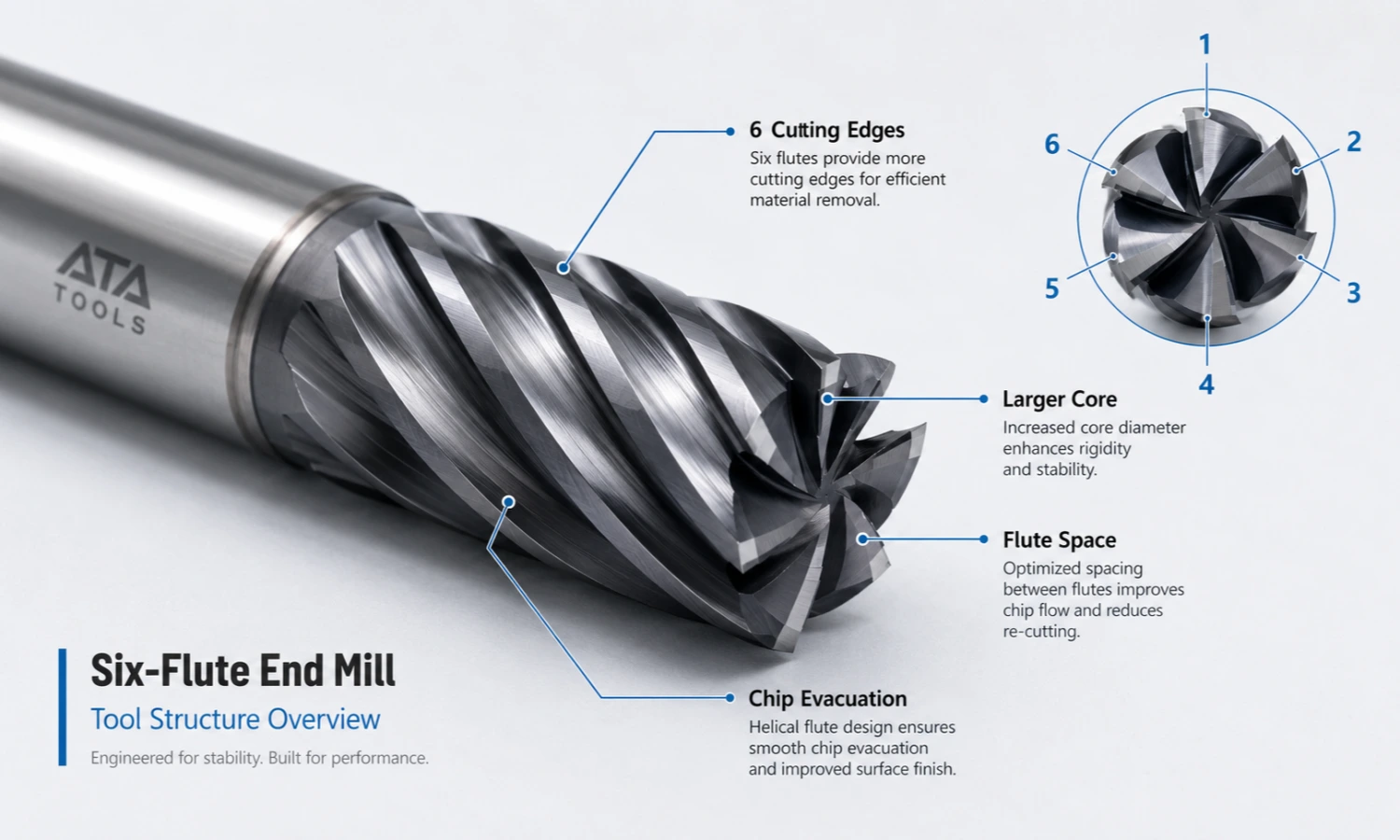
A 6 Der Schaftfräser mit Nut verfügt über sechs Schneidkanten rund um seinen Schneidabschnitt. Bei jeder Spindelumdrehung kommen sechs Schneiden mit dem Werkstück in Kontakt.
Im Vergleich zu einem Fräser mit zwei oder vier Schneiden, Eine sechsschneidige Konstruktion hat normalerweise einen größeren Werkzeugkern und kleinere Spannutenräume. Der größere Kern kann die Werkzeugsteifigkeit unterstützen, während die zusätzlichen Schneidkanten die Schneidwirkung auf mehr Zähne verteilen können.
Der Hauptkompromiss ist die Spanabfuhr. Kleinere Nuträume halten weniger Späne, Daher benötigt der Fräser einen kontrollierten Eingriff und einen freien Weg, damit die Späne den Schneidbereich verlassen können.
Aus diesem Grund, Sechsschneidige Werkzeuge schneiden beim seitlichen Schneiden und Schlichten in der Regel besser ab als beim tiefen Schlitzen oder schweren Schruppen.
Für eine allgemeine Erläuterung der Fräsertypen und -strukturen, Lesen Sie unsere Schaftfräserführung.
Hauptverwendungen von a 6 Schaftfräser mit Nut
Die besten Anwendungen erfordern eine kontrollierte Spanmenge, stabile Maschinenbedingungen, und die Notwendigkeit einer guten Wandqualität oder Oberflächenbeschaffenheit.
Seiten- und Profilfräsen
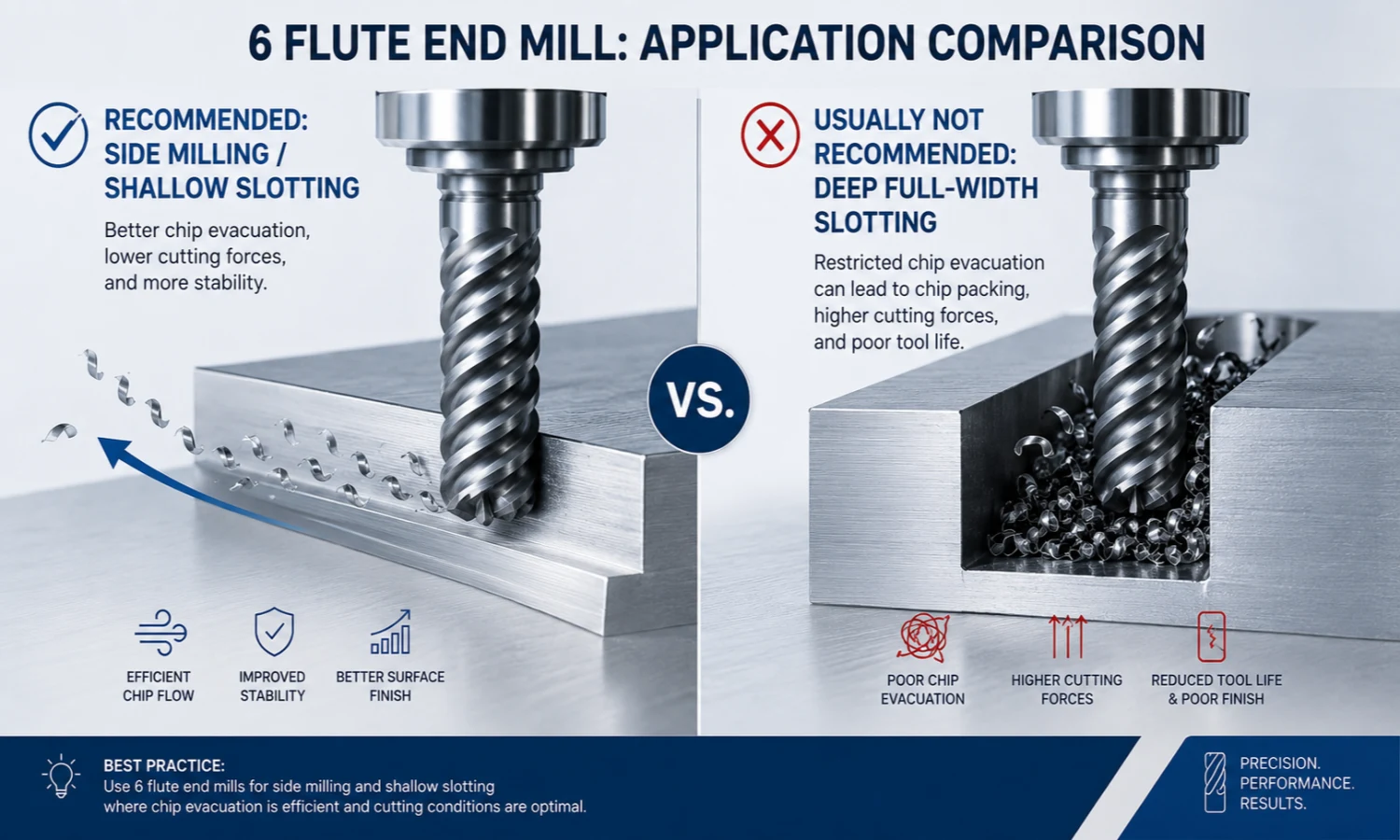
Ein sechsschneidiger Fräser eignet sich gut zum Seitenfräsen, da normalerweise nur ein Teil des Werkzeugdurchmessers in das Werkstück eingreift. Dadurch bleibt mehr Raum für das Entweichen der Späne als bei Schlitzen über die gesamte Breite.
Typische Anwendungen sind gerade Seitenwände, Schultern, Außenprofile, und Präzisionskomponentenmerkmale. Die zusätzlichen Schneidkanten können auch einen stabilen Werkzeugkontakt unterstützen, wenn die radiale Schnittbreite kontrolliert bleibt.
Trotzdem, Das Ergebnis hängt nicht nur von der Anzahl der Flöten ab. Werkzeugunrundheit, Zustand des Halters, Steifigkeit der Maschine, Schnittbreite, und Werkzeugüberstand wirken sich alle auf die Seitenwandqualität aus.
Konturfräsen
Beim Konturfräsen folgt man einem gekrümmten oder unregelmäßigen Werkstückprofil. Ein starres sechsschneidiges Werkzeug kann bei der Bewegung entlang der Kontur einen gleichmäßigen Kontakt gewährleisten.
Dies macht das Design für Formkomponenten nützlich, Werkzeugteile, Maschinenkomponenten, und andere Präzisionsprofile. Jedoch, Ein langer Werkzeugüberhang oder ein instabiler Halter können dennoch Vibrationen verursachen.
daher, Das Werkzeug sollte so kurz bleiben, wie es die Anwendung zulässt, insbesondere bei der Bearbeitung steiler oder tiefer Konturen.
Halbfertigbearbeitung
Beim Halbschlichten wird das nach dem Schruppen verbleibende Material entfernt und die Oberfläche für den letzten Durchgang vorbereitet.
Ein sechsschneidiges Werkzeug eignet sich für diese Phase, wenn das verbleibende Material kontrolliert wird. Die zusätzlichen Schneidkanten können die Schneidwirkung verteilen und dabei helfen, eine gleichmäßige Wandgeometrie beizubehalten.
Bevor Sie sechs Flöten verwenden, Stellen Sie sicher, dass beim Schruppen kein ungleichmäßiges oder übermäßiges Aufmaß entstanden ist. Große und unregelmäßige Bestände können einzelne Schneiden überlasten.
Abschluss
Die Endbearbeitung ist eine der häufigsten 6 Anwendungen für Nutfräser.
Mehr Schneidkanten können bei steigender Geschwindigkeit feinere Schnittspuren hinterlassen, füttern, Werkzeugweg, und Maschineneinrichtung auf das Material abgestimmt sind. Infolge, Für die Bearbeitung gerader Wände werden häufig Sechsschneidefräser eingesetzt, Profile, Schultern, und Präzisionsoberflächen.
Jedoch, Die Anzahl der Nuten allein garantiert keine bestimmte Oberflächenrauheit. Genauigkeit des Halters, Werkzeugunrundheit, Maschinenzustand, Werkstückstabilität, Schnittparameter, und Werkzeugverschleiß beeinflussen auch die endgültige Oberfläche.
Flaches Schlitzen und Hochgeschwindigkeitsbearbeitung
Mit einem sechsschneidigen Fräser können flache Schlitze bearbeitet werden, wenn die Späne den Schneidbereich effektiv verlassen können. Leichtes Schlitzen kann gut funktionieren, insbesondere wenn die axiale Tiefe und das Spanvolumen gering bleiben.
Bei tiefen Schlitzen über die gesamte Breite ist das anders. In diesem Fall, Der Fräser bleibt vom Material umgeben, während die kleineren Nutenräume alle Späne aus dem Schlitz befördern müssen. Chip-Packung und Hitze können dann schnell zunehmen.
Sechsschneidige Werkzeuge können auch die Hochgeschwindigkeitsbearbeitung unterstützen, Eine hohe Spindeldrehzahl allein reicht jedoch nicht aus. Der gesamte Aufbau muss die Wärme kontrollieren, Auslaufen, Vibration, und Spanabfuhr.
Kurzanleitung zur Bewerbung
| Bearbeitungsvorgang | Allgemeine Eignung | Hauptüberlegung |
|---|---|---|
| Seitenfräsen | Empfohlen | Verwenden Sie einen kontrollierten radialen Eingriff |
| Profilfräsen | Empfohlen | Überprüfen Sie die Genauigkeit des Halters und den Werkzeugüberhang |
| Konturfräsen | Empfohlen | Behalten Sie einen starren Aufbau bei |
| Halbfertigbearbeitung | Empfohlen | Halten Sie den Restbestand konstant |
| Abschluss | Empfohlen | Kontrollieren Sie Rundlauf- und Schnittparameter |
| Flache Schlitzung | Bedingt | Stellen Sie sicher, dass die Späne den Schlitz verlassen können |
| Tiefe Nuten über die gesamte Breite | Normalerweise nicht empfohlen | Begrenzter Nutraum schränkt die Spanabfuhr ein |
| Schweres Schruppen | Normalerweise nicht empfohlen | Eine geringere Spannutenzahl sorgt für mehr Spanraum |
Welche Materialien eignen sich für a 6 Schaftfräser mit Nut?
Die richtige Wahl hängt vom Werkstückmaterial ab, Härte, Schneidvorgang, Steifigkeit der Maschine, Kühlmittelzustand, und Werkzeugkonstruktion.
Ein für Stahl hergestelltes Werkzeug sollte nicht automatisch für Aluminium oder Titan verwendet werden. Auch wenn die Anzahl der Flöten gleich bleibt, Die Schneidengeometrie und andere Werkzeugmerkmale müssen möglicherweise geändert werden.
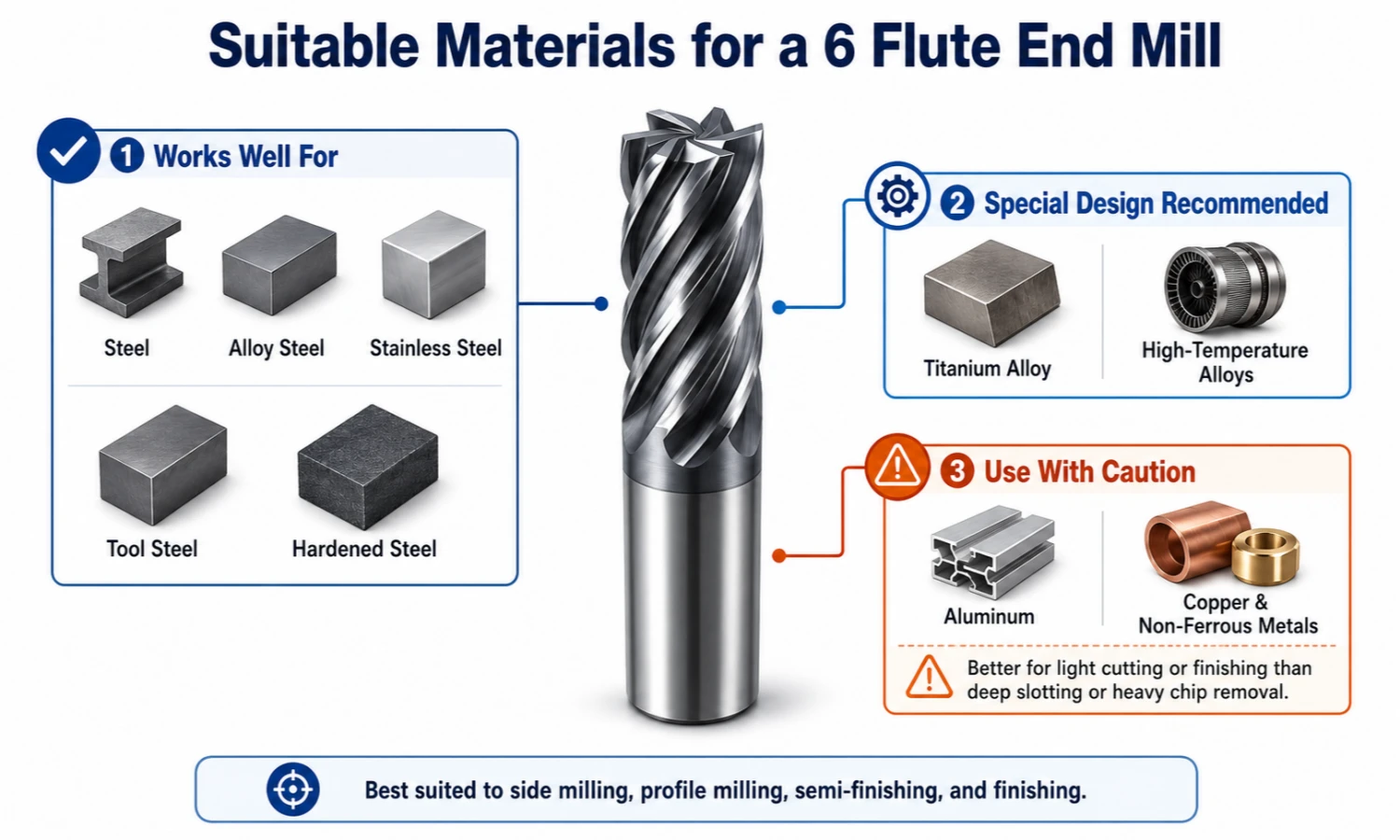
Stahl und legierter Stahl
Stahl und legierter Stahl sind häufige Anwendungsbereiche für sechsschneidige Werkzeuge.
Der Fräser beherrscht das kontrollierte Seitenfräsen, Profilfräsen, Halbfertigbearbeitung, und Endbearbeitung, wenn die Hartmetallsorte vorliegt, Schnittgeometrie, und Beschichtung auf die Materialhärte abgestimmt.
Sechs Spannuten sind besonders nützlich, wenn für die Bearbeitung stabile Wände oder ein sauberer Schlichtdurchgang erforderlich sind. Im Gegensatz, Schweres Schruppen erfordert im Allgemeinen mehr Spanraum.
Edelstahl
Ein sechsschneidiger Fräser kann bearbeiten 304, 316, und andere Edelstahlsorten. Jedoch, Edelstahl kann Hitze erzeugen und sich verfestigen, wenn der Schneidvorgang instabil wird.
daher, Der Fräser muss einen gleichmäßigen Schnitt gewährleisten. Die Schnittgeometrie, Beschichtung, Kühlmittel, Geschwindigkeit, und Vorschub sollten alle zur Edelstahlsorte und zum Bearbeitungsvorgang passen.
Eine sechsschneidige Konstruktion ist in der Regel für kontrolliertes Seitenschneiden und Schlichten sinnvoller als für tiefes Nutenfräsen in Edelstahl.
Werkzeugstahl und gehärteter Stahl
Sechsschneidige Werkzeuge können auch Werkzeugstahl bearbeiten, vorgehärteter Stahl, und gehärteter Stahl, wenn die Werkzeugserie zur Materialhärte passt.
Härtere Materialien erfordern geeignete Hartmetallsorten, Kantenfestigkeit, Beschichtungen, und Schnittgeometrie. Infolge, Ein Standardfräser sollte nicht als Universallösung für jeden Härtebereich betrachtet werden.
Für gehärtete Materialien, Stabile Maschinenbedingungen und ein geringer Werkzeugrundlauf werden noch wichtiger.
Titan und schwer zerspanbare Materialien
Ein speziell entwickeltes sechsschneidiges Werkzeug eignet sich möglicherweise für Titan und andere schwer zu bearbeitende Materialien.
Jedoch, Wärmekontrolle, Schnittlast, Kantenfestigkeit, Kühlmittelzufuhr, und Werkzeugüberhang erfordern besondere Aufmerksamkeit. Die Standardgeometrie zum Schneiden von Stahl liefert möglicherweise nicht das beste Ergebnis.
Bevor Sie sich für den Fräser entscheiden, Überprüfen Sie den genauen Titangrad, Bearbeitungsvorgang, Schnitttiefe, Kühlmittelmethode, und Maschinenzustand.
Kann ein 6 Nutenfräser aus Aluminium?
Ja, Allerdings nur, wenn der Fräser eine für Aluminium geeignete Geometrie verwendet und der Vorgang kein übermäßiges Spanvolumen erzeugt.
Aluminium erzeugt oft größere und anhaftendere Späne als Stahl. daher, Tiefe Schlitze und starkes Schruppen funktionieren normalerweise besser mit zwei oder drei Spannuten, da sie größere Spannutenräume bieten.
Ein sechsschneidiges Werkzeug eignet sich möglicherweise immer noch für leichtes Seitenfräsen oder Schlichten in Aluminium, wenn es über scharfe Schneidkanten verfügt, effektive Spankontrolle, und genügend Platz zum Abtransport der Späne.
Wann sollten Sie a wählen? 6 Schaftfräser mit Nut?
Wählen Sie einen sechsschneidigen Fräser, wenn die meisten der folgenden Bedingungen zutreffen:
- Die Oberflächenbeschaffenheit ist wichtiger als der maximale Materialabtrag.
- Der Vorgang umfasst Seitenfräsen, Profilierung, Halbfertigbearbeitung, oder beenden.
- Die Maschine und der Halter sorgen für eine gute Steifigkeit.
- Die radiale Schnittbreite bleibt kontrolliert.
- Der Werkzeugüberhang bleibt relativ kurz.
- Späne können den Schnittbereich effektiv verlassen.
- Das Fräserdesign ist auf das Werkstückmaterial und die Härte abgestimmt.
Diese Bedingungen helfen dem Tool, seine Hauptstärken auszuschöpfen: Steifigkeit, häufiger Schnittkontakt, und gleichmäßige Wandbearbeitung.
Wann ist ein 6 Nutfräser nicht die beste Wahl?
Mehr Schneidkanten machen einen Fräser nicht für jeden Einsatz geeignet. In einigen Anwendungen, Der reduzierte Spanraum wird zu einem größeren Problem als die Steifigkeit des Werkzeugs.
Tiefe Nuten über die gesamte Breite
Beim Nuten über die gesamte Breite, Der Fräser erfasst das Material über seinen gesamten Durchmesser. Die Späne müssen durch die Rillenräume und aus dem Schlitz heraus transportiert werden.
Weil ein Design mit sechs Rillen kleinere Rillenräume hat, Späne können sich in einem tiefen Schlitz ansammeln. Dies kann die Hitze erhöhen, Schnittlast, und die Gefahr einer Kantenbeschädigung.
Für tiefe Schlitze, Eine geringere Spananzahl sorgt normalerweise für eine sicherere Spanabfuhr.
Schweres Schruppen
Durch starkes Schruppen wird viel Material abgetragen. Infolge, es erzeugt mehr Späne und belastet den Fräser stärker.
Eine Zweiflöte, dreiflötig, vierflötig, Ein spezielles Schruppwerkzeug bietet oft mehr Platz für den Spanfluss. Die beste Wahl hängt vom Material und der Schruppstrategie ab.
Materialien, die große Späne erzeugen
Weiche Materialien wie Aluminium können beim aggressiven Schneiden große oder klebrige Späne erzeugen.
Unter diesen Bedingungen, Bei einem Fräser mit hoher Nutzahl können sich Späne in den Nuten festsetzen. Mit einer geringeren Anzahl an Spannuten ist das Schneiden von schwerem Aluminium normalerweise effektiver.
Instabile Einstellungen und großer Werkzeugüberhang
Ein sechsschneidiges Design kann eine gute Kernsteifigkeit bieten, Es kann jedoch nicht jedes Setup-Problem beheben.
Langer Überhang, abgenutzte Halterungen, hoher Rundlauf, schwache Arbeitsspannung, oder eine instabile Maschine kann dennoch Vibrationen und Schnittspuren verursachen. In schweren Fällen, Sie können auch zum Abplatzen der Kanten beitragen.
daher, Reduzieren Sie den Überhang und überprüfen Sie die vollständige Einrichtung, bevor Sie die Anzahl der Nuten ändern.
Was ist der Hauptnachteil eines Schaftfräsers mit hoher Nutzahl??
Der Hauptnachteil eines Schaftfräsers mit hoher Nutanzahl ist der geringere Nutraum.
Mit zunehmender Flötenanzahl, Jede Rille bietet normalerweise weniger Platz für Späne. Dies kann die Spanabfuhr erschweren, insbesondere beim Tiefschlitzen, starkes Schruppen, oder hoher Materialabtrag.
Wenn Späne den Schnittbereich nicht verlassen können, Sie können erneut geschnitten oder zwischen Werkzeug und Werkstück gepackt werden. Infolge, Hitze und Schnittdruck können zunehmen.
Die richtige Flötenanzahl muss drei Faktoren ausgleichen:
- Spanabfuhr
- Werkzeugsteifigkeit
- Oberflächenqualität
Ein sechsschneidiges Werkzeug bietet möglicherweise eine bessere Steifigkeit und Endstabilität, während ein Fräser mit niedrigerer Spannut große Spanvolumina effektiver bewältigen kann.
4 Flöte bzw 6 Schaftfräser mit Nut?
Ein Schaftfräser mit vier Schneiden ist in der Regel die vielseitigere Option. Es bietet eine praktische Balance zwischen Spanraum, Werkzeugsteifigkeit, und Oberflächenbeschaffenheit.
Ein sechsschneidiges Werkzeug ist spezialisierter. Normalerweise eignet es sich für das kontrollierte Seitenfräsen, Halbfertigbearbeitung, und Schlichten, wenn stabiler Kontakt und Wandqualität wichtiger sind als maximale Spanabfuhr.
Die endgültige Wahl hängt vom Werkstückmaterial ab, Schnitttiefe, radialer Eingriff, Steifigkeit der Maschine, und Bearbeitungsziel.
Für einen detaillierten Vergleich der beiden Tools, lesen 4 Flöte vs 6 Nutfräser.
Für einen breiteren Überblick über die Anzahl der Flöten, lesen 2 Flöte vs 4 Flöte vs 6 Nutfräser.
Häufig gestellte Fragen
Bedeutet „6 Flöten“ a 6 mm Schnittdurchmesser?
NEIN. „6 Schneiden“ bezieht sich auf die Anzahl der Schneiden.
Der Schneiddurchmesser ist eine eigene Werkzeugabmessung. Ein sechsschneidiger Fräser kann viele verschiedene Schneiddurchmesser haben.
Kann ein 6 Nutenfräser werden zum Tiefschlitzen verwendet?
Ein Standardfräser mit sechs Schneiden ist normalerweise nicht die erste Wahl für tiefe Nuten über die gesamte Breite.
Die kleineren Spannutenräume können die Spanabfuhr einschränken. Ein Fräser mit niedrigerer Nut bietet normalerweise mehr Platz für Späne, um den Schlitz zu verlassen.
Ist ein 6 Schaftfräser mit Nut, gut für Edelstahl?
Ja, speziell für kontrolliertes Seitenfräsen, Profilfräsen, Halbfertigbearbeitung, und Abschluss.
Jedoch, die Fräsergeometrie, Beschichtung, Kühlmittel, Geschwindigkeit, und Vorschub müssen zur Edelstahlsorte und zum Bearbeitungsvorgang passen.
Abschluss
Was ist ein 6 Nutenfräser verwendet für? Es wird hauptsächlich zum kontrollierten Seitenfräsen eingesetzt, Profilfräsen, Konturfräsen, Halbfertigbearbeitung, und Abschluss.
Seine Hauptstärken sind die Steifigkeit des Werkzeugs, stabiler Schnittkontakt, Wandqualität, und Abschlussleistung. Die größte Einschränkung besteht in der geringeren Chipfläche.
daher, Vermeiden Sie es, sechs Flöten als die beste Option für jede Aufgabe zu betrachten. Tiefe Schlitzung über die gesamte Breite, starkes Schruppen, instabile Setups, und Betriebe mit großen Spänen profitieren in der Regel von weniger Spannuten.
Für Standard- und kundenspezifische Werkzeugoptionen, Sehen Sie sich unsere an 6 Nutfräser aus Hartmetall.