 Präzisions-Fräser,Schneidwerkzeuge für die CNC-Bearbeitung jedes Materials

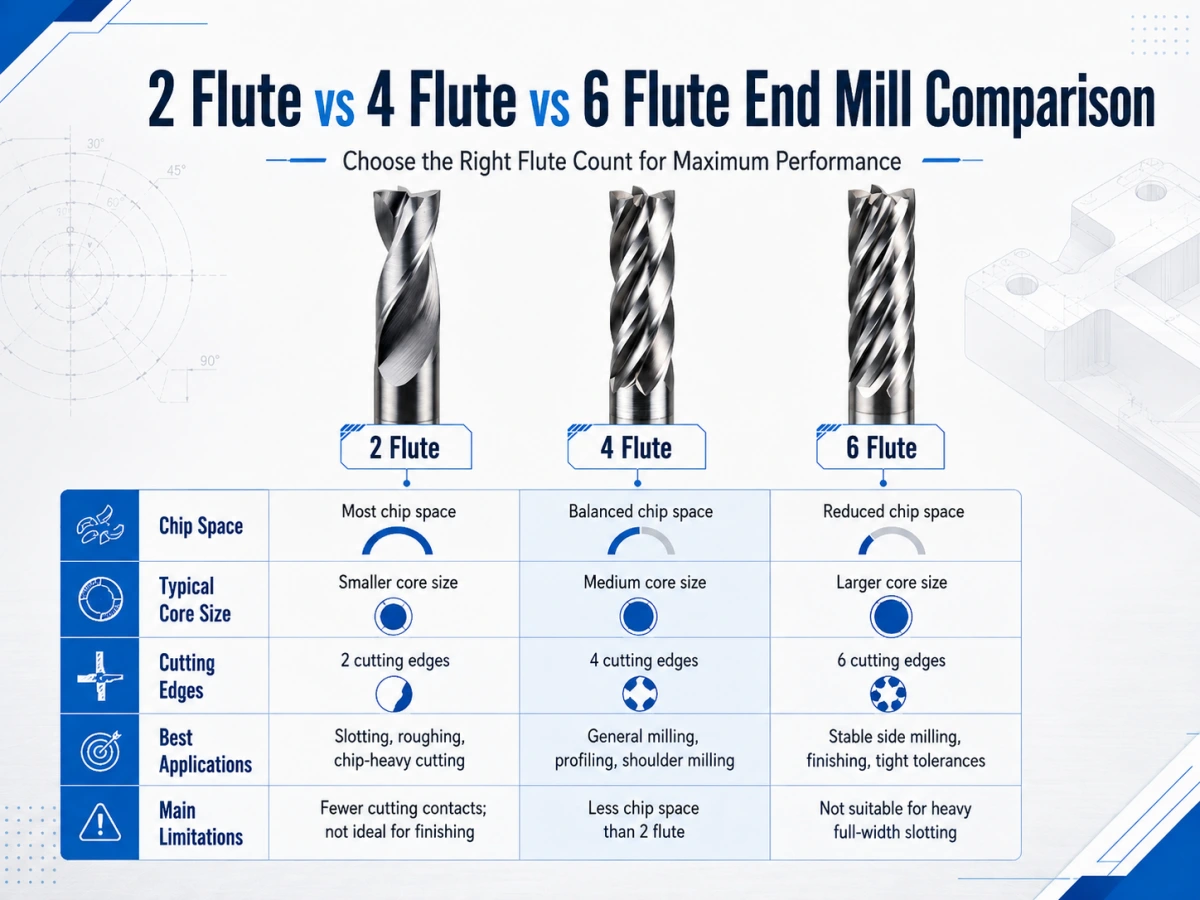
Das 2 Flöte vs 4 Flöte vs 6 Der Leitfaden zum Nutenfräser erklärt, wie sich die Anzahl der Nuten auf den Spanraum auswirkt, typische Kerngröße, Kontakte schneiden, Vorschubpotenzial, und Oberflächenbeschaffenheit.
Verwenden Sie zwei Spannuten, wenn das Spanvolumen die Hauptbeschränkung darstellt. Wählen Sie vier Schneiden, wenn Sie einen ausgewogenen Allzweckschneider benötigen. Wählen Sie sechs Nuten, wenn der Eingriff kontrolliert ist und mehr Schneidkontakte ein stabiles Seitenfräsen oder Schlichten unterstützen.
Die endgültige Wahl hängt auch vom Werkstückmaterial ab, Fräserdurchmesser, Schnitttiefe, radialer Eingriff, Werkzeugüberhang, Zustand des Halters, Steifigkeit der Maschine, und erforderliche Oberflächenbeschaffenheit.
Schnell 2 Flöte vs 4 Flöte vs 6 Vergleich von Nutfräsern
| Vergleich | 2 Flöte | 4 Flöte | 6 Flöte |
|---|---|---|---|
| Chip-Platz | Am meisten | Ausgewogen | Reduziert |
| Schneidende Kanten | 2 | 4 | 6 |
| Typische Kerngröße | Kleiner | Medium | Größer |
| Gemeinsame Anwendung | Schlitzen und spanendes Schneiden | Allgemeines Fräsen und Profilieren | Stabiles Seitenfräsen und Schlichten |
| Hauptvorteil | Einfachere Spanabfuhr | Ausgewogenheit von Spanraum und Kantenanzahl | Mehr Schneidkontakte |
| Haupteinschränkung | Weniger Schneidkontakte | Weniger Spanraum als 2 Flöten | Nicht geeignet für schweres Schlitzen über die gesamte Breite |
Dies sind typische Designrichtungen. Der tatsächliche Kerndurchmesser und die Werkzeugsteifigkeit hängen auch von der Nuttiefe ab, Fräserdurchmesser, Helixwinkel, Flötenlänge, Halsdurchmesser, und die komplette Werkzeuggeometrie.
Warum die Anzahl der Nuten die Schneidleistung verändert
Die Anzahl der Nuten verändert hauptsächlich drei Teile des Schneidprozesses:
- Chipraum
- Modernste Zählung
- Typische Kerngröße
Ein Fräser mit weniger Nuten hat normalerweise breitere Nuten. Der zusätzliche Platz hilft dabei, größere Späne aus einem Schlitz oder einer Tasche zu entfernen, bevor sie erneut geschnitten werden.
Dies ist besonders wichtig bei Aluminium, Kunststoffe, und andere Materialien, die große oder kontinuierliche Späne erzeugen können. Wenn die Rillen der Flöte zu klein sind, Späne können sich in der Schneidzone festsetzen, zunehmende Reibung, Hitze, und Werkzeugbruchgefahr.
Ein Fräser mit mehr Spannuten sorgt für mehr Schneidkontakte bei jeder Spindelumdrehung. Es kann höhere berechnete Vorschübe und eine gleichmäßigere Endbearbeitung unterstützen, wenn der Eingriff kontrolliert wird.
Jedoch, Mehr Rillen lassen auch weniger Platz für Späne. daher, Eine Erhöhung der Anzahl der Nuten ohne Überprüfung des Schneidvorgangs kann die Leistung eher verschlechtern als verbessern.
Ausführliche Erläuterungen zur Flötentiefe, Kerndurchmesser, Helixwinkel, ungleiche Tonhöhe, und Flötenlänge, Lesen Sie unsere Leitfaden zur Auswahl der Schaftfräsernuten.
Wie sich die Anzahl der Nuten auf die Vorschubgeschwindigkeit auswirkt
Die Anzahl der Nuten ist Teil der Vorschubberechnung:
Vorschubgeschwindigkeit = U/min × Nutanzahl × Spanlast pro Zahn
Bei gleicher Spindeldrehzahl und Spanlast pro Zahn, Durch Erhöhen der Anzahl der Nuten erhöht sich die berechnete Vorschubgeschwindigkeit.
Zum Beispiel, Ein 4-schneidiges Werkzeug hat doppelt so viele Schneidkontakte pro Umdrehung wie ein 2-schneidiges Werkzeug. Jedoch, Dies bedeutet nicht, dass die tatsächliche Vorschubgeschwindigkeit immer verdoppelt werden kann.
Die erreichbare Steigerung ist begrenzt durch:
- Spanabfuhr
- Werkzeugeinsatz
- Spindelleistung
- Steifigkeit der Maschine
- Genauigkeit des Halters
- Werkstückspannung
- Werkzeuggeometrie
- Werkstückmaterial
Mehr Nuten schaffen keine unbegrenzte Vorschubkapazität. Beginnen Sie immer mit den empfohlenen Parametern für die jeweilige Werkzeugserie, Fräserdurchmesser, Material, und Bearbeitungsvorgang.
Wozu eignet sich ein 2-schneidiger Schaftfräser am besten??
Ein 2-schneidiger Schaftfräser bietet zwei Schneidkanten und relativ große Nuten. Dieses Design gibt den Spänen mehr Platz, um die Schneidzone zu verlassen.
Üblicherweise werden zweischneidige Werkzeuge verwendet:
- Aluminiumbearbeitung
- Bearbeitung von Messing und Kupfer
- Kunststoffbearbeitung
- Schlitzung über die gesamte Breite
- Tiefe Taschen
- Schruppen weicher Materialien
- Operationen, die ein hohes Spanaufkommen erzeugen
Beim Nuten über die gesamte Breite, Der gesamte Fräserdurchmesser greift am Werkstück an. Infolge, Das Werkzeug muss eine große Menge an Spänen durch die Nuten abtransportieren.
Eine 2-schneidige Konstruktion verringert das Risiko, dass Späne in einem schmalen Schlitz hängen bleiben. Dies kann helfen, die Hitze zu kontrollieren, Aufbaukante, und Spannachschneiden.
Jedoch, Zwei Spannuten sorgen für weniger Schneidkontakte als vier oder sechs Spannuten. daher, Ein 2-schneidiges Werkzeug kann bei gleicher Spindeldrehzahl und Spanlast pro Zahn eine geringere Vorschubgeschwindigkeit und ein geringeres Schlichtungspotenzial aufweisen.
Eine zweischneidige Ausführung bedeutet auch nicht automatisch, dass der Fräser direkt in das Werkstück eintauchen kann. Rampen, spiralförmiger Eintritt, oder begrenztes Eintauchen erfordert eine geeignete Mittenschnittgeometrie und einen kompatiblen Werkzeugweg.
Standard und benutzerdefiniert anzeigen 2 Optionen für Nutfräser.
Für detailliertere Anwendungen, lesen Was ist ein 2 Nutenfräser verwendet für.
Was ist mit 3-schneidigen Schaftfräsern für Aluminium??
Dreischneidige Schaftfräser werden auch häufig für Aluminium und andere Nichteisenmaterialien verwendet.
Sie bieten eine Schneidkante mehr als ein 2-Schneiden-Fräser und behalten gleichzeitig mehr Spanraum als viele 4-Schneiden-Konstruktionen. daher, Sie können eine nützliche Balance bieten:
- Spanabfuhr
- Werkzeugsteifigkeit
- Vorschubpotenzial
- Modernste Zählung
- Oberflächenbeschaffenheit
Wählen Sie zwei Spannuten, wenn das Spanvolumen hoch ist, die Tasche oder der Schlitz ist tief, oder die Spanabfuhr ist schwierig.
Wählen Sie drei Spannuten für das allgemeine Fräsen von Aluminium, wenn die Spanabfuhr stabil ist und Sie mehr Schneidkontakte oder eine verbesserte Endbearbeitungsfähigkeit benötigen.
Scharfe Schnittkanten, polierte Rillenoberflächen, Auch bei der Bearbeitung von Aluminium sind eine geeignete reibungsarme Beschichtung oder unbeschichtete Oberfläche wichtig.
Wozu eignet sich ein 4-schneidiger Schaftfräser am besten??
Ein 4-schneidiger Schaftfräser bietet eine praktische Balance zwischen Spanraum, modernste Zählung, Kerngröße, und allgemeine Vielseitigkeit beim Fräsen.
Üblicherweise werden dafür vierschneidige Werkzeuge verwendet:
- Bearbeitung von Kohlenstoffstahl
- Bearbeitung von legiertem Stahl
- Allgemeines Fräsen von Edelstahl
- Seitenfräsen
- Eckfräsen
- Profilierung
- Halbfertigbearbeitung
- Allgemeine CNC-Bearbeitung
Im Vergleich zu einem 2-Schneiden-Fräser, Ein 4-schneidiges Werkzeug sorgt für mehr Schneidkontakte pro Spindelumdrehung. Es kann eine höhere berechnete Vorschubgeschwindigkeit unterstützen, wenn die Spanlast pro Zahn und die Schnittbedingungen geeignet bleiben.
Durch die zusätzlichen Spannuten verringert sich zudem der verfügbare Spanraum. Aus diesem Grund, Für tiefe Schlitze über die gesamte Breite oder spanintensive Aluminiumtaschen ist ein 4-Schneiden-Fräser möglicherweise nicht die erste Wahl.
Ein 4-Schneiden-Werkzeug kann beim Seitenfräsen oder leichten Schlichten immer noch Aluminium bearbeiten:
- Die Schneiden sind scharf
- Die Flötenoberflächen sind glatt
- Der radiale Eingriff wird kontrolliert
- Luft oder Kühlmittel gelangt in die Schneidzone
- Späne verlassen das Werkstück zuverlässig
Für tiefe Aluminiumnuten, 2-Werkzeuge mit oder mit drei Schneiden bieten normalerweise mehr Spanraum.
Für Stahl und Edelstahl, Die Anzahl der Nuten sollte zusammen mit der Beschichtung und der Vibrationskontrollgeometrie berücksichtigt werden. Konstruktionen mit variabler Helix oder ungleicher Steigung können dazu beitragen, sich wiederholende Schnittkräfte beim Seitenfräsen und Profilieren zu unterbrechen.
Auch die Beschichtung sollte zur Hartmetallsorte passen, Werkstückmaterial, Härte, Schnitttemperatur, und Kühlmittelzustand.
Standard und benutzerdefiniert anzeigen 4 Optionen für Nutfräser.
Wozu eignet sich ein 6-schneidiger Schaftfräser am besten??
Ein 6-schneidiger Schaftfräser bietet sechs Schneidkanten und mehr Schneidkontakte pro Spindelumdrehung.
Viele 6-schneidige Werkzeuge verwenden einen relativ großen Kern. Jedoch, Die tatsächliche Steifigkeit hängt von der Gesamtgeometrie ab, einschließlich Nuttiefe, Fräserdurchmesser, Helixwinkel, Flötenlänge, Halsdurchmesser, und Kantenvorbereitung.
Üblicherweise werden Werkzeuge mit sechs Schneiden verwendet:
- Stabile Seitenfräsung
- Leichter radialer Eingriff
- Profilierung
- Halbfertigbearbeitung
- Abschluss
- Veredelung von gehärtetem Stahl mit einer geeigneten Werkzeugserie
- Anwendungen, die eine gleichbleibende Oberflächenqualität erfordern
Ein 6-Schneiden-Fräser funktioniert am besten, wenn das Spanvolumen und die Maschine kontrolliert werden, Halter, und Werkstückaufbau sind stabil.
Weil die Rillen der Flöte kleiner sind, 6-Flötenwerkzeuge sind normalerweise nicht die erste Wahl:
- Tiefe Schlitzung über die gesamte Breite
- Starke Taschenbildung
- Aggressives Tauchschneiden
- Schruppbearbeitungen, die ein großes Spanvolumen erzeugen
Sechs Spannuten sollten nicht nur deshalb gewählt werden, weil das Werkstück hart ist. Die Materialqualität, Bearbeitungsvorgang, Beschichtung, Hartmetallsorte, radialer Eingriff, Genauigkeit des Halters, und Spanabfuhr sind ebenso wichtig.
Sechsschneidige Schaftfräser im hocheffizienten Fräsen
Sechsschneidige und andere mehrschneidige Werkzeuge werden auch beim Hocheffizienz- oder Wirbelfräsen eingesetzt.
Diese Werkzeugwege werden normalerweise verwendet:
- Leichter radialer Eingriff
- Größerer axialer Eingriff
- Kontrollierter Fräsereingriff
- Gleichbleibende Spandicke
- Reibungslose Werkzeugbewegung durch Ecken
Denn der radiale Eingriff verringert sich, Jede Nut entfernt einen kleineren Span. Dadurch kann eine höhere Nutanzahl auch bei materialabtragenden Vorgängen sinnvoll sein.
Jedoch, Für hocheffizientes Fräsen ist ein kompatibler Fräser erforderlich, CAM-Strategie, Halter, Maschine, und Schnittparameter. Nicht für jede dynamische Schruppoperation sollte automatisch ein Standard-Schlichtwerkzeug mit 6 Schneiden verwendet werden.
Spezialwerkzeuge können sieben oder mehr Nuten für kontrolliertes, hocheffizientes Fräsen und Schlichten verwenden, aber diese Designs liegen außerhalb der Haupt-2-Flöte, 4-Flöte, und 6-Flöten-Vergleich, der in diesem Leitfaden behandelt wird.
Standard und benutzerdefiniert anzeigen 6 Optionen für Nutfräser.
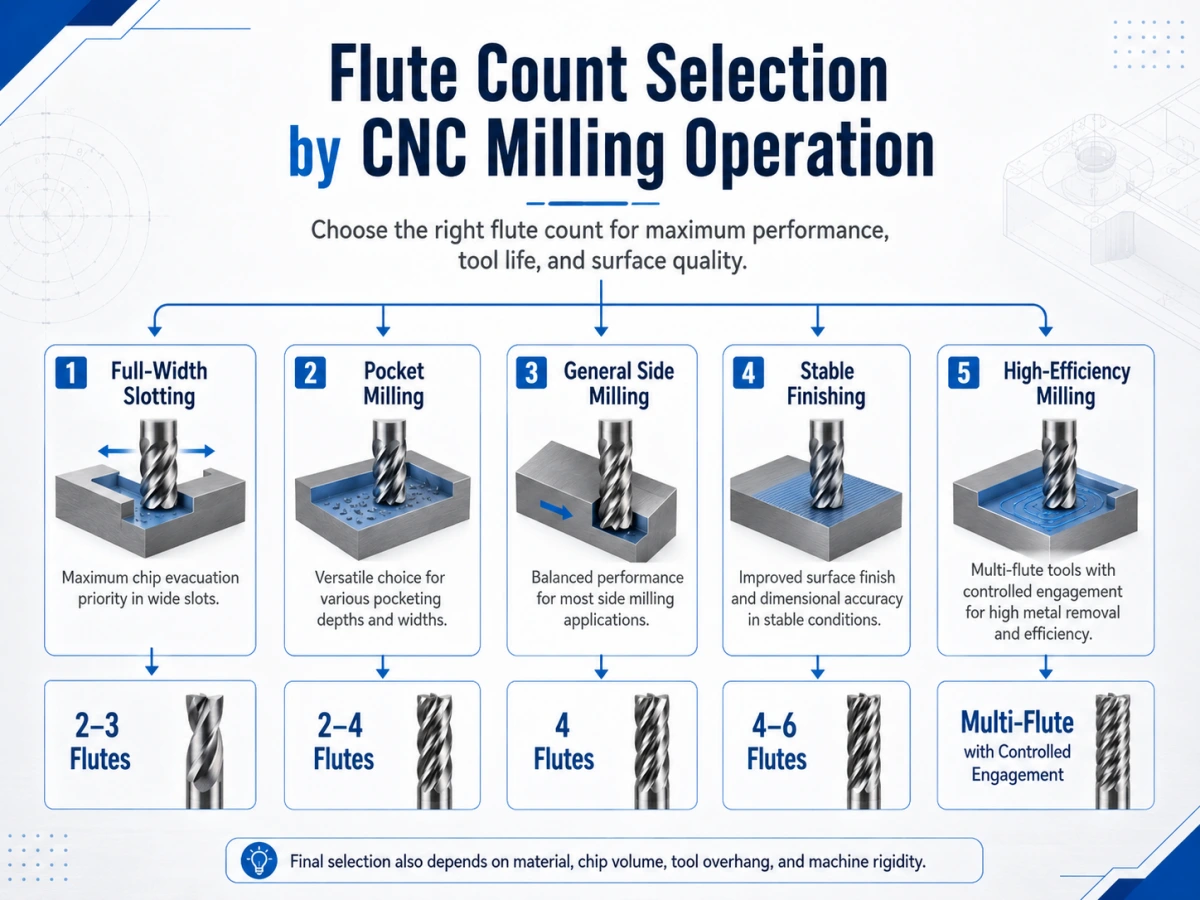
So wählen Sie den CNC-Fräsvorgang aus
Der Bearbeitungsvorgang liefert oft eine klarere Auswahlrichtung als das Material allein.
Schlitzung über die gesamte Breite
Beim Schlitzen über die gesamte Breite entsteht ein hohes Spanvolumen, da der gesamte Fräserdurchmesser in das Werkstück eingreift.
Verwenden Sie bei Bedarf eine niedrigere Nutenzahl:
- Chips sind groß
- Der Schlitz ist tief
- Der Kühlmittel- oder Luftzugang ist eingeschränkt
- Spanansammlungen haben zu einem früheren Werkzeugausfall geführt
Für Aluminium und andere Nichteisenmaterialien, 2-Flötenwerkzeuge bieten eine gemeinsame Auswahlrichtung. Auch ein 3-Schneiden-Fräser kann gut funktionieren, wenn die Spanabfuhr stabil bleibt.
Zum Schlitzen von Stahl, 2-Flöte, 3-Flöte, Je nach Schlitztiefe können Werkzeuge mit oder mit 4 Schneiden verwendet werden, Fräserdurchmesser, Werkzeugserie, Steifigkeit der Maschine, und Spanabfuhrbedingungen.
Ein 6-schneidiges Werkzeug eignet sich im Allgemeinen nicht für schwere Schlitzbearbeitungen über die gesamte Breite, da sich in den kleineren Nuten Späne festsetzen können.
Taschenfräsen
Das Taschenfräsen kann Rampen umfassen, spiralförmiger Eintritt, seitliches Schneiden, Eckeingriff, und Bodenbearbeitung.
Für weiche Materialien und tiefe Taschen, ein 2-schneidiger Fräser bietet mehr Platz für Späne.
Ein 3-Schneiden-Werkzeug kann beim allgemeinen Taschenfräsen von Aluminium ein ausgewogenes Verhältnis zwischen Spanabfuhr und Vorschubpotenzial bieten.
Ein 4-schneidiges Werkzeug eignet sich möglicherweise für flachere Taschen oder Seitenbearbeitungsvorgänge, bei denen die Späne zuverlässig aus der Kavität austreten können.
Wenn eine axiale Einführung erforderlich ist, Stellen Sie sicher, dass das Werkzeug über eine geeignete Mittenschneidegeometrie verfügt. Die Anzahl der Nuten allein bestätigt nicht die Tauchfähigkeit.
Seitenfräsen und Profilieren
Beim Seitenfräsen ist der radiale Eingriff normalerweise geringer als beim Schlitzfräsen über die gesamte Breite. daher, 4-Nut- und 6-Nut-Fräser werden praktischer.
Verwenden Sie vier Nuten als ausgewogene Richtung für allgemeines Seitenfräsen und Profilieren von Stahl.
Verwenden Sie sechs Flöten, wenn:
- Der radiale Eingriff ist leicht oder kontrolliert
- Der Halter weist einen geringen Rundlauf auf
- Der Werkzeugüberhang ist begrenzt
- Die Spanabfuhr ist stabil
- Die Maschinen- und Werkstückaufstellung ist starr
- Mehr Schneidkontakte unterstützen das gewünschte Finish
Eine Geometrie mit variabler Helix oder ungleicher Steigung kann ebenfalls dazu beitragen, Rattern beim Seitenfräsen zu reduzieren.
Schruppen
Beim Schruppen ist ausreichend Spanraum für das erwartete Spanvolumen erforderlich.
Verwenden Sie zum Schruppen von Aluminium einen 2-Schneiden-Fräser, Kunststoffe, und andere Anwendungen, bei denen die Spanabfuhr die Hauptbeschränkung darstellt.
Zum Schruppen von Stahl, eine 3-Flöte, 4-Flöte, oder ein spezieller Schruppfräser kann ein besseres Gleichgewicht zwischen Kantenfestigkeit und Materialabtrag bieten.
Schruppfräser mit gezahnter oder Spanbrechergeometrie unterteilen die Späne in kleinere Abschnitte und können den Schnittwiderstand verringern.
Dynamisches oder trochoidales Schruppen kann auch eine höhere Nutanzahl unterstützen, da der radiale Eingriff kontrolliert bleibt.
daher, Wählen Sie die Anzahl der Nuten nicht nur aus dem Wort „Schruppen“ aus. Überprüfen Sie das Material, Schnittstrategie, Engagement, Spanvolumen, und komplette Werkzeuggeometrie.
Halb- und Endbearbeitung
Beim Halbschlichten und Schlichten wird normalerweise ein geringerer Eingriff durchgeführt und der Schwerpunkt liegt auf Maßhaltigkeit und Oberflächenqualität.
Vierschneidige Werkzeuge bieten eine ausgewogene Richtung für viele allgemeine Endbearbeitungsvorgänge.
Sechsschneidige Fräser sorgen für mehr Schneidkontakte und können eine glattere Oberfläche ermöglichen:
- Späne können den Schneidbereich verlassen
- Der Rundlauf wird kontrolliert
- Die Schnittkanten sind scharf und gleichmäßig
- Der Werkzeugüberhang ist kurz
- Futter und Engagement bleiben stabil
Mehr Spannuten können eine verschlissene Schneidkante nicht korrigieren, ungenauer Halter, instabile Befestigung, oder falsches Endprofil.
Schnellauswahl nach Werkstückmaterial
| Werkstück und Bedienung | Vorgeschlagene Richtung | Hauptgrund |
|---|---|---|
| Aluminiumschlitze und tiefe Taschen | 2 Flöten | Maximaler Spanraum |
| Allgemeines Aluminiumfräsen | 2–3 Flöten | Balance zwischen Spanabfuhr und Schneidkontakten |
| Aluminium-Seitenfräsen oder leichte Endbearbeitung | 3–4 Flöten | Mehr Schneidkontakte bei stabilem Spanfluss |
| Allgemeine Stahlverarbeitung | 4 Flöten | Ausgewogenheit zwischen Spanraum und Schneidenanzahl |
| Schlitzen aus Edelstahl | 3–4 Flöten | Mehr Platz für Chips und Wärmekontrolle |
| Seitenfräsen aus Edelstahl | 4–6 Flöten | Mehr Schneidkontakte bei kontrolliertem Eingriff |
| Ausführung aus gehärtetem Stahl | 4–6 Flöten | Stabiles Schneid- und Endbearbeitungspotenzial |
| Kunststoffe und weiche Materialien | 1–2 Flöten | Einfachere Spanabfuhr |
Obwohl sich dieser Artikel auf 2-Flöten konzentriert, 4-Flöte, und 6-schneidige Werkzeuge, Andere Flötenzahlen sind ebenfalls erhältlich.
Zum Beispiel, Ein 3-schneidiger Schaftfräser ist bei der Aluminiumbearbeitung wichtig, während ein einschneidiger O-Schneider für bestimmte Kunststoffe und weiche Materialien geeignet sein kann.
Unterschiedliche Bearbeitungen desselben Materials können auch unterschiedliche Nutzahlen erfordern. Beim Nutenfräsen von Edelstahl über die gesamte Breite und beim Fräsen von leichten Seiten aus Edelstahl sollte nicht automatisch derselbe Fräser verwendet werden.
Für eine detaillierte Materialauswahl, lesen So wählen Sie einen Hartmetall-Schaftfräser aus.
Häufige Fehler bei der Auswahl der Flötenanzahl
Angenommen, mehr Flöten sind immer besser
Mehr Spannuten sorgen für mehr Schneidkanten, aber sie reduzieren den Chipraum.
Eine höhere Nutanzahl funktioniert am besten, wenn Spanvolumen und Eingriff kontrolliert werden. Bei tiefen Taschen und Nuten über die gesamte Breite kann es zu Spanstau kommen.
Unter der Annahme, dass mehr Nuten einen proportional höheren Vorschub ermöglichen
Mehr Spannuten erhöhen die berechnete Vorschubgeschwindigkeit, wenn Drehzahl und Spanlast pro Zahn unverändert bleiben.
Jedoch, Die tatsächliche Futtersteigerung ist begrenzt durch:
- Chipraum
- Schnittlast
- Spindelleistung
- Steifigkeit der Maschine
- Genauigkeit des Halters
- Werkstückstabilität
Erhöhen Sie den Vorschub nicht nur durch Multiplikation des Nut-Anzahl-Verhältnisses. Beginnen Sie mit den für das jeweilige Werkzeug empfohlenen Parametern und passen Sie diese entsprechend der Spanbildung an, Spindellast, Klang, Oberflächenqualität, und Werkzeugverschleiß.
Benutzen 6 Nuten für schweres Schlitzen
Ein 6-schneidiges Werkzeug bietet weniger Platz für Späne als 2-schneidige und 4-schneidige Konstruktionen.
Beim schweren Schlitzen über die gesamte Breite, Späne können in der Nut verbleiben und ein erneutes Schneiden verursachen, Hitze, Kantenschäden, oder Werkzeugbruch.
Benutzen 4 Nuten für spanintensive Aluminiumtaschen
Ein 4-Schneiden-Fräser kann Aluminium bearbeiten, Es bietet jedoch möglicherweise nicht genügend Spanraum für tiefe Taschen oder Schlitze über die gesamte Breite.
Wählen 2 oder 3 Spannuten, wenn die Spanabfuhr schwierig ist.
Auswahl nur nach Werkstückmaterial
Material ist wichtig, aber die Operation ändert auch die richtige Wahl.
Ein 4-schneidiges Werkzeug eignet sich möglicherweise zum Seitenfräsen von Stahl, Für einen tiefen Stahlschlitz kann eine geringere Nutanzahl besser sein.
Ignorieren von Werkzeugüberhang und Unrundheit
Ein übermäßiger Überhang verringert die Steifigkeit. Unrundheit führt zu einer ungleichmäßigen Belastung zwischen den Schneidkanten.
Ein 6-schneidiges Werkzeug kann keine stabile Schlichtbearbeitung ermöglichen, wenn eine Schneidkante den größten Teil der Schnittlast trägt.
Angenommen, jeder 2-schneidige Schaftfräser ist zentriert
Die Anzahl der Nuten bestätigt nicht die Fähigkeit zum Mittenschneiden.
Überprüfen Sie die Endgeometrie, bevor Sie einen Fräser zum Einstechen verwenden, Rampen, oder spiralförmiger Eintritt.
Häufig gestellte Fragen
Kann ein 4-schneidiger Schaftfräser Aluminium schneiden??
Ja. Ein 4-schneidiger Schaftfräser kann Aluminium beim Seitenfräsen oder leichten Schlichten bearbeiten, wenn das Werkzeug scharfe Schneidkanten hat, glatte Flötenoberflächen, und zuverlässige Spanabfuhr.
Für tiefe Taschen und Schlitze über die gesamte Breite, Ein 2- oder 3-schneidiger Fräser bietet normalerweise mehr Spanraum.
Wann soll ich wählen? 3 Flöten statt 2 Flöten für Aluminium?
Wählen Sie drei Spannuten, wenn die Spanabfuhr zuverlässig bleibt und Sie mehr Schneidkontakte benötigen, größere Steifigkeit, höheres Vorschubpotenzial, oder verbesserte Endbearbeitungsleistung.
Wählen Sie zwei Spannuten, wenn das Spanvolumen hoch ist, die Tasche oder der Schlitz ist tief, oder die Spanabfuhr ist schwierig.
Ist ein 6-schneidiger Schaftfräser nur zum Schlichten?
NEIN. Ein 6-schneidiger Schaftfräser kann auch kontrolliertes Seitenfräsen durchführen, Profilierung, Halbfertigbearbeitung, und bestimmte hocheffiziente Mahlvorgänge.
Jedoch, Für schweres Schruppen oder tiefes Nutenfräsen über die gesamte Breite ist es normalerweise nicht die erste Wahl, da der Spanraum begrenzt ist.
Welche Nutanzahl eignet sich am besten für das Schlitzen über die gesamte Breite??
Verwenden Sie eine geringere Anzahl an Nuten, wenn beim Schlitzen über die gesamte Breite ein hohes Spanvolumen entsteht.
Bei Aluminium sind zwei oder drei Rillen üblich. Beim Schlitzen von Stahl können zwei verwendet werden, drei, oder vier Nuten je nach Schlitztiefe, Fräserdurchmesser, Steifigkeit der Maschine, und Kühlmittelzufuhr.
Ermöglicht eine höhere Nutenzahl eine höhere Vorschubgeschwindigkeit??
Bei gleicher Spindeldrehzahl und Spanlast pro Zahn, Eine höhere Anzahl an Nuten erhöht die berechnete Vorschubgeschwindigkeit.
Die tatsächliche Vorschubgeschwindigkeit hängt weiterhin von der Spanabfuhr ab, Schnittlast, Spindelleistung, Genauigkeit des Halters, Werkzeuggeometrie, und Maschinensteifigkeit.
Kann ein 2-schneidiger Schaftfräser eintauchen??
Einige Schaftfräser mit zwei Schneiden unterstützen Rampen, spiralförmiger Eintritt, oder begrenztes Eintauchen.
Der Fräser muss über eine geeignete Mittenschneidengeometrie verfügen, und die programmierte Eingabemethode muss zum Werkzeugdesign und Werkstückmaterial passen.
Verwandte Schaftfräser-Anleitungen
Für detailliertere Vergleiche und Auswahlinformationen, besuchen:
Leitfaden zur Auswahl der Schaftfräsernuten
So wählen Sie einen Hartmetall-Schaftfräser aus
Benötigen Sie Hilfe bei der Auswahl der richtigen Flötenanzahl??
Schicken Sie uns Ihre Zeichnung, Werkzeugmodell, Werkstückmaterial, oder aktuelles Bearbeitungsproblem. Mit 16 Jahrelange Erfahrung in der Herstellung von Schneidwerkzeugen, Wir können die verfügbaren Informationen überprüfen und dabei helfen, eine geeignete Standard- oder kundenspezifische Schaftfräserrichtung zu bestimmen.
Sehen Sie sich unseren Standard und unsere Sonderanfertigungen an Produktseite für Schaftfräser
Um Ihre Bewerbung zu besprechen, Schicken Sie uns eine E-Mail an sales@cutterbest.com.