 Fraise de précision,Outils de coupe pour l’usinage CNC de chaque matériau

Introduction
UN 4 flute end mill is mainly used for steel, acier inoxydable, acier allié, finition, semi-finition, fraisage latéral, and profile milling in CNC machining. With four cutting edges and a stronger core structure, it provides higher rigidity, coupe plus stable, and a smoother surface finish than lower-flute tools in many harder-material applications.
Cependant, it is not the best choice for every material or operation. For aluminum roughing, deep slotting, or heavy chip removal, un 2 flute tool may clear chips more efficiently. Donc, le bon choix dépend du matériau, profondeur de coupe, exigence d'évacuation des copeaux, et objectif d'usinage.
If you need a carbide 4 fraise à cannelures pour l'usinage de l'acier ou de l'acier inoxydable, vous pouvez également consulter notre 4 fraise à cannelure page produit ici.
Qu'est-ce qu'un 4 Fraise en bout de cannelure?
UN 4 flute end mill is a rotary milling cutter with four helical cutting edges. The four-flute design gives the tool a stronger core structure, so it can improve rigidity during CNC machining.
Machinists often use this tool for side milling, fraisage de contours, usinage de profilés, finition, et semi-finition. It works especially well when surface quality, stabilité de coupe, and tool life matter more than maximum chip space. Cependant, for deep slotting in aluminum or other soft materials, un 2 flute tool may be a better choice.
When Should You Use a 4 Fraise en bout de cannelure?
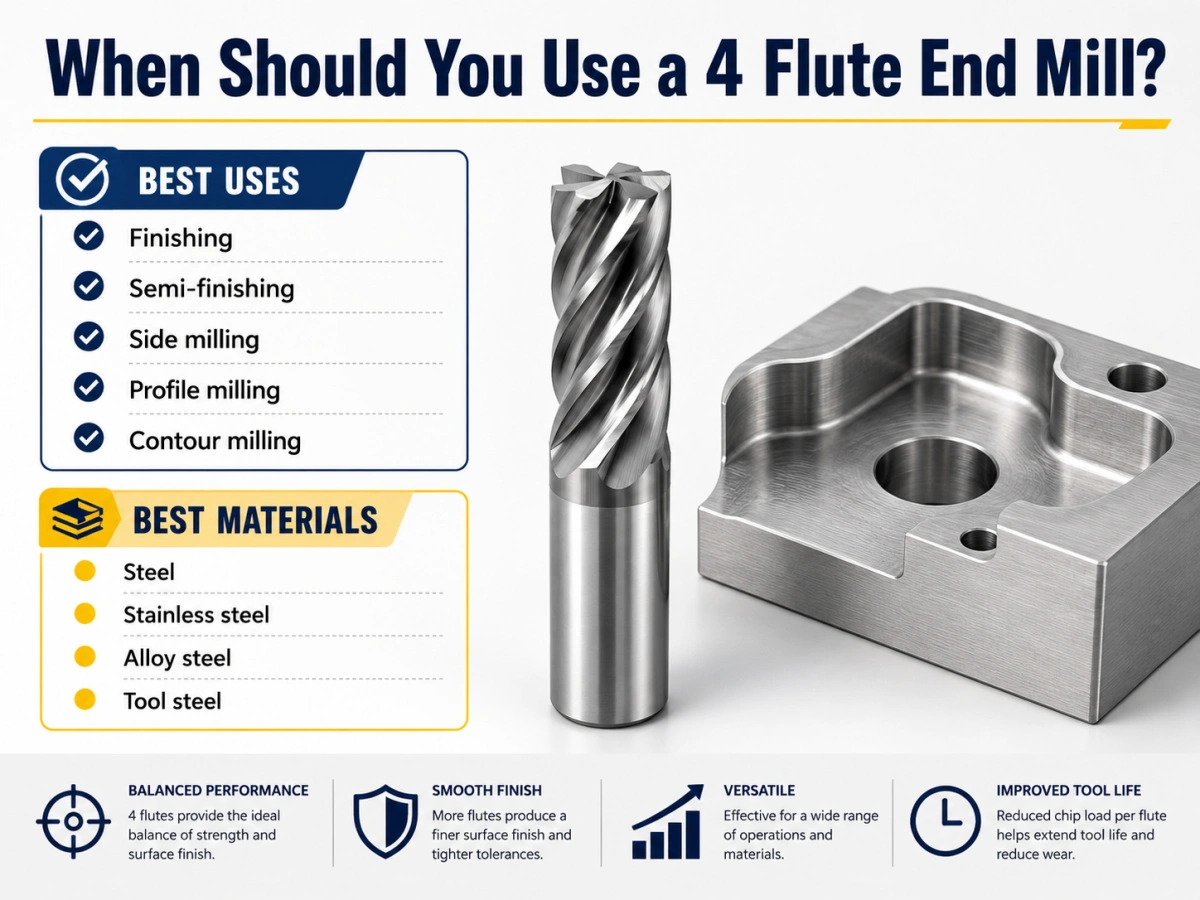
UN 4 flute end mill works best when the operation requires higher rigidity, coupe stable, and a cleaner surface finish. Pour cette raison, many CNC users choose it for finishing and semi-finishing in steel, acier inoxydable, acier allié, et autres matériaux plus durs.
En général, you should consider a 4 fraise à flûte quand:
- the workpiece material is steel, acier inoxydable, acier allié, or tool steel
- the operation requires stable cutting with less vibration
- the goal is better surface finish
- the process involves side milling, fraisage de contours, ou usinage de profilés
- the setup needs higher rigidity than a 2 flute tool can provide
- chip evacuation is not the main limitation
Par contre, for deep slots, heavy aluminum roughing, or very soft materials, a lower flute count tool may remove chips more efficiently.
Best Materials for a 4 Fraise en bout de cannelure
Steel and Alloy Steel
UN 4 flute end mill works well for steel and alloy steel because it provides good rigidity and stable cutting performance. Par conséquent, machinists often choose it for finishing and semi-finishing operations where dimensional accuracy and surface quality matter.
Acier inoxydable
Stainless steel machining usually requires heat resistance, stabilité de coupe, and careful chip control. Pour cette raison, a coated carbide 4 flute end mill can work well in controlled CNC machining when the speed, alimentation, and coolant match the material.
Aluminum for Light Finishing
UN 4 flute end mill can cut aluminum in some cases, especially for light finishing, contour work, and shallow profiling. Cependant, it is usually not the first choice for deep slotting or heavy roughing because aluminum produces larger chips and needs more chip space.
For a full aluminum-focused explanation, lisez notre are 4 fraises à flûte bonnes pour l'aluminium guide.
4 Flûte vs 2 Fraise en bout de cannelure
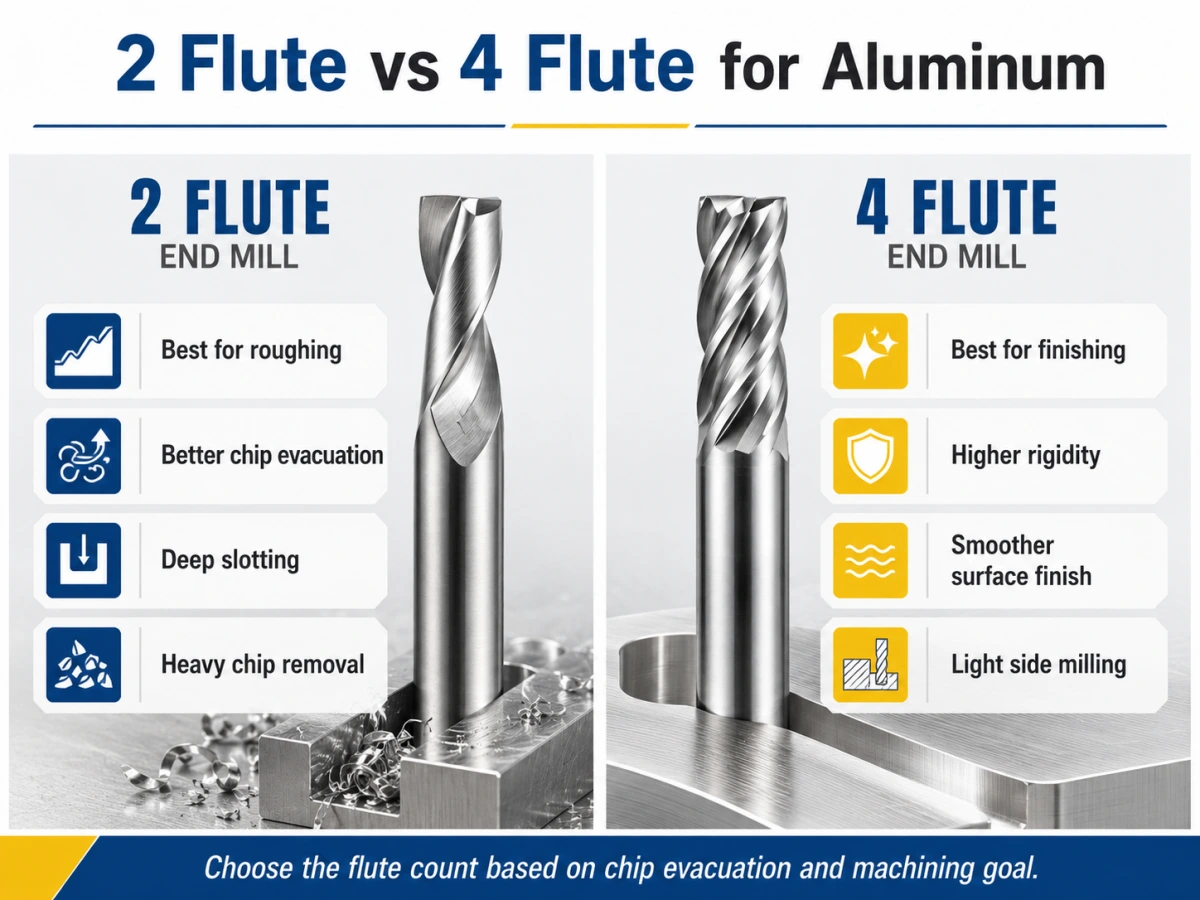
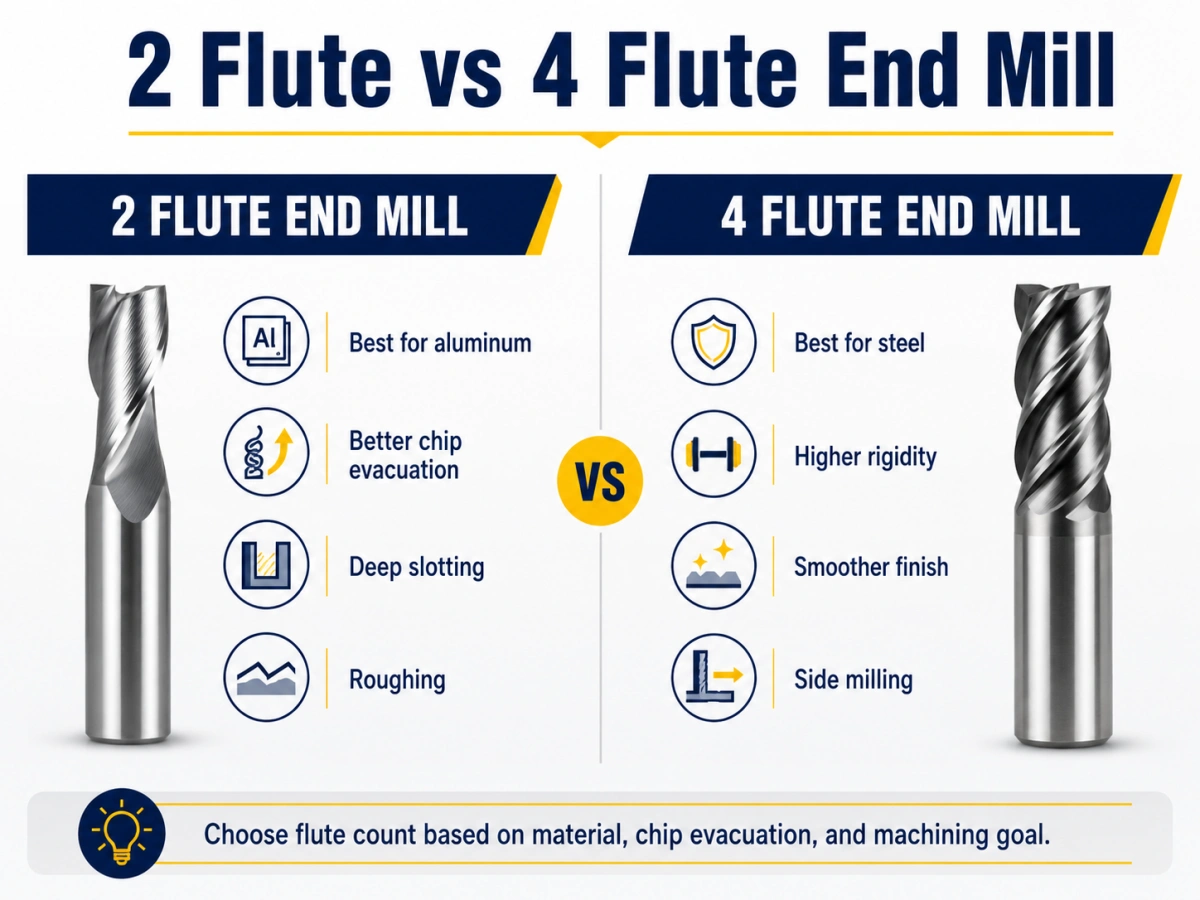
Choisir entre un 2 flûte et un 4 flute end mill depends on the material, profondeur de coupe, exigence d'évacuation des copeaux, et objectif d'usinage.
UN 4 flute end mill is usually better for:
- acier et acier inoxydable
- alloy steel and tool steel
- finition et semi-finition
- side milling and profile milling
- higher rigidity
- smoother surface finish
UN 2 flute end mill is usually better for:
- usinage de l'aluminium
- laiton, cuivre, plastiques, and soft materials
- deeper slotting
- roughing in soft materials
- évacuation plus rapide des copeaux
Autrement dit, un 4 flute end mill is usually the better choice when stability and finish quality matter more than chip space. Par contre, un 2 flute tool may work better when the material produces larger chips or when the operation needs deeper chip clearance.
Pour une comparaison détaillée, lisez notre 2 flûte contre 4 fraise à cannelure guide.
Pour une comparaison plus large par matériau et fonctionnement, vous pouvez également lire notre 2 flûte contre 4 flûte contre 6 fraise à cannelure guide.
Un 4 Flute End Mill Cut Aluminum?
Oui, un 4 flute end mill can cut aluminum, but it usually works better for light finishing, fraisage de contours, and shallow profiling rather than heavy roughing. Because aluminum produces larger chips, tools with fewer flutes often provide more chip space and better chip evacuation.
Donc, if the job involves deep slots or aggressive material removal in aluminum, un 2 flute end mill may be the safer option. Entre-temps, if the operation is light profiling or finishing, un 4 flute design can still work well with proper parameters, suitable coolant, and stable chip control.
Pour plus de détails, lisez notre 4 flute end mills for aluminum guide.
How to Optimize 4 Flute End Mill Performance
Choisissez le bon revêtement
Different materials require different coating strategies. Pour l'acier, acier inoxydable, et acier allié, coatings such as AlTiN, TiAlN, or TiSiN can improve wear resistance, résistance à la chaleur, et durée de vie de l'outil.
Surplomb de l’outil de contrôle
Shorter tool overhang usually improves stability and reduces chatter. Par conséquent, a rigid setup can improve surface finish, machining accuracy, and cutting consistency.
Match Speeds and Feeds to the Material
Cutting speed, vitesse d'avance, radial engagement, and coolant should match the workpiece material and tool geometry. En outre, following the tool manufacturer’s recommendations can reduce unnecessary wear, improve surface finish, and extend tool life.
Common Applications in CNC Machining
Because a 4 flute end mill provides a good balance of rigidity and finish quality, CNC users often choose it for many metalworking applications.
Common examples include:
- mold and die machining
- automotive parts manufacturing
- general machinery components
- precision steel parts
- composants en acier inoxydable
- tool steel machining
- profile and contour milling work
- finishing and semi-finishing of metal parts
Dans ces applications, the tool works well when surface quality, stabilité, and reliable performance matter more than maximum chip space.
FAQ
Qu'est-ce qu'un 4 fraise en bout de cannelure utilisée pour?
UN 4 flute end mill is mainly used for steel, acier inoxydable, acier allié, finition, semi-finition, fraisage latéral, fraisage de profil, and CNC metal machining.
Est-ce un 4 fraise à cannelure bonne pour l'acier?
Oui. UN 4 flute end mill works well for steel because it provides higher rigidity, stable cutting performance, and smoother surface finish than lower-flute tools in many finishing operations.
Un 4 flute end mill cut stainless steel?
Oui, a coated carbide 4 flute end mill can cut stainless steel when the coating, speed, alimentation, liquide de refroidissement, and cutting conditions match the material.
Est-ce un 4 flute end mill good for aluminum?
UN 4 flute end mill can work for aluminum finishing and light profiling. Cependant, for deep slotting or heavy roughing, un 2 la fraise à flûte est généralement meilleure. Pour plus de détails, lisez notre 4 flute end mills for aluminum guide.
Quelle est la différence entre 2 flûte et 4 fraises à cannelure?
UN 2 flute end mill provides more chip space and is often better for aluminum, matériaux souples, and deeper slotting. UN 4 flute end mill provides higher rigidity and is often better for steel, acier inoxydable, finition, and side milling.
Conclusion
UN 4 flute end mill works well for steel, acier inoxydable, acier allié, finition, semi-finition, fraisage latéral, and profile milling. Its main advantages are higher rigidity, smoother surface finish, et des performances de coupe plus stables dans l'usinage CNC.
Cependant, it is not the best choice for every job. For aluminum roughing, deep slotting, or heavy chip removal, a lower flute count tool may perform better. Donc, you should choose the flute count based on material type, profondeur de coupe, exigence d'évacuation des copeaux, et objectif d'usinage.
Besoin d'un 4 Flute End Mill for Steel or Stainless Steel?
If you need a 4 flute end mill for steel, acier inoxydable, acier allié, acier à outils, finition, semi-finition, fraisage latéral, or profile milling, nous pouvons vous aider à choisir une conception d'outil en carbure appropriée.
Envoyez-nous votre matériel, diamètre de coupe, longueur de flûte, exigence de revêtement, dessin, or machining application. Our team can recommend standard or custom carbide end mills for your CNC machining project.
Consultez notre 4 fraise à cannelure page produit ici.
Guides associés:
Sont 4 fraises à flûte bonnes pour l'aluminium?