 Fraise de précision,Outils de coupe pour l’usinage CNC de chaque matériau

Introduction
Les types de fraises en bout affectent l'évacuation des copeaux, stabilité de coupe, état de surface, enlèvement de matière, et durée de vie des outils en usinage CNC. Choisir le bon type n’est pas seulement une question de taille ou de revêtement.
Différents outils fonctionnent mieux pour différentes tâches d'usinage. Les fraises à bout plat sont souvent utilisées pour le rainurage et le fraisage latéral. Les outils à nez sphérique conviennent au contourage 3D et aux surfaces courbes. Rayon d'angle, ébauche, et les outils coniques sont utiles lorsque la pièce nécessite des bords plus solides, enlèvement de matière plus rapide, ou portée spéciale.
Dans ce guide, nous comparons les types de fraises en bout les plus courants, leurs utilisations, facteurs de taille de base, géométrie de la pointe, et conseils de choix pour l'aluminium, acier, acier inoxydable, et applications d'usinage CNC personnalisées.
Si vous êtes nouveau sur cet outil, vous pouvez d'abord lire notre guide des outils de fraisage de base.
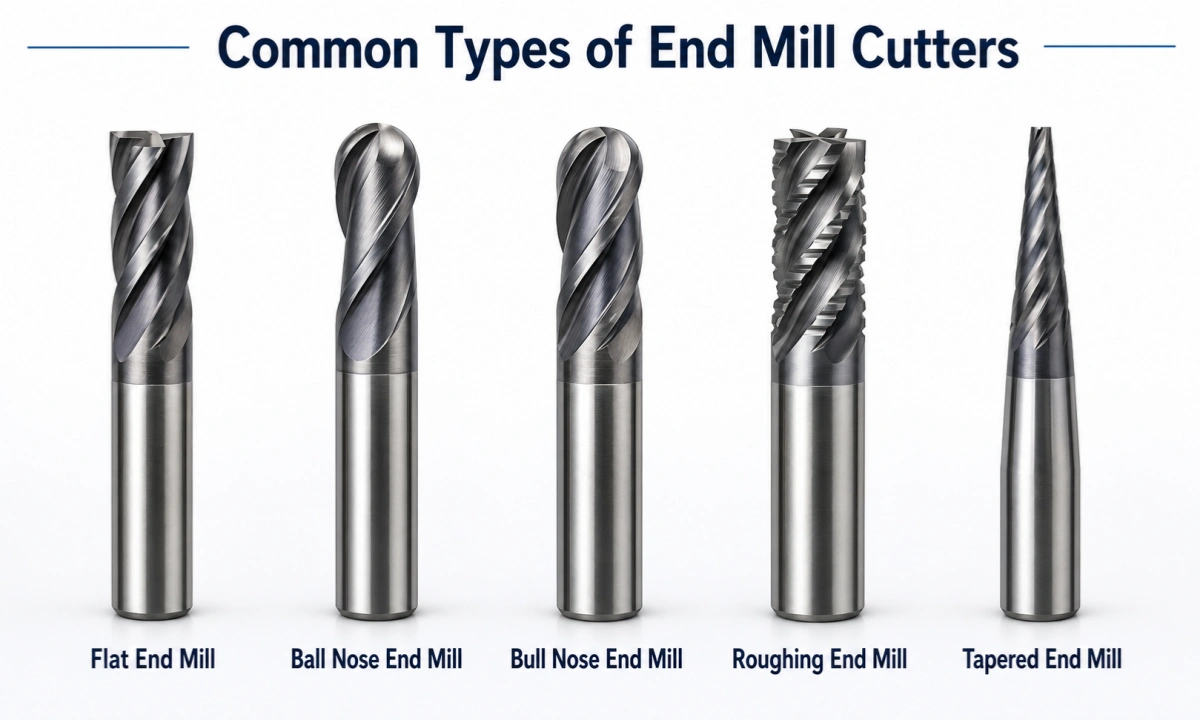
Quels sont les types de fraises en bout?
Les ateliers d'usinage classent généralement les types de fraises en bout par géométrie de pointe, but de coupe, et application d'usinage. Bien que le marché propose de nombreuses fraises, L'usinage CNC utilise couramment des fraises à bout plat, fraises à bout sphérique, fraises en bout à rayon de coin, fraises d'ébauche, et fraises coniques.
Chaque type a ses propres avantages. Par exemple, une fraise à bout plat est couramment utilisée pour le fraisage général, tandis qu'une fraise à bout sphérique est plus adaptée aux contours 3D et aux surfaces courbes..
C'est pourquoi la compréhension du type de fraise est une partie importante de la sélection des outils avant de commander ou d'usiner..
Les types de fraises en bout les plus courants
1. Fraise à bout plat
Une fraise à bout plat est l'un des types d'outils les plus courants dans l'usinage CNC.. Il a une pointe coupante plate, donc les machinistes le choisissent souvent pour le rainurage, fraisage latéral, fraisage d'épaulements, et usinage général.
Parce qu'il peut créer une surface à fond plat, cet outil fonctionne bien pour les pièces nécessitant des fentes droites, poches, ou des caractéristiques aux arêtes vives.
Les utilisations typiques incluent:
- rainurage
- fraisage latéral
- fraisage de poche
- travaux d'usinage généraux
Les ateliers d'usinage utilisent des fraises plates pour l'aluminium, acier, et de nombreux matériaux d'usinage standards.
2. Fraise à bout sphérique
Une fraise à bout sphérique a une pointe de coupe arrondie. Cette conception le rend particulièrement adapté au contouring, profilage, et usinage de surfaces courbes ou 3D.
Les machinistes utilisent couramment cet outil pour:
- travail de moulage et de matrice
- 3Usinage D
- surfaces de pièces courbes
- opérations de finition
Grâce à sa pointe arrondie, une fraise à bout sphérique peut produire des transitions plus douces sur des formes courbes. Cependant, cela ne fonctionne généralement pas comme premier choix pour les fentes à fond pointu.
Pour les utilisations et définitions de base, vous pouvez également lire notre guide des outils de fraisage de base.
3. Fraise en bout à rayon d'angle
Une fraise en bout à rayon d'angle combine un fond plat avec des bords d'angle arrondis. Cette conception contribue à améliorer la résistance des bords et à réduire l'écaillage des coins pendant l'usinage..
Par rapport à une fraise à bout plat standard, une fraise à rayon d'angle offre souvent:
- meilleure résistance des bords
- transitions de coin plus douces
- stabilité améliorée dans certaines applications
Les ateliers d'usinage utilisent couramment ce type pour:
- usinage de l'acier
- usinage de l'acier inoxydable
- semi-finition
- travaux de finition qui nécessitent des coins plus solides
Les utilisateurs choisissent souvent cette conception lorsqu'ils ont besoin à la fois d'une action de coupe plate et d'une durée de vie améliorée de l'outil..
4. Fraise d'ébauche
Une fraise d'ébauche enlève la matière de manière agressive. Il a généralement une géométrie de coupe dentelée ou spécialisée qui aide à briser les copeaux en morceaux plus petits et à réduire la charge de coupe..
Les ateliers d'usinage utilisent couramment ce type pour:
- enlèvement de matière important
- usinage grossier avant finition
- efficacité d'enlèvement de matière améliorée
- Usinage de matériaux plus résistants dans des conditions de coupe stables
Après ébauche, les machinistes utilisent souvent des outils de finition lorsque la pièce nécessite une meilleure finition de surface.
5. Fraise conique
Une fraise en bout conique a un corps progressivement effilé. Les machinistes utilisent cet outil lorsque les coupe-murs droits ne sont pas la meilleure option.
Les utilisations typiques incluent:
- murs en angle
- cavités profondes
- travail de moulage
- usinage de géométries spéciales
En raison de la forme effilée, cette fraise peut fournir un meilleur accès dans les zones d'usinage étroites ou profondes.
Tableau de comparaison rapide des types de fraises en bout
| Type de fraise en bout | Idéal pour | Résultat de surface | Matériaux typiques |
|---|---|---|---|
| Fraise à bout plat | Rainurage, fraisage latéral, poches | Surface à fond plat | Aluminium, acier, usinage à usage général |
| Fraise à bout sphérique | 3Contournage en D, surfaces courbes | Finition incurvée et lisse | Acier moulé, aluminium, 3Pièces D |
| Fraise en bout à rayon d'angle | Bord plus fort, des transitions plus douces | Fond plat avec coins arrondis | Acier, acier inoxydable |
| Fraise d'ébauche | Enlèvement rapide des matières | Surface plus rugueuse | Acier, fonte, usinage intensif |
| Fraise conique | Murs en angle, cavités profondes | Portée et géométrie contrôlées | Travaux de moulage, pièces spéciales |
Ce tableau de comparaison peut aider les acheteurs à comprendre rapidement quel type est le plus adapté à une tâche d'usinage spécifique..
Tableau des tailles des fraises en bout et spécifications de base
Outre le type de coupe, les acheteurs doivent également vérifier les principales spécifications de taille avant de commander. La même géométrie d'outil peut fonctionner différemment lorsque le diamètre, longueur de flûte, longueur totale, ou changements de taille de tige.
| Spécification | Ce que cela signifie | Pourquoi c'est important |
| Diamètre de coupe | La largeur de coupe de l'outil | Affecte la largeur de la fente, force de coupe, et taille des caractéristiques de la pièce |
| Longueur de la flûte | La longueur de coupe de l'outil | Détermine la profondeur de coupe et la rigidité de l'outil |
| Longueur totale | Toute la longueur du coupeur | Affecte la portée, vibration, et stabilité d'usinage |
| Diamètre de la tige | Le diamètre de serrage | Doit correspondre correctement au porte-outil |
| Nombre de flûtes | Nombre de cannelures de coupe | Affecte l'évacuation des copeaux, rigidité, et finition de surface |
| Rayon de coin | Taille des coins arrondis sur la pointe de l'outil | Améliore la résistance des bords et la transition de surface |
| Revêtement | Traitement de surface à la pointe | Aide à améliorer la résistance à l'usure et la durée de vie de l'outil |
Les tailles standard peuvent répondre à de nombreux besoins généraux d'usinage. Cependant, des outils personnalisés peuvent être nécessaires pour les cavités profondes, profils spéciaux, usinage longue portée, matériaux non standards, ou des exigences de tolérance strictes.
Pour la fourniture d'outils standards et personnalisés, vous pouvez également visiter notre page produit pour les outils de fraisage CNC.
Types de fraises en bout et utilisations dans l'usinage CNC
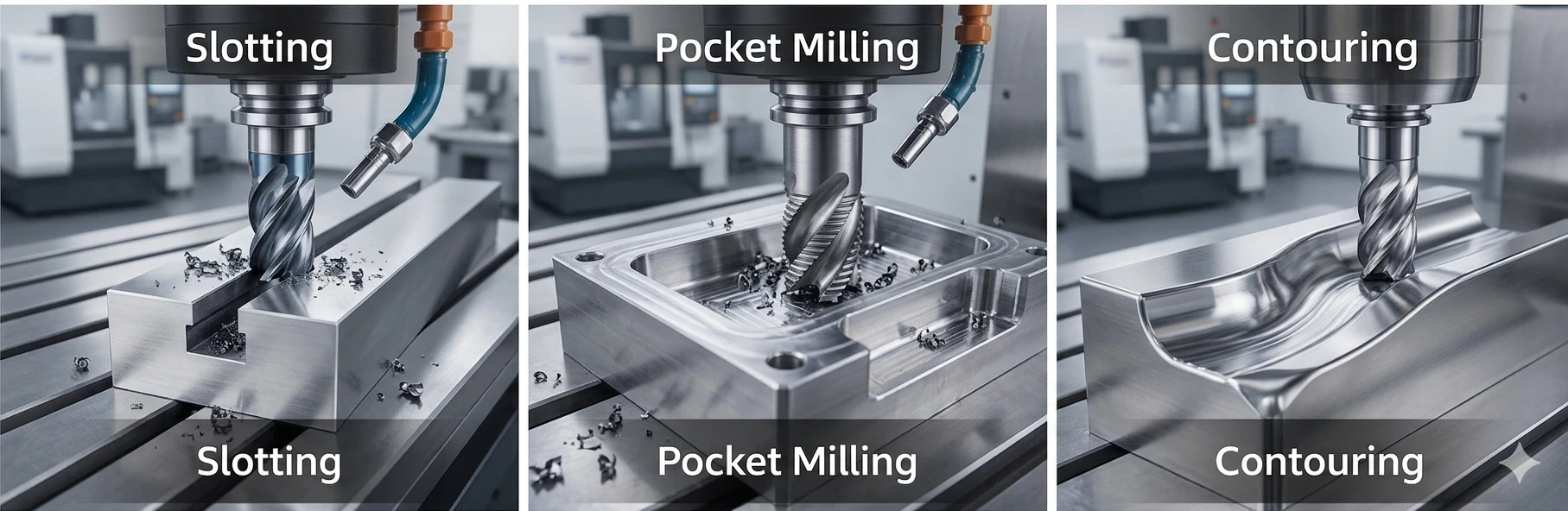
Pour le rainurage et le fraisage de poches
Les machinistes utilisent couramment des fraises à bout plat pour le rainurage et le fraisage de poches, car ces outils peuvent créer des caractéristiques à fond plat et des parois latérales propres..
Pour le contourage et les surfaces 3D
Les fraises à bout sphérique fonctionnent généralement mieux pour le contourage et l'usinage 3D car elles peuvent suivre les surfaces courbes plus facilement..
Pour des coins plus solides et une meilleure durée de vie des outils
Les ateliers d'usinage choisissent souvent des fraises à rayon d'angle lorsque la pièce nécessite un tranchant plus solide et des performances plus stables..
Pour un retrait rapide des matériaux
Les fraises d'ébauche permettent d'enlever une grande quantité de matière avant la finition.
Pour les fonctionnalités profondes ou inclinées
Les fraises coniques fonctionnent bien pour les cavités profondes, murs en angle, et tâches d'usinage liées aux moules.
Si vous souhaitez comprendre comment se déroule réellement la découpe lors de l'usinage, vous pouvez également lire notre Guide de travail pour le fraisage CNC.
Quel type de fraise en bout est le meilleur pour différents matériaux?
Types de fraises en bout pour l'aluminium
Pour l'usinage de l'aluminium, l'évacuation des copeaux est particulièrement importante. Donc, les acheteurs choisissent souvent des fraises à bout plat ou des outils à bout sphérique avec des conceptions de cannelures appropriées.
Dans de nombreux cas, les acheteurs prêtent également une attention particulière au nombre de flûtes. Pour une comparaison plus approfondie, lisez notre guide de comparaison du nombre de flûtes.
Types de fraises en bout pour l'acier
Pour l'usinage de l'acier, la rigidité et la résistance à l'usure sont généralement plus importantes. Les ateliers d'usinage choisissent souvent des fraises à bout plat, fraises en bout à rayon de coin, et outils d'ébauche selon les exigences d'ébauche ou de finition.
Types de fraises en bout pour l'acier inoxydable
Pour l'acier inoxydable, la chaleur de coupe et la stabilité sont essentielles. De nombreux utilisateurs choisissent des outils à rayon d'angle et des outils en carbure appropriés, car des bords plus solides et une meilleure résistance à l'usure peuvent améliorer les performances..
Pour les outils carbure dédiés, vous pouvez également visiter notre outils de fraisage en carbure monobloc page.
Comment choisir le bon type de fraise en bout
1. Vérifier l'opération d'usinage
La première question est de savoir ce que le coupeur doit faire. Rainurage, contouring, ébauche, finition, et le fraisage de poches nécessitent souvent différents types d'outils.
2. Vérifiez le matériau de la pièce à usiner
Aluminium, acier, et l'acier inoxydable ont des caractéristiques d'usinage différentes. Donc, les acheteurs doivent faire correspondre le type de coupeur au matériau.
3. Vérifier les exigences de finition de surface
Si la qualité de la surface est particulièrement importante, Les outils à nez sphérique ou à rayon de coin peuvent mieux fonctionner dans certaines applications.
4. Vérifier la résistance et la rigidité de l'outil
Pour des conditions de coupe plus difficiles, des outils d'ébauche ou des outils à bords plus solides peuvent offrir de meilleures performances.
5. Vérifiez les exigences standard ou personnalisées
Certains utilisateurs ont besoin d'outils standards, tandis que d'autres ont besoin d'une géométrie personnalisée, revêtement, ou dimensions basées sur des dessins ou des échantillons.
Si vous recherchez des solutions standards ou OEM, vous pouvez également visiter notre page produit pour les outils de fraisage CNC.
Géométrie de la fraise en bout et pièces principales
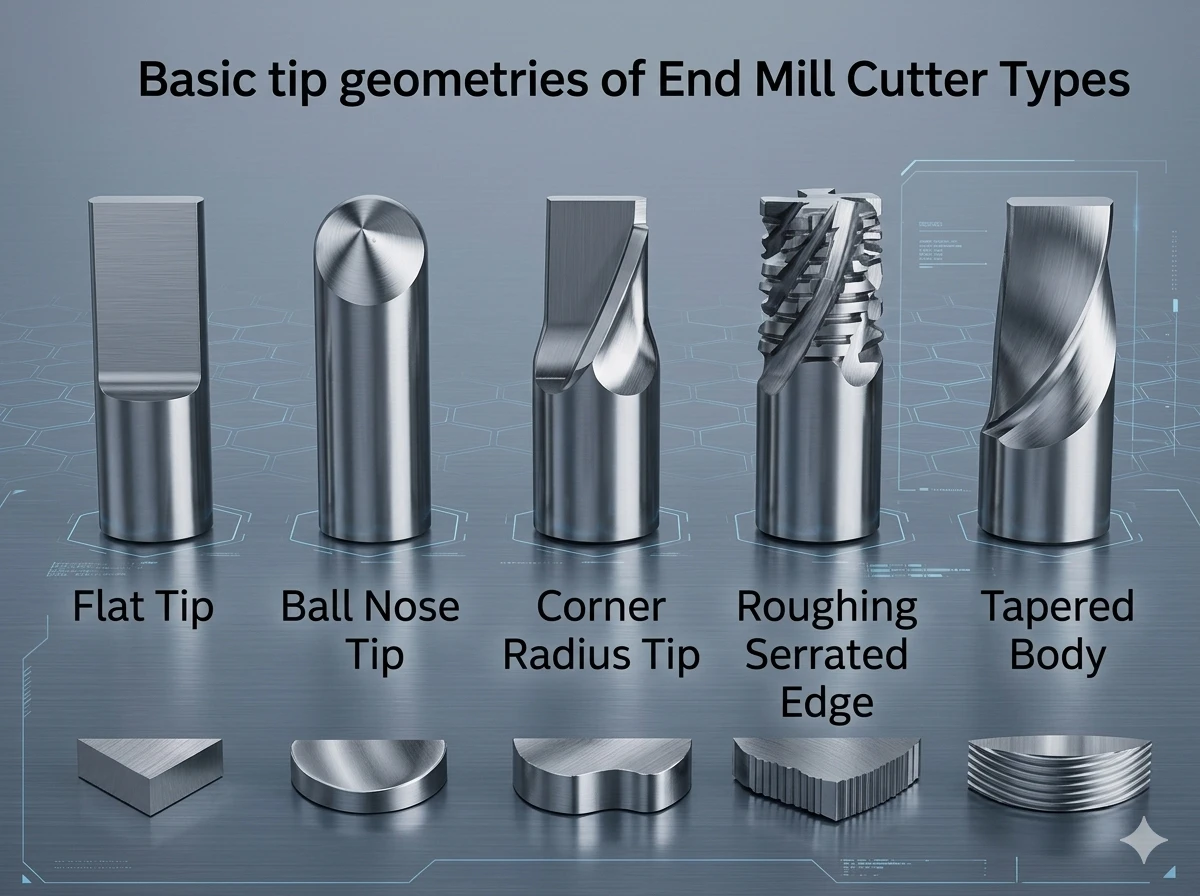
Bien que différents outils puissent sembler similaires à première vue, les acheteurs peuvent identifier la plupart des types de couteaux par géométrie de pointe, conception de flûte, et objectif d'usinage.
Par exemple:
- Une fraise à bout plat a une pointe de coupe plate pour les fentes, poches, et caractéristiques à fond plat.
- Une fraise à bout sphérique a une pointe arrondie pour les surfaces 3D et les profils courbes.
- Une fraise à rayon d'angle combine un fond plat avec des coins arrondis pour des performances de bord plus élevées.
- Une fraise d'ébauche utilise une géométrie de coupe dentelée ou spéciale pour un enlèvement de matière plus rapide.
- Une fraise conique a un corps incliné pour les cavités profondes, travail de moulage, et une portée spéciale.
Comprendre ces différences de géométrie aide les acheteurs à choisir le bon outil avant de commander. Cela permet également d'éviter d'utiliser un seul type de fraise pour chaque matériau ou opération d'usinage..
Erreurs courantes lors du choix des types de fraises en bout
Choisir uniquement par apparence
Certains acheteurs sélectionnent un cutter uniquement en fonction de sa forme mais ignorent le matériau., opération, et exigences de finition.
Utiliser un type pour chaque matériau
Le meilleur type de fraise pour l'aluminium n'est peut-être pas la meilleure option pour l'acier ou l'acier inoxydable..
Ignorer les exigences de finition
Un outil adapté à l'ébauche peut ne pas fournir la qualité de surface requise pour la finition.
Se concentrer uniquement sur le type de fraise et ignorer le nombre de flûtes
Le type de coupe est important, mais la flûte compte, revêtement, et le matériel des outils doivent également être considérés ensemble.
FAQ
Quels sont les principaux types de fraises en bout?
Les types les plus courants sont les fraises à bout plat, fraises à bout sphérique, fraises en bout à rayon de coin, fraises d'ébauche, et fraises coniques.
Quelle est la différence entre une fraise à bout plat et une fraise à bout sphérique?
Une fraise à bout plat est principalement utilisée pour les fentes à fond plat et l'usinage général, tandis qu'une fraise à bout sphérique est plus adaptée au contourage et aux surfaces courbes..
Quel type de fraise est le meilleur pour l'aluminium?
Dans de nombreux cas, les fraises à bout plat sont couramment utilisées pour l'aluminium, surtout lorsqu'une bonne évacuation des copeaux et un usinage général sont nécessaires.
Quel type de fraise est utilisé pour le contourage 3D ??
Les fraises à bout sphérique sont couramment utilisées pour le contourage 3D car leur pointe arrondie convient aux surfaces courbes..
Les fraises d'ébauche et les fraises de finition sont-elles identiques ??
Non. Les fraises d'ébauche sont conçues pour un enlèvement rapide de matière, tandis que les outils de finition sont sélectionnés pour obtenir une meilleure qualité de surface et une meilleure précision finale.
Comment choisir le bon type de fraise en bout?
Vous devez considérer l'opération d'usinage, matériau de la pièce à usiner, exigences de finition de surface, force de l'outil, et si un outillage standard ou personnalisé est nécessaire.
Conclusion
Les types de fraises en bout jouent un rôle important dans les performances d'usinage CNC. Différents types de couteaux sont conçus pour différentes tâches, et choisir le bon peut améliorer l'efficacité de l'usinage, stabilité, état de surface, et durée de vie de l'outil.
Les fraises plates sont largement utilisées pour l'usinage général. Les fraises à bout sphérique conviennent aux surfaces courbes et aux contours. Les fraises à rayon d'angle aident à améliorer la résistance des bords, tandis que les fraises d'ébauche sont meilleures pour l'enlèvement de matière importante. Les fraises coniques sont utiles pour les caractéristiques inclinées ou profondes.
Lors de la sélection d'un type de fraise en bout, il est toujours préférable de considérer l'opération d'usinage, matériau de la pièce à usiner, exigences de finition, et la force des outils ensemble plutôt que de se concentrer sur un seul facteur.
Appel à l'action
À la recherche d'outils standards ou personnalisés pour l'usinage CNC?
Visitez notre page produit pour les outils de fraisage CNC ou envoyez-nous votre dessin, liste des tailles, matériel, et exigences en matière de revêtement. OMIST peut recommander des outils adaptés à l'aluminium, acier, acier inoxydable, et applications d'usinage personnalisées.