 Fraise de précision,Outils de coupe pour l’usinage CNC de chaque matériau

Pouvez-vous plonger avec une fraise en bout? Oui, mais la fraise doit avoir une géométrie de coupe centrale, et le matériel, profondeur d'entrée, évacuation des copeaux, et la configuration de la machine doit être adaptée.
Une conception à 2 cannelures offre généralement plus d'espace pour les copeaux qu'un couteau à cannelures plus hautes.. Donc, il peut supporter une entrée en plongée contrôlée dans l'aluminium, laiton, cuivre, plastiques sélectionnés, et d'autres applications où l'évacuation des copeaux est importante.
Cependant, deux cannelures ne rendent pas automatiquement une fraise en bout adaptée à une entrée verticale. Pour les poches profondes, matériaux difficiles, ou configurations instables, rampe, entrée hélicoïdale, ou le pré-perçage offre souvent un meilleur contrôle.
Que signifie la plongée dans le fraisage CNC?
Plonger signifie alimenter une fraise en bout dans la direction axiale, directement vers la pièce à usiner. Durant ce mouvement, le coupeur doit enlever la matière près de son centre tandis que les copeaux sortent par les cannelures.
Cela diffère du fraisage latéral, où les arêtes de coupe enlèvent principalement de la matière sur le côté de l'outil. La plongée droite crée une charge axiale plus élevée et laisse moins d'espace aux copeaux pour s'échapper du bas de la coupe..
Par conséquent, la géométrie de la fraise et la méthode d'entrée deviennent particulièrement importantes.
Les méthodes typiques d'entrée axiale comprennent:
- Plongeant droit
- Rampe
- Entrée hélicoïdale
- Pré-perçage suivi de fraisage
Chaque méthode crée des charges de coupe et des conditions d'écoulement des copeaux différentes.
Pouvez-vous plonger avec une fraise en bout en toute sécurité?
Une fraise en bout peut plonger en toute sécurité lorsque les conditions suivantes sont remplies:
- L'outil a une géométrie de coupe centrale
- L'entrée est peu profonde et contrôlée
- Les copeaux peuvent quitter la zone de coupe
- Le porte-à-faux de l'outil est limité
- La configuration de la machine et de la pièce à usiner est stable
- L'avance axiale correspond à la fraise spécifique
- Le matériau s'adapte à la géométrie et au revêtement de l'outil
La question la plus importante n’est pas simplement de savoir si la fraise a deux ou quatre cannelures..
Plutôt, confirmer:
Les arêtes de coupe d'extrémité peuvent-elles enlever de la matière au centre de l'outil?
Si la réponse est non, le couteau ne doit pas être introduit directement dans un matériau solide.
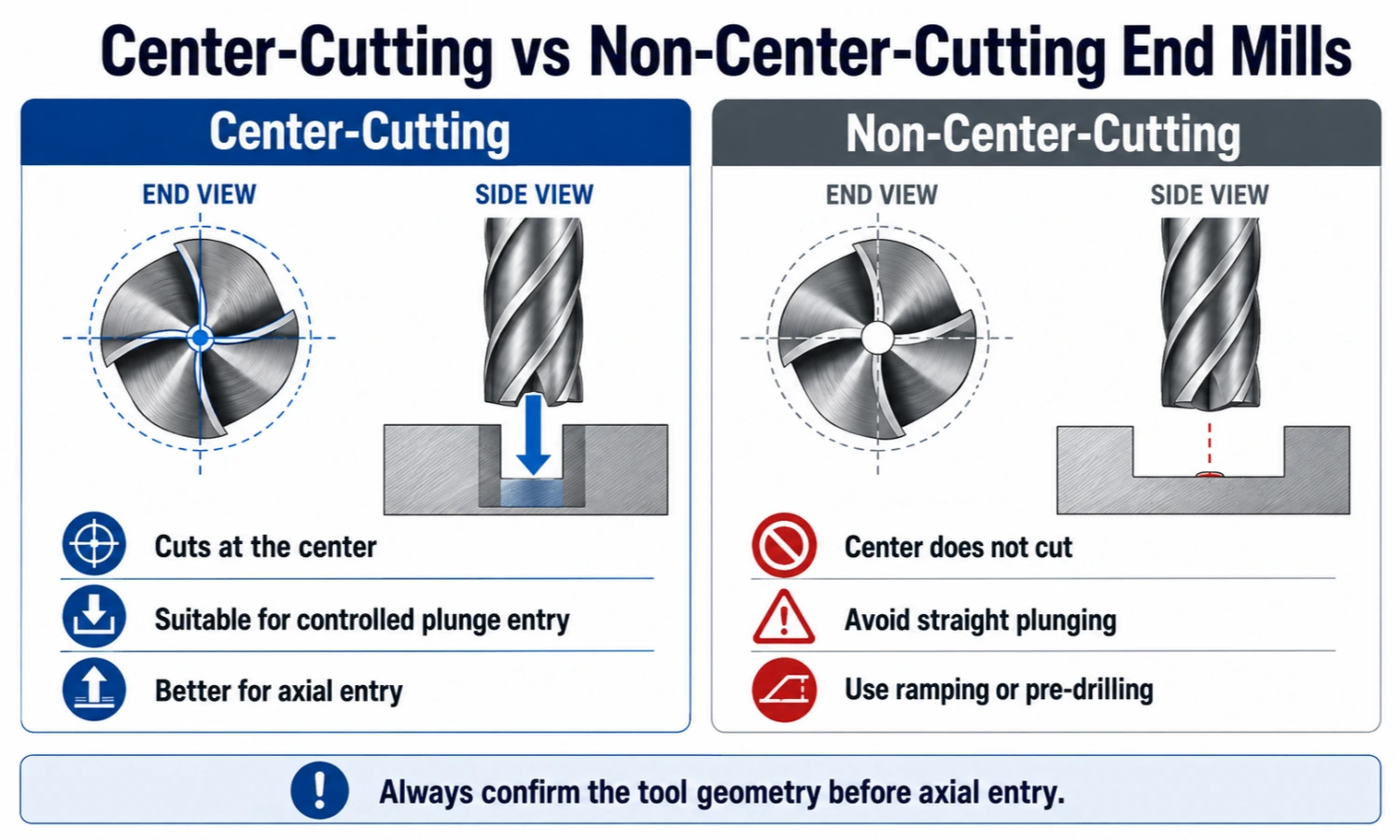
Fraises en bout à coupe centrale ou non
Qu'est-ce qu'une fraise à coupe centrale?
Une fraise en bout à coupe centrale a des arêtes de coupe qui atteignent ou traversent la zone centrale de l'outil..
Cette géométrie permet au coupeur d'enlever de la matière près de son centre de rotation. Donc, il peut supporter certaines opérations d'entrée axiale, y compris plongée droite contrôlée, rampe, ou entrée hélicoïdale.
Une fraise à coupe centrale doit toujours être utilisée dans les limites de sa conception spécifique. Cela ne signifie pas que l'outil peut être utilisé comme une perceuse à n'importe quelle profondeur., matériel, ou vitesse d'avance.
Pourquoi une fraise en bout sans coupe centrale ne peut pas plonger directement vers le bas
Une fraise en bout sans coupe centrale n'a pas d'arête de coupe efficace au centre de l'outil.
Si cet outil est introduit verticalement dans un matériau solide, le centre peut frotter au lieu de couper. Cela peut provoquer:
- Chaleur excessive
- Charge axiale élevée
- Bavarder
- Écaillage des bords
- Déviation de l'outil
- Mauvaise précision de saisie
- Défaillance prématurée de l'outil
Un outil de coupe non centré peut toujours effectuer un fraisage latéral ou entrer dans un trou existant. Cependant, il ne doit pas être utilisé pour plonger directement dans un matériau solide.
Comment confirmer la géométrie de coupe centrale
N'identifiez pas la capacité de coupe centrale uniquement à partir du nombre de flûtes..
Plutôt, vérifier:
- La spécification du produit
- Le dessin de l'outil
- Une photographie claire de la géométrie finale
- Si les arêtes de coupe d'extrémité atteignent le centre
- Les instructions d’application du fabricant
- Confirmation du fournisseur d'outils
Certaines fraises à deux et quatre cannelures ont une géométrie de coupe centrale, tandis que d'autres ne le font pas.
Pourquoi une conception à 2 cannelures peut faciliter l'entrée en plongée
Plus d'espace de puce
Une fraise à 2 cannelures a normalement des rainures de cannelure plus larges qu'une fraise avec plus de cannelures.
L'espace supplémentaire peut aider les copeaux à s'éloigner du centre de la coupe. Ceci est important car les copeaux ont moins de chemins de sortie lors de l'entrée axiale que lors du fraisage latéral ouvert..
Si des copeaux restent sous l'outil, ils peuvent être recoupés ou comprimés contre la pièce. La chaleur et la pression de coupe peuvent alors augmenter rapidement.
Évacuation des copeaux dans les matériaux souples
Aluminium, laiton, cuivre, et certains plastiques peuvent produire des copeaux relativement gros ou continus.
Un couteau tranchant à 2 cannelures avec un espace de flûte adéquat peut aider à réduire:
- Emballage de copeaux
- Bord accumulé
- Recoupe
- Accumulation de chaleur
- Des dégâts de pointe
Air, brume, ou un liquide de refroidissement approprié peut également aider à éloigner les copeaux de la zone de coupe.
Ce que le nombre de flûtes ne peut pas vous dire
Le nombre de flûtes seul ne confirme pas:
- Capacité de coupe centrale
- Une alimentation plongeante sûre
- Profondeur d'entrée maximale
- Aptitude aux matériaux durs
- Méthode de refroidissement requise
- Rigidité de l'outil
- Porte-à-faux maximal de l'outil
La conception complète du cutter doit être revue.
Pour plus d'informations sur l'espace flûte, diamètre du noyau, longueur de flûte, et évacuation des copeaux, lisez notre guide de sélection des flûtes de fraise en bout.
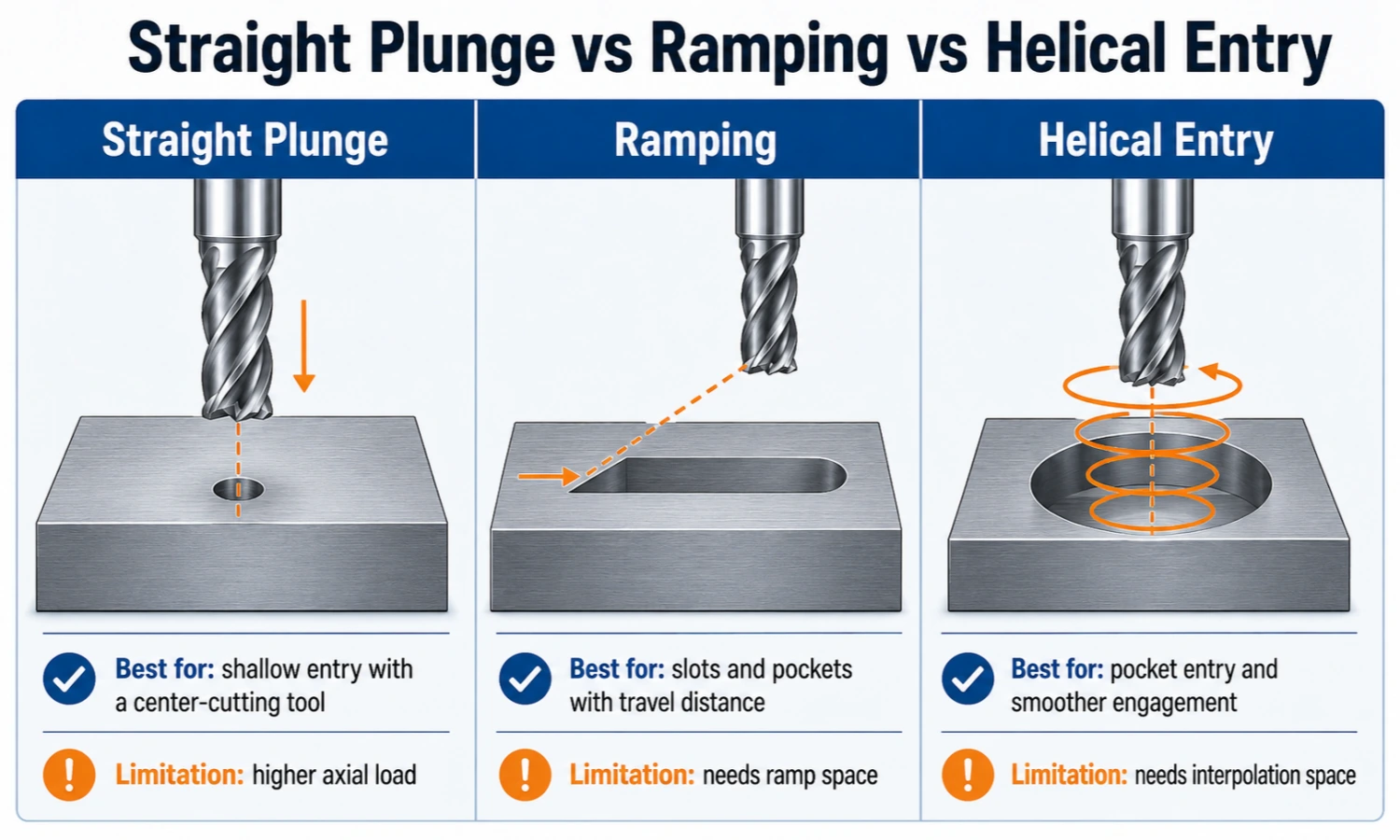
Plongée droite vs rampe vs entrée hélicoïdale
La méthode de saisie la plus sûre dépend de la fonctionnalité, espace de parcours d'outil disponible, matériel, et conception de coupe.
| Méthode de saisie | Situation appropriée | Principal avantage | Principale limite |
|---|---|---|---|
| Plongeon droit | Entrée peu profonde avec un outil de coupe centrale | Parcours d'outil court et direct | Charge axiale plus élevée et évacuation des copeaux limitée |
| Rampe | Fentes et poches avec distance de déplacement disponible | Réduit la charge axiale directe | Nécessite une distance de rampe suffisante |
| Entrée hélicoïdale | Entrée de poche et ouvertures plus grandes | Engagement fluide et flux de copeaux amélioré | Nécessite un espace d'interpolation |
| Pré-perçage | Entrée axiale profonde ou difficile | Enlève le matériau central avant le fraisage | Ajoute une autre opération d'usinage |
Quand la plongée droite est acceptable
La plongée droite peut convenir lorsque:
- Le coupeur est une coupe centrale
- L'entrée est peu profonde
- Le matériau est facile à usiner
- Le porte-à-faux de l'outil est court
- L'évacuation des copeaux reste stable
- Le fournisseur d'outils permet une entrée axiale
L’entrée directe doit être contrôlée plutôt qu’agressive.
Quand la rampe est le meilleur choix
La rampe combine un mouvement axial et horizontal.
Parce que le coupeur se déplace latéralement en entrant dans le matériau, la charge de coupe est répartie plus progressivement que lors d'une plongée droite.
La rampe est souvent utile pour:
- Le créneau commence
- Entrée de poche
- Des chemins d'entrée plus longs
- Applications où la plongée droite crée une charge excessive
L'angle de la rampe et l'avance doivent correspondre à la fraise et au matériau spécifiques..
Quand utiliser l'entrée hélicoïdale
L'entrée hélicoïdale déplace la fraise sur une trajectoire circulaire tout en avançant progressivement vers le bas..
Cette méthode peut améliorer l'engagement et l'évacuation des copeaux car la fraise ne reste pas concentrée en un point central..
L'entrée hélicoïdale convient souvent:
- Fraisage de poche
- Des ouvertures plus grandes
- Entrée plus profonde
- Matériaux générant de la chaleur lors de la plongée droite
- Applications qui nécessitent une entrée plus fluide
La poche doit offrir suffisamment d'espace pour le parcours d'outil hélicoïdal.
Quand le pré-perçage est plus sûr
Le pré-perçage enlève le matériau central avant l'entrée de la fraise en bout.
Cela peut être utile lorsque:
- L'entrée requise est profonde
- Le matériau est difficile à usiner
- La fraise sélectionnée n'est pas adaptée à la plongée directe
- L'évacuation des copeaux est limitée
- Un trou conventionnel fait déjà partie du processus d'usinage
Le pré-perçage ajoute un autre outil et une autre opération, mais cela peut réduire le risque d'endommager la fraise en bout.
Quand une fraise en bout à 2 cannelures peut-elle plonger?
Utilisez cette liste de contrôle avant l'usinage:
- Confirmez que le couteau coupe au centre
- Vérifier que le matériau correspond à l'outil
- Gardez la première entrée peu profonde et contrôlée
- Utiliser une avance axiale adaptée à la fraise spécifique
- Assurez-vous que les copeaux peuvent quitter le bas de la coupe
- Gardez le porte-à-faux de l'outil aussi court que possible
- Vérifier l'état et le faux-rond du support
- Serrez solidement la pièce à usiner
- Air direct, brume, ou du liquide de refroidissement vers la zone d'entrée
- Arrêtez-vous si l'outil frotte au lieu de couper
Les matériaux souples et les démarrages de poches peu profonds sont généralement plus faciles que l'entrée axiale profonde dans les matériaux résistants à la chaleur..
Cependant, le résultat réel dépend toujours du diamètre de la fraise, géométrie des bords, nuance de carbure, revêtement, rigidité de la machine, et parcours d'outil.
Quand faut-il éviter la plongée droite?
Outil de coupe non centré
N'introduisez pas verticalement une fraise en bout à coupe non centrale dans un matériau solide..
Utiliser un trou existant, pré-perçage, rampe, entrée hélicoïdale, ou un autre cutter approprié à la place.
Entrée axiale profonde
Une plongée profonde rend l'évacuation des copeaux plus difficile. Les copeaux peuvent rester sous l'outil et augmenter la chaleur ou la pression de coupe.
Rampe, entrée hélicoïdale, ou une saisie étape par étape peut fournir un meilleur contrôle.
Matériaux durs ou résistants à la chaleur
Les matériaux plus durs ou résistants à la chaleur peuvent augmenter la charge axiale, chaleur, et le stress de pointe.
Ne présumez pas que le passage de deux flûtes à quatre flûtes résoudra automatiquement le problème.. Revoir la série de coupeurs, nuance de carbure, revêtement, méthode de saisie, et état du liquide de refroidissement.
Long porte-à-faux d’outil
Un long porte-à-faux augmente le risque de déviation et de broutage.
Utilisez l'outil pratique et la longueur de flûte les plus courts. En outre, améliorer la rigidité du support et de la pièce avant d'augmenter la charge axiale.
Mauvaise évacuation des copeaux
La plongée droite doit être arrêtée lorsque les copeaux restent à l'intérieur de la poche ou commencent à s'enrouler autour de l'outil..
Améliorer la distribution d'air ou de liquide de refroidissement, réduire la profondeur d'entrée, ou changer de méthode de saisie.
Configuration instable de la machine ou de la pièce
Un support instable, pince usée, luminaire faible, ou une machine à faible rigidité peut provoquer des vibrations lors de l'entrée.
Corrigez la configuration avant de modifier le nombre de flûtes ou d'augmenter l'avance..
Pratiques de démarrage sécuritaires pour l’entrée en plongée
Le bon régime, avance axiale, et la profondeur d'entrée dépendent de la fraise exacte et des conditions d'usinage. Donc, un paramètre fixe ne peut pas être appliqué à chaque fraise à 2 cannelures.
Utilisez les pratiques de démarrage suivantes:
- Confirmer la géométrie de coupe centrale avant l'usinage.
- Commencez avec une avance axiale inférieure à celle du fraisage latéral.
- Gardez l'entrée initiale superficielle.
- Utiliser de l'air, brume, ou un liquide de refroidissement approprié pour éliminer les copeaux.
- Gardez l'extension du coupeur courte.
- Écoutez les frottements, cognement, ou des sons de coupe instables.
- Forme du copeau et charge de la broche.
- Inspectez le tranchant après le premier essai de coupe.
- Passer à une entrée en rampe ou en hélice lorsque la plongée droite est instable.
Les coupes d'essai doivent être effectuées dans des conditions contrôlées avant la production complète.
Problèmes courants de coupe en plongée et solutions
| Problème | Cause possible | Sens de réglage |
|---|---|---|
| L'outil frotte au centre | Géométrie de coupe non centrale | Utilisez un outil de coupe centrale ou une autre méthode de saisie |
| Pack de chips dans la poche | L'entrée est trop profonde ou l'évacuation des copeaux est faible | Réduisez la profondeur d’entrée et améliorez l’apport d’air ou de liquide de refroidissement |
| Bavardage lors de l'entrée | Long porte-à-faux, s'épuiser, ou serrage instable | Raccourcir le porte-à-faux et améliorer la rigidité du support ou du luminaire |
| Bord rapporté en aluminium | Mauvais flux de copeaux, bords ternes, ou état de surface inapproprié | Utilisez une géométrie pointue et améliorez l’évacuation des copeaux |
| Dommages précoces aux bords | Avance axiale excessive ou matériau inapproprié | Réduisez l’avance axiale ou utilisez la rampe |
| Chaleur excessive | Temps de contact long ou mauvais accès au liquide de refroidissement | Utiliser l'entrée hélicoïdale, rampe, ou pré-perçage |
| L'outil entre de manière inégale | Géométrie d'extrémité incorrecte ou configuration instable | Confirmer la coupe centrale et inspecter le faux-rond |
| Mauvaise précision du fond | Déviation de l'outil ou méthode d'entrée inadaptée | Améliorer la rigidité et revoir la géométrie de la fraise |
Un problème peut avoir plusieurs causes. Donc, inspectez la configuration complète avant de remplacer le coupeur.
2 Flûte vs 4 Flûte pour entrée en plongée
Pour entrée en plongée, La géométrie de coupe centrale et la méthode d'entrée sont plus importantes que le nombre de flûtes seul.
Une fraise à 2 cannelures offre généralement plus d'espace pour les copeaux. Cela peut être utile lors d'une entrée peu profonde dans l'aluminium et d'autres matériaux qui génèrent des copeaux plus gros..
Certains outils à 4 cannelures offrent plus d'arêtes de coupe et un noyau plus gros. Cependant, les rainures plus petites peuvent rendre l'évacuation des copeaux plus difficile lors d'une entrée axiale droite.
Les fraises en bout à 2 et 4 dents peuvent être fabriquées avec une géométrie de coupe centrale ou non.. Confirmez toujours le produit spécifique avant de plonger.
Pour une comparaison plus large, lire 2 fraise à flûte vs 4 flûte.
FAQ
Toutes les fraises à 2 cannelures peuvent-elles plonger?
Non. Une fraise à 2 cannelures doit avoir une géométrie de coupe centrale appropriée avant de pouvoir enlever de la matière au centre de l'outil..
Le nombre de flûtes à lui seul ne confirme pas la capacité de plongée.
Comment savoir si une fraise en bout est à coupe centrale?
Vérifiez les spécifications du produit, dessin d'outil, ou une photo de face. Les bords coupants d'extrémité doivent atteindre ou traverser la zone centrale.
Quand la géométrie n'est pas claire, demander au fabricant ou au fournisseur de le confirmer.
La rampe est-elle plus sûre que la plongée directe?
La rampe réduit souvent la charge axiale directe car l'outil se déplace horizontalement tout en avançant vers le bas..
Cependant, l'angle de la rampe, alimentation, géométrie de la fraise, et la distance de déplacement disponible doit toujours être adaptée.
Une fraise en bout à 2 cannelures peut-elle plonger dans l'aluminium?
Oui, une fraise en bout à 2 cannelures à coupe centrale peut effectuer une entrée de plongée contrôlée dans l'aluminium dans des conditions appropriées.
Arêtes de coupe tranchantes, espace adéquat pour la flûte, porte-à-faux court, et une évacuation fiable des copeaux sont particulièrement importantes.
Une fraise en bout peut-elle plonger dans l'acier inoxydable?
Certaines fraises à coupe centrale spécifiques à une application peuvent pénétrer axialement dans l'acier inoxydable.. Cependant, chaleur, écrouissage, contrôle des copeaux, et les contraintes de pointe rendent la plongée droite plus exigeante.
Rampe, entrée hélicoïdale, ou un pré-perçage peut fournir une approche plus sûre.
Une fraise en bout à 4 cannelures peut-elle plonger?
Oui, certaines fraises à 4 cannelures sont à coupe centrale et peuvent prendre en charge certaines opérations à entrée axiale.
Les spécifications du produit et la méthode de saisie recommandée doivent d'abord être confirmées..
Puis-je utiliser une fraise en bout au lieu d'un foret?
Une fraise à coupe centrale peut réaliser certaines entrées peu profondes, caractéristiques à fond plat, et la poche commence.
Cependant, un foret est conçu spécifiquement pour la réalisation de trous axiaux et évacue généralement les copeaux plus efficacement dans les trous conventionnels plus profonds.
Utilisez une fraise en bout lorsque l'opération nécessite un fraisage après l'entrée ou une fonction à fond plat. Utilisez un foret approprié pour la réalisation de trous profonds normaux.
Quelle est la différence entre une entrée plongeante et hélicoïdale?
La plongée droite entraîne la fraise directement vers le bas le long de son axe..
L'entrée hélicoïdale combine un mouvement circulaire avec une avance axiale progressive. Cela réduit la charge centrale concentrée et fournit normalement plus d'espace pour que les copeaux quittent la coupe..
Guides connexes
Pour plus d'informations sur les outils à 2 flûtes et la sélection du nombre de flûtes, lire:
Qu'est-ce qu'un 2 fraise en bout de cannelure utilisée pour?
2 flûte contre 4 flûte contre 6 fraise à cannelure
Guide de sélection des flûtes de fraise en bout
Guide de sélection des fraises en bout
Besoin d'aide pour choisir une fraise à coupe centrale?
Envoyez-nous votre matière à usiner, taille de coupe requise, opération d'usinage, dessin, photographie de l'outil, ou problème de coupe actuel. Nous pouvons examiner les informations disponibles et vous aider à confirmer une direction d'outil standard ou personnalisée appropriée..
Consultez nos standards et nos personnalisés 2 page produit de la fraise à flûte.
Pour discuter de votre candidature, envoyez-nous un e-mail à sales@cutterbest.com.