 Fraise de précision,Outils de coupe pour l’usinage CNC de chaque matériau

UN Fraise à rainure en T est un outil de fraisage spécialisé utilisé pour usiner la section inférieure plus large d'une fente ou d'une contre-dépouille en forme de T. Il a une tête de coupe plus large et un col plus étroit, ce qui permet au col de travailler à travers la fente supérieure tandis que les arêtes coupantes usinent le profil inférieur.
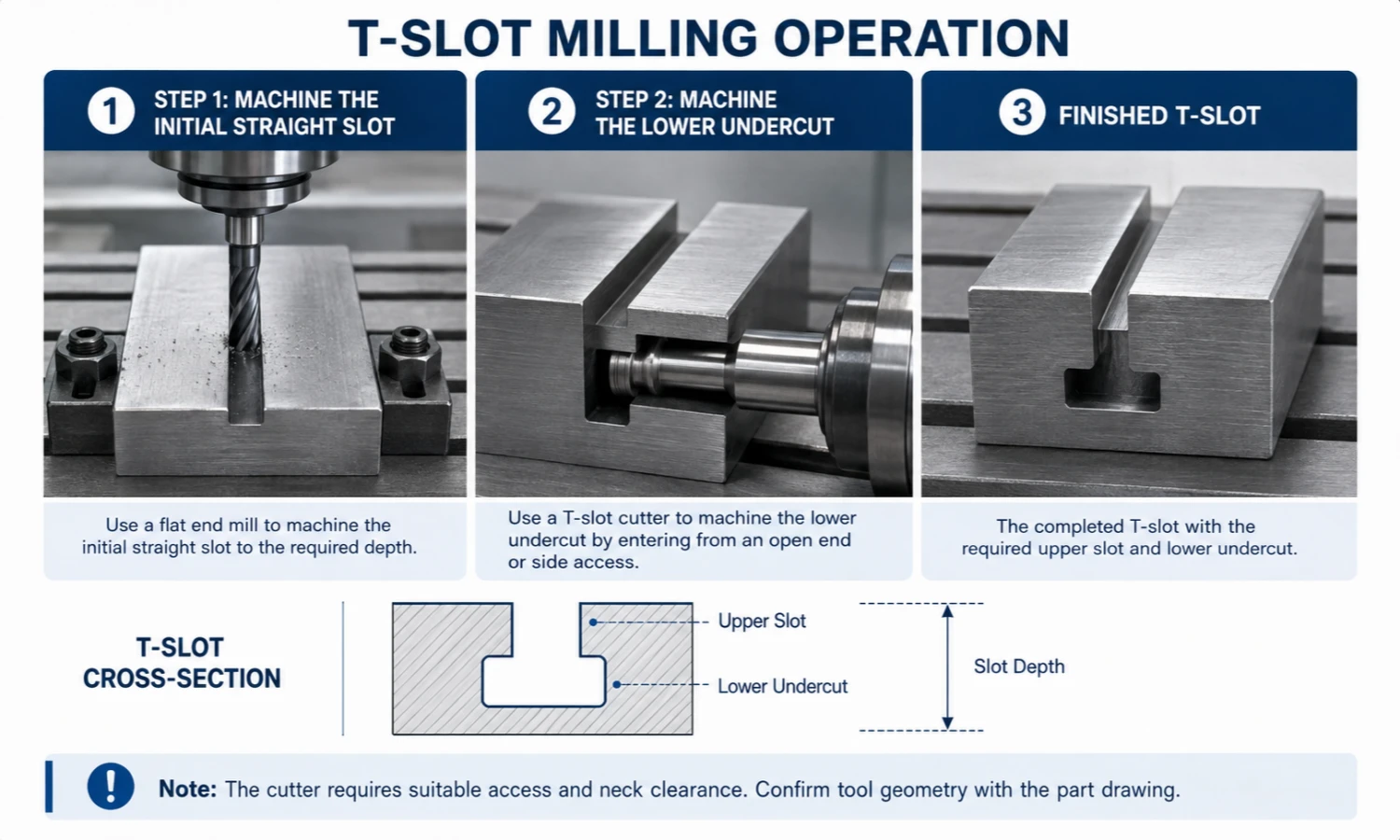
Dans une opération typique de fraisage de rainures en T, l'opérateur usine d'abord une fente droite initiale. Suivant, la fraise entre par une extrémité ouverte ou un autre élément d'accès approprié pour usiner la contre-dépouille inférieure.
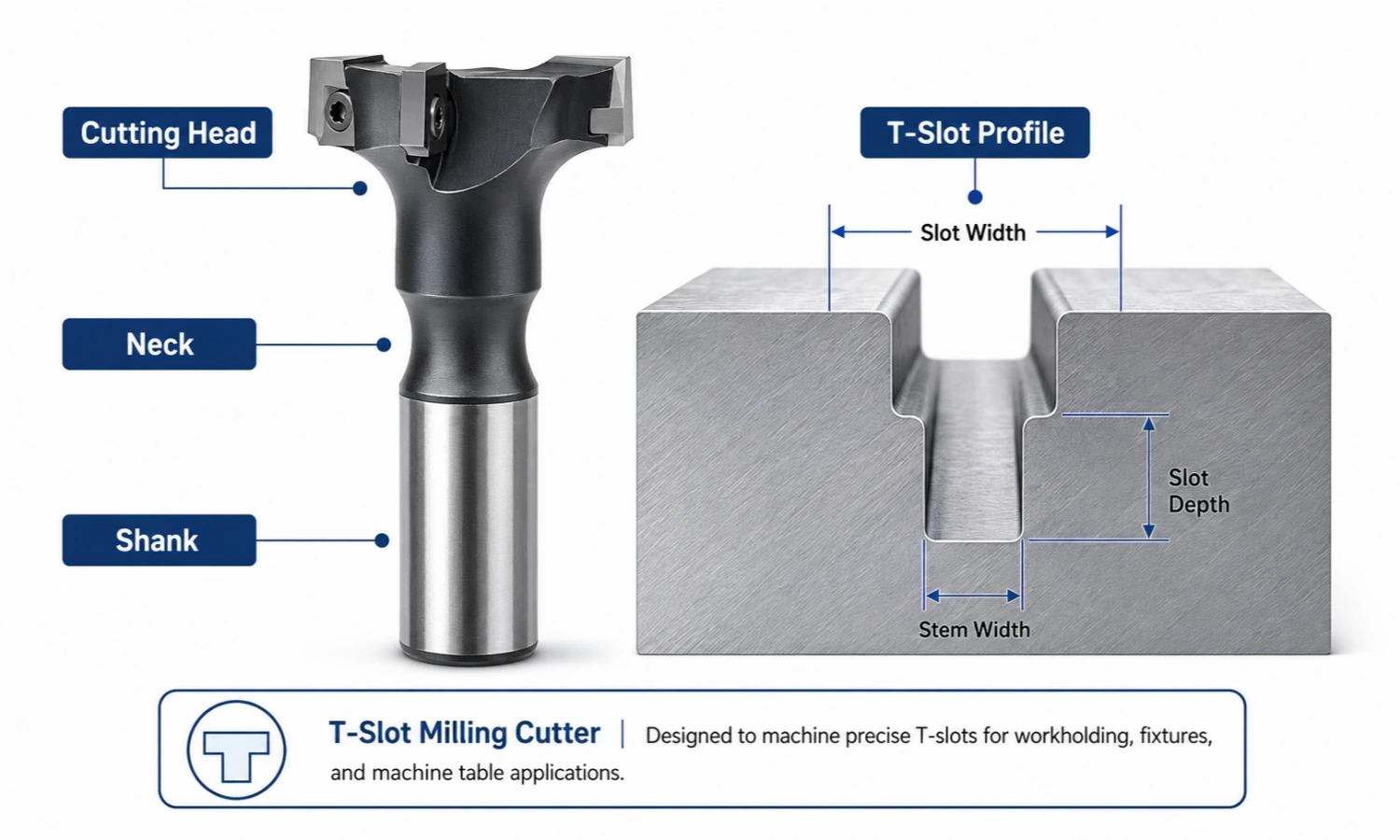
À quoi sert une fraise à rainure en T?
Les fraises à rainure en T sont utilisées lorsqu'un composant nécessite une ouverture supérieure relativement étroite et une contre-dépouille inférieure plus large.. Ce profil peut retenir les boulons en T, noix, luminaires, composants coulissants, ou d'autres éléments de positionnement et de serrage.
Les applications courantes incluent:
- Fentes de serrage de la table de machine
- Plaques de fixation et systèmes de maintien de pièces
- Caractéristiques du moule
- Rainures de retenue des boulons en T et des écrous en T
- Composants coulissants ou de positionnement
- Caractéristiques de l'assemblage mécanique
Par exemple, une table de machine peut utiliser des rainures en T afin que les étaux et les pinces puissent être déplacés et fixés à différentes positions. Les plaques de fixation peuvent utiliser le même principe pour prendre en charge un maintien flexible.
La géométrie de la pièce est le principal facteur décisif. Si la caractéristique nécessite uniquement une rainure droite sans contre-dépouille inférieure plus large, une fraise en bout ou un autre outil de fraisage de rainures peut suffire.
Opération de fraisage de rainures en T: Comment ça marche?
L'usinage des rainures en T implique généralement de préparer d'abord la fente supérieure, puis d'usiner la contre-dépouille inférieure..
Cependant, la tête de coupe ne doit pas être traitée comme si elle pouvait simplement plonger à travers une ouverture supérieure étroite. La géométrie de l'outil et de la pièce doit permettre à la tête de coupe plus large d'atteindre la position d'usinage inférieure..
Étape 1: Usiner la fente droite initiale
D'abord, usiner une première fente droite, parfois appelé emplacement pilote. Cette ouverture établit la partie supérieure de la rainure en T et fournit le chemin et le dégagement requis pour le col de la fraise..
Un adapté fraise à bout plat est couramment utilisé pour usiner la fente droite initiale avant que la contre-dépouille de la rainure en T ne soit coupée.
L'emplacement initial permet de:
- Établir la largeur de la fente supérieure
- Prévoir un dégagement pour le col du coupeur
- Préparez le chemin pour l'opération de contre-dépouille suivante
Si la rainure en T se trouve à l'intérieur d'un élément fermé, le plan d'usinage doit également prévoir une zone d'entrée appropriée pour la tête de coupe plus large. La méthode d'accès exacte dépend de la géométrie de la pièce et de la conception de la fraise.
Étape 2: Usiner la contre-dépouille inférieure
Après avoir préparé la fente initiale et l'accès au cutter, positionner la tête de coupe au niveau inférieur requis. L'outil avance ensuite le long de la fente et retire la matière de la section inférieure pour créer la contre-dépouille en forme de T..
A ce stade, plusieurs conditions doivent être vérifiées:
- Dégagement du cou
- Portée du coupeur
- Dégagement du support
- Porte-à-faux d'outil
- Rigidité de configuration
- Évacuation des copeaux
L'outil doit atteindre le profil requis sans que le col ou le support n'entre en contact avec la pièce.. En outre, un porte-à-faux excessif peut réduire la rigidité et rendre l'opération moins stable.
Dimensions de la fraise à rainure en T: Que vérifier
Les tailles de fraises à rainure en T ne doivent pas être jugées uniquement par un seul diamètre.. Les dimensions de l'outil doivent fonctionner avec la géométrie réelle de la rainure en T indiquée sur le dessin de la pièce..
Pour cette raison, il est utile de séparer dimensions de l'outil depuis vérifications de la géométrie des pièces.
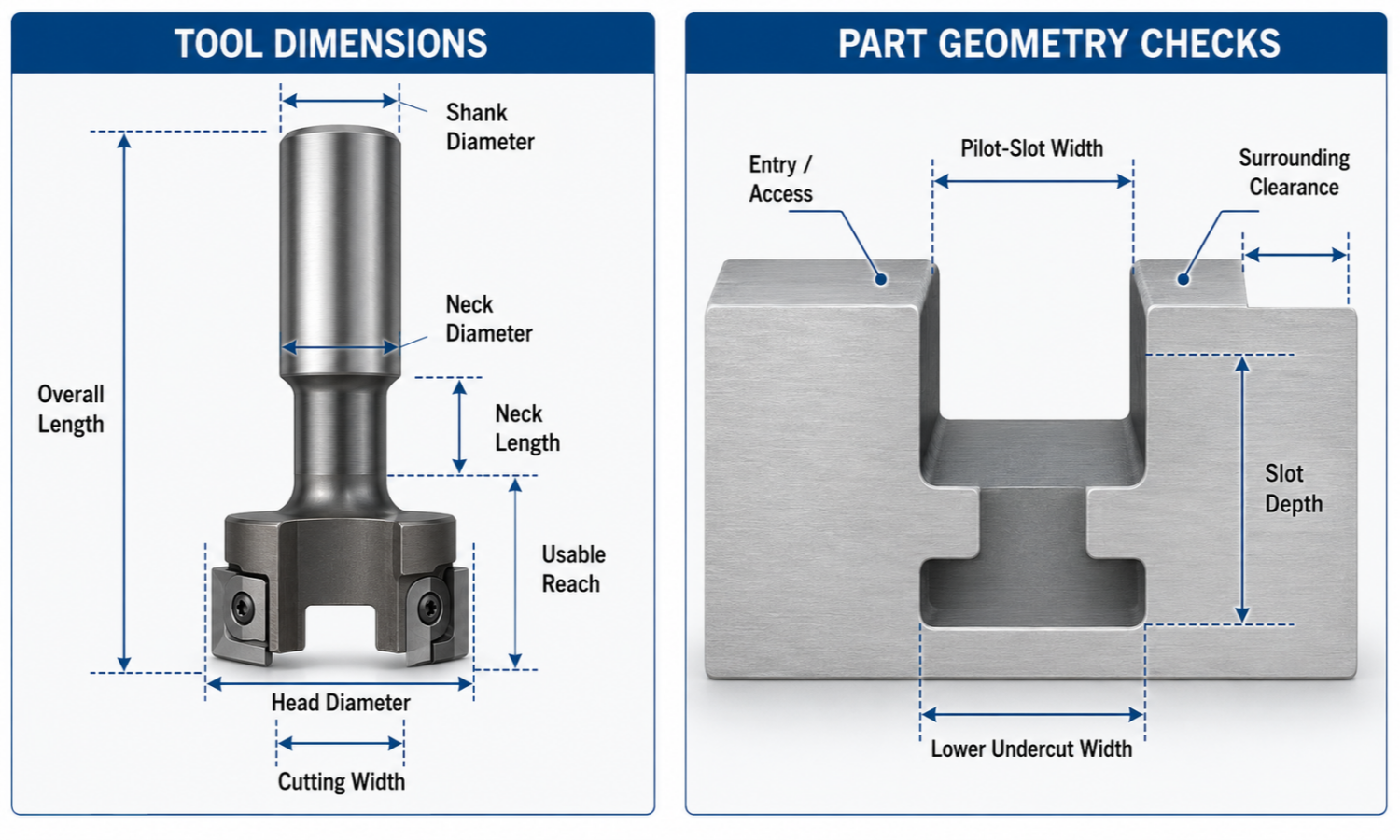
Dimensions de l'outil
| Cote de l'outil | Ce que cela aide à confirmer |
|---|---|
| Coupe / Diamètre de la tête | Aide à déterminer l'étendue latérale de la contre-dépouille inférieure ainsi que la trajectoire de l'outil |
| Largeur de coupe | Détermine la largeur du matériau enlevé par la section de coupe |
| Diamètre du cou | Détermine si la section réduite a un jeu suffisant dans la fente supérieure |
| Longueur du cou | Décrit la longueur de la section de col de diamètre réduit |
| Portée utilisable | Indique jusqu'où la fraise peut atteindre la zone d'usinage requise; confirmez-le à partir du dessin de l'outil réel |
| Diamètre de la tige | Détermine la compatibilité avec le support ou la pince et affecte la rigidité de l'installation |
| Longueur totale | Aide à évaluer l’espace total d’installation mais ne doit pas être considéré comme une portée de coupe utilisable |
| Rayon de coin / Profil de coupe | Aide à faire correspondre la géométrie de l'outil au profil de fente inférieure requis |
Différents fabricants peuvent définir différemment certaines dimensions du dessin. Donc, comparez toujours la terminologie avec le dessin réel de la fraise avant de faire une sélection finale. Kennametal, Par exemple, indique le diamètre de coupe effectif, diamètre du col, longueur totale et longueur utile en tant que spécifications distinctes sur ses pages de données sur les fraises à rainure en T.
Vérifications de la géométrie des pièces
| Vérification de la géométrie de la pièce | Pourquoi c'est important |
| Largeur de la fente pilote | Doit fournir un dégagement approprié pour le col du coupeur |
| Largeur de contre-dépouille inférieure | Définit le profil de rainure en T inférieur fini requis |
| Profondeur de la fente | Aide à déterminer la position et la portée requises du couteau |
| Géométrie des épaules | Affecte l'accès à la fraise et les interférences possibles |
| Entrée / Conditions d'accès | Détermine comment la tête de coupe plus large peut atteindre la position d'usinage inférieure |
| Dégagement environnant | Aide à prévenir les interférences entre la pièce à travailler, col de coupe, jarret, et titulaire |
Ce type d'interprétation des dimensions est plus utile que de s'appuyer sur un tableau générique des tailles de fraises à rainure en T., surtout pour les composants non standards.
Diamètre du col et largeur de la fente pilote
Le col doit passer par la fente supérieure sans contact indésirable avec les parois latérales.
Si le dégagement disponible est insuffisant, le col ou la structure de l'outil environnante peut interférer avec la pièce à usiner. Cela peut affecter la stabilité de l'usinage et la qualité de la surface..
Cependant, il n'existe pas de valeur de jeu générique unique qui convienne à chaque fraise. Comparez plutôt le dessin de la pièce avec le dessin réel de la fraise..
La longueur du cou et la portée utilisable sont différentes
La longueur du col décrit la section de diamètre réduit de l'outil.
La portée utilisable fait référence à la portée pratique disponible pour la géométrie d'usinage requise et doit être vérifiée séparément.. La longueur totale est également une dimension différente et ne doit pas être utilisée comme substitut à l'une ou l'autre valeur.. Les données produit du fabricant répertorient généralement ces dimensions séparément.
Types de fraises à rainure en T
Les fraises à rainure en T sont disponibles dans plusieurs constructions de base. Le but de cette classification est d'aider les utilisateurs à reconnaître les principaux types d'outils plutôt que de sélectionner un produit à partir du seul matériau..
| Type de coupeur | Caractéristique générale |
| Fraise à rainure en T HSS | Utilise de l'acier rapide comme matériau d'outil de coupe |
| Fraise à rainure en T en carbure monobloc | Utilise une construction en carbure pour l'outil de coupe ou la section de coupe |
| Coupe-fente en T indexable | Utilise des plaquettes de coupe remplaçables dans le corps de la fraise |
| Coupe-fente en T personnalisé | Utilise une géométrie spécifique au dessin pour un profil de fente non standard |
Par exemple, les systèmes de fraises à rainure en T indexables peuvent utiliser des plaquettes remplaçables et publier des données séparées pour le diamètre de coupe, diamètre du col, longueur utile, et profondeur de coupe.
Toujours, la construction de la fraise à elle seule ne détermine pas le meilleur choix. Matériau de la pièce, géométrie de la fraise, conditions d'usinage, rigidité de la machine, exigences en matière de revêtement, et le contrôle des copeaux doit également être pris en compte.
Comment choisir la bonne fraise à rainure en T
Le meilleur point de départ est le dessin de la pièce, pas la marque du revêtement ou du cutter.
D'abord, confirmer si la fraise peut accéder physiquement à la fente et produire le profil inférieur requis. Examinez ensuite la pièce à usiner et les conditions d'usinage..
Commencez par la géométrie des fentes
Vérifier la géométrie dans un ordre pratique:
- Largeur supérieure ou de la fente pilote
- Largeur de contre-dépouille inférieure
- Profondeur de fente requise
- Portée du coupeur
- Dégagement du cou
- Profil de fond ou d'angle
- Conditions d'entrée
- Dégagement de la tige et du support
Ces vérifications aident à déterminer si l'outil peut accéder à la fonctionnalité, atteindre la position d'usinage, et coupez le profil requis sans interférence.
Pour un emplacement non standard, comparer le dessin de la pièce avec le dessin de la fraise proposé au lieu de choisir l'outil uniquement par diamètre nominal.
Confirmer la pièce et les conditions d'usinage
Suivant, prendre en compte l'environnement d'usinage réel.
Les informations importantes peuvent inclure:
- Matériau et qualité de la pièce
- État ou dureté du matériau
- Qualité de surface requise
- Conditions de refroidissement ou d'usinage à sec
- Quantité produite
- Géométrie de la fraise
- État de la machine et du support
Le matériel est important, mais ne l'utilisez pas comme seule règle de sélection. Vérifier la géométrie des arêtes, revêtement, évacuation des copeaux, construction de fraises, et les conditions de la machine ensemble pour l'application spécifique.
Vérifier la configuration, Titulaire, et dégagement des outils
Le fraisage de rainures en T s'effectue autour d'une contre-dépouille et souvent dans une zone d'usinage confinée. Donc, l'accès à la fraise et le dégagement d'installation nécessitent une attention particulière.
Vérifier:
- Porte-à-faux d'outil
- Dégagement du support
- Stabilité de maintien
- Rigidité des machines
- Stabilité de l'installation
- Évacuation des copeaux
Une configuration d'outil pratique plus courte réduit généralement le porte-à-faux inutile, tandis qu'un dégagement adéquat empêche le support ou le corps de l'outil d'interférer avec le composant.
Si une fraise standard ne correspond pas à la géométrie requise, revoir une fraise à rainure en T pour un profil spécifique au dessin.
Fraise à rainure en T vs fraise à fente
Une fraise à rainurer en T et une fraise à rainurer standard ne créent pas le même type de fonctionnalité.
La différence la plus importante est la contre-dépouille inférieure.
| Outil | Profil créé | Emplacement initial / Accéder | Utilisation typique |
| Fraise à rainure en T | Profil en forme de T avec une contre-dépouille inférieure plus large | Nécessite un emplacement initial approprié et un accès au couteau | Fentes en T, caractéristiques de la table de machine, rainures de fixation |
| Fraise à fente | Fente droite ou rainure latérale | N'utilise pas le même processus de contre-dépouille des rainures en T | Usinage général de rainures et de rainures |
| Fraise en bout | Fentes droites, poches, épaules, et profils | Peut être utilisé pour préparer l'emplacement initial | Fraisage CNC général |
Si la caractéristique n’a pas de contre-dépouille inférieure plus large, un outil de fraisage de fente standard ou une fraise en bout peut suffire.
Un coupe-fente en T est nécessaire lorsque le dessin nécessite que du matériau soit retiré en dessous d'une ouverture supérieure plus étroite..
Erreurs courantes de fraisage de rainures en T
Une bonne sélection d'outils ne garantit pas à elle seule un processus d'usinage de rainures en T stable. Accéder, autorisation, rigidité, et le contrôle des copeaux peut également affecter le résultat.
Ignorer le créneau initial ou la planification d'entrée
Une fraise à rainure en T standard ne doit pas être traitée comme une fraise plongeante conventionnelle..
Avant d'usiner la contre-dépouille, préparez la fente supérieure requise et confirmez comment la tête de coupe plus large atteindra le niveau inférieur. Pour une fonctionnalité interne fermée, cela peut nécessiter une zone d'accès dédiée ou une autre méthode d'entrée planifiée.
Sélection d’un dégagement du cou insuffisant
Le col du coupeur a besoin d'un espace suffisant à l'intérieur de la fente supérieure.
Un dégagement insuffisant peut provoquer:
- Contact avec le cou
- Interférence sur les parois latérales
- Accumulation de chaleur
- Coupe instable
- Mauvaise finition de surface
Vérifiez le diamètre du col par rapport à la géométrie réelle de la fente supérieure avant l'usinage.. Évitez de vous fier à une valeur de jeu universelle.
Utilisation d'un porte-à-faux excessif ou d'une configuration instable
Le long porte-à-faux de l'outil réduit la rigidité de l'installation et peut augmenter les vibrations.
Utilisez uniquement la portée requise par la géométrie de la pièce. En outre, fixez correctement la pièce à usiner et vérifiez que le support a suffisamment d'espace autour du composant.
Ignorer l'évacuation des copeaux dans une rainure confinée
La contre-dépouille inférieure peut créer une zone confinée où les copeaux sont plus difficiles à éliminer.
S'il reste des copeaux autour de la zone de coupe, ils peuvent être recoupés ou interférer avec l'outil. Donc, l'évacuation des copeaux doit être prise en compte lors de la planification de la stratégie d'usinage et de l'alimentation en liquide de refroidissement ou en air.
FAQ
Pourquoi une première rainure droite est-elle nécessaire avant le fraisage d'une rainure en T?
La fente droite initiale crée la partie supérieure de la rainure en T et fournit un dégagement pour le col du coupeur.. Il établit également le chemin utilisé avant l'usinage de la contre-dépouille inférieure..
Cependant, la fente initiale ne permet pas nécessairement à la tête de coupe plus large de plonger verticalement à travers l'ouverture. Le plan d'usinage doit prévoir un accès approprié à la tête de coupe.
Une fraise à rainure en T peut-elle plonger directement à travers la fente supérieure?
Pas dans une configuration typique où la tête de coupe est plus large que l'ouverture supérieure. La tête de coupe doit atteindre la position d'usinage inférieure via une extrémité ouverte ou un autre élément d'accès approprié déterminé par la géométrie de l'outil et de la pièce..
Comment choisir la bonne taille de coupe-fente en T?
Commencez par le dessin de la pièce et comparez-le avec le dessin réel de la fraise.. Vérifiez la largeur de la fente supérieure, géométrie de contre-dépouille inférieure, diamètre du col, portée de coupe, condition d'entrée, taille de la tige, et l'autorisation de support disponible avant de faire la sélection finale.
Conclusion
Une fraise à rainure en T usine la contre-dépouille inférieure d'un élément en forme de T après que la fente supérieure et l'accès approprié à la fraise ont été préparés.. La sélection précise dépend de la relation entre la géométrie de la pièce et les dimensions réelles de la fraise., surtout le dégagement du cou, géométrie de coupe, portée utilisable, condition d'entrée, et dégagement du support.