 Fraise de précision,Outils de coupe pour l’usinage CNC de chaque matériau

Une fraise en bout est un outil de coupe rotatif utilisé dans le fraisage CNC pour enlever de la matière de l'extrémité et du côté d'une pièce.. Il peut usiner des machines à sous, poches, profils, parois latérales, surfaces courbes, et caractéristiques de finition dans des matériaux tels que l'aluminium, acier, acier inoxydable, cuivre, et les plastiques.
Dans ce guide, vous apprendrez ce qu'est une fraise en bout, en quoi il diffère d'un foret, ce qu'il fait dans le fraisage CNC, types de couteaux courants, spécifications de base, et comment choisir le bon outil pour différentes applications d'usinage.
Qu'est-ce qu'une fraise en bout?
Une fraise en bout est un outil de coupe rotatif utilisé sur les machines CNC et les fraiseuses. Il tourne à grande vitesse tandis que l'outil ou la pièce se déplace le long d'une trajectoire contrôlée pour enlever la matière..
La principale différence entre une fraise en bout et de nombreux autres outils réside dans sa géométrie de coupe.. La plupart des fraises en bout ont des arêtes de coupe à l'extrémité et sur les côtés. Donc, ils peuvent couper verticalement et latéralement. Cela les rend adaptés au rainurage, fraisage latéral, profilage, fraisage de poche, contouring, et finition.
Les fabricants fabriquent généralement des fraises en bout en acier rapide ou en carbure monobloc. Cependant, de nombreux ateliers d'usinage CNC choisissent des outils en carbure monobloc car ils offrent une meilleure rigidité, résistance à l'usure plus élevée, et des performances de coupe plus stables.
Si vous avez besoin d'outils standards ou personnalisés pour l'usinage de production, vous pouvez également visiter notre page produit de la fraise en bout.
Principales parties d'une fraise en bout
Bien que les fraises en bout se présentent sous différentes formes et conceptions, la plupart des outils comprennent plusieurs parties de base. Comprendre ces pièces aide les acheteurs à choisir la fraise adaptée à leur matériau., machine, et objectif d'usinage.
| Partie | Fonction | Pourquoi c'est important |
| Arêtes de coupe | Retirer de la matière de la pièce | Affecte l'efficacité de coupe et la finition de surface |
| Flûtes | Aide à évacuer les copeaux pendant l'usinage | Influencer l'élimination des copeaux, rigidité, et stabilité de coupe |
| Info-bulle | Définit la géométrie d'extrémité de la fraise | Affecte le placement, contouring, finition, et la force des coins |
| Jarret | Maintenu par le porte-outil ou la broche | Doit correspondre au support pour un serrage stable |
| Revêtement | Protège le tranchant pendant l'usinage | Améliore la résistance à l'usure, résistance à la chaleur, et durée de vie de l'outil |
Tranchants
Les arêtes de coupe sont la partie active de l'outil. Ils enlèvent de la matière pendant le fraisage et affectent directement les performances de coupe., précision, et finition de surface.
Flûtes
Les cannelures sont les rainures le long du corps de la fraise. Ils aident à éliminer les copeaux de la zone de coupe. En outre, la conception des flûtes affecte la rigidité, contrôle de la chaleur, et stabilité de coupe.
Info-bulle
La conception de la pointe de l'outil dépend du type de fraise. Certaines fraises ont des extrémités plates, tandis que d'autres ont le nez boule, rayon de coin, ou géométrie conique. Par conséquent, différents modèles de pointes sont utilisés pour différentes tâches d'usinage.
Jarret
La tige est la pièce maintenue par le porte-outil ou la broche. Son diamètre doit correspondre correctement au support. Sinon, vibration, mauvaise précision, ou un faux-rond de l'outil peut se produire.
Revêtement
De nombreuses fraises en bout utilisent des revêtements tels que TiAlN, Or, TiSiN, Étain, Contenu téléchargeable, ou revêtement Nano bleu. Le bon revêtement peut améliorer la résistance à la chaleur, réduire l'usure, et prolonger la durée de vie de l'outil.
Fraise en bout vs foret
De nombreux débutants confondent une fraise en bout avec un foret. Cependant, ils sont conçus pour différents usages d'usinage.
Un foret coupe principalement dans le sens axial pour créer des trous ronds. Par contre, une fraise en bout peut couper à la fois axialement et latéralement. Donc, il peut usiner des machines à sous, poches, contours, profils, parois latérales, et surfaces finies.
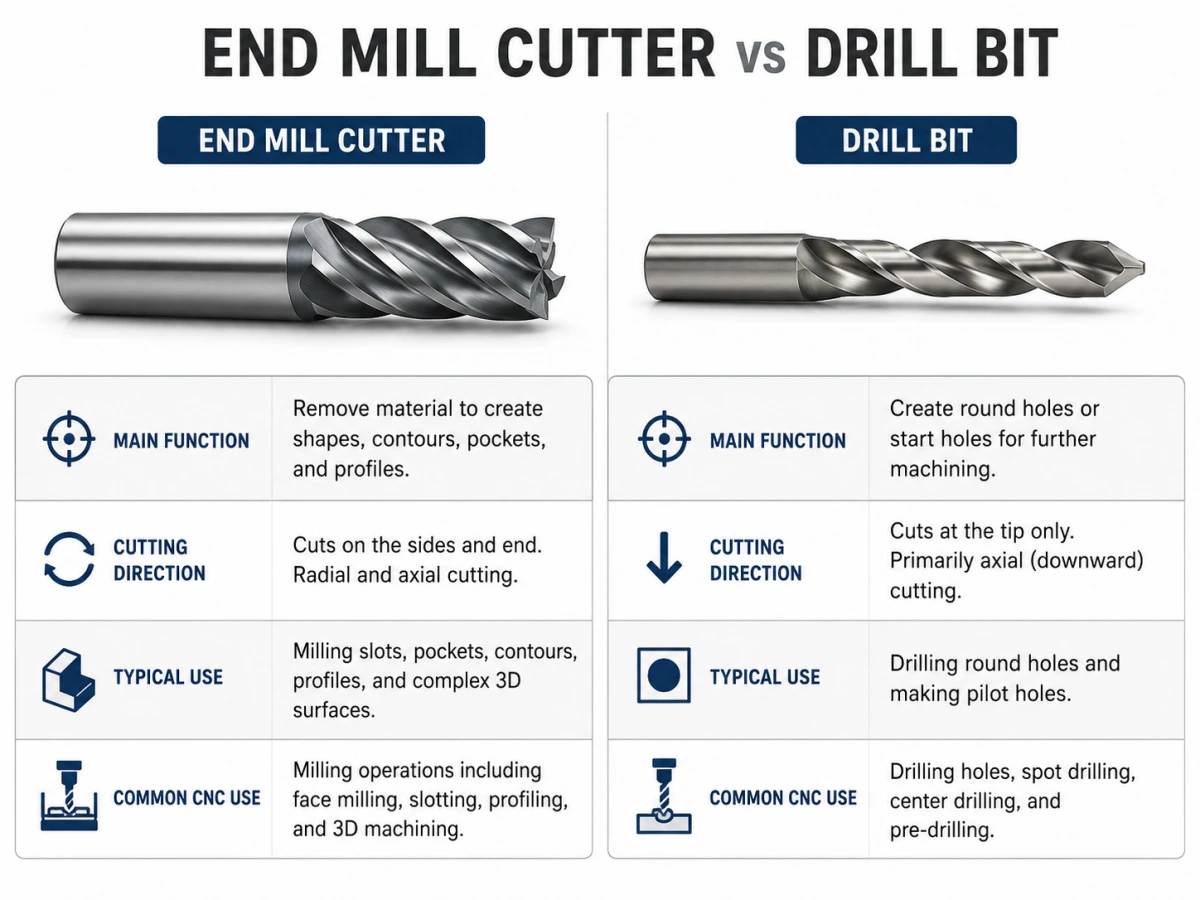
| Fonctionnalité | Fraise en bout | Foret |
| Fonction principale | Fraisage, rainurage, profilage, coupe latérale | Percer des trous |
| Sens de coupe | Axial et latéral | Principalement axial |
| Utilisation typique | Machines à sous, poches, contours, parois latérales | Trous ronds |
| Flexibilité des outils | Plus haut | Inférieur |
| Utilisation courante de la CNC | Opérations générales de fraisage | Opérations de perçage |
En bref, les deux outils enlèvent de la matière, mais ils ne sont pas interchangeables dans la plupart des situations d'usinage. Une fraise à coupe centrale peut plonger dans certaines applications, mais ce n'est toujours pas la même chose qu'un foret standard.
Types courants de fraises en bout
Il existe de nombreux types de fraises en bout, et chaque design a un but spécifique. Choisir le bon type contribue à améliorer l’efficacité de la coupe, qualité de surface, et durée de vie de l'outil.
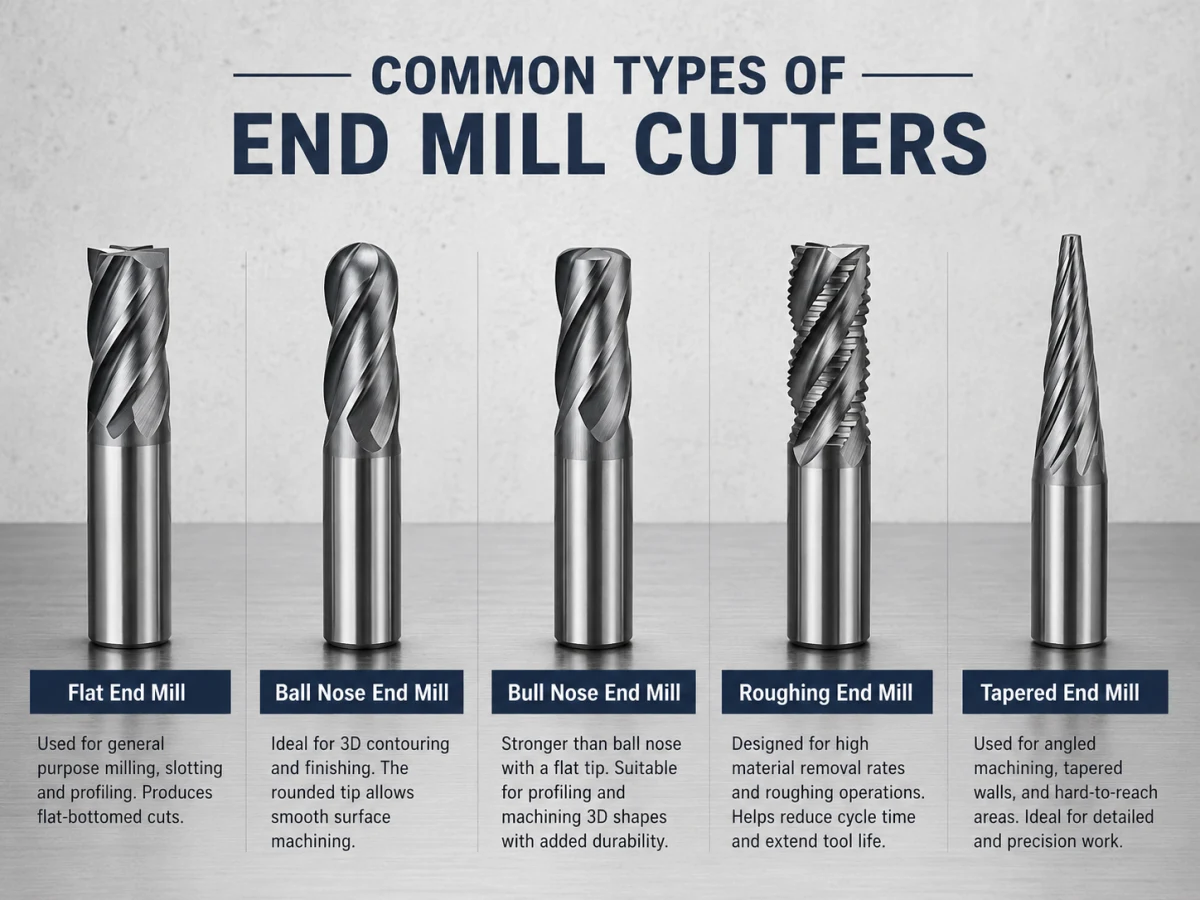
Fraise à bout plat
Une fraise à bout plat a une extrémité coupante plate. Il est largement utilisé pour le rainurage, fraisage latéral, fraisage d'épaulements, et usinage général.
Fraise à bout sphérique
Une fraise à bout sphérique a une extrémité coupante arrondie. Il est couramment utilisé pour le contourage 3D, usinage de moules, surfaces courbes, et opérations de finition.
Pour l'usinage de surfaces courbes et le travail de moulage, vous pouvez également consulter notre fraises à bout sphérique.
Fraise à nez arrondi
Une fraise à nez arrondi, également appelée fraise en bout à rayon de coin, combine un fond plat avec des coins arrondis. Il améliore la résistance des bords et aide à créer des transitions plus fluides.
Pour une géométrie de coin plus solide, voir notre fraise à nez arrondi.
Fraise d'ébauche
Une fraise d'ébauche est conçue pour un enlèvement de matière agressif. Il est souvent utilisé avant la finition pour éliminer rapidement de grandes quantités de matière..
Pour un enlèvement de matière important, vous pouvez consulter notre fraises d'ébauche.
Fraise conique
Une fraise conique a un diamètre qui change progressivement. Il est utilisé pour les murs en angle, cavités profondes, usinage de moules, et profils spéciaux.
Pour cavités de moules et usinage en angle, visitez notre fraise conique.
Pour une comparaison plus détaillée des géométries d'outils, lisez notre guide des types de fraises en bout.
À quoi sert une fraise en bout?
Les fraises en bout sont utilisées dans de nombreuses opérations de fraisage CNC. Parce qu'ils peuvent couper par le bout et par le côté, ils conviennent aussi bien aux tâches d'usinage simples que complexes.
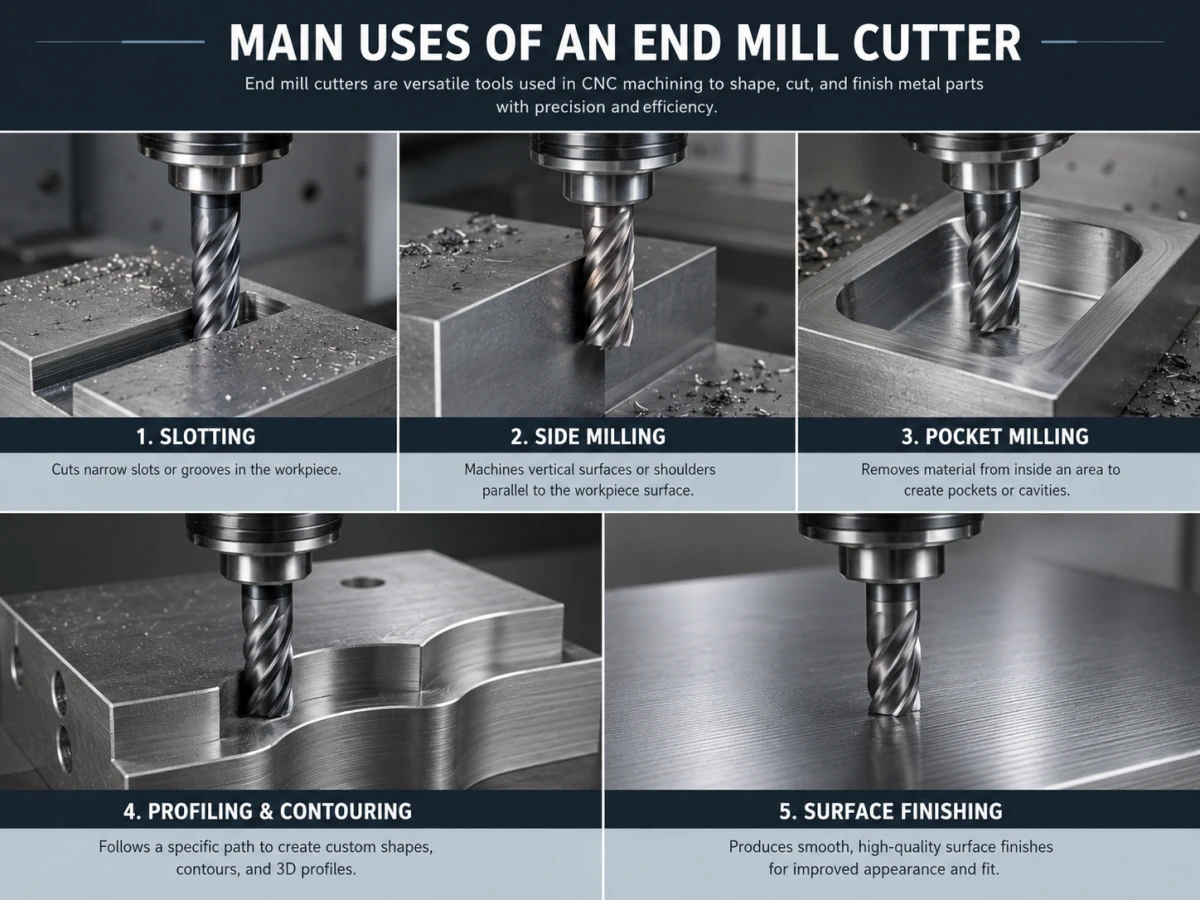
Rainurage
Le rainurage est l'une des applications les plus courantes. Une fraise en bout peut couper des fentes droites ou incurvées dans une pièce avec une bonne précision. Ces emplacements peuvent créer des rainures, rainures, pistes de guidage, et caractéristiques d'assemblage.
Pour les matériaux plus tendres comme l'aluminium, l'évacuation des copeaux est importante. Donc, les machinistes sélectionnent souvent 2 outils à flûtes lorsque la pièce nécessite une meilleure évacuation des copeaux.
Fraisage latéral
Le fraisage latéral utilise les arêtes de coupe latérales de l'outil pour enlever de la matière de la surface verticale d'une pièce.. Cette opération est utile pour l'usinage des épaulements, mesures, et parois latérales.
Les ateliers d'usinage utilisent couramment le fraisage latéral pour les pièces de précision, composants de moule, pièces d'outillage, et production CNC générale.
Profilage et contourage
Les machinistes utilisent également des fraises en bout pour le profilage et le contournage.. Ces opérations créent des formes complexes, chemins courbes, et profils externes ou internes.
Les machinistes choisissent souvent des outils à bout sphérique et à rayon de coin pour ce type de travail, car ces outils peuvent améliorer les transitions de surface et la qualité de finition..
Fraisage de poche
Le fraisage de poche enlève la matière d'une zone fermée ou en retrait à l'intérieur d'une pièce à usiner. Cette opération est courante dans les pièces nécessitant des cavités internes, réduction de poids, ou un enlèvement de matière précis dans une zone limitée.
Bon contrôle des copeaux, trajectoires d'outils stables, et la géométrie correcte de la fraise sont importantes pour ce processus.
Finition des surfaces
Après un usinage grossier, une fraise en bout peut également être utilisée pour la finition. L’objectif est d’améliorer la précision dimensionnelle et la douceur de la surface.
Les outils de finition sont sélectionnés en fonction de la tolérance, matériau de la pièce à usiner, stabilité de la machine, et qualité de surface requise.
Fraisage étagé et usinage d'épaulements
Les fraises en bout peuvent usiner des surfaces étagées, épaules, et fonctionnalités à plusieurs niveaux. Ces fonctionnalités nécessitent souvent des transitions nettes, coupe stable, et dimensions précises.
Par conséquent, rigidité de l'outil, conception de flûte, et le choix du revêtement sont importants.
Utilisations de la fraise en bout pour l'aluminium, Acier, et acier inoxydable
Différents matériaux de pièce nécessitent différentes conceptions de fraises. Donc, les acheteurs doivent faire correspondre la fraise en bout au matériau et aux conditions d'usinage.
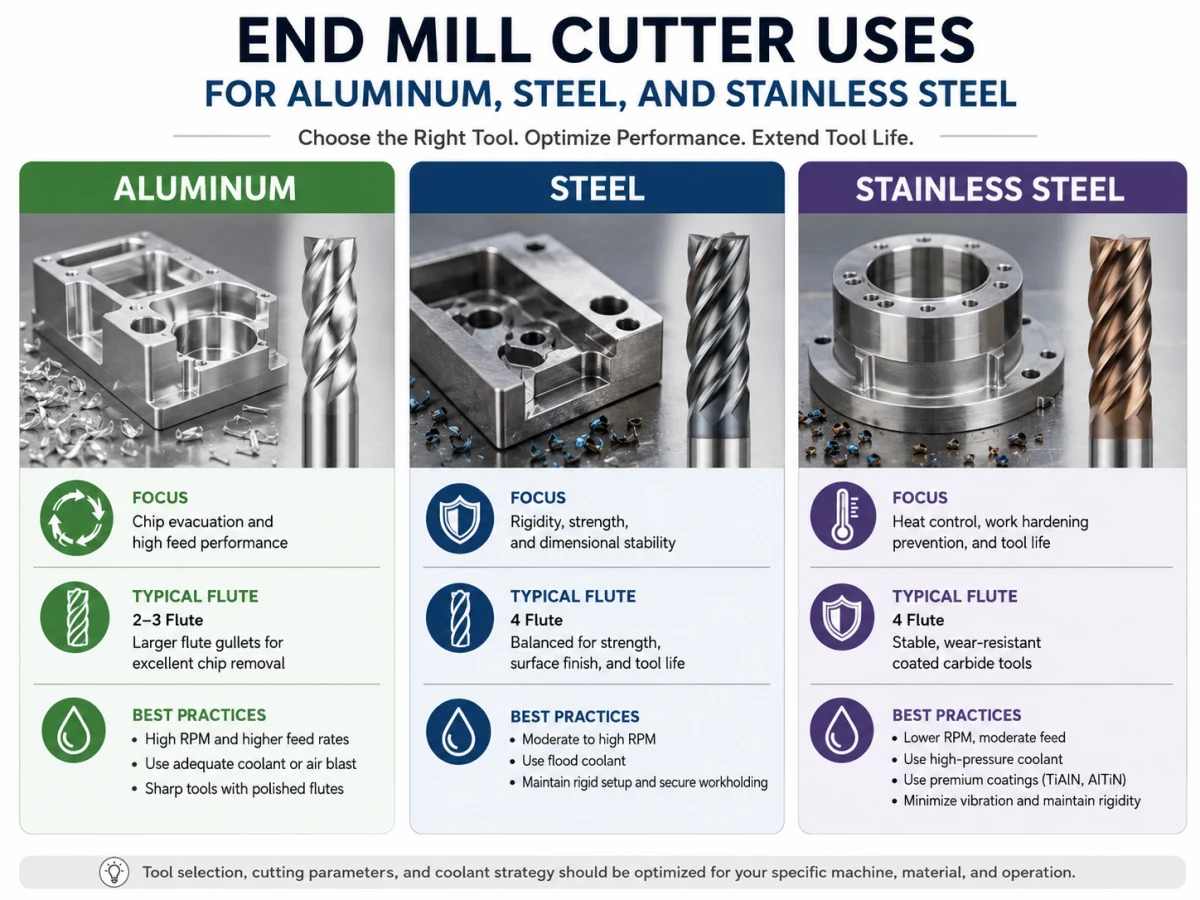
| Matériau de la pièce | Choix de coupe commun | Raison principale |
| Aluminium | 2 flûte ou 3 fraise en bout de carbure de cannelure | Meilleure évacuation des copeaux et coupe en douceur |
| Acier | 4 fraise en carbure à cannelure avec revêtement approprié | Meilleure rigidité et résistance à l'usure |
| Acier inoxydable | Fraise en carbure revêtue à géométrie stable | Meilleur contrôle de la chaleur et protection des bords |
| Cuivre et laiton | Fraise en bout de carbure à arête vive | Coupe nette et bavures réduites |
| Plastiques | Pointu, coupe-flûte poli | Élimination des copeaux en douceur et risque de fonte réduit |
Fraise en bout pour aluminium
Lors de l'usinage de l'aluminium, les fraises en bout sont utilisées pour le rainurage, fraisage de poche, fraisage latéral, et finition. L'aluminium produit des copeaux plus gros, les outils avec moins de cannelures et une bonne évacuation des copeaux sont donc souvent préférés.
Les fraises en carbure à haute hélice sont également courantes pour l'aluminium car elles contribuent à améliorer la douceur de coupe et à réduire l'accumulation de copeaux..
Pour l'aluminium et les matériaux non ferreux, vous pouvez comparer les options de flûtes sur notre 2 fraise à cannelure et 3 fraise à cannelure pages.
Fraise en bout pour l'acier
Pour acier au carbone et acier allié, les fraises en bout sont souvent utilisées pour le fraisage latéral, contouring, usinage d'épaulement, et semi-finition. L'acier nécessite généralement une meilleure rigidité et une plus grande résistance à l'usure.
Dans de nombreux cas, 4 Les fraises en carbure à cannelures sont sélectionnées pour l'usinage de l'acier et des métaux à usage général..
Pour l'usinage de l'acier, vous pouvez consulter notre 4 fraise à cannelure.
Fraise en bout pour acier inoxydable
L'acier inoxydable est plus difficile à usiner car il génère de la chaleur et a tendance à provoquer une usure des outils.. Dans les applications en acier inoxydable, les fraises en bout sont couramment utilisées pour le profilage, finition, et fraisage latéral contrôlé.
Le bon revêtement, géométrie de la flûte, et les paramètres de coupe aident à maintenir la stabilité de coupe et à réduire l'usure des bords.
Comment choisir une fraise en bout de base
Choisir une fraise en bout n'a pas besoin d'être compliqué. Cependant, les acheteurs doivent vérifier plusieurs facteurs avant de commander.
Matériau de la pièce
Le matériau de la pièce à usiner est l'un des facteurs les plus importants. Aluminium, acier, acier inoxydable, cuivre, laiton, plastiques, et la fonte peut nécessiter des conceptions de flûtes différentes, revêtements, et stratégies de coupe.
Nombre de flûtes
Le nombre de cannelures affecte l'évacuation des copeaux, rigidité, et efficacité de coupe. Par exemple, les machinistes utilisent souvent 2 outils de flûte pour l'aluminium, alors qu'ils choisissent généralement 4 outils à flûtes pour l'usinage de l'acier et à usage général.
Pour une comparaison plus approfondie, lisez notre 2 flûte contre 4 guide de fraise en bout de cannelure.
Matériau de l'outil
De nombreux ateliers d'usinage CNC choisissent des fraises en carbure monobloc car elles offrent une plus grande rigidité., meilleure résistance à l'usure, et des performances stables. Certains ateliers utilisent encore des outils HSS pour des applications d'usinage à faible vitesse ou générales.
Revêtement
Le revêtement doit correspondre au matériau et aux conditions d'usinage. Par exemple, les machinistes choisissent souvent les revêtements TiAlN et AlTiN pour l'acier, tandis que le revêtement DLC peut convenir à l'aluminium et aux matériaux non ferreux.
Finition requise
Pour les opérations d'ébauche, l'objectif principal est un enlèvement de matière plus élevé. Cependant, pour finir les travaux, la qualité de la surface et la précision dimensionnelle deviennent plus importantes.
Spécifications de base à vérifier avant d’acheter
Avant de passer une commande, les acheteurs doivent confirmer plusieurs spécifications clés. Cela permet d'éviter les décalages d'outils et d'améliorer la stabilité de l'usinage..
Diamètre de coupe
Le diamètre de la fraise affecte la largeur de coupe, rigidité, et la taille de l'élément usiné.
Longueur de la flûte
La longueur de la flûte détermine la profondeur à laquelle la fraise peut usiner. Cependant, une flûte plus longue peut réduire la rigidité, elle doit donc correspondre à la profondeur de coupe réelle.
Longueur totale
La longueur totale affecte la portée de l'outil et le contrôle des vibrations. Un outil plus long peut être nécessaire pour les cavités profondes, mais il doit être utilisé avec précaution pour réduire les bavardages.
Diamètre de la tige
Le diamètre de la tige doit correspondre correctement au support. Un serrage stable contribue à améliorer la précision et la durée de vie de l'outil.
Géométrie des coins
Plat, nez sphérique, rayon de coin, et les géométries coniques sont utilisées pour différents objectifs d'usinage. Donc, la géométrie des coins doit correspondre à la forme de la pièce et à la finition requise.
Type de revêtement
Le revêtement doit être choisi en fonction du matériau de la pièce à usiner, vitesse de coupe, état du liquide de refroidissement, et exigence de durée de vie de l'outil.
Pourquoi les fraises en bout en carbure monobloc sont courantes dans le fraisage CNC
Les fraises en carbure monobloc sont populaires car elles offrent une forte rigidité, haute dureté, et bonne résistance à l'usure. Ils peuvent prendre en charge des vitesses de coupe plus élevées et offrir des performances plus stables que de nombreux matériaux d'outils standard..
En usinage de production, de nombreux magasins utilisent des outils en carbure pour l'acier, acier inoxydable, fonte, aluminium, et autres matériaux exigeants. En outre, la bonne géométrie et le bon revêtement peuvent améliorer la cohérence de l'usinage.
Acheteurs industriels, distributeurs, et les ateliers d'usinage préfèrent souvent les outils en carbure car ils contribuent à réduire les changements d'outils et permettent une production plus stable..
Pour outils en carbure standards et personnalisés, vous pouvez visiter notre fraise en bout de carbure pape.
Quand avez-vous besoin d’une fraise en bout personnalisée?
Une fraise standard peut résoudre de nombreuses tâches d'usinage courantes.
Cependant, vous pourriez avoir besoin d'un outillage personnalisé lorsque la pièce a un profil spécial, cavité profonde, matériau inhabituel, tolérance stricte, ou exigence de taille non standard.
Les fabricants peuvent concevoir des fraises en bout personnalisées avec un diamètre spécial, longueur de flûte, longueur totale, rayon de coin, revêtement, taille de la tige, et la géométrie des outils.
Pour les outils basés sur des dessins ou OEM, visitez notre fraises en bout personnalisées pape.
FAQ
Qu'est-ce qu'une fraise en bout?
Une fraise en bout est un outil de coupe rotatif utilisé pour les opérations de fraisage CNC telles que le rainurage., fraisage latéral, profilage, contouring, fraisage de poche, et finition.
A quoi sert une fraise en bout?
Il est utilisé pour enlever de la matière de l'extrémité et du côté d'une pièce.. Les applications courantes incluent les machines à sous, poches, parois latérales, profils, épaules, surfaces courbes, et surfaces finies.
Quelle est la différence entre une fraise en bout et un foret?
Un foret coupe principalement des trous dans le sens axial. Une fraise en bout peut couper axialement et latéralement, afin qu'il puisse effectuer davantage d'opérations de fraisage telles que le rainurage, profilage, et fraisage latéral.
Quels sont les types courants de fraises en bout?
Les types courants incluent les fraises à bout plat, fraises à bout sphérique, fraises à nez arrondi, fraises d'ébauche, fraises coniques, 2 fraises à cannelure, 3 fraises à cannelure, 4 fraises à cannelure, et 6 fraises à cannelure.
Comment choisir une fraise en bout de base?
Vous devriez vérifier le matériau de la pièce à usiner, nombre de flûtes, diamètre de coupe, longueur de flûte, longueur totale, diamètre de la tige, matériau de l'outil, revêtement, et finition de surface requise.
Les fraises en bout en carbure sont-elles meilleures que les fraises en bout HSS?
Les fraises en carbure offrent généralement une meilleure rigidité, résistance à l'usure, et stabilité de coupe. Cependant, le meilleur choix dépend de la machine, matériau de la pièce à usiner, vitesse de coupe, et budget.
Conclusion
Une fraise en bout est un outil de fraisage CNC polyvalent utilisé pour le rainurage, fraisage latéral, fraisage de poche, profilage, contouring, usinage d'épaulement, et finition. Parce qu'il peut couper à la fois par l'extrémité et par le côté, il est plus flexible que de nombreux outils de coupe de base.
Pour choisir le bon coupeur, les acheteurs doivent comprendre la structure de l'outil, type de coupe, nombre de flûtes, matériel, revêtement, diamètre, longueur de flûte, et application d'usinage. Une fois que ces facteurs correspondent correctement, le coupeur peut fournir une meilleure efficacité de coupe, durée de vie de l'outil plus longue, et des résultats d'usinage plus stables.
À la recherche d'un fabricant de fraises en bout fiable pour l'aluminium, acier, acier inoxydable, ou usinage CNC sur mesure?
Explorez notre page produit de la fraise en bout pour les solutions standards et OEM, ou contactez-nous avec vos exigences en matière de dessin et d'application.