 Fraise de précision,Outils de coupe pour l’usinage CNC de chaque matériau

Introduction
Comment fonctionne une fraise en bout dans le fraisage CNC? Il enlève le matériau avec les bords de coupe rotatifs tandis que le mouvement d'avance déplace l'outil à travers la pièce à usiner.. Les cannelures éloignent les copeaux de la zone de coupe, donc stabilité de coupe, état de surface, et la durée de vie de l'outil dépend de la vitesse de rotation, vitesse d'avance, géométrie de la fraise, et évacuation des copeaux.
Ce guide explique comment fonctionne le processus de fraisage en bout, comment le coupeur enlève la matière, comment les copeaux quittent la zone de coupe, et ce qui affecte la stabilité de coupe, état de surface, et durée de vie de l'outil.
Si vous êtes nouveau sur cet outil, vous pouvez d'abord lire notre guide des outils de fraisage de base.
Qu'est-ce qu'une fraise en bout dans le fraisage CNC?
Une fraise en bout est un outil de coupe rotatif utilisé sur les machines CNC et les fraiseuses. Contrairement à un foret standard, il peut couper verticalement et latéralement. Donc, ça peut créer des créneaux, poches, contours, parois latérales, et surfaces finies.
La plupart des outils ont des bords coupants à l’extrémité et sur les côtés. Par conséquent, ils peuvent enlever de la matière dans différentes directions en fonction du parcours d'outil et de l'opération d'usinage.
Schéma de la fraise en bout et pièces principales
| Partie | Fonction | Pourquoi c'est important |
| Jarret | Maintient la fraise dans la broche ou le porte-outil | Affecte la stabilité du serrage et le contrôle du faux-rond |
| Flûtes | Éloigner les copeaux de la zone de coupe | Affecte l'évacuation des copeaux, contrôle de la chaleur, et stabilité de coupe |
| Tranchants | Cisailler le matériau de la pièce | Affecte l’efficacité de la coupe, état de surface, et durée de vie de l'outil |
| Fin du tranchant | Coupes depuis la pointe de l'outil | Aide au placement, entrée de poche, et coupe du bas |
| Bord de coupe latéral | Coupe le long du côté de l'outil | Aide au profilage, fraisage latéral, et usinage des épaulements |
| Angle d'hélice | Contrôle l'angle de spirale de la flûte | Affecte le flux de copeaux, douceur de coupe, et vibrations |
| Revêtement | Protège le tranchant | Améliore la résistance à l’usure et à la chaleur |
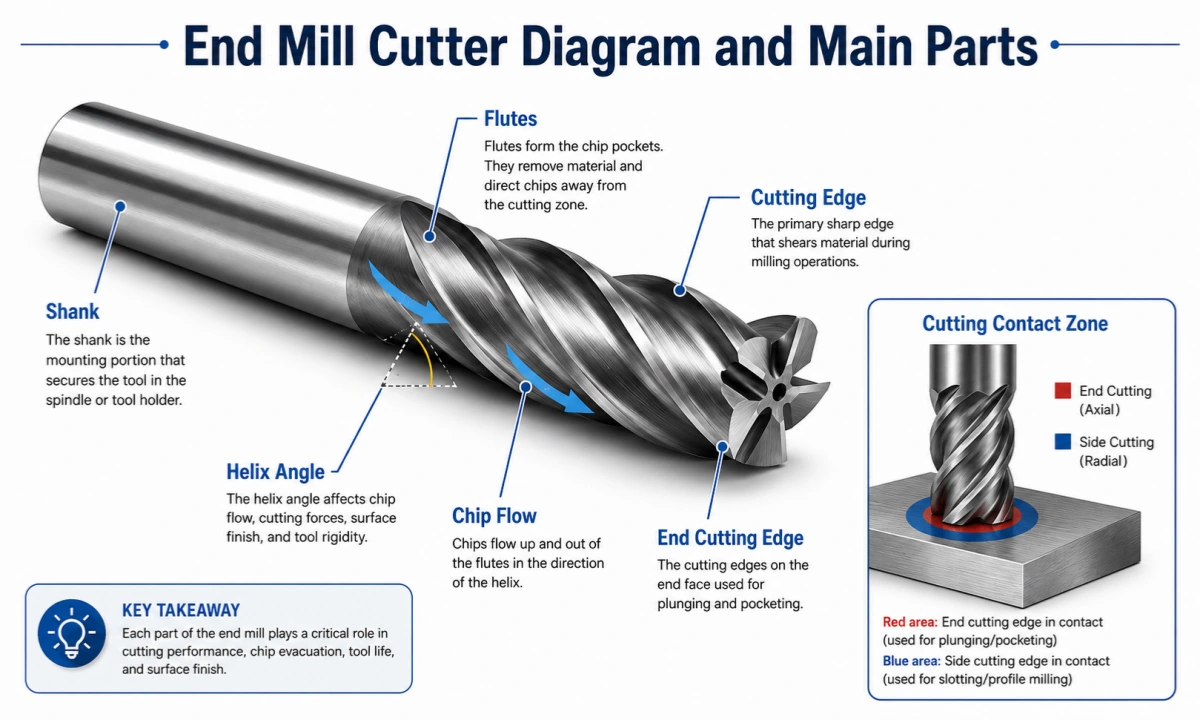
Flûtes
Les cannelures sont les rainures le long du corps de la fraise. Ils aident à éliminer les copeaux pendant la coupe et affectent directement l'évacuation des copeaux., rigidité, et performances de coupe.
Tranchants
Les arêtes de coupe cisaillent le matériau de la pièce à usiner. Leur netteté et leur géométrie affectent l’efficacité de coupe, état de surface, et durée de vie de l'outil.
Jarret
La tige est la pièce serrée dans la broche ou le support. Une configuration stable de la tige est importante pour la précision de l'usinage et le contrôle des vibrations..
Angle d'hélice
L'angle d'hélice influence le flux des copeaux et la douceur de coupe. Dans de nombreux cas, cela affecte également le contrôle de la chaleur et la stabilité de l'usinage.
Géométrie de la pointe de l'outil
Différentes formes de pointe prennent en charge différentes tâches d'usinage. Les fraises à bout plat fonctionnent bien pour le rainurage et le fraisage latéral, tandis que les outils à nez sphérique conviennent au contourage et aux surfaces 3D.
Si vous souhaitez comparer différentes formes d'outils, lisez notre guide de comparaison des types d'outils.
Comment fonctionne une fraise en bout dans le fraisage CNC?
1. La rotation crée l'action de coupe
D'abord, la fraise tourne à grande vitesse dans la broche. Cette rotation amène les arêtes de coupe en contact avec la pièce et crée l'action de coupe..
2. Le mouvement d'avance déplace l'outil à travers le matériau
En même temps, l'outil ou la pièce se déplace dans une direction contrôlée. Ce mouvement est appelé mouvement d'avance. Il détermine la manière dont le coupeur se déplace à travers le matériau et la quantité de matériau retirée à chaque passage..
3. Les arêtes de coupe cisaillent le matériau
Lorsque le couteau rotatif pénètre dans le matériau, les arêtes de coupe coupent de petites sections de la pièce. Ces sections supprimées deviennent des puces.
4. Les flûtes emportent les copeaux
Suivant, les cannelures aident à éloigner les copeaux de la zone de coupe. Une bonne évacuation des copeaux est importante car les copeaux piégés peuvent augmenter la chaleur, endommager le coupeur, et réduire la qualité de la surface.
5. Des passes répétées créent la forme finale
Enfin, la machine CNC crée la forme finale en contrôlant le parcours d'outil, profondeur de coupe, vitesse d'avance, et vitesse de broche. Avec des passes répétées, le cutter peut produire des fentes, poches, contours, parois latérales, et surfaces finies.
Pour les lecteurs demandant « comment fonctionne une fraise en bout ?," Le tableau ci-dessous explique les étapes de coupe de base dans une simple opération de fraisage CNC..
Tableau du processus de fraisage en bout
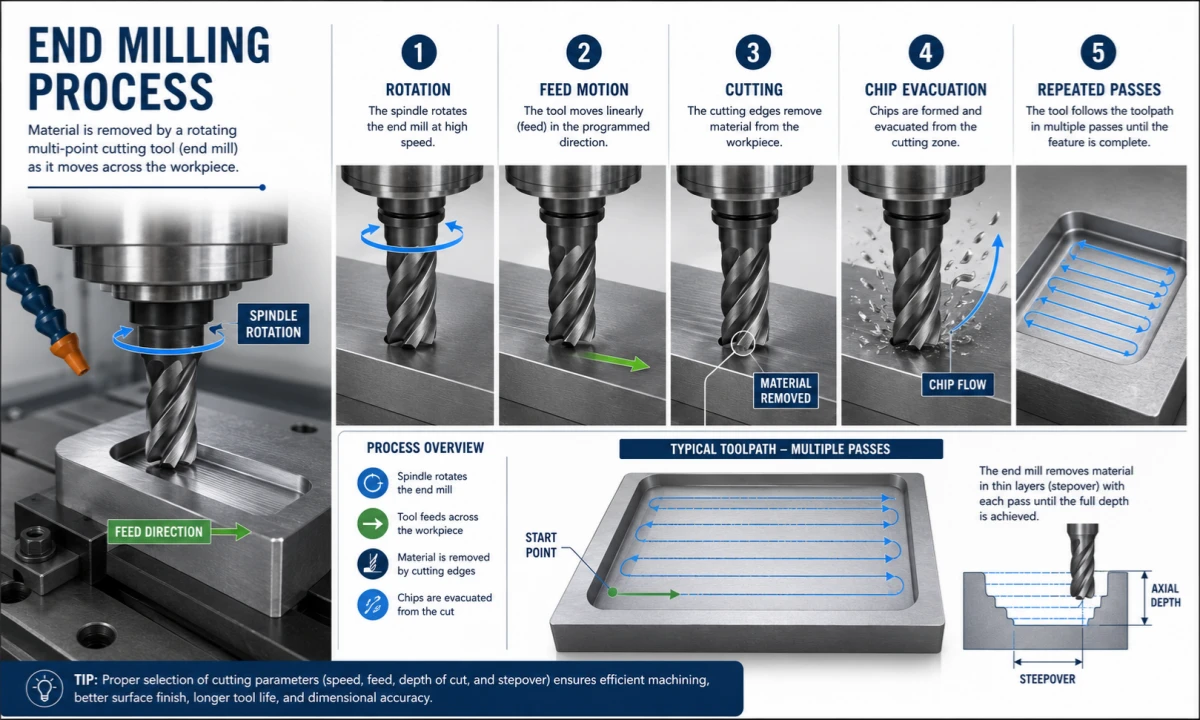
| Étape du processus | Ce qui se produit | Pourquoi c'est important |
|---|---|---|
| Rotation | Le cutter tourne à grande vitesse | Crée une action de coupe |
| Mouvement d'alimentation | L'outil ou la pièce se déplace selon une trajectoire contrôlée | Détermine l'enlèvement de matière |
| Coupe | Les bords coupent le matériau en copeaux | Forme la fonction usinée |
| Évacuation des copeaux | Les cannelures guident les copeaux | Réduit la chaleur et améliore la stabilité |
| Passes répétées | La machine suit les parcours d'outils programmés | Produit la forme finale |
Ce tableau explique de manière simple la logique de base du processus de fraisage en bout..
Coupe en bout ou coupe latérale
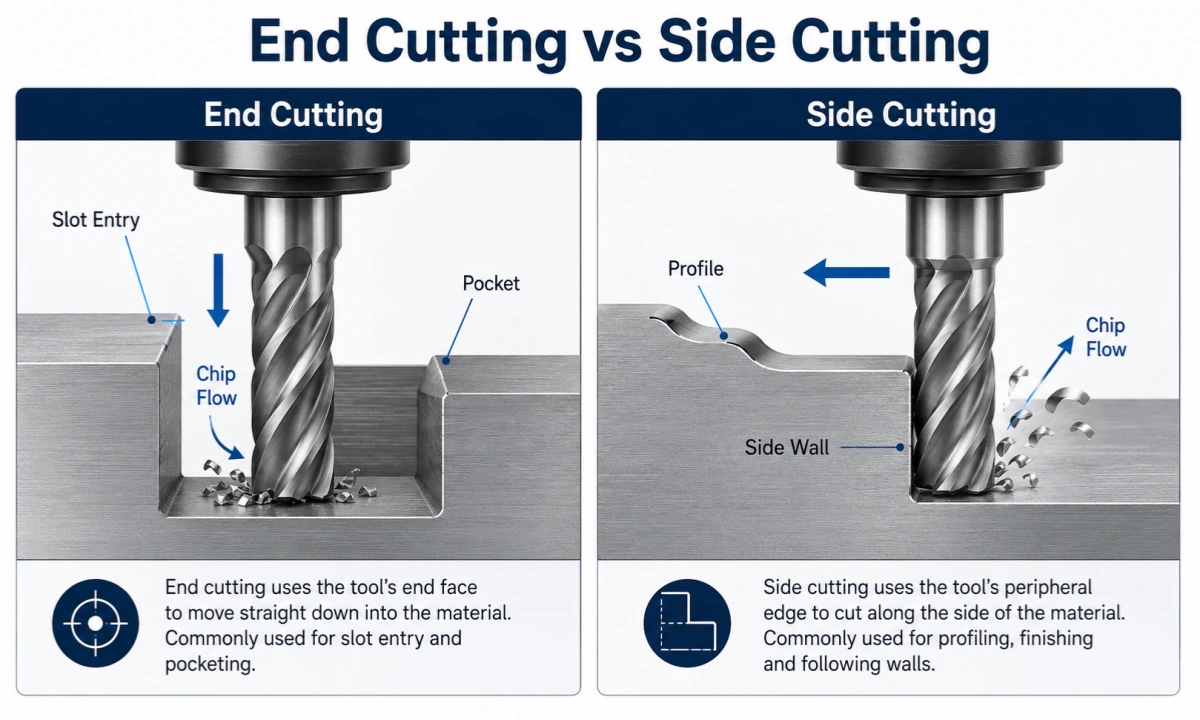
Une fraise en bout peut enlever de la matière de l'extrémité et du côté de l'outil. C'est l'une des raisons pour lesquelles il est plus flexible qu'un foret standard.
Fin de coupe
La coupe finale se produit lorsque la pointe de l'outil retire de la matière du fond d'une fente., poche, ou zone d'entrée peu profonde. Les fraises en bout à coupe centrale peuvent gérer certaines opérations de plongée ou d'entrée de poche, mais ils sont quand même différents des forets.
Coupe latérale
La coupe latérale se produit lorsque les arêtes de coupe latérales enlèvent de la matière de la paroi ou du profil d'une pièce.. Cette action de coupe est courante dans le fraisage latéral, fraisage d'épaulements, profilage, et fraisage de contours.
Pour cette raison, géométrie de l'outil, nombre de flûtes, vitesse d'avance, et la stabilité du serrage affectent les performances de la fraise dans différentes opérations..
Opérations courantes de fraisage en bout
Rainurage
Le coupeur enlève le matériau en ligne droite pour créer des rainures ou des fentes étroites.
Fraisage latéral
Les arêtes de coupe latérales usinent des parois verticales ou des surfaces latérales.
Fraisage de poche
La fraise enlève la matière d'une zone interne fermée à l'intérieur de la pièce à usiner.
Contouring
L'outil suit des chemins courbes ou façonnés pour créer des profils et des surfaces complexes.
Finition des surfaces
Une passe de finition améliore la qualité de la surface et la précision dimensionnelle.
Ces opérations expliquent pourquoi les ateliers d'usinage utilisent ces outils dans la fabrication de moules., pièces de machines, composants automobiles, pièces aérospatiales, et travail des métaux en général.
Qu'est-ce qui affecte le fonctionnement d'une fraise en bout?
Matériau de l'outil
Les outils en carbure monobloc offrent généralement une meilleure rigidité, résistance à l'usure, et des performances de coupe plus stables dans l'usinage CNC.
Pour les outils carbure dédiés, vous pouvez également visiter notre outils de fraisage en carbure monobloc page.
Nombre de flûtes
Le nombre de cannelures affecte l'évacuation des copeaux et la rigidité. Dans de nombreux cas, les machinistes choisissent moins de cannelures pour l'aluminium et plus de cannelures pour l'acier ou les matériaux plus durs.
Pour une comparaison plus approfondie, lisez notre guide de comparaison du nombre de flûtes.
Revêtement
Le bon revêtement peut améliorer la résistance à l’usure, résistance à la chaleur, et durée de vie de l'outil, surtout dans des conditions de coupe exigeantes.
Avance et vitesse
L'avance et la vitesse de broche doivent correspondre au matériau de la pièce à usiner et à la conception de l'outil.. Sinon, le couteau peut surchauffer, porter trop vite, ou laisser une mauvaise finition de surface.
Matériau de la pièce
Aluminium, acier, et l'acier inoxydable se comportent différemment lors de l'usinage. Donc, les machinistes doivent ajuster la géométrie de la fraise, revêtement, vitesse d'avance, et vitesse de broche en fonction du matériau.
Comment utiliser une fraise en bout plus efficacement
Faites correspondre l'outil au matériau
Choisissez la géométrie de l'outil, nombre de flûtes, et revêtement en fonction du matériau de la pièce à usiner.
Utiliser un serrage stable
Un support stable et une configuration appropriée aident à réduire les vibrations et à améliorer la précision de coupe.
Gardez l'évacuation des copeaux claire
Une bonne évacuation des copeaux aide à prévenir l'accumulation de chaleur et une coupe instable.
Utiliser des paramètres de coupe appropriés
Vitesse, alimentation, profondeur axiale, et l'engagement radial doit correspondre à la fraise et à la tâche d'usinage.
Surveiller l’usure des outils
Une fraise usée peut réduire la précision, qualité de surface, et efficacité d'usinage. Donc, une inspection régulière des outils est importante.
Si vous avez besoin de solutions d'outillage standard ou OEM, vous pouvez également visiter notre page produit pour les outils de fraisage CNC.
Schéma d'opération de fraisage en bout et flux de copeaux
Un diagramme clair des opérations de fraisage en bout doit montrer la rotation de la broche., sens d'alimentation, arêtes de coupe, flux de copeaux, et la zone de contact de la pièce. Ces points aident les lecteurs à comprendre comment la fraise enlève de la matière et pourquoi la stabilité de la coupe dépend à la fois du mouvement de l'outil et de l'évacuation des copeaux..
Dans une opération typique, la broche fait tourner l'outil, le mouvement d'avance déplace le couteau à travers le matériau, et les cannelures éloignent les copeaux de la zone de coupe. Si les copeaux restent près du tranchant, la chaleur et les vibrations peuvent augmenter, ce qui peut réduire la qualité de surface et la durée de vie de l'outil.
Cette explication visuelle est utile pour les lecteurs qui recherchent des schémas de fraises en bout, diagrammes d'opération de fraisage en bout, ou exemples de processus de fraisage en bout.
Erreurs courantes lors de l'utilisation d'une fraise en bout
Utiliser le mauvais nombre de flûtes
Une mauvaise sélection de goujures peut réduire l'évacuation des copeaux ou la stabilité de coupe..
Ignorer les paramètres d'avance et de vitesse
Des paramètres de coupe incorrects peuvent entraîner une surchauffe, dommages aux bords, et durée de vie courte.
Choisir le mauvais type d'outil
Une fraise à bout plat, fraise à bout sphérique, et travaux d'ébauche de fraises en bout pour différentes opérations, donc un outil ne devrait pas remplacer tous les types de couteaux.
Mauvaise évacuation des copeaux
Quand les copeaux restent dans la zone de coupe, l'état de surface et la durée de vie de l'outil peuvent tous deux en souffrir.
Utiliser une configuration pour chaque matériau
Les mêmes conditions de coupe ne fonctionnent pas aussi bien pour l'aluminium, acier, et acier inoxydable.
FAQ
Comment fonctionne une fraise en bout?
Une fraise en bout fonctionne en combinant la rotation de la broche et le mouvement d'avance. Les arêtes de coupe cisaillent le matériau de la pièce à usiner, et les cannelures éliminent les copeaux de la zone de coupe.
Qu'est-ce que le fraisage en bout?
La fraisage en bout est un processus d'usinage dans lequel une fraise en bout rotative enlève de la matière pour créer des fentes., poches, parois latérales, contours, et surfaces finies.
Quelle est la différence entre une fraise en bout et un foret?
Un foret fait principalement des trous, tandis qu'une fraise en bout peut couper verticalement et latéralement pour une plus large gamme d'opérations de fraisage.
A quoi servent les fraises en bout?
Les fraises en bout sont utilisées pour le rainurage, fraisage latéral, profilage, fraisage de poche, contouring, et finition de surface.
Une fraise en bout peut-elle être utilisée à la fois pour l'aluminium et l'acier ??
Pas toujours. Géométrie de l'outil, nombre de flûtes, revêtement, et les paramètres de coupe doivent souvent changer en fonction du matériau.
Pourquoi l'évacuation des copeaux est-elle importante en fraisage en bout?
L'évacuation des copeaux aide à contrôler la chaleur, réduire les dommages aux outils, et améliorer la stabilité de coupe et la qualité de la surface.
Conclusion
Comprendre le fonctionnement d'une fraise en bout permet d'améliorer l'efficacité de l'usinage et les performances de l'outil.. Le processus de fraisage final dépend de la rotation de la broche, mouvement d'alimentation, géométrie de pointe, et évacuation des copeaux.
Quand les machinistes correspondent au type de coupe, nombre de flûtes, revêtement, et paramètres de coupe correctement, le fraisage en bout peut produire des pièces précises, meilleure finition de surface, et des résultats d'usinage plus stables. C'est pourquoi une sélection d'outils et une configuration d'usinage appropriées sont essentielles..
Appel à l'action
À la recherche d'outils standards ou personnalisés pour l'aluminium, acier, ou usinage d'acier inoxydable?
Visitez notre page produit pour les outils de fraisage CNC ou envoyez-nous votre dessin, liste des tailles, matériel, et exigences en matière de revêtement. OMIST peut recommander des outils adaptés aux applications de fraisage CNC.