 Fraise de précision,Outils de coupe pour l’usinage CNC de chaque matériau

Milling cutter types vary by shape, conception de pointe, nombre de flûtes, revêtement, tool structure, et objectif d'usinage. Each cutter type works for a different CNC milling operation, such as slotting, facing, profilage, 3Contournage en D, ébauche, finition, thread machining, or abrasive material machining.
Choosing the right milling cutter type is important for tool life, état de surface, retrait des copeaux, stabilité de coupe, and machining cost. Par exemple, machinists commonly use an end mill cutter for slotting and profiling, while they choose a ball nose end mill for curved surfaces and mold cavities.
Donc, this guide explains common types of milling cutters, their uses, tool structures, and selection tips for different CNC machining applications.
What Are Milling Cutter Types?
Milling cutter types refer to different cutter designs used for different machining tasks. Some cutters remove material quickly. Some create flat surfaces. Others machine slots, threads, surfaces courbes, or special profiles.
En usinage CNC, the cutter type should match the operation, matériau de la pièce à usiner, rigidité de la machine, et exigence de surface. A wrong cutter type may cause poor surface finish, vibration, chip clogging, short tool life, or unstable machining.
For a general introduction, vous pouvez également lire notre guide de fraise.
Milling Cutter Types by Tool Structure
Milling cutters can also be classified by tool structure. This is useful for buyers who need to compare cost, précision, replacement method, and production scale.
Fraises solides
Manufacturers make solid milling cutters from one complete tool body. Common materials include HSS and solid carbide. Machinists often choose them for precision machining, small-batch production, pièces de moule, and applications that require good rigidity.
Solid carbide cutters are especially common in CNC machining because they offer better hardness, résistance à l'usure, and cutting stability than many general HSS tools. Cependant, the tool should still match the workpiece material, revêtement, nombre de flûtes, et paramètres de coupe.
Fraises indexables
Indexable milling cutters use a reusable cutter body with replaceable carbide inserts. When the cutting edge wears, the operator can index or replace the insert instead of replacing the whole cutter body.
Factories often use this type for face milling, fraisage d'épaulements, ébauche lourde, et production par lots. It can help reduce tool replacement cost in suitable applications, especially when machining larger parts or removing more material.
Fraises brasées
Brazed milling cutters use carbide tips brazed onto a steel body. Machinists often use them for general machining and some roughing applications.
Compared with solid carbide tools, brazed cutters can be more economical in some jobs. Cependant, they are not always the best choice for high-speed machining, high-heat cutting, or applications that require frequent tool replacement.
Common Milling Cutter Types and Uses
The table below shows common milling cutter types and their main uses. It is useful for buyers, engineers, and machinists who want to compare different cutter options before choosing a tool.
| Milling Cutter Type | Utilisation principale | Typical Application |
| Fraise en bout | Rainurage, profilage, fraisage de poche | Fraisage CNC général |
| Fraise à bout sphérique | 3D contouring and curved surfaces | Cavités de moisissures, meurt, 3Pièces D |
| Fraise à nez arrondi | Semi-finishing and stronger corners | Steel and stainless steel parts |
| Coupe-rainure en T | T-slots and undercuts | Calendrier, tables de machines, moules |
| Fraise latérale | Side cutting and grooves | Machines à sous, épaules, side surfaces |
| Fraise de surfaçage | Flat surface machining | Large surface finishing |
| Fraise à fileter | Internal and external threads | CNC thread machining |
| Fraise d'ébauche | Fast material removal | Rough machining before finishing |
| Diamond-Coated End Mill | Abrasive material machining | Graphite, CFRP, composites |
For a broader range of tool options, voir Fraises CNC.
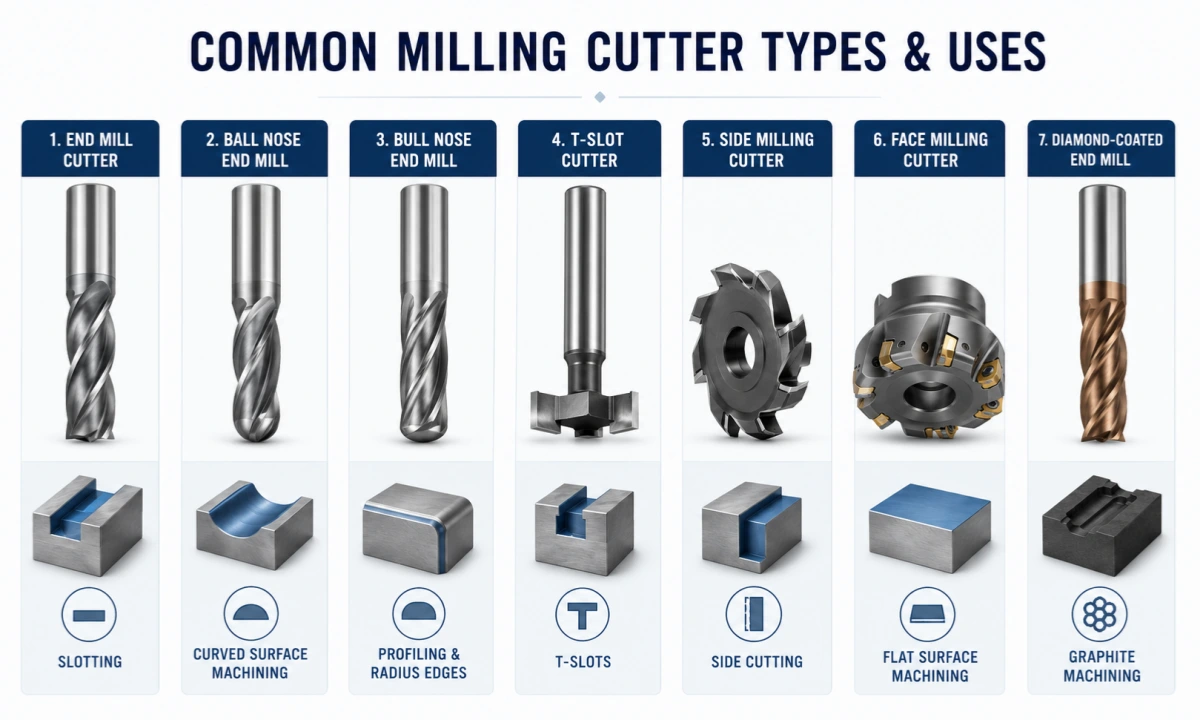
Main Types of Milling Cutters
Fraise en bout
An end mill cutter is one of the most common milling cutter types. It can cut from the side and the end of the tool, so it is suitable for slotting, profilage, fraisage de poche, contouring, et fraisage d'épaulements.
End mills come in different flute counts, revêtements, longueurs, and carbide grades. Par exemple, 2 flute end mills are often used for aluminum because they provide more chip space. En revanche, 4 flute end mills are often used for steel because they offer better rigidity and cutting stability.
Pour le fraisage CNC général, voir notre Fraise en bout.
Fraise à bout sphérique
A ball nose end mill has a round cutting tip. This cutter type is used for 3D contouring, surfaces courbes, cavités de moule, die machining, and precision finishing.
Compared with a flat end mill, a ball nose cutter can follow curved tool paths more smoothly. Cependant, it is not the best choice for sharp inside corners because the cutting tip is round.
For mold machining and curved surfaces, choisir fraises à bout sphérique.
Fraise à nez arrondi
A bull nose end mill is also called a corner radius end mill. It has a small radius on the cutting corner. This design improves corner strength and reduces chipping during machining.
Bull nose end mills are useful for semi-finishing, rough finishing, and machining materials such as steel and stainless steel. They are a good choice when a sharp square corner is not required, but stronger tool corners are needed.
For semi-finishing and stronger corners, voir fraise à nez arrondi.
Coupe-rainure en T
A T-slot cutter machines T-shaped slots and undercuts. These slots are common in machine tables, luminaires, moules, and clamping systems.
Généralement, an end mill first opens a straight slot. Alors, the T-slot cutter creates the wider undercut shape. This process helps reduce tool load and improves machining stability.
For T-slot and undercut machining, use a Fraise à rainure en T.
Fraise latérale
A side milling cutter cuts grooves, machines à sous, et surfaces latérales. It removes material from the side of the workpiece and works well for wider grooves or vertical side cutting.
This cutter type is often used in general machinery, fixture parts, composants de moule, and metalworking applications. Cependant, the setup must be stable because side cutting can create higher cutting forces.
For groove and side surface machining, voir fraise latérale.
Fraise de surfaçage
A face milling cutter is used to machine flat surfaces. It is often used for large surfaces, machine bases, mold plates, plaques de fixation, and metal blocks.
Compared with a small end mill, a face milling cutter can cover a wider cutting area. Donc, it is suitable when the workpiece needs a clean, flat, and consistent surface before the next machining step.
For large flat surface machining, voir Fraise à surfacer.
Fraise à fileter
A thread milling cutter machines internal or external threads on CNC machines. It can be useful when the part needs accurate threads, different thread sizes, or better control than traditional tapping.
Thread milling also helps reduce the risk of tap breakage in some difficult materials. Cependant, it requires proper CNC programming and a stable machining setup.
For precision thread machining, voir Fraise à fileter.
Fraise d'ébauche
A roughing end mill is designed for fast material removal. It usually has a special cutting edge design that breaks chips into smaller pieces and reduces cutting pressure.
This cutter type is often used before finishing. It removes extra material quickly and prepares the part for a smoother final surface. Cependant, roughing end mills are not usually used when the final surface finish is the main requirement.
For fast stock removal before finishing, choisir fraises d'ébauche.
Diamond-Coated End Mill
Diamond-coated end mills are used for graphite, CFRP, composites, et autres matériaux abrasifs. These materials can wear normal cutting edges quickly, so coating selection is very important.
Diamond coating can improve wear resistance and help extend tool life in graphite machining. Cependant, the tool should still match the workpiece material, paramètres de coupe, et état de la machine.
For graphite and abrasive materials, choisir fraises en bout diamantées.
How to Choose Milling Cutter Types by Operation
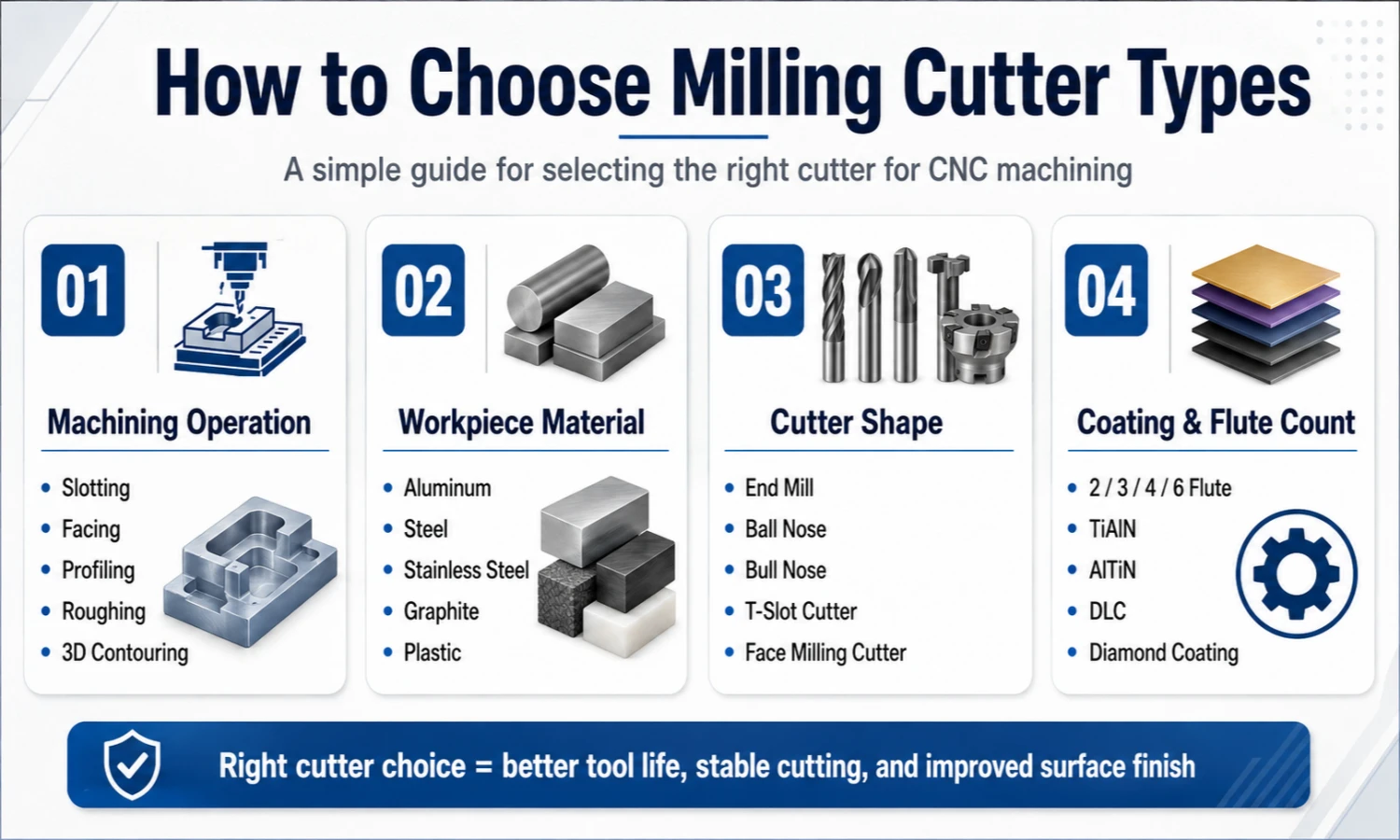
Different machining operations need different cutter types. Donc, you should choose the cutter based on the cutting task first.
| Opération d'usinage | Recommended Cutter Type | Reason |
| Rainurage | End mill cutter | Good for straight slots and pockets |
| T-slot machining | Fraise à rainure en T | Creates T-shaped slots and undercuts |
| Facing | Fraise à surfacer | Machines flat surfaces efficiently |
| Profilage | End mill cutter | Cuts side walls and contours |
| 3Contournage en D | Ball nose end mill | Follows curved surfaces |
| Semi-finition | Fraise à nez arrondi | Provides stronger cutting corners |
| Ebauche | Roughing end mill | Removes material faster |
| Thread machining | Thread milling cutter | Cuts internal and external threads |
| Graphite machining | Diamond-coated end mill | Improves wear resistance |
Cutter Type for Slotting
End mill cutters are usually the most common choice for slotting. In aluminum machining, un 2 flute end mill often works well because it provides more chip space.
When cutting steel slots, machinists may choose a 2 flûte ou 4 flute tool depending on slot depth, liquide de refroidissement, et rigidité de la machine.
Cutter Type for Steel Machining
L'acier a besoin d'arêtes de coupe plus solides et d'une meilleure rigidité des outils. Pour cette raison, un 4 flute end mill is often used for general steel milling, profilage, and side milling.
En outre, coated carbide tools can improve heat resistance and tool life.
Cutter Type for Finishing
Finishing requires stable cutting and better surface quality. Donc, many machinists choose 4 flûte ou 6 flute end mill tools when chip evacuation is not a major problem.
A higher flute count can improve surface finish, but the tool must match the machine rigidity and cutting parameters.
How to Choose Milling Cutter Types by Material
Workpiece material also affects cutter selection. A cutter type that works well for aluminum may not work well for stainless steel or graphite.
| Matériau de la pièce | Suggested Cutter Type | Raison principale |
|---|---|---|
| Aluminium | 2 flûte ou 3 fraise à cannelure | Meilleure évacuation des copeaux |
| Acier | 4 fraise en bout de carbure de cannelure | Better rigidity and stability |
| Acier inoxydable | Fraise en carbure revêtue | Meilleure résistance à la chaleur et à l’usure |
| Graphite | Diamond-coated end mill | Meilleure résistance à l'usure |
| Acier trempé | Outil en carbure revêtu haute performance | Tranchant plus fort |
| Plastic | 1 flûte ou 2 outil de flûte | Reduces chip clogging |
When choosing a cutter type, do not only compare price. Plutôt, vérifier le matériau de la pièce à usiner, profondeur de coupe, longueur de l'outil, revêtement, nombre de flûtes, et exigence de finition de surface.
For high-performance carbide tools, voir Fraise en carbure de bois.
Milling Cutter Types Selection Checklist
Before choosing a milling cutter type, check these points:
| Point de sélection | Que vérifier |
|---|---|
| Opération d'usinage | Rainurage, facing, profilage, ébauche, finition |
| Matériau de la pièce | Aluminium, acier, acier inoxydable, graphite, plastique |
| Cutter Shape | Plat, nez sphérique, nez de taureau, T-slot, coupe latérale |
| Tool Structure | Solid, indexable, brazed |
| Matériau de l'outil | HSS, carbure, coated carbide, diamond-coated carbide |
| Nombre de flûtes | 2 flûte, 3 flûte, 4 flûte, 6 flûte |
| Revêtement | TiAlN, Or, Contenu téléchargeable, revêtement de diamant |
| Taille de l'outil | Diamètre, longueur de flûte, diamètre de la tige, longueur totale |
| État de la machine | Rigidité, vitesse de broche, porte-outil |
| Exigence de surface | Ebauche, semi-finition, finition |
En bref, the best milling cutter type depends on both the material and the machining operation. A suitable cutter can reduce tool wear, improve surface finish, and make CNC milling more stable.
FAQ About Milling Cutter Types
What are the main types of milling cutters?
Common milling cutter types include end mill cutters, fraises à bout sphérique, bull nose end mills, Fraises à rainure en T, fraises latérales, fraises à surfacer, thread milling cutters, fraises d'ébauche, and diamond-coated end mills.
They can also be classified by tool structure, such as solid milling cutters, indexable milling cutters, and brazed milling cutters.
What is the most common milling cutter type?
The end mill cutter is one of the most common milling cutter types. Il est largement utilisé pour le rainurage, profilage, fraisage de poche, fraisage d'épaulements, and general CNC machining.
Pour les applications générales de fraisage, voir Fraise en bout.
Which milling cutter type is used for slots?
End mill cutters are commonly used for straight slots. For T-shaped slots, a T-slot cutter is used after the first straight slot is opened.
For special slot machining, voir Fraise à rainure en T.
Which milling cutter type is used for curved surfaces?
Ball nose end mills are used for curved surfaces, cavités de moule, 3Contournage en D, and die machining. Their round tip can follow complex tool paths and create smooth curved surfaces.
For 3D surface machining, choisir fraises à bout sphérique.
Which milling cutter type is used for flat surfaces?
Face milling cutters are often used for large flat surfaces. End mills can also machine smaller flat areas when more flexible tool movement is needed.
What is the difference between solid and indexable milling cutters?
Solid milling cutters are made from one complete tool body and are often used for precision machining, small-batch production, and smaller tool sizes.
Indexable milling cutters use a reusable cutter body with replaceable inserts. They are often used for larger tools, fraisage du visage, ébauche, et production par lots.
How do I choose the right milling cutter type?
D'abord, confirm the machining operation. Alors, vérifier le matériau de la pièce à usiner, required surface finish, profondeur de coupe, rigidité de la machine, revêtement, nombre de flûtes, tool structure, and tool size.
If the job involves abrasive materials such as graphite, diamond-coated tools may be a better choice. If the job requires large flat surface machining, a face milling cutter may be more suitable. Pour le rainurage et le profilage généraux, an end mill cutter is often the first option.
Conclusion
Milling cutter types include end mill cutters, fraises à bout sphérique, bull nose end mills, Fraises à rainure en T, fraises latérales, fraises à surfacer, thread milling cutters, fraises d'ébauche, and diamond-coated end mills. They can also be classified by tool structure, such as solid, indexable, and brazed milling cutters.
Each cutter type has a different function, so the right choice depends on the machining operation, matériau de la pièce à usiner, état de la machine, surface requirement, et quantité de production.
Pour le fraisage CNC général, many factories start with an end mill cutter because it is suitable for slotting, profilage, et fraisage de poches. For abrasive materials such as graphite and CFRP, diamond-coated end mills are usually a better choice because they offer better wear resistance.
If you are not sure which milling cutter type is suitable for your application, envoyez-nous votre matière à usiner, opération d'usinage, taille de l'outil, exigence de revêtement, et dessin. We can help you choose a suitable milling cutter or provide a custom tool solution.
A wider product range is available in our Fraises CNC.