 精密フライスカッター,あらゆる材料を加工するCNC用の切削工具

A 3 フルートエンドミルは主にアルミ加工に使用されます。, 側面フライス加工, プロファイルフライス加工, controlled slotting, ポケットフライス加工, 中仕上げ, そして仕上げ. Its three cutting edges provide a practical balance between chip space, cutter rigidity, and surface quality.
Compared with a 2 フルートカッター, the third cutting edge increases tool engagement and supports more stable side milling. 同時に, a three-flute design normally retains more chip space than many higher-flute tools.
This balance makes the cutter useful for aluminum parts that require clean walls and controlled chip removal. しかし, the correct choice still depends on the operation, 切込み深さ, ツールリーチ, machine setup, and coolant method.
簡単な回答: Common Uses of a 3 フルートエンドミル
代表的なアプリケーションには次のものがあります。:
- Aluminum and aluminum-alloy machining
- 側面フライス加工
- プロファイルおよび輪郭フライス加工
- Controlled slotting
- Pocket milling
- Step and shoulder milling
- 中仕上げ
- 仕上げ
A three-flute cutter works best when the machining process needs both chip evacuation and stable cutting. It is especially useful for profiling and finishing operations where wall quality matters.
For deep full-width slots or heavy roughing, ある 2 flute tool may work better because it offers larger flute spaces.
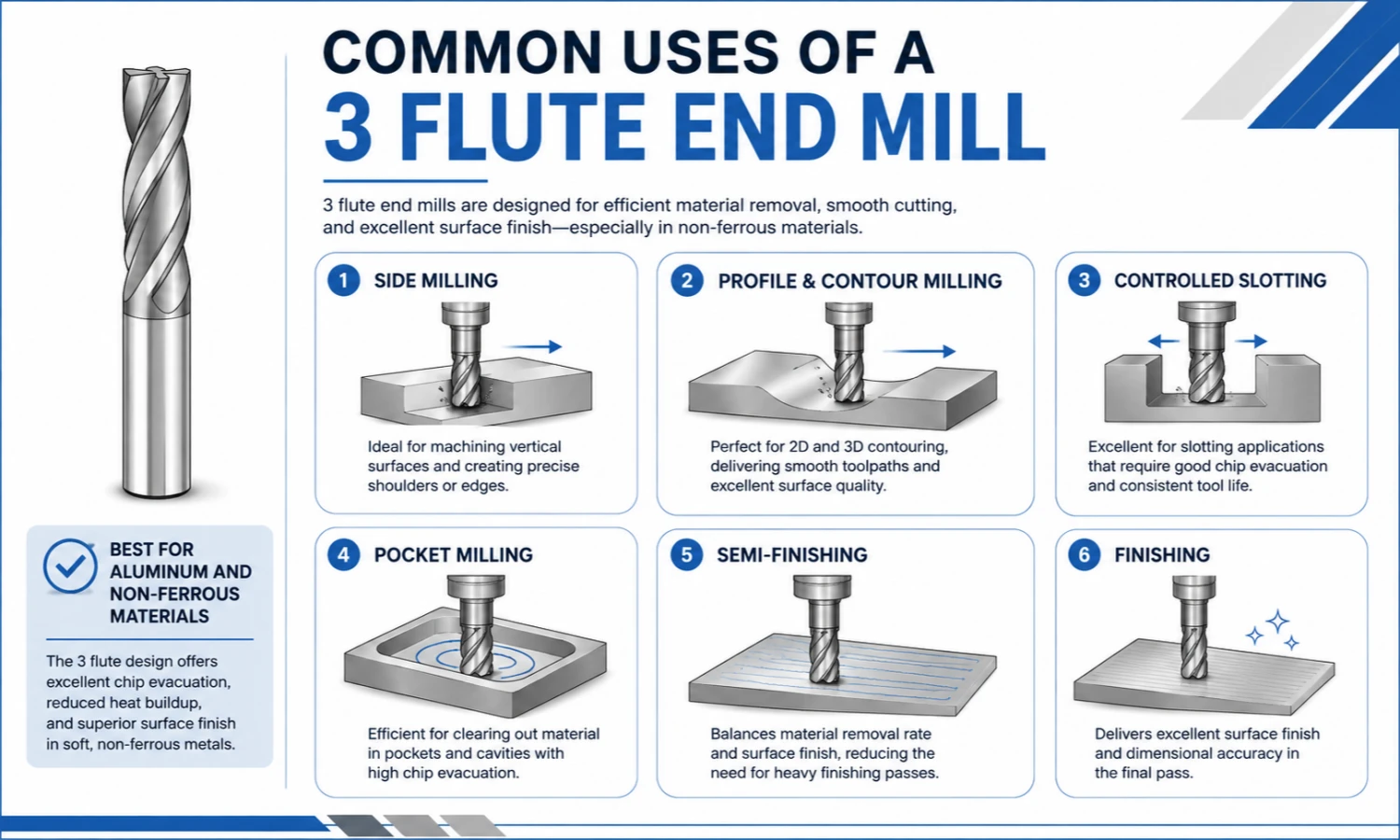
Why Three Flutes Work Well in Aluminum
Flute Space Helps Control Aluminum Chips
Aluminum often produces large or continuous chips. If these chips remain inside the cutting area, they may be recut, collect in the flutes, or stick to the cutting edge.
A three-flute cutter keeps useful chip space while adding another cutting edge. したがって, it can remove aluminum efficiently when the toolpath, 冷却剤, air blast, スピード, and feed support smooth chip evacuation.
The cutter does not solve poor chip control by itself. Deep engagement, excessive tool load, or weak coolant delivery can still cause chip packing.
A Stronger Core Supports Cutting Stability
In comparable cutter designs, adding a third flute usually increases the core section compared with a two-flute tool. A stronger core can reduce tool deflection and support more stable engagement.
This matters during side milling, プロファイリング, そして仕上げ. Less deflection can help maintain wall geometry and produce a more consistent surface.
しかし, tool length also matters. A long flute length or excessive overhang can reduce rigidity even when the cutter has a strong core.
More Cutting-Edge Engagement Can Improve Finish
The additional cutting edge increases the number of cutting engagements per tool revolution. 結果として, the tool can support a smoother and more consistent finish under suitable conditions.
なくなる, ホルダーの状態, 歯当たりの送り, edge geometry, and machine rigidity still affect the final result. Flute count is important, but it is only one part of the cutting system.
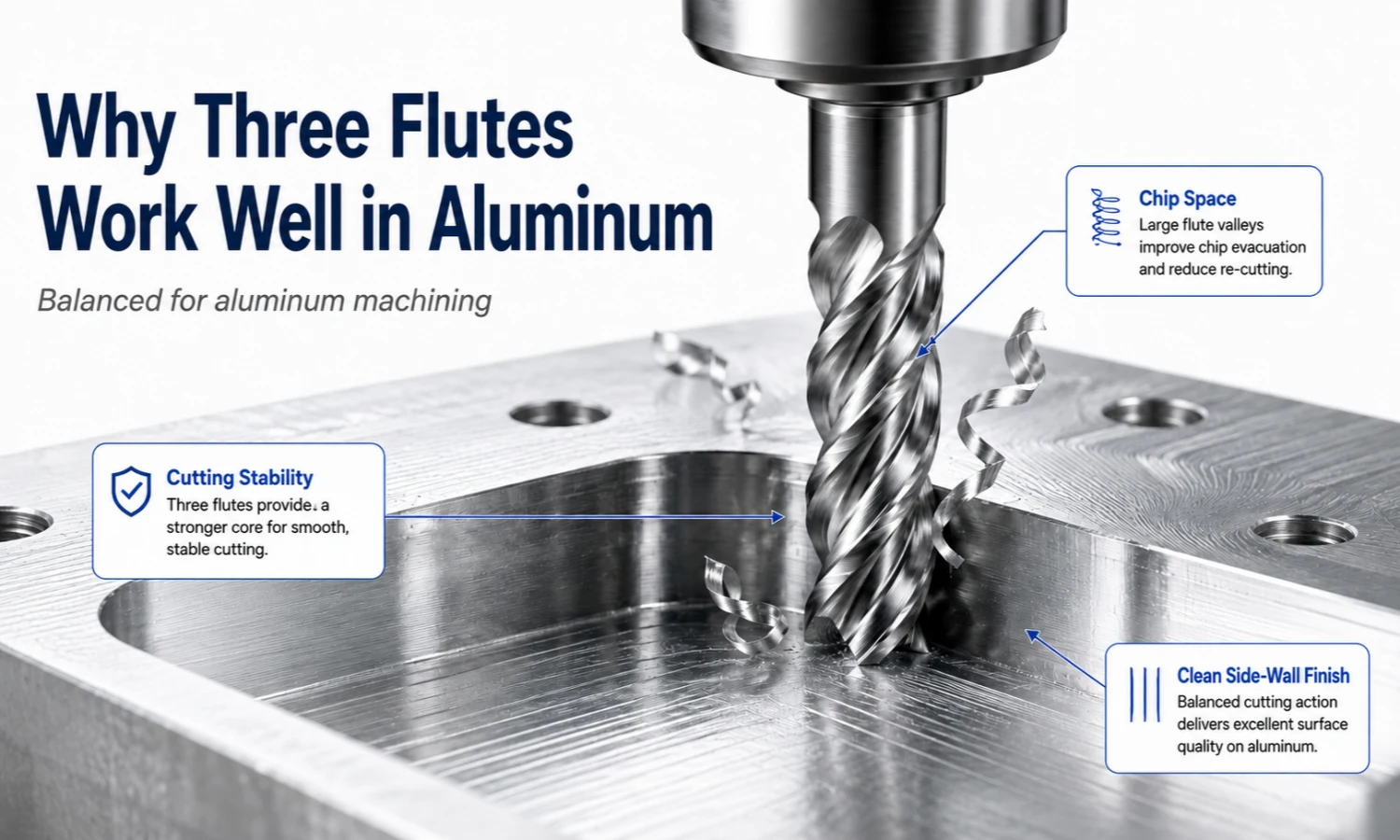
Main 3 Flute End Mill Applications
側面フライス加工とプロファイリング
Side milling and profile milling are common uses of a three-flute cutter. These operations need stable contact, accurate wall geometry, and controlled chip removal.
The third cutting edge supports regular engagement with the workpiece. Meanwhile, the flute spaces leave room for aluminum chips.
This combination suits straight walls, external profiles, internal contours, and component edges.
Controlled Slotting
A 3 flute end mill can machine slots when the slot depth and chip-control conditions are suitable.
For shallow or controlled slotting, it provides a good balance between material removal and stability. しかし, full-width slotting places all three cutting edges in contact with the material and leaves less room for chips.
If chips begin to collect inside a deep slot, reduce the cutting load, improve coolant or air delivery, or move to a 2 フルートカッター.
ポケットミーリング
Pocket milling requires both stable cutting and an effective toolpath. The cutter must remove material while allowing chips to leave the pocket.
A ramping entry, helical entry, or adaptive toolpath can reduce chip recutting. 対照的に、, aggressive full-width engagement may overload the cutter or trap chips.
Toolpath design therefore matters as much as flute count.
中仕上げと仕上げ
Three-flute cutters also work well for semi-finishing and finishing aluminum parts.
The additional cutting edge can support cleaner walls and a more uniform surface than some two-flute tools. したがって, this flute count is useful when surface quality matters more than maximum chip volume.
What Materials Can a 3 Flute End Mill Cut?
アルミニウムおよびアルミニウム合金
Aluminum is the main application for many three-flute tools. The design combines chip space with the rigidity needed for side milling, プロファイリング, ポケット, そして仕上げ.
Before selecting the cutter, review the aluminum grade, 手術, 切込み深さ, chip form, クーラント方式, そして仕上げ要件.
Copper and Brass
A three-flute carbide cutter can also machine copper and brass when its edge geometry and cutting conditions suit the material.
Sharp cutting edges and good chip control help reduce burrs and maintain surface quality. しかし, copper and brass do not behave exactly like aluminum, so one tool design may not suit every grade.
Plastics and Other Non-Ferrous Materials
Some plastics and other non-ferrous materials can also be machined with a three-flute tool.
For plastics, heat buildup and chip melting may become important. したがって, use a tool geometry and coolant method that keep the cutting zone clear.
Composite Materials
A three-flute cutter may suit selected composites, but composite structures vary widely. Fiber direction, resin content, エッジ品質, and delamination risk can change the required geometry.
For composite applications, confirm the material structure and cutting goal before choosing the tool.
Common Problems and Practical Checks
| Machining Problem | Practical Check |
|---|---|
| Chips collect inside a slot | Reduce engagement, improve coolant or air blast, or consider a 2 フルートカッター |
| Aluminum sticks to the edge | Check chip evacuation, lubrication, edge geometry, and surface treatment |
| Side walls look rough | Check runout, 工具オーバーハング, ホルダーの状態, 餌, and radial engagement |
| Chatter or vibration occurs | Shorten tool reach, improve clamping, and reduce unstable engagement |
| Tool life is inconsistent | Review runout, chip recutting, 切削負荷, 冷却剤, and tool selection |
| Burrs remain on the part | Check edge sharpness, 工具の摩耗, cutting direction, and finishing parameters |
These symptoms do not always come from flute count. 例えば, changing from two flutes to three flutes will not correct excessive runout or a weak tool holder.
Start by checking the complete setup. Then adjust the flute count if chip space, 剛性, or cutting-edge engagement remains the main problem.
いつですか 3 Flute End Mill a Good Choice?
Choose a three-flute cutter when:
- The workpiece is aluminum or another suitable non-ferrous material
- The operation includes side milling or profiling
- Wall quality is important
- Semi-finishing or finishing is required
- A 2 flute tool does not provide enough stability
- A higher-flute tool leaves insufficient chip space
- The toolpath and coolant method can control chip evacuation
The cutter is not automatically the best option for every aluminum job. 切込み深さ, ラジアルかみ合い, ツールリーチ, 機械剛性, and chip form should guide the final decision.
When Should You Choose Another Flute Count?
Different flute counts suit different materials, chip-control needs, and machining operations. The following comparison provides a quick selection reference.
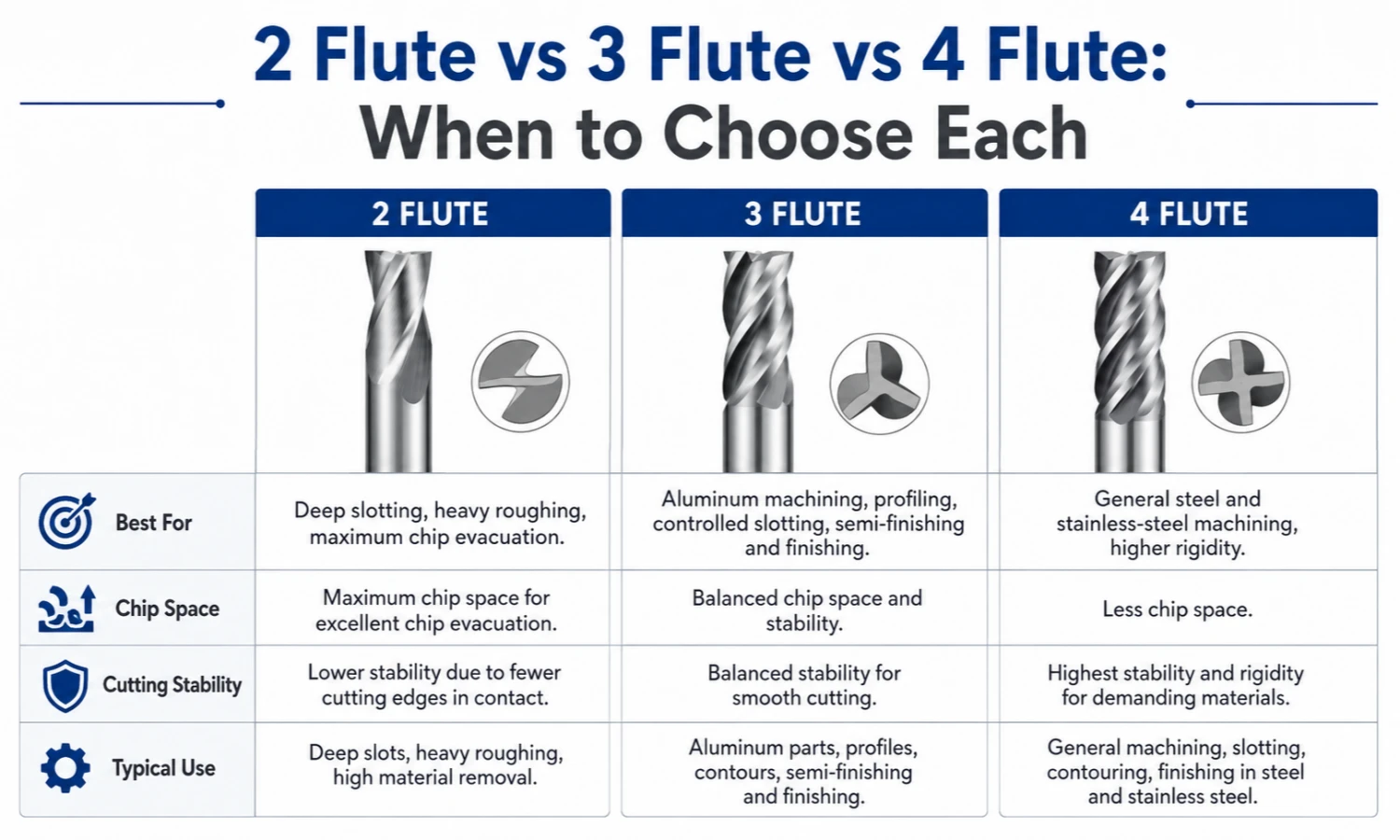
選ぶ 2 Flutes for Deep Slotting and Heavy Roughing
A 2 flute cutter provides larger flute spaces. It is often the better choice for:
- 全幅の深い溝加工
- Heavy aluminum roughing
- Large chip loads
- Operations where maximum chip evacuation is the main concern
A three-flute cutter becomes more attractive when wall quality and cutting stability matter more.
詳細な比較については, 私たちのを読んでください 2 フルート対 3 flute end mill for aluminum guide.
You can also view our 2 フルートエンドミル for deep slotting and aluminum roughing.
Consider 4 Flutes for Steel and Stainless Steel
A 4 flute cutter provides more cutting edges and often has a stronger core than a lower-flute tool. It is commonly selected for general steel and stainless-steel machining, where chip volume may be lower and rigidity is important.
しかし, four flutes are not automatically better. The correct choice depends on the material, chip form, 切込み深さ, and operation.
For steel and stainless-steel applications, 私たちのものを見る 4 フルートエンドミル.
How to Select a 3 フルートエンドミル
Start with the Workpiece Material
初め, identify the material and grade. アルミニウム, 銅, 真鍮, プラスチック, and composites produce different chips and cutting temperatures.
The material affects the required edge geometry, surface treatment, and chip-control method.
Match the Tool to the Operation
次に, 主な操作を特定する.
A cutter used for side milling may need a different flute length and edge design from one used for slotting, ポケット, または仕上げ.
Full-width engagement also creates different chip-control demands from light radial finishing.
Choose Suitable Dimensions and Reach
Important dimensions include:
- 切断径
- 刃長さ
- 全長
- シャンク径
- 首の長さ, when required
Use the shortest practical flute length and overall length. A shorter setup generally improves rigidity and reduces vibration.
Long-reach tools can access deep or restricted features. しかし, additional overhang increases deflection risk, so the cutting strategy must match the setup.
Review Edge Geometry and Surface Treatment
Edge geometry and surface treatment should match the material, 手術, 冷却水の状態, chip-adhesion risk, 必要な工具寿命.
アルミ用, sharp cutting edges and smooth chip flow are especially important. The correct option should be selected for the application rather than chosen only by coating name.
Confirm Starting Parameters for the Actual Tool
A single speed and feed value cannot fit every three-flute cutter.
工具径, 刃の長さ, エッジデザイン, コーティング, workpiece grade, 機械剛性, ホルダー, 冷却剤, 軸方向の深さ, and radial engagement all affect the starting parameters.
したがって, use parameters supplied for the confirmed tool specification. Begin with a controlled trial, then review chip form, surface finish, 主軸負荷, sound, and cutter wear.
よくある質問
とは何ですか 3 に使用されるフルートエンドミル?
It is mainly used for aluminum operations that require controlled chip evacuation, 安定した切断, and clean side walls.
It is selected when the operation needs both chip evacuation and stable cutting.
Is a Three-Flute Cutter Suitable for Deep Slotting?
It may work in controlled slots, but it is not normally the first choice for very deep full-width slotting.
Deep slots leave less room for chips to escape. In that situation, ある 2 フルートカッター, lighter engagement, or a different toolpath may provide better chip control.
Why does aluminum stick to the cutting edge?
Aluminum may stick when chips are not removed quickly, lubrication is insufficient, the cutting edge is worn, or the tool geometry does not suit the material.
Check coolant or air delivery, chip recutting, 切削負荷, edge condition, and surface treatment.
Can a Three-Flute Cutter Machine Steel?
3 枚刃カッターは、選択された鋼材用途向けに設計可能. しかし, 多くの 3 枚刃工具は、主にアルミニウムおよび非鉄材料を対象としています。.
一般鋼・ステンレス鋼加工用, ある 4 フルート工具は、剛性と刃数のより適切なバランスを提供する可能性があります。.
が必要です 3 アルミ用フルートエンドミル?
製品仕様について, カスタムディメンション, 幾何学, コーティング, マーキング, およびパッケージングオプション, 私たちのものを見る 3 アルミ用フルート超硬フラットエンドミル.
ワーク素材を送る, 機械加工作業, 必要な寸法, 量, および利用可能な図面または現在のカッター情報.
描いた絵をメールで送信する, ツールの写真, または要件 sales@cutterbest.com.