 정밀 밀링 커터,모든 재료를 가공하는 CNC용 절삭 공구

Tapered end mills are CNC milling tools used to machine draft angles, 테이퍼형 측벽, 금형 구멍, deep profiles, 좁은 홈, and detailed machined features. Unlike a standard straight end mill, the cutting diameter gradually increases from the tip toward the shank.
결과적으로, the tool can follow angled surfaces while providing more support behind the small cutting tip. 하지만, the correct cutter still depends on the taper angle, 팁 직경, 끝 기하학, 공작물 재료, 절단 깊이, 그리고 기계상태.
This guide explains what tapered end mills are used for, how different types work, and how to select a suitable tool for mold making, 조각, 프로파일 밀링, and other CNC applications.
What Is a Tapered End Mill?
A tapered end mill is a milling cutter with a cutting section that gradually becomes larger from the tip toward the shank. The tool may have a flat end, 공 코, 코너 반경, or custom cutting profile.
Manufacturers often use these tools when a part includes angled walls, 구배 각도, 테이퍼 홈, 깊은 충치, or small details that cannot be machined efficiently with a straight cutter.
The main dimensions usually include:
| Tool Feature | Description |
| 테이퍼 각도 | The angle formed by the tapered cutting section |
| 팁 직경 | The smallest cutting diameter near the tool tip |
| Maximum cutter diameter | The largest diameter of the cutting section |
| 플루트 길이 | The length of the cutting edges |
| 전체 길이 | The complete tool length from tip to shank end |
| 생크 직경 | The diameter held by the tool holder |
| End geometry | Flat end, 공 코, radius end, or custom form |
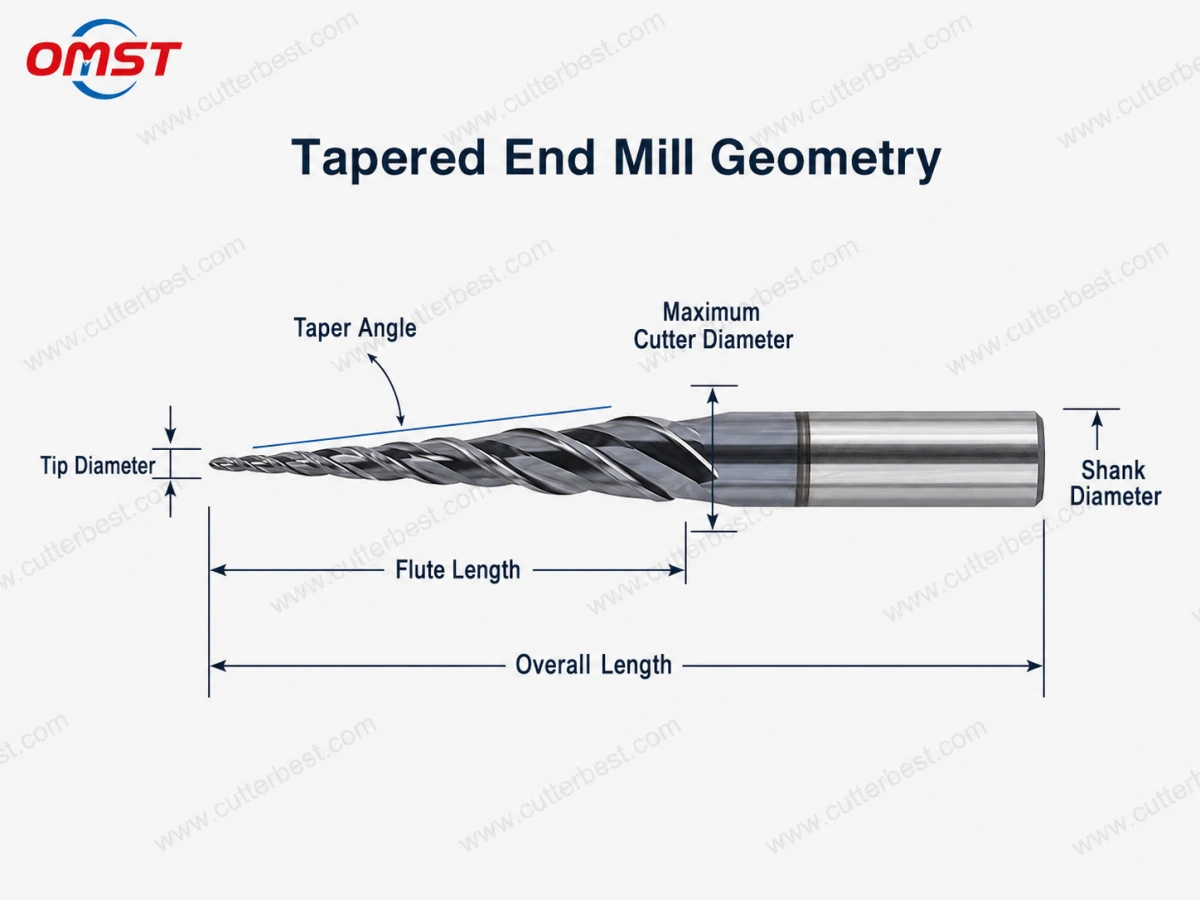
Before ordering a cutter, confirm whether the drawing shows a single-side taper angle or a total included angle. 그렇지 않으면, the finished profile may not match the part design.
테이퍼 엔드 밀은 무엇에 사용됩니까??
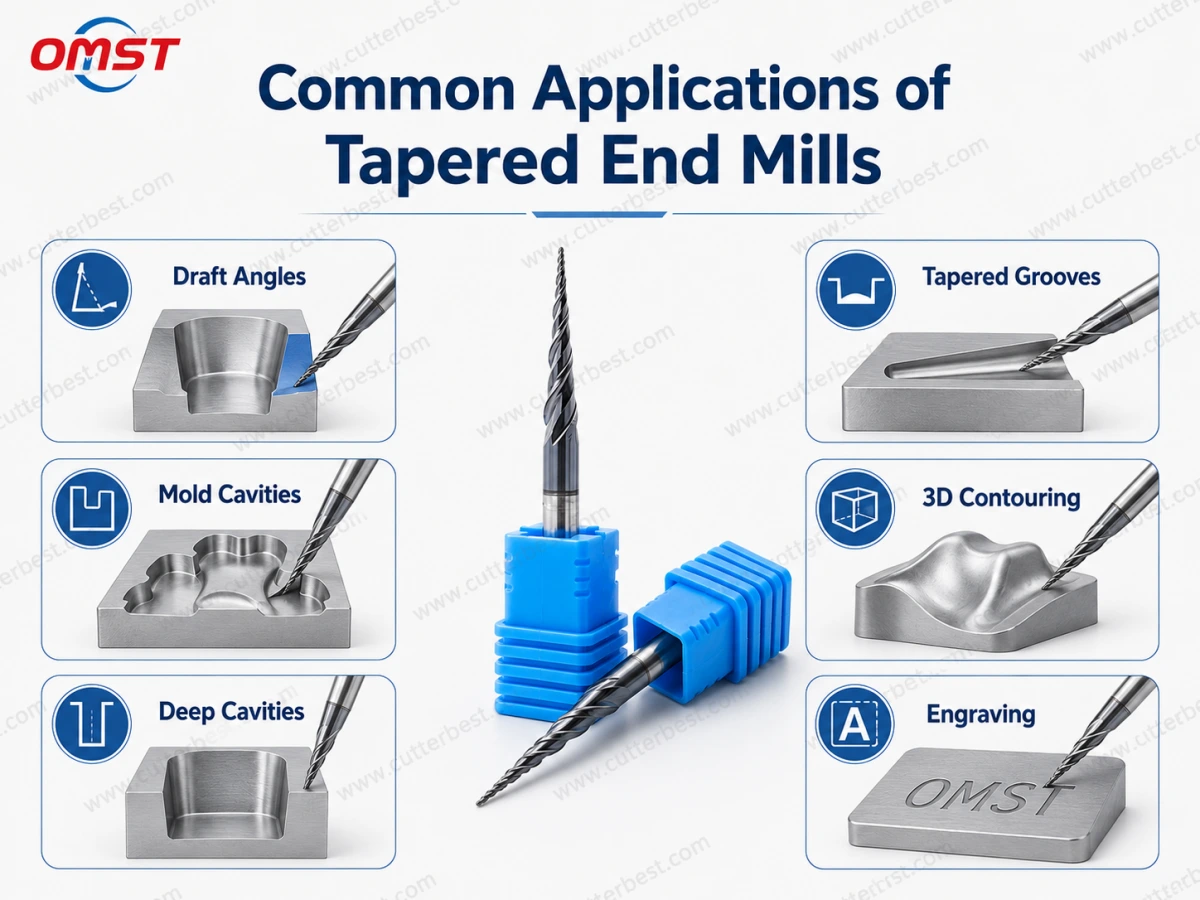
Tapered end mills are used for CNC operations that require angled surfaces, gradually changing wall profiles, small cutting tips, or improved support during long-reach machining.
Their most common applications include mold making, draft-angle milling, tapered groove cutting, deep-cavity machining, 3D 컨투어링, 조각, and custom profile production.
Machining Draft Angles and Tapered Sidewalls
Many molds, 죽는다, and machined components include draft angles. These angles help molded parts release more easily and allow designers to create non-vertical walls.
A tapered end mill can machine the required angle directly when the cutter geometry matches the drawing. 그러므로, the tool is often used for:
- Mold draft walls
- Tapered pockets
- Angled sidewalls
- Sloped profiles
- Non-parallel surfaces
하지만, the cutter angle must be confirmed carefully. Even a small difference between the tool angle and the drawing can affect the final wall geometry.
Mold and Die Cavity Machining
Mold cavities frequently contain deep areas, 각진 벽, 곡면, and detailed transitions. A standard end mill may not reach these features efficiently, especially when the cavity becomes narrow near the bottom.
A tapered cutter can provide a small cutting tip while maintaining a larger cross-section closer to the shank. 따라서, it may offer better rigidity than a straight tool with a similar tip diameter and reach.
일반적인 금형 및 다이 애플리케이션에는 다음이 포함됩니다.:
- Injection mold cavities
- 다이캐스팅 금형
- Forming dies
- Electrode machining
- Draft-wall finishing
- Detailed cavity profiles
For curved cavities and 3D surfaces, a tapered ball-nose design is often selected.
Deep-Cavity and Long-Reach Machining
Deep cavities require additional tool reach. 그럼에도 불구하고, increasing the tool length can also increase vibration and deflection.
Because a tapered tool becomes thicker toward the shank, it can provide more support behind the cutting area. This geometry may improve stability during light profiling and finishing operations.
Actual performance still depends on:
- 팁 직경
- 테이퍼 각도
- 플루트 길이
- 공구 오버행
- 공구 홀더 런아웃
- 기계 강성
- 공작물 재료
- 절단 매개변수
A tapered design does not replace a proper machining setup. 그러므로, use the shortest practical tool length whenever possible.
Tapered Grooves and Special Profiles
Tapered grooves have non-parallel walls, so they cannot always be produced with a standard straight end mill in one operation.
A taper milling cutter may be used for:
- Tapered slots
- 각진 홈
- V-shaped profiles
- Special form features
- 맞춤형 CNC 부품
- Non-standard machine parts
When the groove has a special angle or profile, a custom tool may reduce the number of machining steps.
3D Contouring and Curved Surfaces
A tapered ball nose end mill combines a tapered cutting section with a rounded tip. This tool is suitable for curved surfaces, 3D 윤곽, 및 금형 마무리.
일반적인 응용 분야는 다음과 같습니다.:
- 금형 캐비티 마무리
- Curved component surfaces
- 3D profile milling
- Complex die shapes
- Transition surfaces
- Sculptured parts
The ball radius, 테이퍼 각도, and tool path must work together. 게다가, a small step-over is normally required when a finer surface finish is needed.
For curved surfaces and 3D profiles that require tapered geometry, 우리를 보아라 테이퍼 볼 노즈 엔드밀.
Engraving and Fine Detail Machining
Micro tapered end mills are often used for small details, 좁은 특징, fine engraving, and miniature mold components.
A small tip can enter tight areas. 그 동안에, the tapered body supports the tool behind the cutting edge.
These tools may be used for:
- Fine lettering
- Small mold details
- Narrow channels
- Decorative profiles
- Precision engraving
- Miniature components
하지만, micro cutters are sensitive to runout and excessive cutting load. 그러므로, 도구 보유, 스핀들 상태, and cutting parameters must be checked carefully.
Common Tapered End Mill Applications
The following table summarizes several common uses:
| 애플리케이션 | Suitable Cutter Type | Main Selection Point |
| Draft-angle machining | Tapered flat end mill | Match the taper angle to the drawing |
| 금형 캐비티 마무리 | Tapered ball nose end mill | Confirm radius, 도달하다, 표면 요구 사항 |
| 테이퍼 홈 밀링 | Flat-end or custom tapered cutter | Check groove width and wall angle |
| Deep-cavity profiling | Rigid carbide tapered end mill | Minimize overhang and control cutting load |
| 정밀한 조각 | Micro tapered end mill | Control runout and tip diameter |
| Curved 3D surfaces | 테이퍼 볼 노즈 커터 | Select suitable radius and step-over |
| Custom profiles | 맞춤형 테이퍼 커터 | Provide a complete drawing and material information |
Why Use a Tapered End Mill?
A tapered end mill is not required for every milling operation. 하지만, it offers several practical advantages when the workpiece contains angled or difficult-to-reach features.
Improved Rigidity in Long-Reach Applications
A small straight end mill with a long cutting length may deflect under cutting pressure. 비교하여, a tapered tool has more material behind the small tip.
결과적으로, the increasing cross-section can help improve rigidity during suitable finishing and profile-milling operations.
아직, rigidity depends on the complete setup. 공구 직경, 초경 등급, 홀더 상태, 절단 깊이, and machine stability must also be considered.
Better Access to Angled and Narrow Areas
The small tip can enter narrow areas, while the tapered cutting edges follow an angled wall. 그러므로, one cutter may reach features that would otherwise require several operations or special tool paths.
This is especially useful in mold cavities, detailed parts, and tapered grooves.
Direct Machining of the Required Wall Angle
When the cutter angle matches the part design, the tapered cutting edge can machine the complete wall angle directly.
This may simplify the tool path and improve profile consistency. 하지만, the angle must be checked before production because drawings may use different angle definitions.
Stable Finishing of Tapered Profiles
A suitable tapered tool can provide stable contact along an angled profile. 게다가, the correct flute design and coating can improve chip evacuation and wear resistance.
For the best result, the cutting parameters should be validated through a controlled test cut before full production.
Common Types of Tapered End Mills
Different end geometries are selected for different workpiece features.
Tapered Flat End Mills
A tapered flat end mill has a flat cutting tip. It is commonly used for:
- 평평한 바닥 테이퍼형 홈
- Angled sidewalls
- Draft profiles
- Mold features
- Tapered slots
This design is suitable when the bottom surface must remain relatively flat.
For this flat-end tapered geometry, 우리를 보아라 테이퍼 스퀘어 엔드밀.
Tapered Ball Nose End Mills
A tapered ball nose end mill has a rounded cutting tip. It is mainly used for:
- 곡면
- 3D 윤곽
- 금형 공동
- Complex profiles
- Surface finishing
Because the tip is rounded, the tool can follow curved tool paths more smoothly than a flat-end cutter.
Tapered Radius End Mills
A tapered radius end mill includes a corner radius between the tool bottom and side cutting edges.
The radius can strengthen the cutting corner and produce a smooth transition between the bottom and sidewall. 그러므로, this type may be used for semi-finishing, mold profiles, and filleted features.
For tapered cutting geometry with a flat end and R transition, 우리를 보아라 테이퍼 코너 반경 엔드밀.
Micro Tapered End Mills
Micro tapered cutters have a very small tip diameter. They are used for detailed profiles, 좁은 특징, 조각, and miniature cavities.
Since the tip is small, runout control is critical. Even limited runout can increase uneven cutting loads and shorten tool life.
Custom Form Tapered Cutters
Some components require a non-standard taper angle, 팁 직경, 플루트 길이, or cutting profile. 이러한 경우, the manufacturer can produce a custom cutter according to the drawing.
Cutterbest can review standard and non-standard tapered cutter requirements. 우리의 보기 custom tapered cutter product page for available geometry, 코팅, and OEM options.
Tapered End Mill vs Straight End Mill
Tapered and straight end mills are used for different machining requirements. A straight end mill maintains a constant cutting diameter, while a tapered cutter gradually increases in diameter toward the shank.
| 선택 포인트 | 테이퍼 엔드밀 | Straight End Mill |
| Cutting geometry | 테이퍼 절단 섹션 | Constant cutting diameter |
| Main application | 구배 각도, 테이퍼 벽, 그리고 특별한 프로필 | 직선 벽, 주머니, 및 슬롯 |
| Deep reach | Increasing section may improve rigidity | Rigidity depends strongly on diameter and reach |
| 금형 가공 | Suitable for draft walls and special cavities | Suitable for general pockets and vertical walls |
| End options | Flat end, 공 코, 반지름, 또는 맞춤 | Flat end, 공 코, 반지름, and other standard types |
| Main dimensions | 테이퍼 각도, 팁 직경, 그리고 도달하다 | Cutter diameter and cutting length |
| Customization | Often customized for angle and profile | Often selected from standard diameters and lengths |
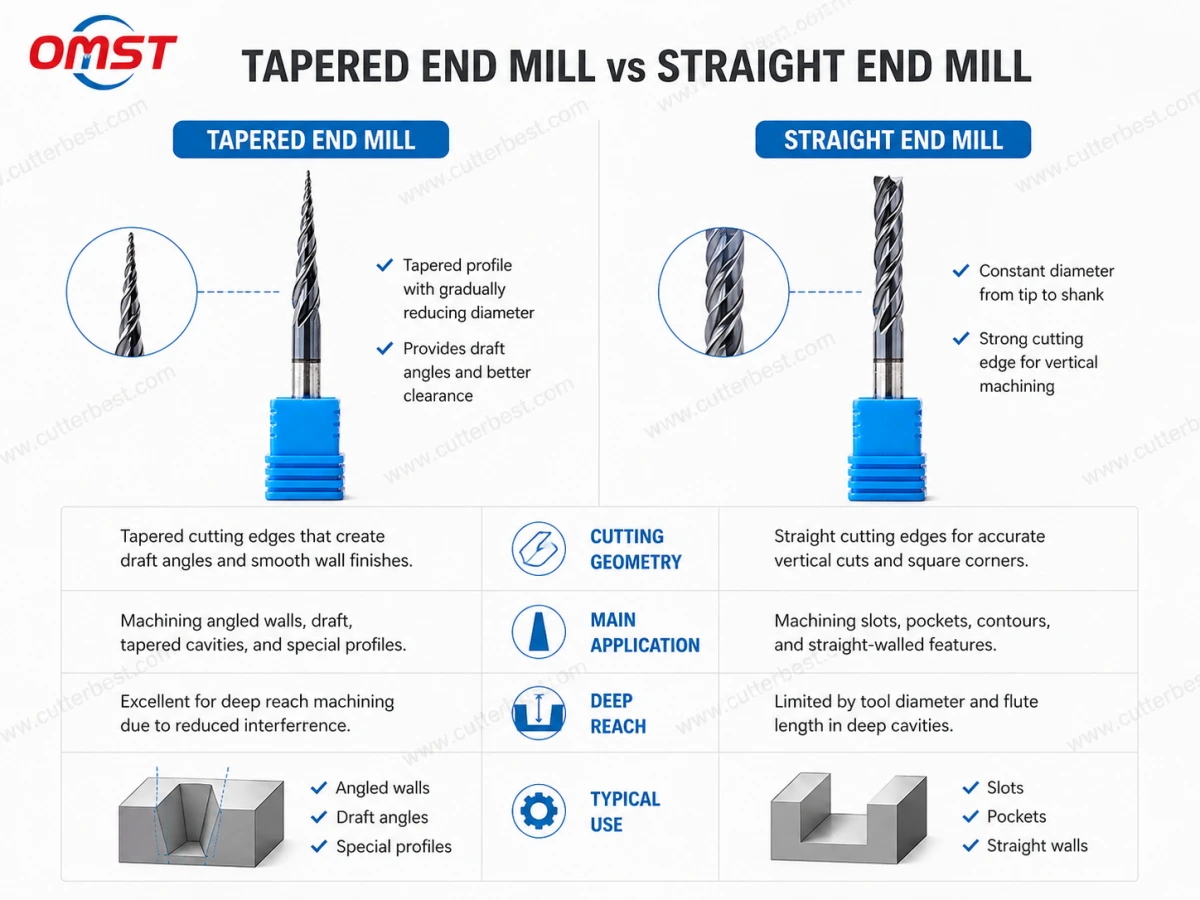
A tapered tool is usually preferred when the wall angle is part of the component design. 대조적으로, a straight end mill is normally selected for general slots, 주머니, vertical sidewalls, and standard profile milling.
How to Choose a Tapered End Mill
Selecting a cutter only by the tip diameter is not enough. The complete geometry and machining conditions must be reviewed.
Confirm the Required Taper Angle
첫 번째, check the drawing and confirm how the angle is specified.
Some drawings show the angle on one side of the tool. Others show the complete included angle. 그러므로, this detail should be confirmed before production.
Also check whether the final wall requires:
- A constant taper
- A draft angle
- A curved transition
- A special profile
- A tolerance on the wall angle
Select the Tip and Maximum Cutter Diameters
The tip diameter affects the smallest feature that the tool can machine.
A smaller tip can enter fine details. 하지만, it is also more sensitive to vibration, 런아웃, and excessive cutting load.
The maximum cutter diameter must also fit the cavity opening and part geometry.
Choose the Correct End Geometry
The workpiece shape determines whether a flat end, 공 코, radius end, or special profile is required.
| Workpiece Feature | Suggested End Geometry |
| Flat-bottom tapered slot | 테이퍼형 편평한 끝 |
| Curved mold cavity | Tapered ball nose |
| Filleted transition | Tapered radius end |
| 정밀한 조각 | 마이크로 테이퍼 커터 |
| Non-standard form | Custom profile cutter |
Check the Flute Length and Tool Reach
Use the shortest flute length and overall length that can safely reach the machining area.
A longer tool increases access. 하지만, it may also increase vibration and deflection. 그러므로, unnecessary tool extension should be avoided.
The holder should also grip as much of the shank as practical without contacting the workpiece.
Match the Flute Design to the Workpiece Material
Different materials require different cutting-edge and flute designs.
예를 들어, aluminum usually needs sharp edges and sufficient chip space. 대조적으로, steel machining often requires stronger cutting edges and suitable wear resistance.
| 공작물 재료 | General Selection Consideration |
| Aluminum and non-ferrous materials | 날카로운 모서리, 광택이 나는 플루트, and good chip evacuation |
| 탄소강 | Suitable carbide grade and wear-resistant coating |
| 스테인레스 스틸 | Sharp geometry, stable holding, 및 내열 코팅 |
| 금형강 | Good rigidity, controlled reach, and suitable coating |
| 주철 | Wear-resistant geometry and stable cutting conditions |
| 경화강 | High-rigidity setup, 적합한 초경 재종, and controlled parameters |
These recommendations are general. The exact tool should be selected according to material hardness, 기계 상태, 냉각수, 그리고 절단 작업.
Select the Carbide Grade and Coating
The coating should match the workpiece and cutting conditions.
Common options include:
- Uncoated carbide for sharp cutting and some non-ferrous applications
- TiAlN or AlTiN for suitable steel and higher-temperature operations
- TiSiN for selected hard-material applications
- DLC for aluminum and other non-ferrous materials
- Polished flutes for improved chip flow
하지만, no coating is ideal for every job. Before selecting one, consider cutting speed, 냉각수, 공작물 경도, 공구 직경, and machining time.
Review Machine Rigidity and Tool Holding
Even the correct cutter may perform poorly if the machine or holder is unstable.
확인하다:
- 스핀들 상태
- Tool-holder runout
- Tool extension
- 공작물 클램핑
- Coolant or air supply
- 이송 속도
- 스핀들 속도
- Axial and radial cutting depth
For micro tools, runout should be controlled as closely as the equipment allows.
How to Use Tapered End Mills More Effectively
Correct operation is especially important when the cutter has a small tip or extended reach.
Minimize Tool Runout
Runout causes one cutting edge to remove more material than the others. 따라서, the load becomes uneven and the small tip may wear or break early.
Use a clean, accurate holder and inspect the spindle and collet regularly.
Use the Shortest Practical Tool Extension
Excessive overhang reduces rigidity. 그러므로, mount the tool with the shortest extension that still provides safe access to the workpiece.
하지만, make sure the holder does not contact the part or fixture.
Avoid Excessive Cutting Loads
Do not apply cutting parameters based only on the shank diameter. The small tip and local cutting diameter must also be considered.
Start with conservative parameters when machining a new material or profile. 그 다음에, adjust the process after checking cutting sound, 칩 형성, 도구 마모, 표면 품질.
Maintain Effective Chip Evacuation
Chips can collect inside deep cavities. If they are recut, surface quality may decline and cutting heat may increase.
공기, 냉각수, or another suitable chip-removal method should be directed toward the cutting zone when practical.
Inspect the Tool and Finished Surface
Regular inspection can identify problems before tool failure occurs.
Look for:
- Edge wear
- 치핑
- Built-up material
- Uneven flute wear
- Vibration marks
- 표면 마감 불량
- Profile or dimensional changes
If these signs appear, review runout, 도구 확장, 절단 부하, 코팅, 칩 배출.
What Information Is Needed for a Custom Tapered End Mill?
Provide the main machining details before requesting a custom tool:
- 공작물 재질 및 경도
- Taper angle and angle definition
- Tip diameter and maximum cutter diameter
- 플루트 길이, 전체 길이, and shank diameter
- End geometry and coating requirement
- 그림, 수량, 및 가공 응용
For non-standard cutter geometry, 우리의 보기 custom tapered cutter 제품 페이지:
For other custom cutting tools, 우리의 보기 맞춤형 엔드밀.
자주 묻는 질문
What Is a Tapered End Mill Used For?
A tapered end mill is used to machine draft angles, 테이퍼 벽, 깊은 금형 구멍, 좁은 홈, 3D 윤곽, engraving details, 비표준 프로필.
The exact application depends on the taper angle, 팁 직경, 끝 기하학, 절단 길이, 및 공작물 재료.
Are Tapered End Mills Stronger Than Straight End Mills?
A tapered cutting section has more material behind the small tip. 그러므로, it may provide better rigidity than a straight tool with a similar tip diameter and reach.
하지만, actual strength still depends on the carbide grade, 공구 길이, tip size, 홀더 런아웃, 절단 매개변수, 및 공작물 재료.
What Is the Difference Between a Tapered Flat End and a Tapered Ball Nose End Mill?
Machinists use a tapered flat end mill for flat-bottom features, 테이퍼 홈, and angled sidewalls.
A tapered ball nose end mill has a rounded tip and is more suitable for curved surfaces, 금형 구멍, 3D 윤곽, 그리고 마무리 작업.
Can Tapered End Mills Machine Hardened Steel?
Tapered end mills can machine hardened steel when the carbide grade, 코팅, 도구 기하학, 기계 강성, and cutting parameters are suitable.
생산 전, confirm the material hardness and perform a controlled test cut.
How Is the Taper Angle Specified?
A drawing may specify the taper as either a single-side angle or a total included angle. Because drawing standards and customer descriptions can differ, confirm the angle definition before manufacturing the tool.
Can You Customize Tapered End Mills?
예. 테이퍼 각도를 사용자 정의할 수 있습니다., 팁 직경, 최대 절단 직경, 끝 기하학, 플루트 길이, 전체 길이, 생크 직경, 초경 등급, 코팅, 레이저 마킹, and packaging according to the application.
Can You Order a Sample Before Production?
We can usually evaluate a sample order based on the cutter geometry, 공작물 재료, 코팅, manufacturing difficulty, 및 소요수량.
Please provide a complete drawing before we confirm the tool design and quotation.
결론
Tapered end mills are used for draft angles, 테이퍼형 측벽, 금형 구멍, deep profiles, 테이퍼 홈, 3D 윤곽, 조각, and other detailed CNC applications.
Flat-end tools are suitable for flat-bottom and angled-wall features. Ball-nose designs are better for curved surfaces and mold finishing. 그 동안에, micro tapered cutters are useful for narrow areas and fine details.
To select the correct tool, confirm the taper angle, 팁 직경, 최대 커터 직경, 끝 기하학, 절단 길이, 공작물 재료, 기계 상태, 그리고 필요한 표면 마감.
For custom tapered cutter 요구 사항, you can send the drawing, 공작물 재료, 필수 치수, 가공 응용, and order quantity to Cutterbest for review. We can recommend or customize a suitable carbide tapered cutter for sample testing or production machining.