 Precision Milling Cutters,Cutting Tools for CNC Machining Every Material

Tapered Corner Radius End Mill Specifications
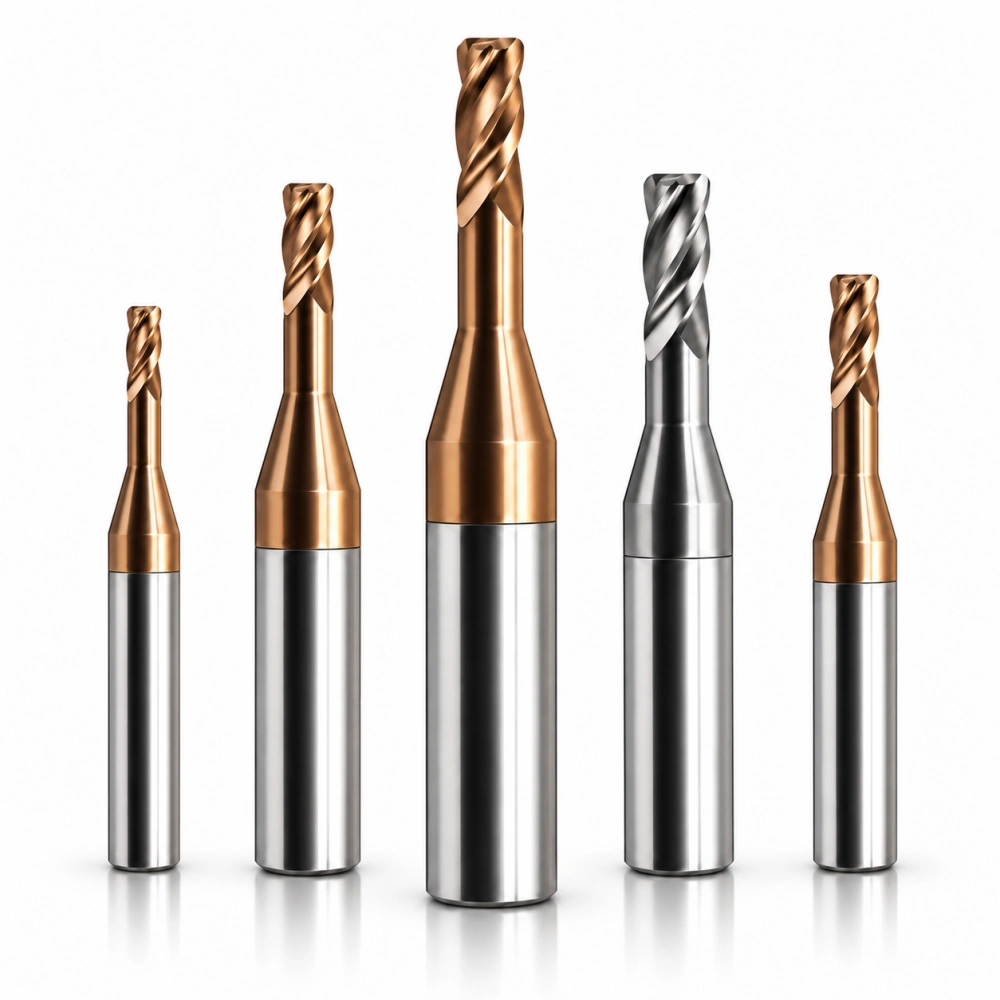
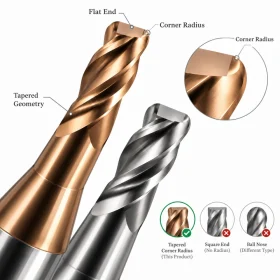
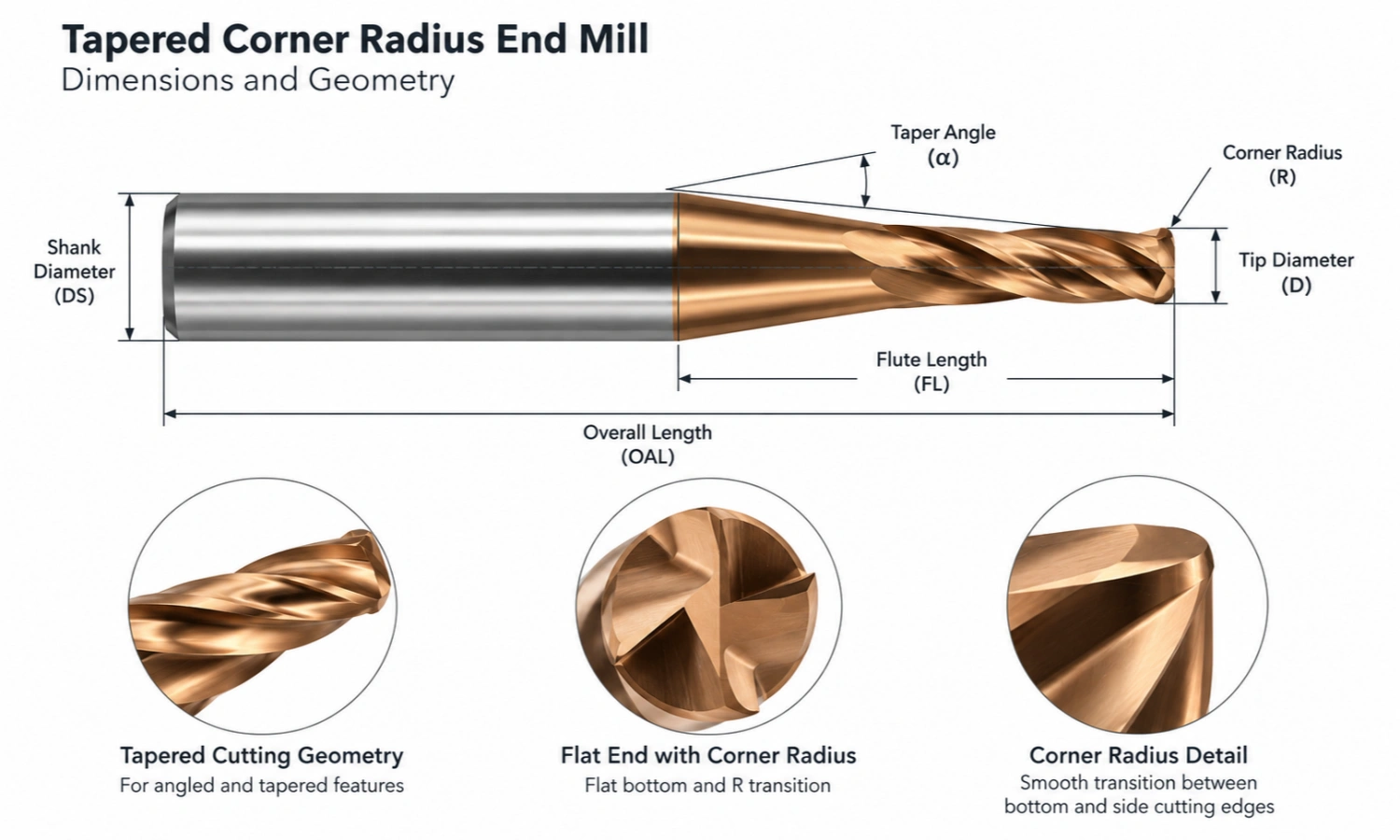
A tapered corner radius end mill combines three key geometric features: a tapered cutting section, a flat cutting end, and a defined corner radius between the end and side cutting edges.
This geometry differs from a tapered square end mill, which uses a flat end without a corner radius. It also differs from a tapered ball nose end mill, which uses a fully rounded cutting tip.
The corresponding standard corner-radius end mill series provides reference dimensions for diameter, corner radius, flute length, shank diameter, and overall length. For the tapered version, however, the required taper angle also affects the final dimensional combination.
Representative reference dimensions include:
| Tip Diameter | Corner Radius | Flute Length | Shank Diameter | Overall Length |
|---|---|---|---|---|
| Ø1.0 mm | R0.2 | 3 mm | Ø4 mm | 50 mm |
| Ø2.0 mm | R0.2 / R0.3 | 5 mm | Ø4 mm | 50 mm |
| Ø3.0 mm | R0.2 / R0.5 | 8 mm | Ø4 mm | 50 mm |
| Ø4.0 mm | R0.2 / R0.5 / R1.0 | 10 mm | Ø4 mm | 50 mm |
| Ø6.0 mm | R0.5 / R1.0 | 15 mm | Ø6 mm | 50 mm |
| Ø8.0 mm | R0.5 / R1.0 | 20 mm | Ø8 mm | 60 mm |
| Ø10.0 mm | R0.5 / R1.0 | 25 mm | Ø10 mm | 75 mm |
| Ø12.0 mm | R0.5 / R1.0 | 30 mm | Ø12 mm | 75 mm |
| Ø14.0 mm | R1.0 / R2.0 | 35 mm | Ø14 mm | 100 mm |
| Ø16.0 mm | R1.0 | 40 mm | Ø16 mm | 100 mm |
| Ø20.0 mm | R1.0 | 40 mm | Ø20 mm | 100 mm |
These values serve as dimensional references rather than a complete list of tapered-tool combinations. Because the taper angle changes the relationship between the tip diameter, cutting length, and upper cutting diameter, we confirm the final tool geometry from the drawing.
For other tapered cutting geometries, see our tapered end mills.
Tip Diameter, Corner Radius and Taper Angle Options
Tip diameter, corner radius, and taper angle define the main cutting geometry of this tool. Therefore, buyers should review these dimensions together rather than select them independently.
Tip Diameter and Corner Radius
The corresponding standard corner-radius series provides a reference diameter range of approximately Ø1–20 mm and corner-radius options from R0.2 to R2.0.
However, not every diameter uses every radius option. The selected R value must suit both the cutting diameter and the required feature geometry.
A smaller corner radius keeps more of the flat-end geometry. In contrast, a larger R creates a broader transition between the bottom and side cutting edges. For this reason, the required radius should follow the part drawing or machined feature.
Taper Angle
This product does not use one fixed taper angle across the complete range.
Instead, we confirm the required taper according to the drawing or machining requirement. When sending a drawing, please also identify whether the stated taper value represents an angle per side or the total included angle.
This information helps us confirm the geometry correctly before quotation and production.
Steel Machining Applications
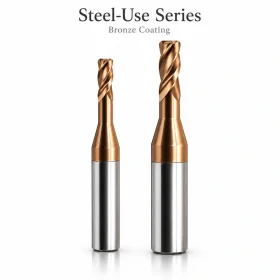
We supply this series as a standard tool for steel machining.
The tapered cutting section supports angled or tapered sidewalls, while the corner radius creates an R transition between the flat bottom and the side cutting surface.
In addition, the final geometry and coating requirement should match the workpiece, drawing, and machining condition. We therefore confirm specific coating requirements during quotation instead of applying one fixed coating specification to every tool.
Flute and Tool Configuration Options
Four flutes are the standard configuration for the corresponding corner-radius end mill series.
For the tapered version, the final flute geometry depends on the required diameter, corner radius, taper angle, flute length, and overall tool design.
If an application requires another configuration, we can review other flute counts according to the drawing. Likewise, we confirm coating requirements for each application rather than treating one coating as standard across the complete range.
Applications
The combination of tapered cutting geometry, a flat end, and a corner radius suits steel-machining features that require both an angled wall and an R transition.
Typical applications include:
- Tapered sidewalls
- Draft-angle features
- Mold cavities
- Tapered profiles
- Flat-bottom features with a corner-radius transition
- Steel components requiring tapered and radius geometry in one tool
The corner-radius geometry distinguishes this tool from a tapered square end mill, which uses a flat end without a corner radius. Meanwhile, unlike a tapered ball nose end mill, the center of the cutting end remains flat rather than fully rounded.
For broader guidance on tapered tools and their applications, see tapered end mill applications and selection.
Custom Tapered Corner Radius End Mill Manufacturing
We can manufacture custom tapered corner radius end mills according to customer drawings or dimensional requirements.
Custom parameters can include:
- Tip diameter
- Corner radius
- Taper angle
- Flute length
- Shank diameter
- Overall length
- Flute count
- Coating
- Other non-standard dimensions
Because the taper angle affects the complete cutting geometry, we use the drawing as the primary reference for a non-standard tool.
For custom projects, clearly identifying the corner radius and taper-angle definition helps us review the geometry before quotation and production.
FAQ About Tapered Corner Radius End Mills
What corner radius options are available?
The corresponding standard corner-radius series provides reference R values from approximately R0.2 to R2.0.
The available radius depends on the tool diameter and complete geometry. Therefore, we confirm the final combination before production.
Is the taper angle fixed or customizable?
The taper angle is customizable according to the drawing or machining requirement. We do not apply one fixed taper angle across the complete product range.
For quotation, please specify whether the taper value represents an angle per side or a total included angle.
What information is needed for a custom tool?
A drawing is the preferred reference for custom tapered geometry.
For technical review, please provide the required tip diameter, corner radius, taper angle, cutting length, shank diameter, overall length, and quantity.
Can you manufacture a tapered corner radius end mill from a drawing?
Yes. We can review and manufacture non-standard tapered corner radius geometry according to customer drawings and machining requirements.
Before production, we confirm the final dimensional combination with the customer.
Send Your Tapered Corner Radius End Mill Inquiry
Send your tapered corner radius end mill inquiry by email at sales@cutterbest.com, or contact us on WhatsApp for specification review and quotation.