 Precision Milling Cutters,Cutting Tools for CNC Machining Every Material

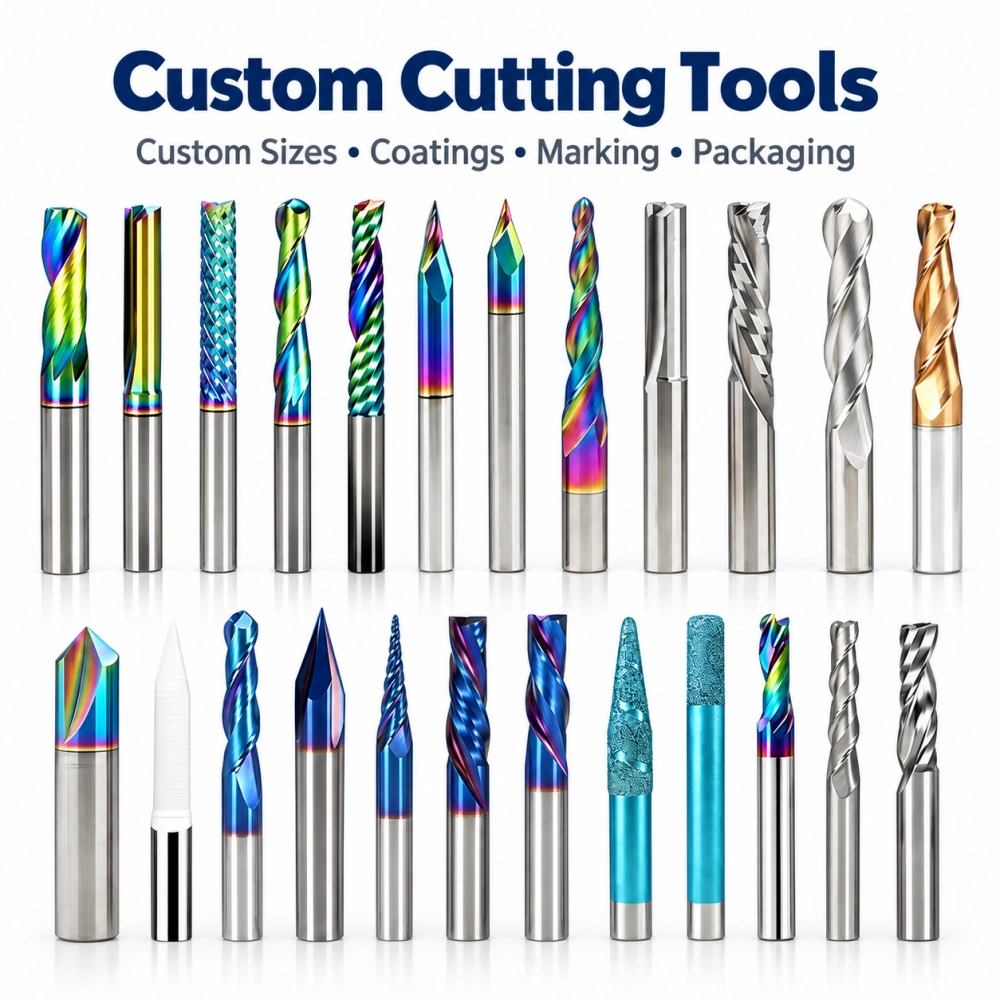
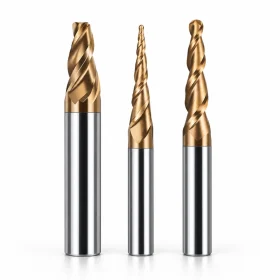
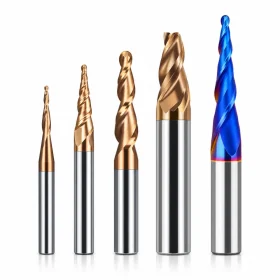
A tapered end mill uses a tapered cutting section instead of a straight side profile. Buyers may also use terms such as tapered cutter or taper milling cutter for this broad tool family. Because taper angle, diameter, cutting length, and end geometry work together, the final tool specification should match the actual part feature and machining requirement.
Tapered End Mill Specifications and Manufacturing Options
Tapered end mills combine several related dimensions, so one general size table cannot represent every geometry. Buyers should review the tip diameter, maximum cutting diameter, taper angle, flute length, shank diameter, and overall length together when selecting or customizing the tool.
Across the factory’s solid carbide milling range, available cutter diameters extend from approximately Ø0.1 to Ø25 mm. However, the feasible diameter range for a specific tapered end mill depends on its taper, end geometry, cutting length, and overall tool design.
| Specification | Available Option |
|---|---|
| Construction | Solid Carbide / Tungsten Carbide |
| Tip Diameter | According to Tool Design |
| Maximum Cutting Diameter | According to Tool Design |
| Taper Angle | Standard or Custom |
| Flute Length | According to Tool Design |
| Shank Diameter | According to Tool Design |
| Overall Length | According to Tool Design |
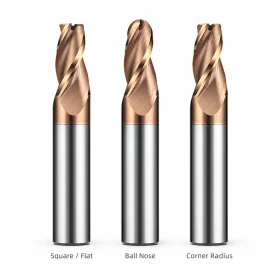
| End Geometry | Square / Flat, Ball Nose, Corner Radius, Custom |
| Special Designs | Reverse Taper and Drawing-Based Profiles |
For non-standard dimensions, we confirm the final combination from the required tool geometry, drawing, and machining requirement rather than from a general end mill size table.
Taper Angle and Dimension Definition
Taper angle is one of the main dimensions to confirm before manufacturing a tapered end mill.
A drawing may show either an angle per side or an included angle. These values are different. For a symmetrical taper, the included angle equals twice the angle per side. Therefore, the drawing should clearly identify which angle definition it uses.
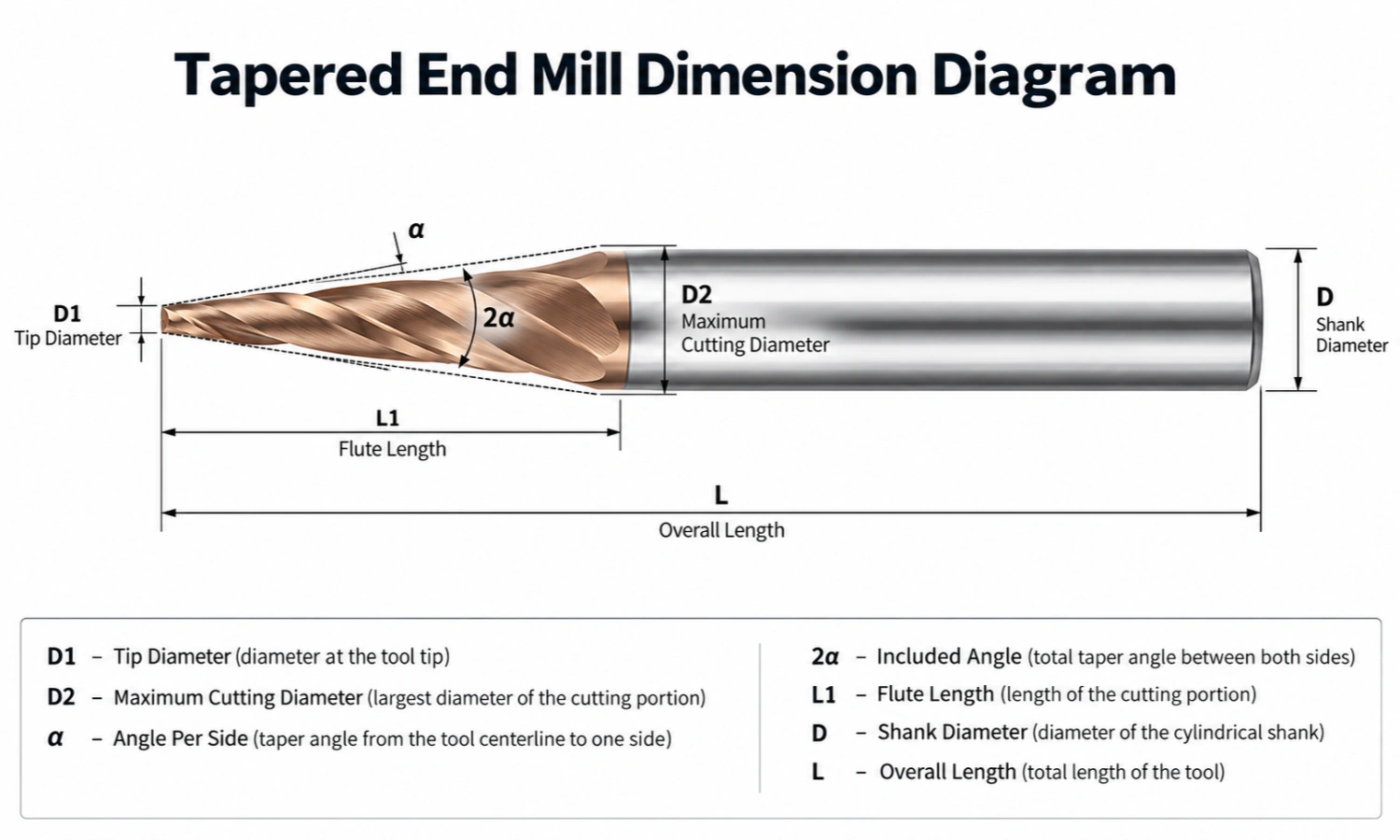
| Parameter | Definition |
|---|---|
| Tip Diameter | Diameter at the smaller cutting end |
| Maximum Cutting Diameter | Largest diameter of the tapered cutting section |
| Taper Angle | Angle per side or included angle |
| Flute Length | Length of the cutting section |
| Shank Diameter | Diameter of the tool shank |
| Overall Length | Total tool length |
Because these dimensions affect one another, the taper angle and diameter should be reviewed together with the required cutting length and end geometry.
When a drawing is available, please indicate whether the marked angle is an angle per side or an included angle. This helps avoid ambiguity during quotation and production.
Tapered End Mill Types
Tapered Square / Flat End Mill
A tapered square end mill combines a tapered cutting section with a flat cutting end. It suits features that require tapered sidewalls together with a flat-bottom profile or defined lower surface.
Buyers may use both tapered square end mill and tapered flat end mill for this general cutting geometry. View our Tapered Square End Mill for standard reference sizes, angle-per-side options, and custom configurations.
Tapered Ball Nose End Mill
A tapered ball nose end mill combines tapered cutting edges with a rounded ball end. This geometry suits curved surfaces, mold cavities, 3D profiles, and other features that require a rounded cutting end. View our Tapered Ball Nose End Mill for radius, taper-angle, and custom size options.
Tapered Corner Radius End Mill
A tapered corner radius end mill has a tapered cutting section with a corner radius between the bottom and side cutting edges. It suits part profiles that require a flatter bottom together with a radius at the corner. View our Tapered Corner Radius End Mill for diameter, corner-radius, taper, and custom geometry options.
Miniature tapered designs are also available within selected geometries. Because tip diameter, taper, flute length, and end style are interrelated, micro-size tools should be reviewed as a complete tool specification rather than by diameter alone.
Custom Reverse Taper End Mill
We handle reverse taper end mills as custom tools rather than one fixed standard configuration. For these requirements, we review the reverse taper, profile, dimensions, and machining feature from the available drawing before confirming the final tool design.
Workpiece Materials and Applications
We can configure solid carbide tapered end mills for different workpiece materials, including:
- Alloy Steel
- Stainless Steel
- Hardened Steel
- Aluminum Alloys
- Cast Iron
- Titanium and Heat-Resistant Alloys
- Graphite
- Selected Composite Materials
For hardened materials, high-hardness tool series are available for applications up to approximately HRC68. The carbide grade, coating, flute configuration, and tool geometry should match the actual workpiece and machining conditions.
Typical applications include tapered walls, mold cavities, tapered grooves, deep features, angled profiles, and special CNC profiles.
The end geometry should also match the machined feature. For example, square or flat ends suit flat-bottom features, while ball nose and corner radius designs serve different curved or radius profile requirements.
For detailed application and selection guidance, see What Are Tapered End Mills Used For.
Custom Tapered End Mill Manufacturing
We can produce custom tapered end mills according to the required taper, dimensions, end geometry, coating, and machining application. For non-standard tools, please send the available drawing, sample information, or machining requirement for review. We will confirm the final specification and manufacturability according to the actual tool design and application.
For broader non-standard tooling requirements, see Custom Cutting Tools.
FAQ About Tapered End Mills
Can you manufacture tapered end mills according to drawings?
Yes. We can review standard and non-standard tapered end mill requirements from a tool drawing, part drawing, existing tool specification, or machining requirement. Final manufacturability is confirmed after the design is reviewed.
Is there a fixed MOQ for custom tapered end mills?
No single MOQ applies to every tapered cutter. Order quantity depends on the tool geometry, size, and customization requirements, so we confirm it with the specific quotation.
What should I provide for a tapered end mill quotation?
Send the available drawing, existing tool specification, or machining requirement. We will review the information and confirm any additional details needed before quotation.
Send Your Tapered End Mill Inquiry
Need a standard or custom solid carbide tapered end mill? Send your drawing or machining requirement by email, or contact us on WhatsApp if you prefer. We will review the tool geometry and application requirements, then confirm the suitable configuration before quotation.