 Cortadores de fresagem de precisão,Ferramentas de corte para usinagem CNC de todos os materiais

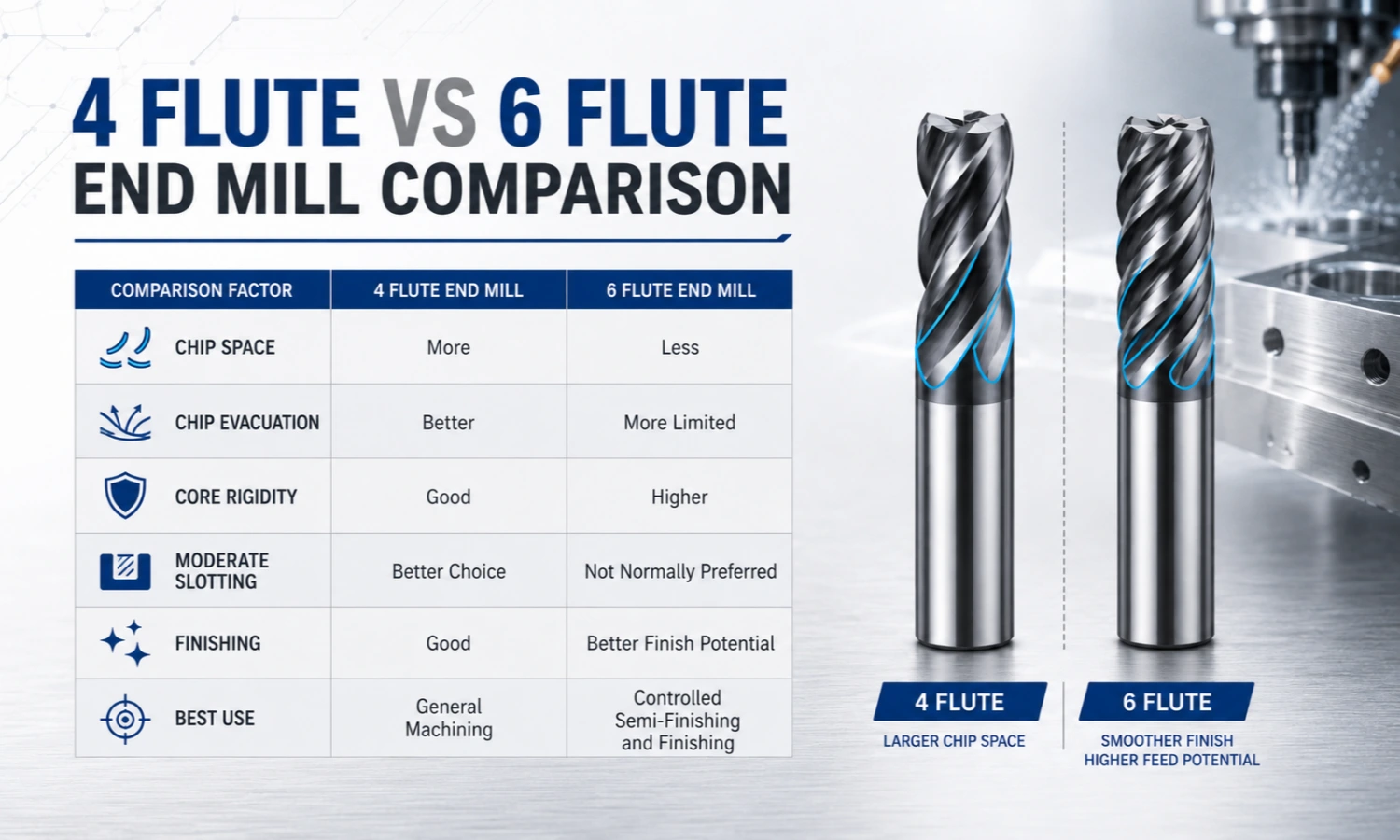
A principal diferença em um 4 flauta vs. 6 A comparação da fresa de topo de canal é o equilíbrio entre o escoamento de cavacos e a rigidez da ferramenta.
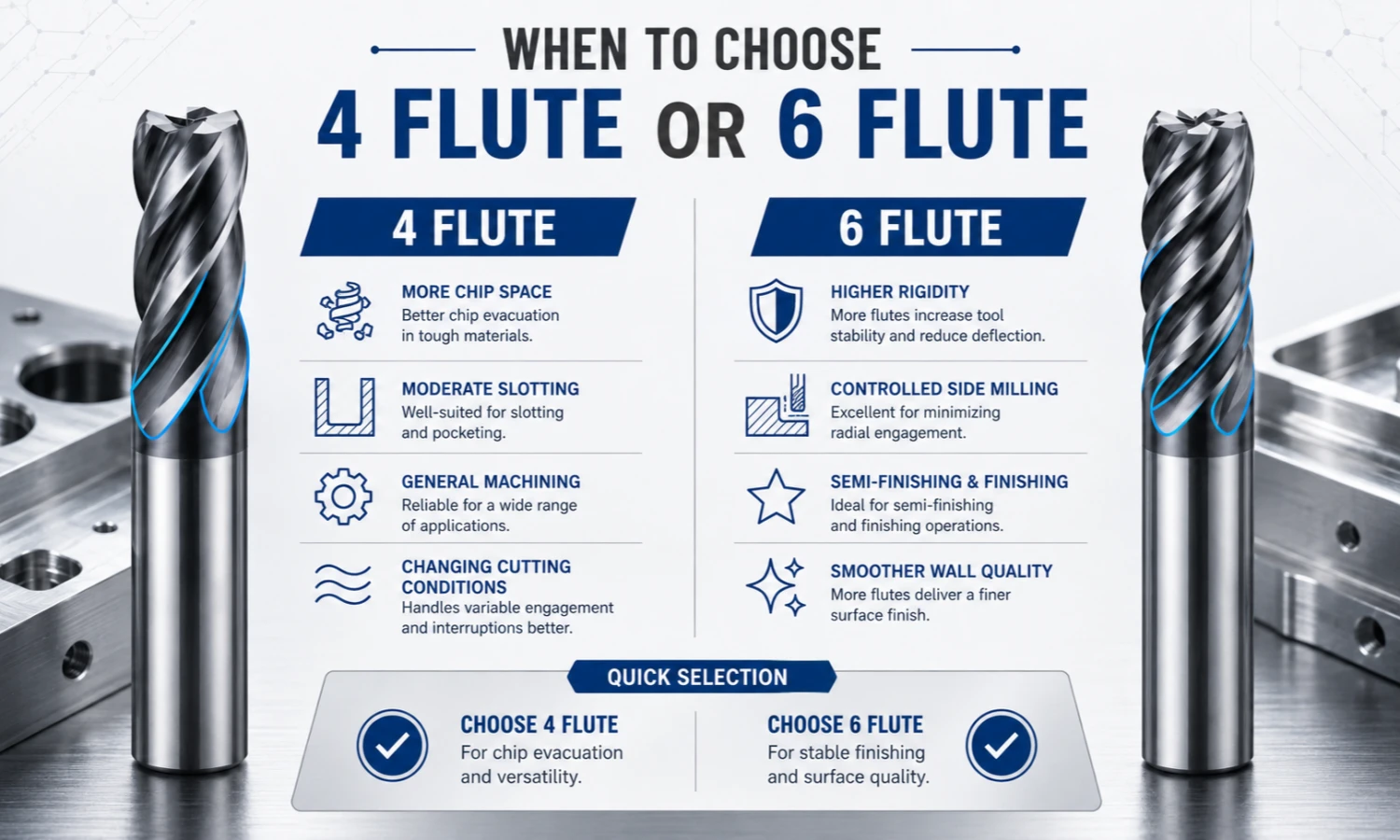
A 4 fresa de topo de canal oferece mais espaço de canal. Portanto, geralmente é mais flexível para ranhuras moderadas, fresagem lateral, fresagem de perfil, e alterando as condições de corte.
Em contraste, um 6 A fresa de topo de canal tem mais arestas de corte e geralmente um núcleo mais forte. Pode proporcionar melhor estabilidade durante semiacabamento e acabamento controlados, especialmente quando a qualidade da parede e o acabamento superficial são os objetivos principais.
Nenhuma contagem de flauta é sempre melhor. A escolha correta depende da operação de usinagem, volume de chips, corte de engajamento, rigidez da máquina, balanço da ferramenta, e acabamento necessário.
Principais diferenças entre 4 Flauta e 6 Fresas de topo de flauta
4 Fresa de topo de flauta: Mais espaço para chips e versatilidade
A 4 A fresa de topo de canal tem quatro arestas de corte com mais espaço entre os canais do que um projeto de seis canais. Como resultado, os cavacos podem sair da zona de corte mais facilmente.
Este design fornece um equilíbrio prático de evacuação de cavacos, força central, e estabilidade de corte. É comumente selecionado para usinagem geral de aço e aço inoxidável, ranhura moderada, fresagem lateral, fresagem de perfil, e semi-acabamento.
Uma fresa de quatro canais também é mais indulgente quando o engate de corte ou as condições de usinagem mudam durante a produção.
Para tamanhos padrão, projetos de corte central, revestimentos, e opções personalizadas, revise nosso 4 fresa de topo de carboneto de flauta.
Para um guia de aplicação mais amplo, ler o que é um 4 fresa de topo de flauta usada para.
6 Fresa de topo de flauta: Maior rigidez para acabamento
A 6 A fresa de topo de canal tem seis arestas de corte e menos espaço de canal. As arestas de corte adicionais e o núcleo mais forte podem melhorar a rigidez, estabilidade da parede, e consistência da superfície durante a usinagem controlada.
Portanto, este design é frequentemente usado para fresamento lateral, acabamento de perfil, semi-acabamento, e acabamento em aço, stainless steel, e liga de aço.
No entanto, o espaço menor do canal limita a evacuação de cavacos. Uma fresa de seis canais normalmente não é a primeira escolha para canais profundos e de largura total, desbaste pesado, ou operações que produzem um alto volume de chips.
Para tamanhos de produtos e opções de personalização, revise nosso 6 fresa de topo de carboneto de flauta.
Para mais informações sobre suas aplicações, ler o que é um 6 fresa de topo de flauta usada para.
4 Flauta vs. 6 Comparação de fresas de topo de canal
| Fator de comparação | 4 Fresa de topo de flauta | 6 Fresa de topo de flauta |
|---|---|---|
| Espaço para fichas | More | Menos |
| Evacuação de chips | Melhorar | Mais limitado |
| Rigidez central | Bom | Mais alto |
| Usinagem Geral de Aço | Mais versátil | Mais especializado |
| Slot moderado | Melhor escolha | Normalmente não preferido |
| Fresamento lateral | Adequado | Adequado com engajamento controlado |
| Fresamento de perfil | Adequado | Adequado para passes de acabamento estáveis |
| Semiacabamento | Adequado | Muitas vezes melhor |
| Acabamento | Bom | Melhor potencial de acabamento |
| Desbaste Pesado | Mais adequado | Não é o ideal |
| Configuração da máquina | Mais indulgente | Apresenta melhor desempenho em configurações rígidas |
| Melhor uso | Usinagem geral e remoção moderada de cavacos | Semiacabamento e acabamento controlados |
| Use com cuidado | Acabamento muito leve onde mais arestas de corte podem ajudar | Slots profundos, má evacuação de cavacos, saliência longa, ou configurações instáveis |
Esta tabela fornece orientação geral de seleção. O desempenho real também depende do tipo de metal duro, revestimento, ângulo de hélice, diâmetro da ferramenta, comprimento da flauta, condição de titular, entrega de refrigerante, e parâmetros de corte.
4 Flauta vs. 6 Fresa de topo de flauta para aço
Ambas as contagens de canais podem usinar aço. No entanto, eles se adequam a diferentes operações.
A 4 A fresa de topo de canal é geralmente a opção mais flexível para usinagem geral de aço. Seu maior espaço de canal suporta remoção moderada de cavacos, alterando o engajamento de corte, fresagem lateral, fresagem de perfil, e ranhura leve a moderada.
A 6 A fresa de topo de canal torna-se mais útil quando a operação se concentra em semiacabamento ou acabamento controlado. Suas arestas de corte adicionais podem melhorar a qualidade da parede e a consistência da superfície. No entanto, a máquina, titular, fixação de trabalho, e o percurso da ferramenta deve permanecer estável.
Escolher 4 Flauta para usinagem geral de aço
Um cortador de quatro canais é uma escolha prática quando:
- A operação inclui slots moderados.
- A evacuação de cavacos continua importante.
- O envolvimento de corte pode mudar.
- Uma ferramenta precisa cobrir várias operações.
- O setup não é otimizado apenas para acabamento.
Escolher 6 Flauta para Acabamento Controlado
Um cortador de seis canais pode fornecer melhores resultados quando:
- A operação envolve principalmente semiacabamento ou acabamento.
- É necessária melhor qualidade de parede.
- O engate radial permanece leve e controlado.
- A máquina e o suporte proporcionam boa rigidez.
- A qualidade da superfície é mais importante do que o espaço máximo do chip.
Em muitas oficinas, um design de quatro canais serve como ponto de partida para uso geral. Uma ferramenta de seis canais oferece uma escolha mais especializada quando a operação se torna estável e focada no acabamento.
4 Flauta vs. 6 Fresa de topo de flauta para aço inoxidável
O aço inoxidável pode gerar calor e endurecer quando as condições de corte se tornam instáveis. Portanto, evacuação de cavacos, corte de engajamento, revestimento, geometria da ferramenta, e a rigidez da máquina são importantes.
A 4 A fresa de topo de canal é geralmente um ponto de partida prático para usinagem geral de aço inoxidável. Ele fornece um equilíbrio útil entre o espaço do chip e a resistência do núcleo, para que ele possa lidar com fresamento de perfil, fresagem lateral, remoção moderada de material, e semi-acabamento.
A 6 fresa de topo de flauta é mais especializada. Pode ter bom desempenho em passes controlados de semiacabamento e acabamento onde a consistência dimensional, qualidade da parede, e superfícies mais lisas são os principais objetivos.
No entanto, o volume de cavacos e o engajamento de corte devem permanecer controlados. De outra forma, lascas e calor podem se acumular ao redor das arestas de corte.
Para acabamento especializado em aço inoxidável, ferramentas com cinco ou mais canais e ângulos de hélice maiores também são comuns. Mesmo assim, canais adicionais só ajudam na evacuação de cavacos, acabar, segurando ferramenta, e a rigidez da configuração permanecem sob controle. A hélice variável ou a geometria de passo variável também podem melhorar o controle de vibração.
Em geral:
- Escolher 4 flauta para maior versatilidade e mais espaço para cavacos.
- Escolher 6 canal para acabamento controlado e maiores requisitos de qualidade superficial.
Como escolher um 4 Flauta ou 6 Fresa de topo de canal em três etapas
Etapa 1: Comece com a operação de usinagem
Primeiro, identificar a operação principal.
Escolha um 4 fresa de topo de canal quando o trabalho inclui ranhuramento moderado, alterando o engajamento de corte, ou fresamento geral lateral e de perfil. Seu maior espaço de canal proporciona um caminho mais seguro para que os cavacos saiam da zona de corte.
Considere um 6 fresa de topo de canal quando a operação utiliza engate lateral controlado e se concentra em semiacabamento ou acabamento.
Para desbaste pesado, uma fresa de desbaste dedicada pode ser mais adequada do que uma ferramenta de acabamento padrão de quatro ou seis canais.
Etapa 2: Verifique a evacuação do chip e a rigidez da configuração
Próximo, revise a configuração completa da usinagem.
Um cortador de seis canais tem melhor desempenho quando:
- O envolvimento de corte permanece controlado.
- A máquina e o suporte proporcionam boa rigidez.
- O balanço da ferramenta é mantido o mais curto possível.
- O líquido refrigerante ou o ar podem atingir a zona de corte.
- Os cavacos podem sair da peça de trabalho sem recortar.
Uma ferramenta de quatro canais geralmente é mais tolerante quando a configuração é menos rígida ou as condições de corte mudam.
Uma contagem de canais mais alta não pode corrigir um suporte instável, saliência excessiva, má fixação de trabalho, ou evacuação de cavacos bloqueada.
Etapa 3: Defina a prioridade de acabamento de superfície
Finalmente, decidir se o controle de cavacos ou a qualidade do acabamento têm maior prioridade.
Escolha quatro flautas quando tiver versatilidade, evacuação de cavacos, e a remoção moderada de material é mais importante.
Escolha seis canais quando a configuração estiver estável e a operação visar a qualidade da parede, consistência dimensional, e uma superfície com acabamento mais liso.
Mais arestas de corte podem reduzir a carga transportada por cada aresta quando o avanço está definido corretamente. No entanto, o mau controle de cavacos ou o calor excessivo podem remover esta vantagem.
O que verificar quando um 6 Fresa de topo de flauta não melhora o resultado
Uma fresa de seis canais não produz automaticamente um acabamento melhor. Quando o resultado piora, inspecione a condição completa do corte antes de culpar a ferramenta.
| Sinal de usinagem | Possível causa | Primeiro ponto a verificar |
|---|---|---|
| Lascas se acumulam ao redor das arestas de corte | O volume do cavaco é muito alto para o espaço disponível no canal | Reduza o envolvimento de corte ou considere uma 4 desenho de flauta |
| A temperatura de corte aumenta rapidamente | Os cavacos permanecem na zona de corte ou o acesso à refrigeração é limitado | Melhore o escoamento de cavacos e o fornecimento de refrigeração |
| Aparecem vibrações na parede ou marcas de vibração | Saliência da ferramenta ou a configuração completa carece de rigidez | Porta-cheques, saliência, fixação de trabalho, e percurso |
| O acabamento da superfície não melhora | Acabar, alimentar, ou o engate de corte é inadequado | Verifique o desvio e ajuste a estratégia de acabamento |
| As arestas de corte lascam inesperadamente | Recorte de cavacos, aquecer, ou envolvimento instável | Revise o controle de cavacos, revestimento, e condições de corte |
Estes são sinais gerais de solução de problemas, em vez de regras de corte fixas. O ajuste correto depende do desenho da fresa, material da peça, máquina, titular, e parâmetros de usinagem.
Exemplos práticos de seleção
Aço Geral com Entalhamento Moderado
Para ranhuras moderadas ou alteração do acoplamento de corte em aço em geral, um 4 A fresa de topo de canal é normalmente a escolha mais flexível.
Seu maior espaço de canal suporta a evacuação de cavacos, enquanto o núcleo de quatro canais ainda fornece rigidez útil para fresamento lateral e de perfil.
Se a operação mudar para uma passagem final leve de acabamento lateral, um 6 cortador de flauta pode ser avaliado separadamente.
Acabamento de perfil de aço inoxidável
Quando o aço inoxidável é usinado com engate lateral leve e estável, uma configuração rígida, e uma meta de finalização clara, um 6 fresa de topo de canal pode fornecer melhor potencial de acabamento.
No entanto, se os cavacos começarem a se acumular ou a temperatura de corte aumentar rapidamente, um 4 o design do canal pode fornecer um equilíbrio mais seguro entre o espaço do canal e a estabilidade de corte.
Estes exemplos mostram por que a contagem de canais deve corresponder à operação em vez de ser selecionada apenas pelo nome do material.
Frequently Asked Questions
Qual é a principal diferença entre um 4 flauta e 6 moinho de extremidade de flauta?
A principal diferença é o equilíbrio entre evacuação de cavacos e rigidez.
A 4 A fresa de topo de canal oferece mais espaço de canal e maior versatilidade. Em contraste, um 6 fresa de topo de canal fornece mais arestas de corte, maior rigidez do núcleo, e melhor potencial de acabamento em condições estáveis.
É um 4 flauta ou 6 fresa de topo de flauta melhor para aço?
A 4 A fresa de topo de canal geralmente é melhor para usinagem geral de aço, ranhura moderada, e alterando as condições de corte.
A 6 fresa de canal geralmente tem melhor desempenho durante fresamento lateral controlado, semi-acabamento, e acabamento quando a qualidade da superfície é o objetivo principal.
Quando devo evitar usar um 6 moinho de extremidade de flauta?
A 6 A fresa de topo de canal normalmente não é a primeira escolha para canais profundos e de largura total, desbaste pesado, operações com alto volume de chips, acesso deficiente ao refrigerante, ou configurações instáveis.
Seu menor espaço de canal pode aumentar o corte de cavacos e o calor quando o engajamento de corte é muito alto.
Uma contagem mais alta de canais sempre produz um melhor acabamento superficial??
Não. Uma contagem mais alta de canais pode melhorar o potencial de acabamento, mas o resultado também depende do runout, alimentação por dente, geometria da ferramenta, rigidez da máquina, condição de titular, evacuação de cavacos, e estabilidade da peça.
Se lascas ou calor permanecerem na zona de corte, um cortador de seis canais pode não melhorar a superfície.
Como faço para escolher entre um 4 flauta e 6 moinho de extremidade de flauta?
Comece com a operação de usinagem e volume de cavacos. Em seguida, verifique o engate de corte, balanço da ferramenta, condição de titular, e rigidez da máquina.
Escolha quatro canais quando o escoamento de cavacos e a versatilidade são mais importantes. Escolha seis flautas quando a configuração estiver estável e o acabamento controlado for o objetivo principal.
Conclusão
Ao comparar um 4 flauta vs. 6 moinho de extremidade de flauta, comece com o objetivo de usinagem.
Uma fresa de quatro canais proporciona mais espaço para cavacos e maior flexibilidade para usinagem de aço em geral e aço inoxidável, ranhura moderada, fresagem lateral, e alterando as condições de corte.
Uma fresa de seis canais oferece maior rigidez e melhor potencial de acabamento quando o envolvimento do corte permanece controlado. Portanto, é adequado para operações estáveis de semiacabamento e acabamento que exigem melhor qualidade de parede e superfícies mais lisas.
Em vez de selecionar uma fresa apenas pela contagem de canais, combine a ferramenta com o material, volume de chips, profundidade de corte, rigidez da máquina, segurando ferramenta, e acabamento necessário.
Precisa de ajuda para escolher entre 4 Flauta e 6 Fresas de topo de flauta?
Selecionar a contagem correta de canais pode melhorar o controle de cavacos, estabilidade de corte, vida útil da ferramenta, e qualidade da superfície.
Envie-nos o material da sua peça, dureza do material, diâmetro de corte, comprimento da flauta, operação de usinagem, exigência de revestimento, e quantidade. Você também pode fornecer um desenho, referência de ferramenta, ou foto da aplicação quando a especificação estiver incompleta.
Analisaremos as informações disponíveis e ajudaremos você a selecionar uma fresa de topo de metal duro padrão ou personalizada adequada.
Envie sua solicitação diretamente para sales@cutterbest.com.