 Freze de precizie,Scule de tăiere pentru prelucrarea CNC a fiecărui material

This end mill selection guide explains how to choose a cutter by machining operation, profilul final, material pentru scule, număr de flaut, acoperire, dimensiuni, și configurarea mașinii. Choosing the wrong tool can cause poor chip evacuation, vorbărie, rapid edge wear, erori dimensionale, spargerea sculei, or an inconsistent surface finish.
This guide is written for machinists, process engineers, workshop managers, distribuitori, and buyers who need a practical starting point before selecting or requesting an end mill.
Ce este o moara de capat?
An end mill is a rotary cutting tool used for slotting, buzunare, profilare, frezare laterală, degrosare, finisare, și conturarea 3D. Spre deosebire de un burghiu standard, it can cut with both the end and outside cutting edges.
Some center-cutting designs support ramping, helical entry, or limited plunging. Cu toate acestea, the center geometry and entry method must suit the operation.
For a basic explanation, citire ce este o freză de tăiat.
Quick End Mill Selection Guide
The table below provides practical starting directions. Final tool selection should still reflect the workpiece grade, diametrul tăietorului, adâncimea de tăiere, starea titularului, rigiditatea mașinii, and chip-removal method.
| Machining Situation | Starting Tool Direction | Motivul principal |
|---|---|---|
| Aluminum Slotting or Deep Pockets | 2– 3 flaute, Sharp Edge, Flaute lustruite | More chip space and lower risk of chip packing |
| General Steel Side Milling | 4 Fluiere, Strong Core, Heat-Resistant Coating | Echilibru de rigiditate, numărarea marginilor, and chip evacuation |
| Frezare sau finisare laterală din oțel inoxidabil | 4– 6 flaute, Variable-Helix or Unequal-Pitch Geometry | Helps control vibration, căldură, și tăiere instabilă |
| Degroșare grea | Lower or Medium Flute Count, Roughing or Chipbreaker Geometry | More chip space and controlled cutting load |
| Finishing with Light Engagement | Higher Flute Count and Stable Geometry | More cutting contacts and improved surface consistency |
| Flat-Bottom Slots and Pockets | Moara plată | Produces a flat bottom and straight walls |
| 3D Contours and Mold Cavities | Moara de capăt cu nas bilă | Rounded end follows curved surfaces |
| Semi-Finishing and Stronger Corners | Bull Nose or Corner Radius End Mill | Radius strengthens the outside cutting corner |
| Deep Features with Limited Cutting Depth | Long-Neck Tool with Minimum Necessary Flute Length | Reduces deflection compared with an excessively long flute |
Use this matrix as the first filter. După care, confirm the end profile, material pentru scule, număr de flaut, acoperire, dimensiuni, și configurarea mașinii.
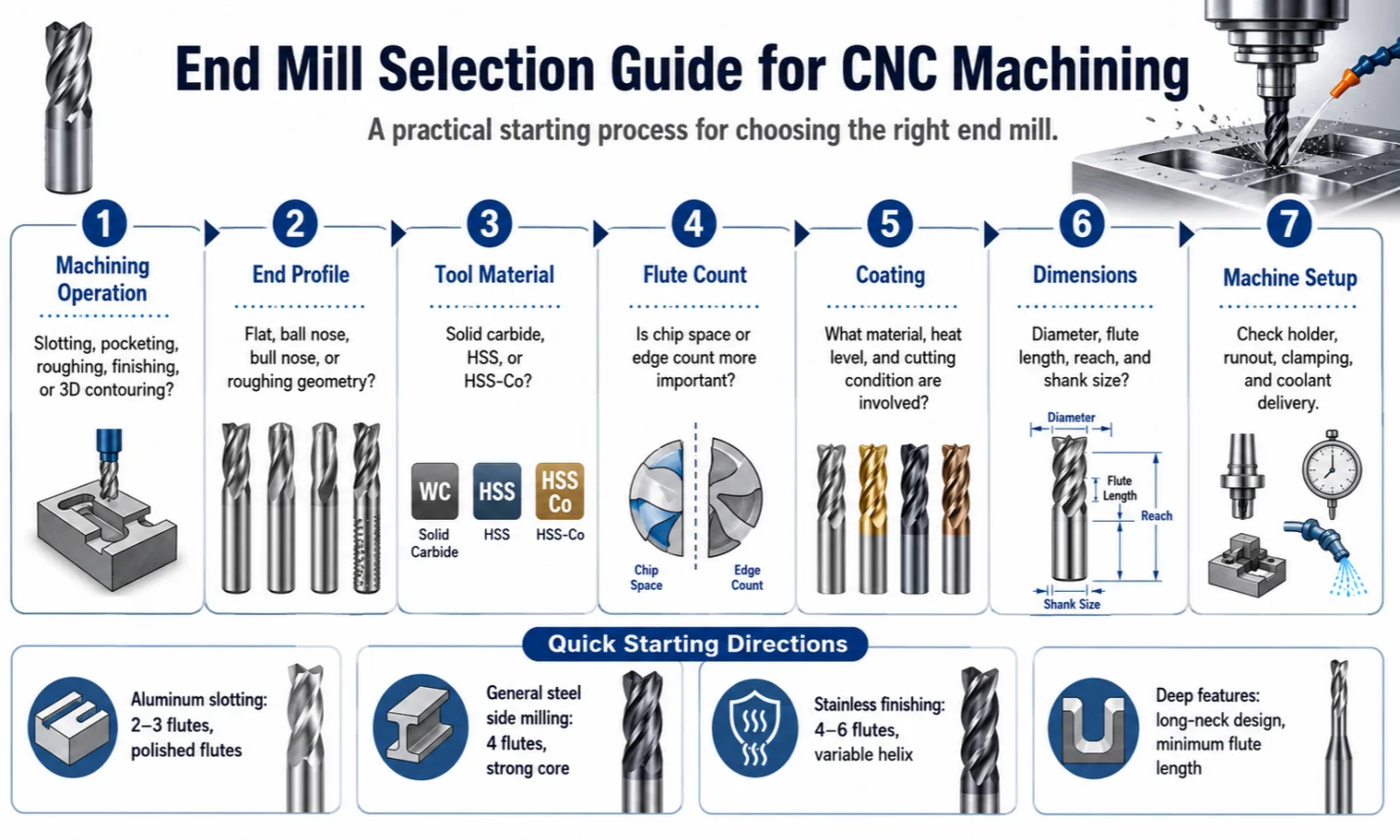
Pas 1: Choose an End Mill by CNC Operation
The machining operation should guide the first decision because it determines the cutting direction, volumul cipului, logodnă, and required surface.
Slotting
Full-width slotting creates a high chip volume because the cutter engages the material across its full diameter.
When cutting a full-width slot, prioritize chip space before increasing the flute count. Start with fewer flutes when chips are large or evacuation is difficult.
A suitable slotting tool normally requires:
- Enough flute space
- Reliable chip evacuation
- A center-cutting design when direct entry is required
- Conexiune sculă scurtă și stabilă
- Edge strength matched to the material
For aluminum or other materials that produce larger chips, 2–3 flutes provide a practical starting point. Pentru oțel, the final flute count also depends on slot depth, angrenare radială, diametrul tăietorului, and coolant or air delivery.
If chips remain inside the slot, do not immediately increase the feed or change the coating. First check the flute space, adâncimea de tăiere, air or coolant direction, și surplombarea sculei.
Frezarea buzunarului
Pocket milling may combine ramping, helical entry, side cutting, corner engagement, and bottom finishing.
Use a center-cutting end mill when the programmed entry requires cutting near the tool center. Cu toate acestea, center cutting does not turn an end mill into a standard drill bit. The tool geometry and CAM entry strategy must support the movement.
Deep pockets also need reliable chip removal. Trapped chips can be re-cut, which increases heat and may damage the cutting edge.
When the pocket is deep but the actual cutting depth is short, choose a long-neck tool rather than an end mill with an unnecessarily long flute.
Side Milling and Profiling
Side milling loads the outside cutting edges. Ca urmare, angrenare radială, cutter rigidity, a alerga afară, and side-wall accuracy become important.
Use a flat end mill for straight walls and shoulders. Choose a bull nose or corner radius tool when the outside corner needs more strength.
For general steel side milling, a 4-flute tool provides a practical balance between edge count, puterea miezului, și spațiu pentru cip.
For lighter radial engagement and stable finishing, 5–6 flutes can increase the number of cutting contacts. Cu toate acestea, chip evacuation must remain stable.
Aspre
Roughing produces a high cutting load and chip volume. Prin urmare, the cutter needs enough flute space and an edge structure that can handle the engagement.
For traditional roughing, choose a lower or medium flute count when chip removal is difficult. Roughing or chipbreaker geometry divides chips into smaller sections and can reduce cutting resistance.
For dynamic or trochoidal toolpaths with lighter radial engagement, a higher flute count can become practical because each flute removes a smaller chip while the tool follows a controlled engagement path.
The CAM strategy, rigiditatea mașinii, starea titularului, and tool geometry must work together. A high-performance roughing tool cannot compensate for weak clamping or excessive overhang.
Finisare
Finisarea necesită o geometrie stabilă, runout controlat, consistent cutting edges, and a tool profile that matches the required surface.
When radial engagement is light and chip evacuation remains stable, more flutes increase the number of cutting contacts and can support a smoother finish.
Înainte de a schimba freza, inspect:
- Cutting-edge wear
- Holder accuracy
- Contopirea sculei
- Prinderea piesei de prelucrat
- Feed consistency
- Required corner shape
A worn tool or unstable holder can produce a poor finish even when the flute count is correct.
3D Conturarea și prelucrarea matrițelor
Ball nose end mills are widely used for curved surfaces, cavitățile de mucegai, moare, and 3D finishing. Their rounded end follows complex surfaces more effectively than a flat cutting end.
Bull nose tools suit semi-finishing and profiling when stronger outer corners are required. Their corner radius strengthens the cutting edge while retaining a flatter central area.
For hardened mold steel, match the tool series to the actual workpiece hardness. A tool intended for materials up to HRC45 may use a different carbide grade, pregătirea marginilor, and coating from one designed for HRC60 or HRC65.
Pas 2: Select the End Profile
| Finalizare profil | Main Feature | Common Application |
|---|---|---|
| Moara plată | Flat cutting end with sharp outer corners | Sloturi, buzunare, umerii, flat surfaces, and side walls |
| Moara de capăt cu nas bilă | Fully rounded cutting end | 3D contururi, suprafete curbate, moare, and mold cavity finishing |
| Taur Nose End Mill | Flat end with rounded outer corners | Profilare, semifinisare, prelucrarea matrițelor, and stronger corners |
| Moara de degroșare | Serrated or chipbreaker cutting edges | High material removal and rough machining |
| Center-Cutting End Mill | Cutting edges extend across or close to the center | Certain ramping, helical entry, and pocket-entry operations |
Select the profile according to the feature being machined.
A flat end mill produces flat-bottom features and straight walls. A ball nose cutter follows curved surfaces. A bull nose tool strengthens the outside corner and often suits semi-finishing.
A center-cutting end mill can support specific entry movements, but its plunging capability depends on the center geometry, diametrul tăietorului, materialul piesei de prelucrat, și traseul sculei programat.
For a more detailed comparison, citeste-ne end mill cutter types and uses guide.
Pas 3: Choose Solid Carbide or HSS
Tool material affects rigidity, toughness, rezistenta la uzura, cutting-speed potential, and cost.
Freze din carbură solidă
Carbura solidă oferă o rigiditate ridicată, good wear resistance, and stable dimensional performance under suitable machining conditions.
Choose solid carbide when the application requires:
- CNC machining at higher cutting speeds
- Stable dimensional accuracy
- Oțel, oțel inoxidabil, fontă, or mold steel machining
- Longer production runs
- Consistent surface quality
- Small or medium cutter diameters with sufficient machine rigidity
Carbide is less tolerant of impact, runout excesiv, unstable clamping, and severe vibration. Prin urmare, the machine and holder must support the tool.
For solid carbide options, vezi noastre freza de freza din carbură pagina produsului.
HSS and HSS-Co End Mills
HSS and cobalt HSS provide greater toughness and can tolerate vibration or interrupted cutting better in some applications.
Choose HSS or HSS-Co when:
- The machine runs at a lower spindle speed
- The setup has limited rigidity
- The cut is interrupted
- A larger custom cutter is required
- The order quantity is small
- Toughness matters more than maximum cutting speed
For a low-rigidity machine, HSS-Co may tolerate vibration and interrupted cutting better than solid carbide. Cu toate acestea, carbide usually offers higher rigidity and wear resistance when the setup is stable.
The final choice should reflect the machine, piesa de prelucrat, dimensiunea tăietorului, operatie de taiere, cantitate, și costul țintă.
Pas 4: Choose the Flute Count
Flute count changes chip space, puterea miezului, capacitatea de alimentare, and the number of cutting edges.
| Numărul de flaute | Direcția generală de selecție |
|---|---|
| 2 Fluiere | Spațiu maxim pentru cip; useful when chip evacuation is the first priority |
| 3 Fluiere | Balance between chip space, rigiditate, and cutting-edge count |
| 4 Fluiere | Common direction for general steel milling and side cutting |
| 5– 6 flaute | More cutting edges for stable side milling or finishing with controlled engagement |
Use 2–3 flutes when chip space is the main priority. This often applies to aluminum slotting, buzunare adânci, and operations that produce larger chips.
Use 4 flutes as a practical starting point for many general steel and side-milling applications.
Choose 5–6 flutes when radial engagement is lighter, the machine is rigid, and chip evacuation is already controlled.
More flutes do not automatically make a tool suitable for harder materials. In full-width slotting, too many flutes can trap chips and cause heat, deteriorarea marginilor, sau ruperea sculei.
For a deeper explanation, citeste-ne Ghid de selectare a flautului pentru freza finală.
Pentru o comparație directă, citire 2 flaut vs 4 flaut vs 6 Freză de capăt pentru caneluri.
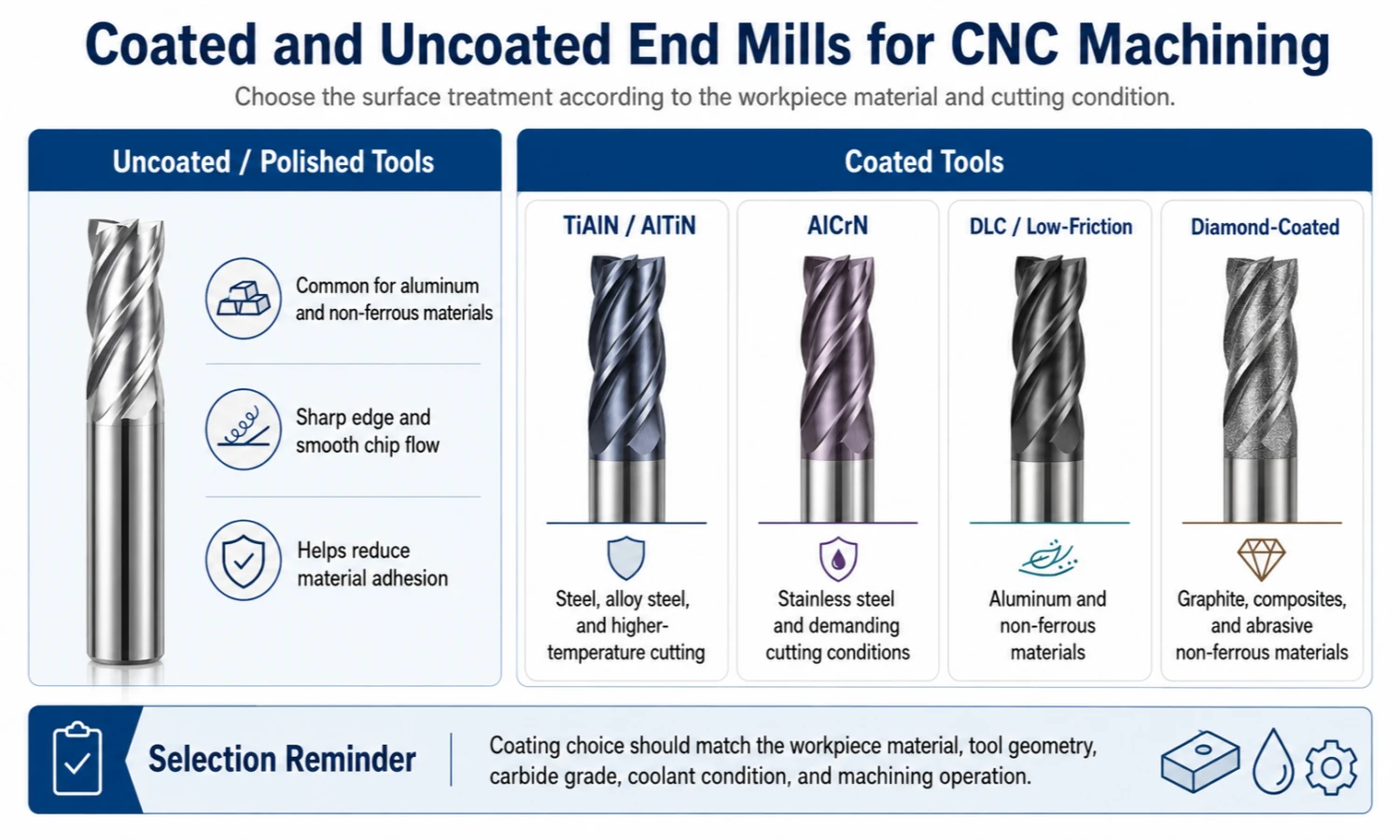
Pas 5: Choose Coated or Uncoated End Mills
Coating affects friction, rezistenta la caldura, rezistenta la uzura, material adhesion, și protecție de ultimă oră.
Use the following table as a selection direction rather than a fixed rule.
| Direcția piesei de prelucrat | Coating or Surface Direction | Main Consideration |
|---|---|---|
| Aluminiu și materiale neferoase | Neacoperit, Polished, DLC, or Suitable Low-Friction Coating | Reduce adhesion and support chip flow |
| Oțel carbon și aliat | TiAlN, Altin, or Suitable Heat-Resistant Coating | Heat resistance and edge protection |
| Oţel inoxidabil | AlCrN, TiAlN, Altin, sau acoperire specifică aplicației | Căldură, wear, și stabilitate de tăiere |
| Graphite and Abrasive Composites | Diamond-Coated Tools | Abrasive wear resistance |
| General Lower-Speed Applications | TiN or Uncoated Options | Lubricity and general wear protection |
Aluminiu și materiale neferoase
Pentru aluminiu, start with a sharp edge, flaut lustruit, and uncoated or low-friction surface.
A coating with high heat resistance is not automatically suitable for aluminum. If the surface increases material adhesion, built-up edge and poor chip flow may occur.
Oțel
For carbon and alloy steel, TiAlN, Altin, TiSiN, or another suitable heat-resistant coating can protect the cutting edge.
As workpiece hardness and cutting temperature increase, calitate de carbură, pregătirea marginilor, and coating become more important.
Oţel inoxidabil
Pentru oțel inoxidabil, choose a coating and geometry that support heat control and cutting stability.
AlCrN, TiAlN, or AlTiN can provide useful starting directions, but the final choice should match the stainless grade, operare, număr de flaut, starea lichidului de răcire, and cutting load.
Diamond-Coated Tools
Diamond-coated end mills suit graphite, compozite, abrasive non-ferrous materials, and other specific applications.
Do not use diamond coating as a universal choice for all metals. The workpiece chemistry and cutting conditions must be compatible.
The exact coating should match the carbide grade, geometria sculei, workpiece grade, operatie de taiere, si starea lichidului de racire.
Pas 6: Confirm Dimensions and Geometry
Cutter diameter is only one part of the tool specification.
Înainte de a comanda, confirma:
- Diametrul tăietorului
- Lungimea flautului
- Lungime totală
- Diametrul tijei
- Required machining depth
- Atingerea instrumentului
- Raza colțului
- Helix angle
- Număr de flaut
- Center-cutting requirement
- Toleranță dimensională
Use the shortest practical tool that reaches the machining area.
If the required reach is long but the cutting depth is short, choose a long-neck tool rather than an end mill with an unnecessarily long flute. A shorter cutting section can provide better rigidity.
Excessive flute length or overall length increases the risk of:
- Chatter
- Deformarea sculei
- Eroare dimensională
- Uzura neuniformă
- ciobirea colțurilor
- Ruperea sculei
Choose a custom end mill when standard dimensions or geometry cannot reach the feature or meet the required diameter, raza colțului, toleranţă, acoperire, or application target.
Pas 7: Check Machine, Titularul, and Clamping Conditions
The correct end mill can still perform poorly in an unstable setup.
Contopirea sculei
Consola lungă reduce rigiditatea. Keep the tool as close to the holder as the machining depth allows.
Before changing the coating or flute count, check whether the cutter extends farther than necessary.
Holder Runout
Runout can make one cutting edge carry more load than the others. This causes uneven wear and may lead to poor surface finish, chipping, or premature failure.
Inspectați suportul, colt, shank cleanliness, and tool seating when one flute shows more wear than the others.
Machine Rigidity
Stare ax, precizia titularului, machine structure, and workpiece clamping all affect the result.
A rigid carbide tool cannot correct movement in the workpiece or holder.
Chip and Coolant Delivery
Air or coolant must reach the cutting area.
Poor delivery can leave chips inside deep pockets and slots. The tool then re-cuts those chips, which increases heat and damages the edge.
Workpiece Clamping
Movement at the workpiece can look like a tool problem.
Înainte de a schimba freza, confirm that the fixture holds the part securely and that the toolpath does not create unnecessary vibration.
How Workpiece Material Affects End Mill Selection
Workpiece material remains important, but it should be considered together with the machining operation.
- Aluminum needs sharp edges and enough chip space.
- Carbon and alloy steel need stronger cutting edges and wear resistance.
- Oțelul inoxidabil necesită tăiere stabilă pentru a controla căldura și întărirea prin lucru.
- Cast iron needs good abrasion resistance.
- Mold and tool steel require a tool series matched to the actual hardness.
- Titanium alloys require careful heat control and stable engagement.
Pentru o selecție detaliată pe bază de material, citire cum să alegi o freză din carbură.
End Mill Selection and Setup Problems
| Symptom | Cauza posibila | First Adjustment Direction |
|---|---|---|
| Chips Pack Inside the Slot | Too many flutes, insufficient flute space, evacuare slabă a așchiilor | Reduceți numărul de flaut, îmbunătățiți livrarea aerului sau a lichidului de răcire, and check flute length |
| Ruperea sculei | Chip packing, surplombarea excesivă, unstable holder, logodna grea | Îmbunătățiți îndepărtarea așchiilor, shorten reach, check clamping, și reduce implicarea instabilă |
| Chatter Marks | Long overhang, weak setup, forțe de tăiere repetitive | Scurtați instrumentul, îmbunătăți prinderea, și luați în considerare geometria helixului variabil |
| Finisaj slab al suprafeței | Worn edge, a alerga afară, unstable feed, profil de capăt necorespunzător | Inspect the tool and holder, stabilize the cut, and select the correct profile |
| Uzura rapidă a marginilor | Grad greșit de carbură, acoperire, sau starea de tăiere | Potriviți calitatea și acoperirea cu materialul, duritate, căldură, si functionare |
| Corner Chipping | Sharp corner under heavy load, vibratie, tăiere întreruptă | Consider a corner radius and improve setup stability |
| Marginea încorporată din aluminiu | Frecare mare, marginea plictisitoare, rough flute surface, poor chip flow | Folosiți geometrie lucioasă ascuțită și îmbunătățiți evacuarea așchiilor |
A machining problem can have several causes. Changing only the coating or flute count may not solve it.
Start with the setup, fluxul de cip, starea sculei, and engagement. Then evaluate whether the tool geometry needs to change.
Common End Mill Selection Mistakes
Choosing by Diameter Only
Two end mills with the same diameter may have different flute lengths, flaut numără, profile de capăt, clase de carbură, acoperiri, and applications.
Always review the complete specification.
Ignorând Evacuarea Cipului
Poor chip evacuation causes heat, re-tăierea așchiilor, marginea construită, vorbărie, și ruperea sculei.
This problem is especially common during full-width slotting, deep pocketing, and aluminum machining.
Folosirea prea multă surplus de scule
Excessive reach reduces rigidity.
Use the shortest tool that safely reaches the machining depth. If the feature is deep, consider a long-neck design with the minimum necessary cutting length.
Choosing More Flutes Without Checking Chip Space
More cutting edges improve feed capability and surface consistency when engagement is light and chip flow remains stable.
In deep slotting, cu toate acestea, excessive flute count can trap chips and damage the cutter.
Choosing a Coating by Name Only
A more expensive coating is not automatically better.
Match the coating with the material, calitate de carbură, geometrie, lichid de răcire, temperatura de tăiere, si functionare.
Using One End Mill for Every Operation
A roughing cutter, finishing tool, slotting end mill, and ball nose cutter perform different jobs.
Choose the end mill according to the feature and machining stage rather than using one general tool for every operation.
FAQ
Can an end mill drill a hole?
Some center-cutting end mills support ramping, helical entry, or limited plunging. Cu toate acestea, they should not automatically replace a drill bit.
Confirm the center geometry, diametrul tăietorului, materialul piesei de prelucrat, and programmed entry method before using an end mill for axial entry.
Should I choose carbide or HSS for a low-rigidity machine?
HSS or HSS-Co may provide more toughness and tolerance to vibration on a lower-speed or less rigid machine.
Carbide provides greater rigidity and wear resistance, but it needs a stable holder, runout controlat, and reliable clamping.
Why does an end mill break during slotting?
Common causes include chip packing, excessive flute count, too much tool overhang, unstable clamping, logodna grea, and poor coolant or air delivery.
Check chip evacuation and setup stability before assuming that the carbide grade is the only problem.
When should I choose a variable-helix end mill?
Choose variable-helix or unequal-pitch geometry when repetitive cutting forces create chatter during side milling, profilare, sau finisare.
The design can reduce vibration, but it still requires a rigid holder and stable workpiece clamping.
When should I use a long-neck end mill instead of a long-flute end mill?
Use a long-neck tool when the feature needs additional reach but only a short cutting section.
The reduced flute length normally provides more support than an unnecessarily long cutting edge.
What information helps when requesting a custom end mill?
Send the available tool dimensions, desen, imaginea produsului, materialul piesei de prelucrat, operatie de prelucrare, caracteristica necesară, current tool model, cantitate, and any existing machining problem.
You do not need to prepare every detail before contacting the supplier. Missing specifications can be confirmed during the quotation process.
Need Help Selecting the Right End Mill?
The right end mill depends on the machining operation, materialul piesei de prelucrat, feature shape, dimensiunile cerute, configurarea mașinii, and surface-finish target.
Trimite-ne desenul tău, model de instrument, dimensiunile cerute, imaginea produsului, eşantion, sau informațiile de prelucrare disponibile. Cu 16 ani de experiență în fabricarea sculelor de tăiere, we can review the application and help confirm a suitable standard or custom tool direction.
View our standard and custom pagina produsului freza de freza.
Pentru a discuta aplicația dvs, trimite-ne un e-mail la sales@cutterbest.com.