 Freze de precizie,Scule de tăiere pentru prelucrarea CNC a fiecărui material

The T Slot Cutter vs Woodruff Cutter comparison can be confusing because the two tools often look very similar. Both may use a wider cutting head with a narrower neck or shank area, so it is easy to assume that they are interchangeable.
They are not automatically the same tool.
Machinists normally use a T-slot cutter to machine the wider lower section of a T-shaped slot or undercut. Machinists primarily use a Woodruff cutter, more precisely a Woodruff keyseat cutter, to machine a Woodruff keyseat, typically on a shaft.
In some applications, a specific Woodruff or keyseat cutter may also be suitable for undercutting or slotting. Cu toate acestea, suitability depends on the actual cutter geometry, cutting capability, clearance-ul, and the finished feature shown on the part drawing.
T Slot Cutter vs Woodruff Cutter: Comparație rapidă
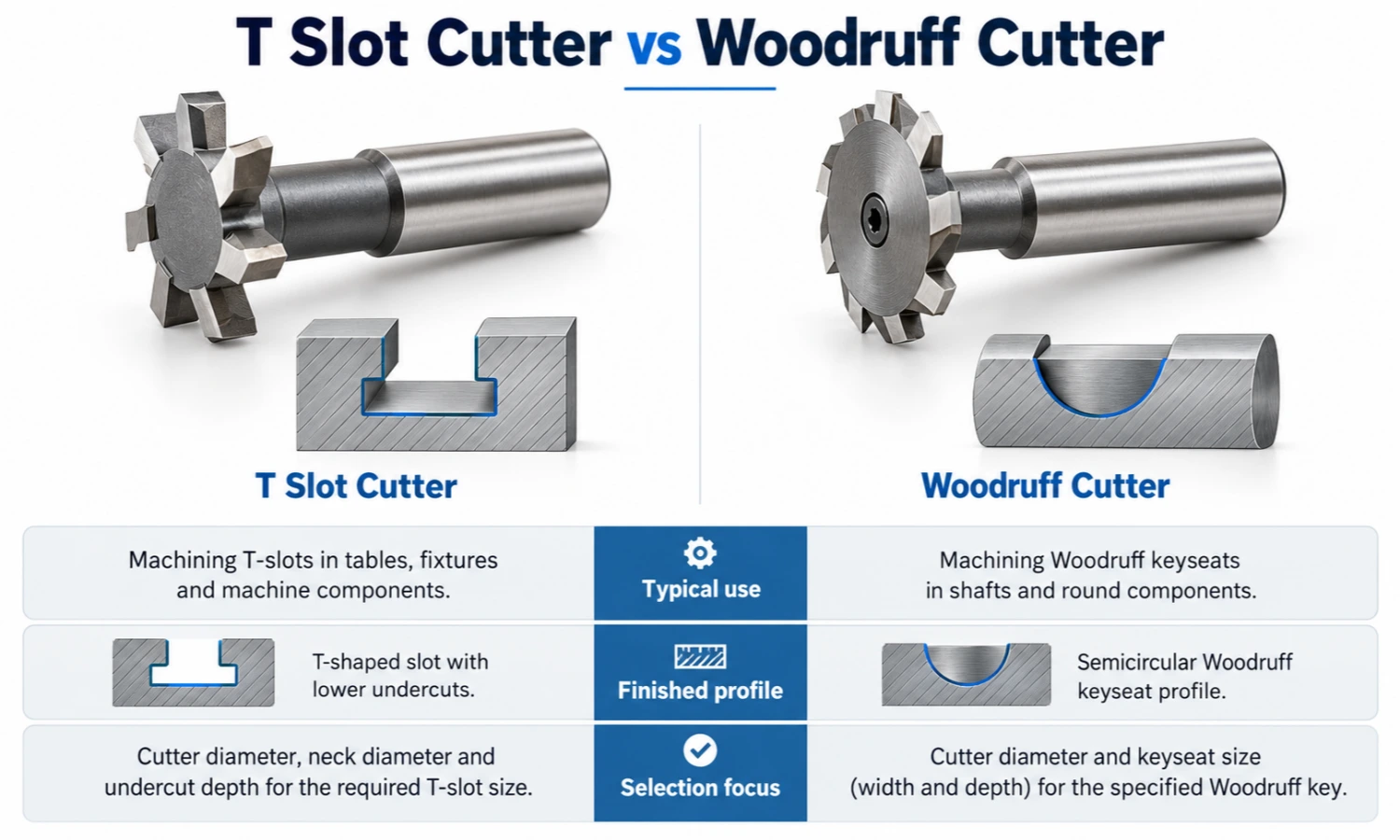
| Comparison | Tăietor de fante | Woodruff Cutter |
|---|---|---|
| Typical Finished Feature | T-shaped undercut or lower section of a T-slot | Woodruff keyseat |
| Typical Workpiece | Plates, corpuri de fixare, componentele mașinii, and parts requiring an undercut | Shafts and keyed assemblies |
| Diametrul tăietorului | Selected according to the required undercut geometry, available clearance, and planned toolpath | Selected according to the required keyseat geometry and cutter specification |
| Lățimea de tăiere | Relates to the axial width of the cutting section and the required T-slot profile | Commonly closely related to the required keyseat width |
| Neck / Ajunge | Important for passing through the upper slot and reaching the lower undercut | Depends on shaft geometry, keyseat depth, clearance-ul, și design cutter |
| Geometrie de tăiere | Depends on the specific cutter design and required cutting direction | Depends on the specific cutter design; not all Woodruff cutters have the same cutting capability |
| Interschimbabilitatea | Not automatic | Not automatic |
The safest way to choose between them is to start with the finished feature, then compare the cutter drawing with the part drawing.
What Is the Main Difference?
The main difference is not simply the shape of the tool. It is the geometry that the tool is intended to produce.
T-Slot Geometry
A T-slot normally has a narrower upper opening and a wider lower section.
În multe procese de prelucrare, the machinist creates the upper straight slot first. The T-slot cutter then enters through this prepared slot and cuts the wider lower undercut.
Din cauza acestei geometrii, diametrul tăietorului, lățimea de tăiere, diametrul gâtului, clearance-ul gâtului, and reach all affect whether the tool can access and machine the required profile.
For standard or custom tooling, vezi noastre Tăietor de fante pagina produsului.
For a more detailed explanation of the machining sequence and cutter access, vedea how T-slot milling works in our T-slot milling guide.
Woodruff Keyseat Geometry
A Woodruff keyseat is designed to accept a Woodruff key, usually in a shaft.
The cutter must therefore match the required keyseat geometry rather than simply fit inside a general undercut.
Check cutter diameter, lățimea de tăiere, and keyseat depth together with the actual shaft and key requirements.
For available tooling, vezi noastre Woodruff Keyseat Cutter pagina produsului.
Manufacturer terminology can overlap, so the product name alone is not enough to confirm that two cutters are equivalent. The actual cutter geometry and drawing are more reliable.
Tool Geometry and Cutting Structure
Prin urmare, when two cutters look similar, the next step is to compare the dimensions and cutting structure that affect the finished feature.
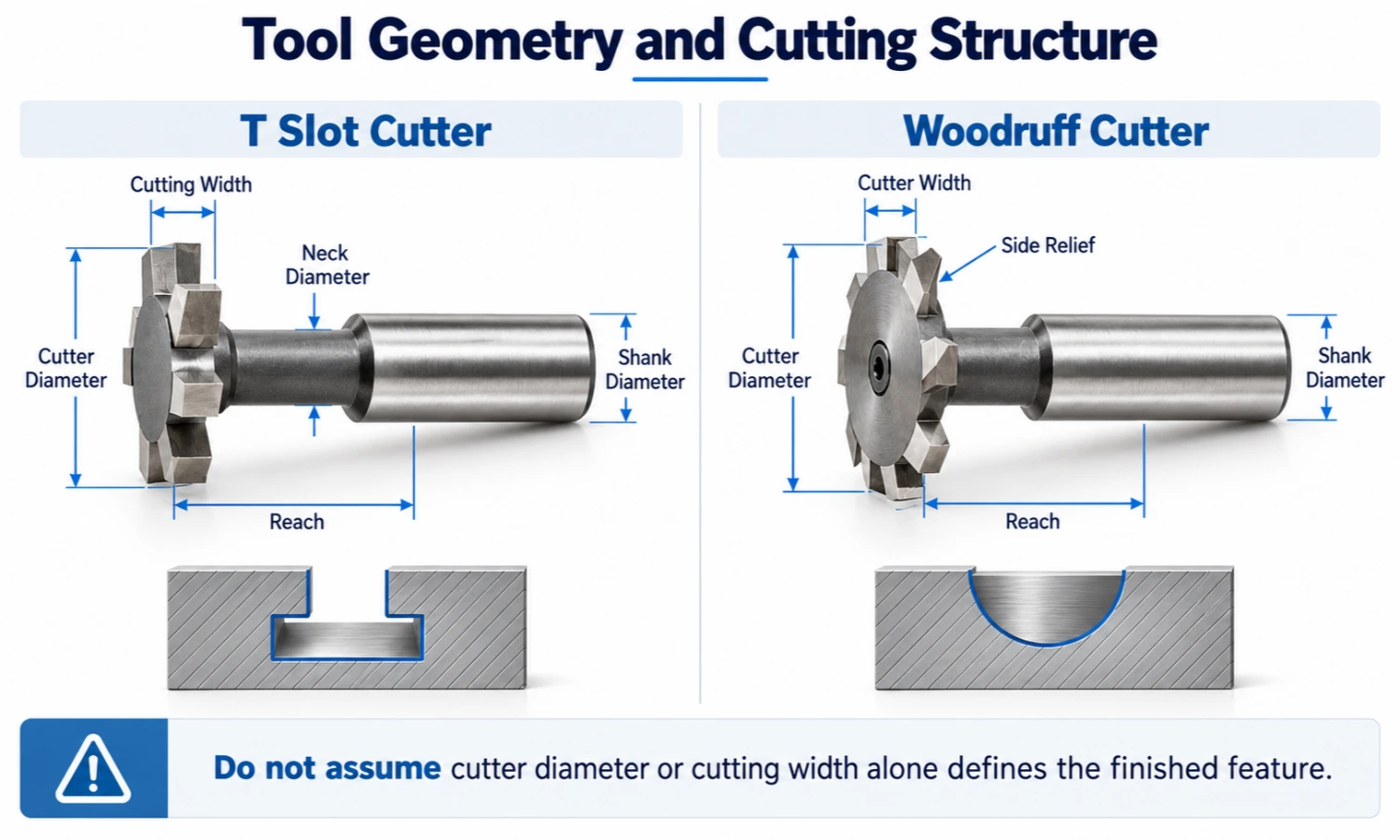
Diametrul tăietorului, Cutting Width and Finished Geometry
Cutter diameter and cutting width are important for both tool types, but they should not be interpreted in exactly the same way.
Lățimea de tăiere refers to the width of the cutting section along the cutter axis.
With a Woodruff keyseat cutter, this width is commonly closely related to the required keyseat width.
In T-slot milling, the cutting width relates to the axial dimension of the cutting section, în timp ce diametrul tăietorului, angrenare radială, and toolpath together determine whether the required undercut profile can be produced.
Prin urmare, do not assume that two cutters with similar outside diameters and cutting widths are interchangeable.
The finished profile must still match the part drawing.
Neck Clearance and Reach
Neck geometry becomes especially important when the cutter must reach behind or below another feature.
For T-slot milling, the neck usually has to pass through the prepared upper slot while allowing the cutting head to reach the lower undercut.
Important checks may include:
- Neck diameter
- Neck transition geometry
- Usable reach
- Diametrul tăietorului
- Workpiece clearance
- Shank and holder interference
În mod similar, Woodruff cutters may require neck and clearance checks, especially when machining close to shoulders or other shaft features.
The same terms should not be assumed to mean the same usable cutting reach on every cutter. Whenever available, use the manufacturer’s drawing to confirm these dimensions.
Tooth Form, Peripheral Cutting and Face-Cutting Capability
Do not use tooth form alone to identify a T-slot cutter or Woodruff cutter.
Both product families can include different tooth arrangements depending on the cutter design.
It is more useful to separate three concepts:
Peripheral cutting refers to cutting with the outside diameter of the cutter.
Front-face or back-face cutting refers to cutting with one or both axial faces of the cutting head.
Side relief provides clearance between the tool and the workpiece, but side relief does not automatically mean that the relieved surface is designed for active cutting.
Some cutter designs are intended mainly for peripheral cutting. Other specific designs may also provide front- or back-face cutting capability.
This matters when a machining path requires axial widening, face engagement, or another cutting direction beyond simple peripheral cutting.
The correct capability must therefore be confirmed from the actual cutter geometry rather than from labels such as “straight tooth” or “staggered tooth” alone.
Can a Woodruff Cutter Be Used for a T-Slot?
Sometimes, but not automatically.
Some Woodruff or keyseat cutters may be suitable for certain undercut or T-slot-type operations when their geometry matches the required feature.
Cu toate acestea, do not select the tool only because it looks similar to a T-slot cutter.
When a Specific Cutter May Be Suitable
A specific Woodruff or keyseat cutter may be suitable for a T-slot-type operation when its cutter diameter, lățimea de tăiere, available reach, cutting capability, and clearance are compatible with the required feature and planned toolpath. If axial widening or face cutting is required, the specific cutter must also be designed for that cutting direction.
Suitability still depends on whether the finished profile and required tolerance can be achieved.
Cu alte cuvinte, the question is not simply:
“Is this a Woodruff cutter?”
Întrebarea mai utilă este:
“Does this specific cutter geometry match the required T-slot feature and toolpath?”
What Must Be Checked Before Substitution
Before using a Woodruff cutter in place of a T-slot cutter, compare the part drawing and cutter drawing carefully.
Finished profile: Can the cutter create the required lower slot geometry and shoulder shape?
Diametrul tăietorului: Does the diameter, together with the permitted radial engagement and toolpath, suit the required undercut and available space?
Lățimea de tăiere: Is the cutting width suitable for the required axial slot dimension, or does the specific cutter support the necessary axial widening?
Cutting capability: Does the tool support the peripheral or face-cutting direction required by the planned toolpath?
Degajarea gâtului: Can the neck pass through the upper slot without rubbing or interference?
Ajunge: Can the cutting head reach the required machining position?
Cutter access: Can the cutting head physically enter the machining area?
Spațiu liber pentru tijă și suport: Will the shank, colt, or holder interfere with the workpiece?
If any of these points are uncertain, do not use the tool as a direct substitute without technical review.
Can a T-Slot Cutter Cut a Woodruff Keyseat?
Conversely, using a T-slot cutter for a Woodruff keyseat also requires caution.
A T-slot cutter may be able to create a slot that appears similar to a Woodruff keyseat, but that does not automatically mean the finished feature will meet the required keyseat geometry.
The required Woodruff keyseat geometry may depend on:
- Diametrul tăietorului
- Lățimea de tăiere
- Keyseat depth
- Finished profile
- Required tolerance
- The specified Woodruff key
A cutter that can physically remove the material is not necessarily the correct cutter for the finished keyseat.
For a specified keyseat requirement, compare the cutter and part geometry with the actual drawing and the relevant cutter or key specification.
How to Choose Between a T Slot Cutter and a Woodruff Cutter
The most reliable selection method is to start with the feature you need to machine rather than with the cutter name.
Start With the Finished Feature
Ask first:
Are you machining a T-shaped undercut?
If yes, a T-slot cutter is normally the starting point.
Are you machining a Woodruff keyseat in a shaft?
If yes, a Woodruff keyseat cutter is normally the starting point.
If the feature does not clearly match either geometry, treat the application as a drawing-specific tool-selection problem.
Check Diameter, Width, Profile and Tolerances
Do not compare only one cutter dimension.
A better review includes:
- Diametrul tăietorului
- Lățimea de tăiere
- Finished profile
- Required depth
- Relevant tolerances
- Available space around the feature
For a T-slot, also consider how the planned toolpath creates the lower undercut.
For a Woodruff keyseat, check how the cutter dimensions relate to the specified keyseat geometry.
Check Neck Clearance, Reach and Access
Even if the cutting head size looks correct, the tool may still be unsuitable if the neck, coadă, or holder cannot reach the feature without interference.
Verifica:
- Upper slot or entry width
- Neck diameter
- Neck transition
- Usable reach
- Nearby shoulders
- Workpiece interference
- Spațiu liber pentru suport
This is especially important for deeper or recessed features.
Compare the Cutter Drawing With the Part Drawing
For standard applications, catalog dimensions may sometimes provide enough information for an initial selection.
Cu toate acestea, for non-standard features, the safest approach is to compare the cutter drawing directly with the part drawing.
This helps avoid common selection mistakes such as choosing a cutter only because:
- The outside diameter looks correct
- The cutting width is similar
- The tool is listed under a similar product name
- The cutter head visually resembles another tool
The finished part geometry should control the final tool selection.
FAQ
How Do I Identify an Unknown T-Slot or Woodruff Cutter?
Do not identify the cutter only from appearance.
A better sequence is:
- Check the tool marking or model number.
- Measure the cutter diameter.
- Measure the cutting width.
- Check the neck and shank geometry.
- Inspect which surfaces are actually designed to cut.
- Compare the tool with the manufacturer drawing or catalog.
If the original model information is unavailable, a dimensioned sketch or clear tool drawing can help determine whether the cutter is suitable for a T-slot, Woodruff keyseat, or another undercut application.
Is Every Keyseat Cutter a Woodruff Cutter?
No.
“Keyseat cutter” can be used as a broader product-family term by some manufacturers.
Depending on the manufacturer, keyseat cutters may include different profiles, tooth forms, and cutting structures. A Woodruff keyseat cutter is one specific type associated with Woodruff keyseat applications.
Terminology varies by manufacturer, so the catalog definition and actual cutter drawing should take priority over the product name alone.
What Information Should I Provide When Selecting Either Cutter?
For accurate tool selection, furnizați cât mai multe dintre următoarele informații posibil:
- Part drawing
- Finished slot or keyseat profile
- Required cutter diameter or available machining space
- Slot or keyseat width
- Required depth or reach
- Degajarea gâtului
- Access condition
- Material piesa de prelucrat, when relevant to tool configuration
If the feature is non-standard, a drawing is usually more useful than a product name alone.
Need Help Choosing the Right Cutter?
Send us your part drawing or application details. We can review the required slot or keyseat geometry and help you confirm whether a T Slot Cutter, Woodruff Keyseat Cutter, or a custom tool is more suitable.
Send your inquiry by email, sau contactați-ne pe WhatsApp.