 Freze de precizie,Scule de tăiere pentru prelucrarea CNC a fiecărui material

O 6 flute end mill is mainly used for controlled side milling, frezarea profilului, frezarea conturului, semifinisare, si finisare. Its six cutting edges provide frequent cutting contact, which can support good tool rigidity, stable wall machining, and a smoother finishing pass.
Cu toate acestea, more flutes leave less space for chip evacuation. Prin urmare, a standard six-flute cutter is usually not the best choice for deep full-width slotting, degrosare grea, or aggressive cutting in materials that produce large chips.
În practică, a six-flute tool works best when surface quality and cutting stability matter more than maximum material removal.
Ce este a 6 Moara de capăt pentru flaut?
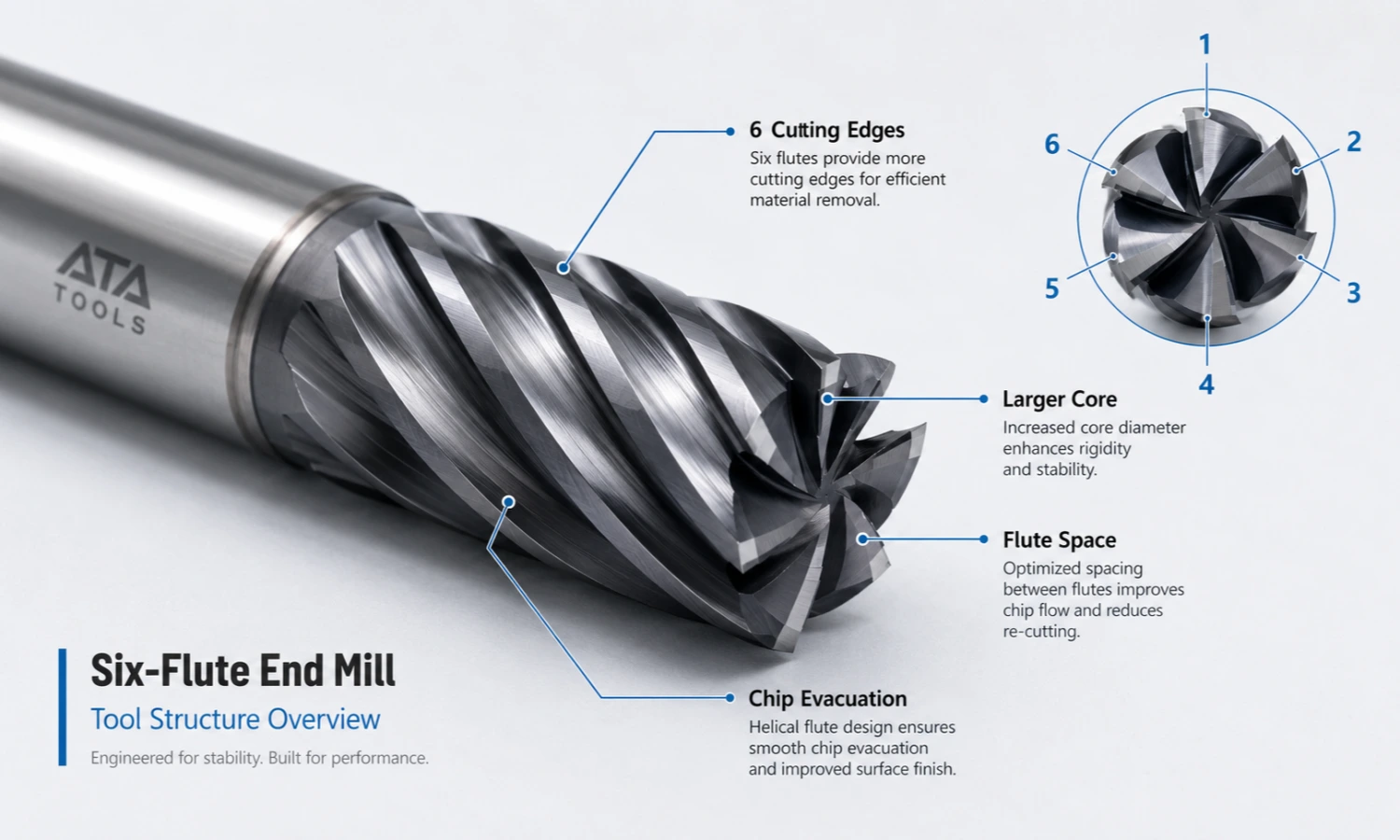
O 6 flute end mill has six cutting edges around its cutting section. Each spindle revolution brings six cutting edges into contact with the workpiece.
Compared with a cutter that has two or four flutes, a six-flute design normally has a larger tool core and smaller flute spaces. The larger core can support tool rigidity, while the additional cutting edges can spread the cutting action across more teeth.
The main trade-off is chip evacuation. Smaller flute spaces hold fewer chips, so the cutter needs controlled engagement and a clear path for chips to leave the cutting area.
Din acest motiv, six-flute tools usually perform better in side cutting and finishing than in deep slotting or heavy roughing.
For a general explanation of milling cutter types and structures, citeste-ne end mill cutter guide.
Main Uses of a 6 Moara de capăt pentru flaut
The best applications involve controlled chip volume, stable machine conditions, and a need for good wall quality or surface finish.
Side and Profile Milling
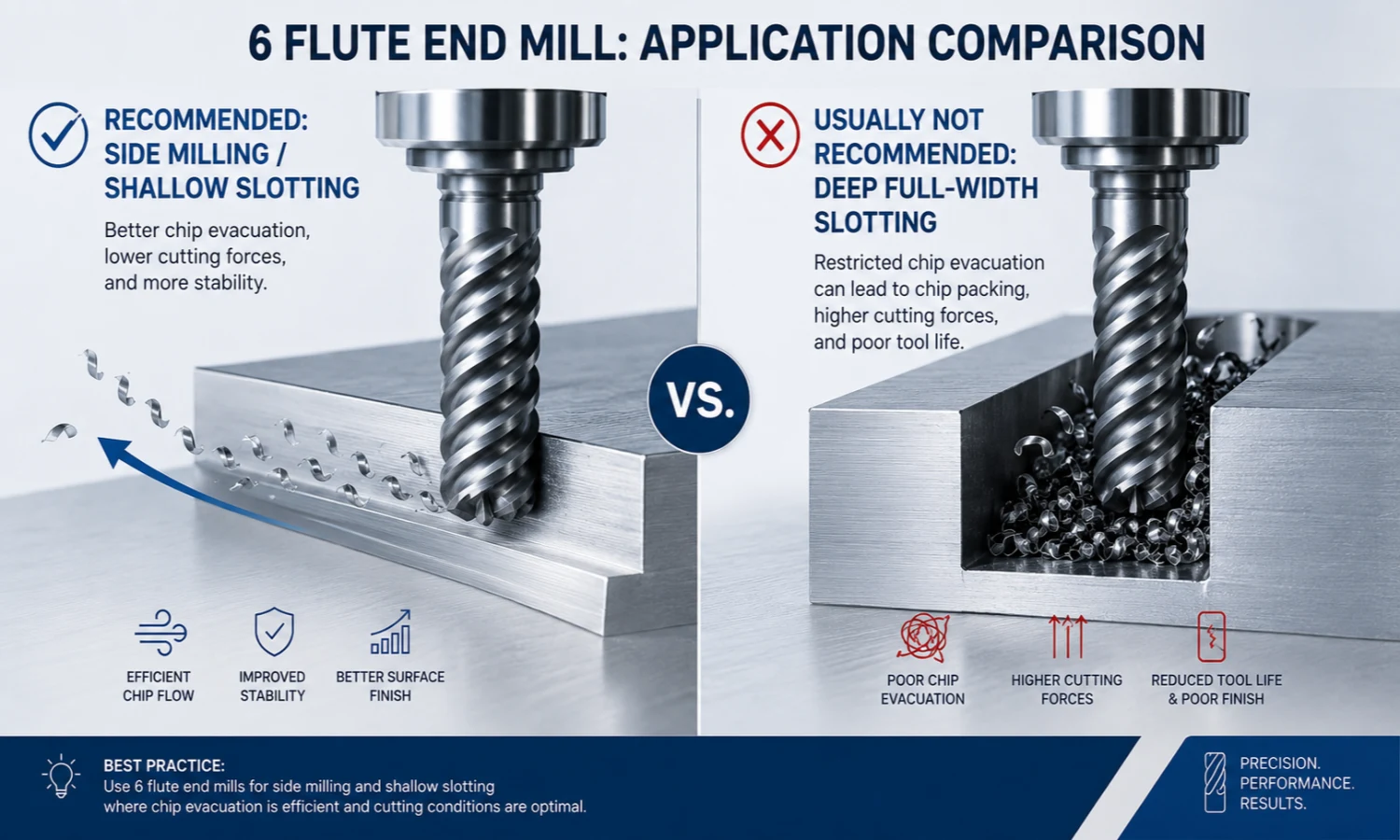
A six-flute cutter works well for side milling because only part of the tool diameter normally engages with the workpiece. This leaves more room for chips to escape than full-width slotting does.
Typical uses include straight side walls, umerii, outside profiles, and precision component features. The extra cutting edges can also support stable tool contact when the radial cutting width remains controlled.
Încă, the result depends on more than flute count. Executarea sculei, starea titularului, rigiditatea mașinii, lățimea de tăiere, and tool overhang all affect side-wall quality.
Contour Milling
Contour milling involves following a curved or irregular workpiece profile. A rigid six-flute tool can support consistent contact as it moves along the contour.
This makes the design useful for mold components, tooling parts, machinery components, and other precision profiles. Cu toate acestea, o surplosă lungă a sculei sau un suport instabil pot crea în continuare vibrații.
Prin urmare, instrumentul ar trebui să rămână cât de scurt permite aplicația, mai ales la prelucrarea contururilor abrupte sau adânci.
Semifinisare
Semifinisarea îndepărtează materialul rămas după degroșare și pregătește suprafața pentru trecerea finală.
O unealtă cu șase caneluri se potrivește acestei etape când stocul rămas este controlat. Muchiile de tăiere suplimentare pot distribui acțiunea de tăiere și pot ajuta la menținerea unei geometrii consistente a peretelui.
Înainte de a folosi șase flute, asigurați-vă că operațiunea de degroșare nu a lăsat un aport neuniform sau excesiv. Stocul mare și neregulat poate supraîncărca muchiile de tăiere individuale.
Finisare
Finisarea este una dintre cele mai comune 6 aplicații de freza cu caneluri.
Mai multe muchii de tăiere pot lăsa urme de tăiere mai fine atunci când viteza, hrana, calea sculei, și configurația mașinii se potrivește cu materialul. Ca urmare, six-flute cutters are often selected for finishing straight walls, profiluri, umerii, and precision surfaces.
Cu toate acestea, flute count alone does not guarantee a specific surface roughness. Holder accuracy, epuizarea sculei, starea mașinii, workpiece stability, parametrii de tăiere, and tool wear also influence the final surface.
Shallow Slotting and High-Speed Machining
A six-flute cutter can machine shallow slots when the chips can leave the cutting area effectively. Light slotting may work well, especially when the axial depth and chip volume remain low.
Deep full-width slotting is different. În acest caz, the cutter stays surrounded by material, while the smaller flute spaces must carry all chips out of the slot. Chip packing and heat can then increase quickly.
Six-flute tools can also support high-speed machining, but high spindle speed alone is not enough. The full setup must control heat, a alerga afară, vibratie, și evacuarea așchiilor.
Quick Application Guide
| Operație de prelucrare | General Suitability | Main Consideration |
|---|---|---|
| Frezare laterală | Recomandat | Use controlled radial engagement |
| Frezarea profilului | Recomandat | Check holder accuracy and tool overhang |
| Contour Milling | Recomandat | Maintain a rigid setup |
| Semifinisare | Recomandat | Keep the remaining stock consistent |
| Finisare | Recomandat | Control runout and cutting parameters |
| Shallow Slotting | Conditional | Make sure chips can leave the slot |
| Deep Full-Width Slotting | Usually Not Recommended | Limited flute space restricts chip evacuation |
| Degroșare grea | Usually Not Recommended | Lower flute counts provide more chip space |
Which Materials Are Suitable for a 6 Moara de capăt pentru flaut?
The correct choice depends on the workpiece material, duritate, operatie de taiere, rigiditatea mașinii, starea lichidului de răcire, and tool design.
A tool made for steel should not automatically be used for aluminum or titanium. Even when the flute count stays the same, the cutting-edge geometry and other tool features may need to change.
Steel and Alloy Steel
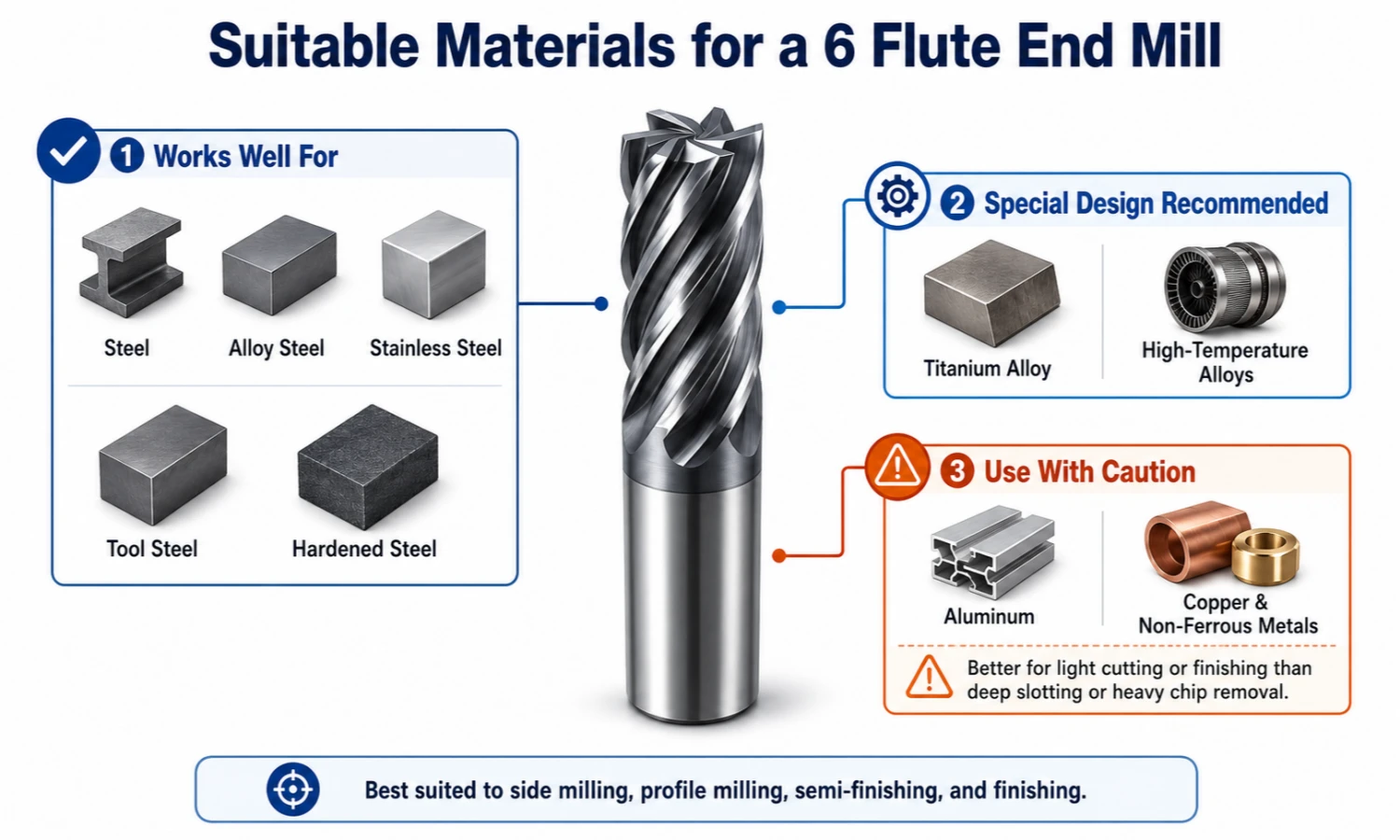
Steel and alloy steel are common application areas for six-flute tools.
The cutter can handle controlled side milling, frezarea profilului, semifinisare, and finishing when its carbide grade, geometria de tăiere, and coating match the material hardness.
Six flutes are especially useful when the operation requires stable walls or a clean finishing pass. În contrast, heavy roughing generally needs more chip space.
Oţel inoxidabil
A six-flute cutter can machine 304, 316, and other stainless steel grades. Cu toate acestea, stainless steel can generate heat and may work-harden if the cutting action becomes unstable.
Prin urmare, the cutter must maintain a consistent cut. The cutting geometry, acoperire, lichid de răcire, speed, and feed should all match the stainless steel grade and machining operation.
A six-flute design usually makes more sense for controlled side cutting and finishing than for deep slotting in stainless steel.
Tool Steel and Hardened Steel
Six-flute tools can also machine tool steel, oțel pre-călit, and hardened steel when the tool series matches the material hardness.
Harder materials need suitable carbide grades, puterea muchiei, acoperiri, and cutting geometry. Ca urmare, one standard cutter should not be treated as a universal solution for every hardness range.
For hardened materials, stable machine conditions and low tool runout become even more important.
Titanium and Difficult-to-Machine Materials
A specially designed six-flute tool may suit titanium and other difficult-to-machine materials.
Cu toate acestea, heat control, sarcina de tăiere, puterea muchiei, livrarea lichidului de răcire, and tool overhang require careful attention. Standard steel-cutting geometry may not provide the best result.
Before choosing the cutter, review the exact titanium grade, operatie de prelucrare, adâncimea de tăiere, metoda lichidului de răcire, și starea mașinii.
Can a 6 Flute End Mill Cut Aluminum?
Da, dar numai atunci când freza folosește o geometrie adecvată pentru aluminiu și operațiunea nu creează un volum excesiv de așchii.
Aluminiul produce adesea așchii mai mari și mai adezive decât oțelul. Prin urmare, fantele adânci și degroșarea grea funcționează de obicei mai bine cu două sau trei caneluri, deoarece oferă spații mai mari pentru caneluri.
O unealtă cu șase caneluri poate fi încă potrivită pentru frezarea laterală ușoară sau finisarea în aluminiu atunci când are muchii ascuțite, control eficient al cipurilor, și suficient spațiu pentru evacuarea așchiilor.
Când ar trebui să alegeți a 6 Moara de capăt pentru flaut?
Alegeți un tăietor cu șase caneluri atunci când se aplică majoritatea condițiilor următoare:
- Finisajul suprafeței contează mai mult decât îndepărtarea maximă a materialului.
- Operația presupune frezare laterală, profilare, semifinisare, sau finisare.
- Mașina și suportul asigură o bună rigiditate.
- Lățimea de tăiere radială rămâne controlată.
- Contopirea sculei rămâne relativ scurtă.
- Chips can leave the cutting area effectively.
- The cutter design matches the workpiece material and hardness.
These conditions help the tool use its main strengths: rigiditate, frequent cutting contact, and consistent wall machining.
When Is a 6 Flute End Mill Not the Best Choice?
More cutting edges do not make a cutter suitable for every operation. In some applications, the reduced flute space becomes a greater concern than tool rigidity.
Deep Full-Width Slotting
În timpul creării pe toată lățimea, the cutter engages material across its full diameter. Chips must travel through the flute spaces and out of the slot.
Because a six-flute design has smaller flute spaces, chips may collect inside a deep slot. This can increase heat, sarcina de tăiere, and the risk of edge damage.
For deep slots, a lower flute count usually provides safer chip evacuation.
Degroșare grea
Heavy roughing removes a large amount of material. Ca urmare, it produces more chips and places higher loads on the cutter.
A two-flute, three-flute, four-flute, or dedicated roughing tool often provides more space for chip flow. The best choice depends on the material and roughing strategy.
Materials That Produce Large Chips
Soft materials such as aluminum can produce large or adhesive chips during aggressive cutting.
In these conditions, a high-flute-count cutter may pack chips inside the flutes. A lower flute count normally handles heavy aluminum cutting more effectively.
Unstable Setups and Long Tool Overhang
A six-flute design can provide good core rigidity, but it cannot correct every setup problem.
Consolă lungă, worn holders, high runout, weak workholding, or an unstable machine can still cause vibration and cutting marks. In severe cases, they may also contribute to edge chipping.
Prin urmare, reduce the overhang and check the complete setup before changing flute count.
What Is the Main Disadvantage of a High-Flute-Count End Mill?
The main disadvantage of a high-flute-count end mill is reduced flute space.
As flute count increases, each flute usually has less room to carry chips. This can make chip evacuation more difficult, especially during deep slotting, degrosare grea, or high material removal.
If chips cannot leave the cutting area, they may be cut again or packed between the tool and workpiece. Ca urmare, heat and cutting pressure can increase.
The correct flute count must balance three factors:
- Evacuare cip
- Rigiditatea sculei
- Surface quality
A six-flute tool may provide better rigidity and finishing stability, while a lower-flute cutter may handle large chip volumes more effectively.
4 Flaut sau 6 Moara de capăt pentru flaut?
A four-flute end mill is usually the more versatile option. It offers a practical balance between chip space, rigiditatea sculei, și finisarea suprafeței.
A six-flute tool is more specialized. It normally suits controlled side milling, semifinisare, and finishing when stable contact and wall quality matter more than maximum chip evacuation.
The final choice depends on the workpiece material, adâncimea de tăiere, angrenare radială, rigiditatea mașinii, și obiectivul de prelucrare.
For a detailed two-tool comparison, citire 4 flaut vs 6 Freză de capăt pentru caneluri.
For a broader flute-count overview, citire 2 flaut vs 4 flaut vs 6 Freză de capăt pentru caneluri.
Întrebări frecvente
Does “6 Flute” Mean a 6 mm Cutting Diameter?
No. “6 flute” refers to the number of cutting edges.
The cutting diameter is a separate tool dimension. A six-flute cutter can have many different cutting diameters.
Can a 6 Flute End Mill Be Used for Deep Slotting?
A standard six-flute cutter is usually not the first choice for deep full-width slotting.
Its smaller flute spaces can restrict chip evacuation. A lower-flute cutter normally provides more room for chips to leave the slot.
Este o 6 Flute End Mill Good for Stainless Steel?
Da, especially for controlled side milling, frezarea profilului, semifinisare, si finisare.
Cu toate acestea, the cutter geometry, acoperire, lichid de răcire, speed, and feed must match the stainless steel grade and machining operation.
Concluzie
Ce este a 6 moara cu flaut folosit pt? It is mainly used for controlled side milling, frezarea profilului, frezarea conturului, semifinisare, si finisare.
Its main strengths are tool rigidity, stable cutting contact, calitatea peretelui, and finishing performance. Its main limitation is reduced chip space.
Prin urmare, avoid treating six flutes as the best option for every job. Deep full-width slotting, degrosare grea, unstable setups, and large-chip operations usually benefit from fewer flutes.
For standard and custom tool options, vezi noastre 6 freză de capăt din carbură de flute.