 Прецизионные фрезы,Режущие инструменты для обработки любого материала с ЧПУ

A spiral vs straight flute reamer comparison should focus on the application rather than simply asking which design is better. Both configurations can be used for precision hole finishing, but their flute geometry affects chip movement and how they behave in different hole conditions.
A practical reamer selection should consider whether the hole is blind or through, whether it contains a keyway or cross-hole, where the chips need to move, and what machining conditions apply. When a spiral flute is selected, the spiral direction also matters because right-hand and left-hand designs guide chips in different directions.
Быстрый ответ
- Straight flute reamers use straight axial flutes and do not create the same spiral-directed chip movement as helical designs.
- Spiral flute reamers can be made with right-hand or left-hand spiral geometry.
- Right-hand spiral flute reamers are typically preferred for blind holes because chips move toward the hole entrance.
- Left-hand spiral flute reamers are typically preferred for through holes because chips move forward through the hole.
- Spiral flute designs are generally worth considering for interrupted holes, шпоночные пазы, and cross-holes.
- Workpiece material alone does not determine flute selection.
- Final selection should consider hole geometry, направление чипа, заготовка, глубина отверстия, precision requirements, и условия обработки.
Spiral vs Straight Flute Reamer: Ключевые различия
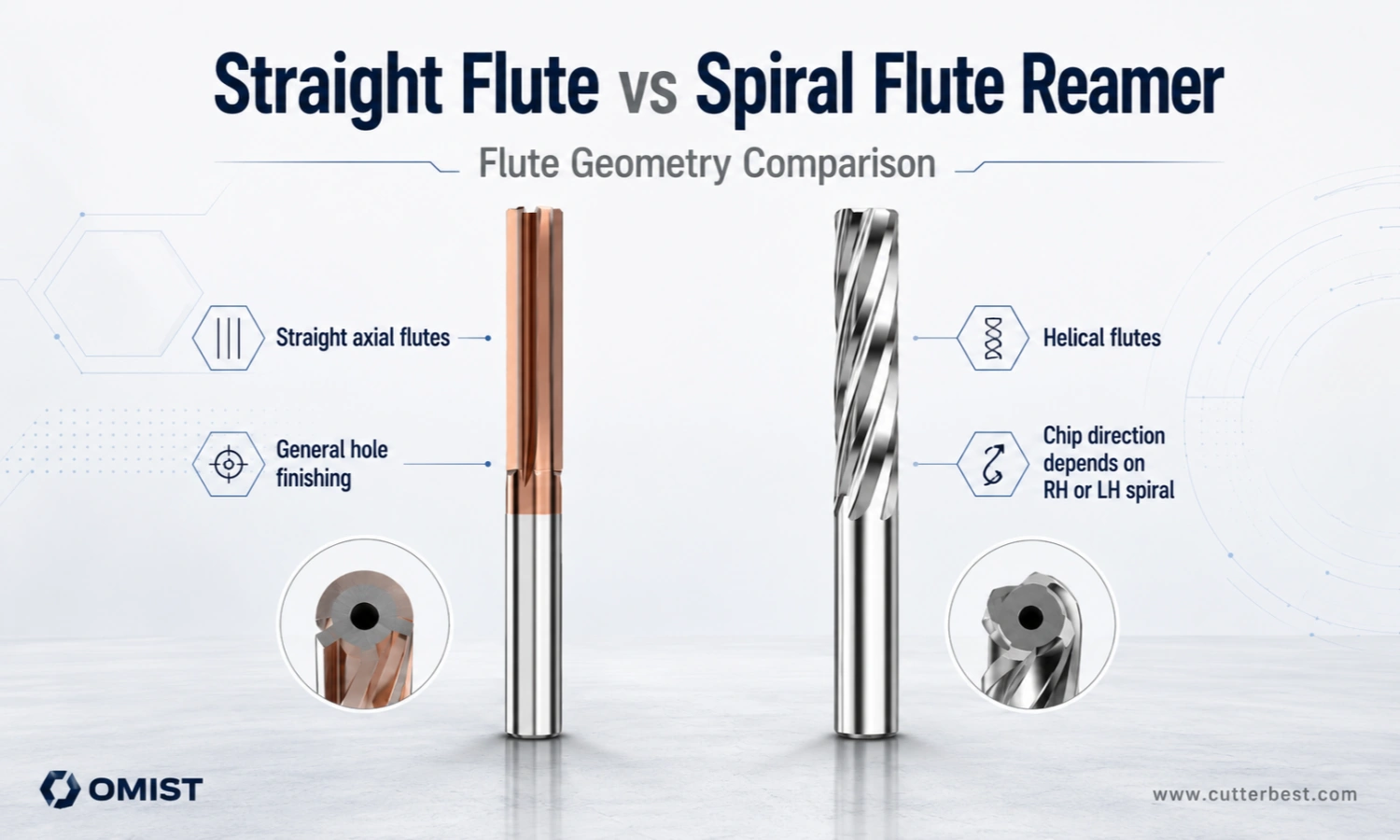
When evaluating a spiral vs straight flute reamer, the primary distinction lies in flute geometry and how that geometry affects chip movement during reaming.
Both designs perform final sizing and finishing of a pre-machined hole. Однако, their different flute configurations make each more suitable for certain machining conditions.
Straight Flute Geometry
A straight flute reamer has flutes that run axially along the cutting section of the tool. Because the flutes do not form a helix, they do not create the same directional chip movement as a spiral flute.
Straight flute tools remain a practical machine-reaming configuration when the hole geometry, chip conditions, and machining requirements suit this design.
For product specifications and available options, см. наш straight flute reamers.
Spiral Flute Geometry
A spiral flute reamer uses a helical flute around the cutting section. This geometry creates directional chip movement, so the spiral direction becomes an important part of tool selection.
Right-hand and left-hand spiral flutes do not guide chips in the same direction. Поэтому, simply specifying a spiral flute reamer may not be enough when the application involves blind holes, through holes, or specific chip-direction requirements.
Термин helical flute reamer may also be used for this general flute configuration. OMIST can manufacture both right-hand and left-hand spiral flute reamers according to the application.
| Selection Factor | Прямая флейта | Right-Hand Spiral | Left-Hand Spiral |
|---|---|---|---|
| Flute Geometry | Straight axial flute | Right-hand spiral / helical flute | Left-hand spiral / helical flute |
| Chip Direction | No spiral-directed chip movement | Toward the hole entrance | Forward through the hole |
| Blind Hole | Application-dependent | Typically preferred | Usually not the first choice for chip direction |
| Through Hole | Application-dependent | Can be considered depending on conditions | Typically preferred |
| Interrupted Hole / Keyway | Selection depends on the interruption and machining conditions | Spiral flute generally preferred | Spiral flute generally preferred |
| Main Selection Consideration | Hole and machining conditions | Blind-hole chip direction | Through-hole chip direction |
Этот spiral vs straight flute reamer comparison table is a selection guide rather than an absolute rule. The final tool choice should still be confirmed against the actual hole design and machining conditions.
Hole Type and Chip Direction: Right-Hand vs Left-Hand Spiral Reamers
Hole type is one of the most important factors in straight vs spiral reamer selection. Once a spiral flute is being considered, the required chip direction becomes another key decision.
Blind Holes – Right-Hand Spiral
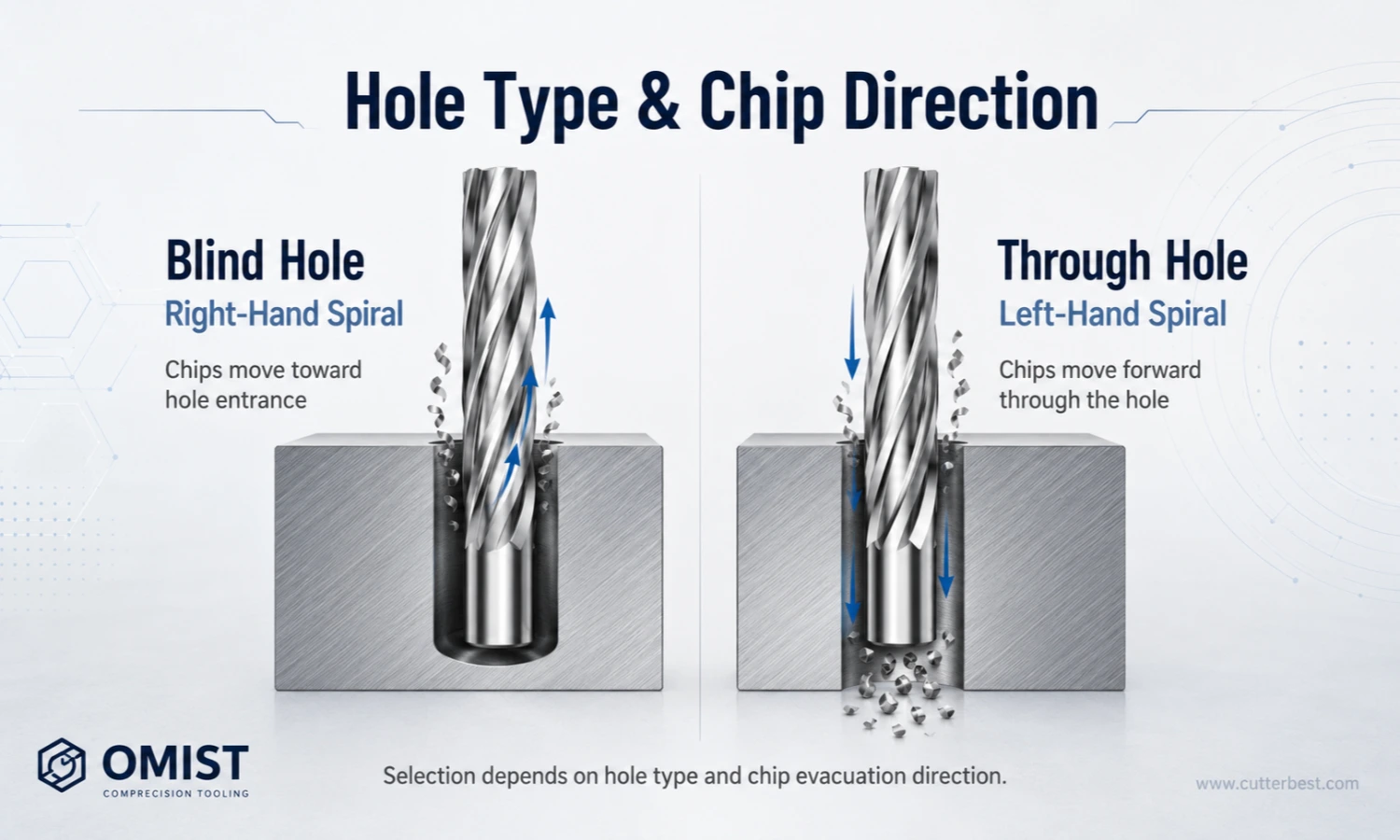
A blind hole has a closed bottom, so chips cannot continue through the workpiece.
For this type of application, а right-hand spiral reamer is typically preferred. Its spiral direction moves chips backward toward the hole entrance, helping reduce chip accumulation at the bottom of the blind hole.
Однако, this does not mean that every blind-hole application uses exactly the same configuration. Глубина отверстия, материал заготовки, required precision, and machining conditions still need to be considered.
For that reason, a right-hand spiral is a useful starting point when selecting a blind hole reamer, rather than an absolute rule.
Through Holes – Left-Hand Spiral
A through hole provides an exit on the opposite side of the workpiece.
In this type of application, а left-hand spiral reamer is typically preferred because chips move forward through the hole. This direction suits applications where chips can continue toward the open end of the hole.
A left-hand spiral is therefore an important option when the through-hole geometry and machining setup allow forward chip movement.
As with blind holes, final selection should still reflect the complete machining conditions.
Where Straight Flute Reamers Fit In
The blind-hole and through-hole discussion should not suggest that straight flute reamers have no role in CNC reaming.
Straight flute designs remain a valid machine-reaming configuration when the hole geometry, chip conditions, and machining requirements match the tool design. Unlike spiral flutes, однако, straight flutes do not create the same spiral-directed chip movement.
Поэтому, flute selection should begin with the actual application rather than assuming that every blind hole or through hole requires one specific design.
Spiral Flutes for Interrupted Holes, Keyways and Cross-Holes
Not every bore has a continuous internal surface. Some holes contain a keyway, intersect with another hole, or include another interruption along the reamed surface.
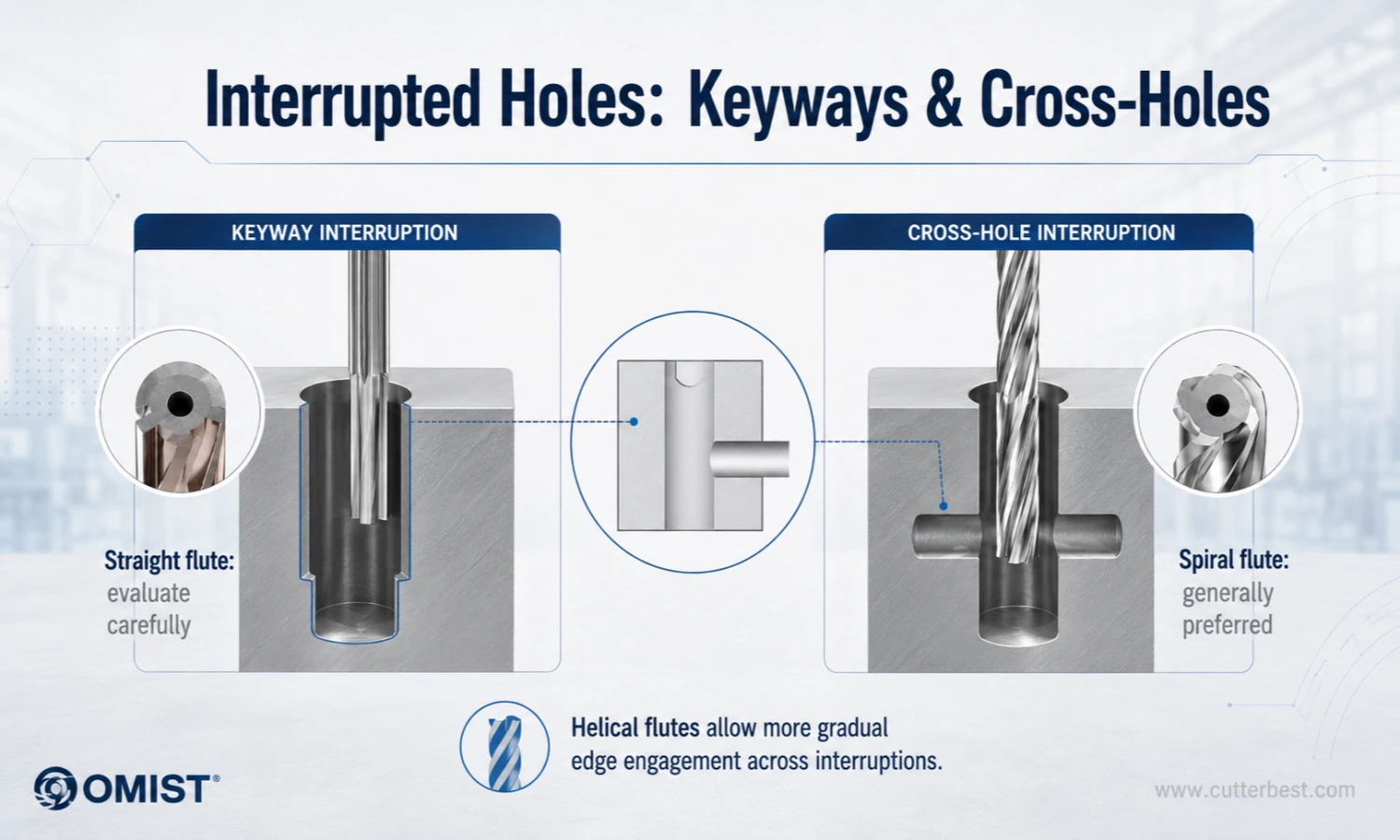
В этих приложениях, the cutting edge moves repeatedly between material and open sections.
A spiral flute is generally worth prioritizing for interrupted hole reaming, including keyway and cross-hole applications. The spiral geometry allows the cutting edge to enter an interrupted area more gradually than a straight flute configuration.
По этой причине, spiral flute geometry is an important selection consideration when the reamer must pass across discontinuities inside the hole.
Однако, the interruption itself does not define the complete tool specification. Hole dimensions, interruption geometry, материал заготовки, and machining conditions should still be reviewed before selecting the final reamer.
OMIST can evaluate spiral flute configurations for these applications according to the actual workpiece and machining requirements.
Does Workpiece Material Determine Flute Selection?
Not by itself.
Workpiece material matters in reamer selection, but it should not be used as a simple rule for choosing between straight and spiral flutes.
OMIST supplies solid carbide reamers for applications involving:
- Пресс-форма стальная
- Закаленная сталь
- Алюминий
- Медь
- Пластмассы
Однако, this does not mean that steel always requires a straight flute or that aluminum always requires a spiral flute.
Вместо, the material should be considered together with the hole type, глубина отверстия, направление чипа, precision requirements, и условия обработки.
Two applications using the same workpiece material may still require different reamer configurations if their hole geometries and chip conditions are different.
The workpiece material helps define the application. It does not, by itself, determine the flute design.
Straight vs Spiral Reamer Selection: A Quick 3-Step Checklist
Use the following three steps as a practical starting point for spiral vs straight flute reamer выбор.
Шаг 1: Identify the Hole Geometry
Determine whether the hole is:
- Blind
- Through
- Interrupted
- Interrupted by a keyway or cross-hole
This establishes the basic chip-direction and cutting-condition requirements.
Шаг 2: Determine the Required Chip Direction
If a spiral flute is appropriate, consider where the chips should move.
For blind holes, chip movement toward the hole entrance generally favors a right-hand spiral. For through holes, forward chip movement generally favors a left-hand spiral.
Шаг 3: Confirm Workpiece and Machining Conditions
Окончательно, обзор:
- Материал заготовки
- Глубина отверстия
- Required precision
- Machine setup
- Other machining requirements
If the correct flute configuration is still uncertain, OMIST can review the application and help select a suitable option from our цельнотвердосплавные развертки диапазон.

Часто задаваемые вопросы
What is the difference between right-hand and left-hand spiral reamers?
The main difference for reamer selection is the resulting chip direction. A right-hand spiral moves chips toward the hole entrance, while a left-hand spiral moves chips forward through the hole.
This is why right-hand spiral configurations are commonly considered for blind holes and left-hand spiral configurations for through holes.
Which reamer is better for a blind hole?
A right-hand spiral flute reamer is typically preferred for blind-hole applications because its chip direction moves chips toward the hole entrance instead of toward the closed bottom.
The final choice should still consider hole depth, материал заготовки, required precision, и условия обработки.
Why are spiral flute reamers preferred for keyways or cross-holes?
Keyways and cross-holes create interrupted cutting conditions. A spiral flute allows the cutting edge to enter these interruptions more gradually, so spiral geometry is generally worth considering when a reamer must pass across interrupted surfaces.
The final tool configuration still depends on the actual hole and machining conditions.
Does workpiece material alone determine straight vs spiral flute selection?
No. Material is only one part of the selection process.
Hole type, направление чипа, interruptions, глубина отверстия, precision requirements, and machining conditions should also be considered before selecting a straight or spiral flute reamer.
Find the Right Reamer for Your CNC Application
If your application is suited to a straight flute configuration, изучить наш straight flute reamers.
If your application requires directional chip movement, blind-hole or through-hole selection, or a spiral configuration for interrupted features, просмотрите наш spiral flute reamers. OMIST can manufacture both right-hand and left-hand spiral versions according to the application.
If you are not sure which configuration to choose, send us the hole type, drawing or dimensioned sketch, hole dimensions, материал заготовки, и доступная информация по обработке. We can review the requirement and help confirm the appropriate flute configuration before quotation.
You can also browse our reamers for CNC hole finishing or contact us through Электронная почта или WhatsApp for application review and quotation.