 Precision Milling Cutters,Cutting Tools for CNC Machining Every Material

Introduction
End mill cutter types affect chip evacuation, cutting stability, surface finish, material removal, and tool life in CNC machining. Choosing the right type is not only about size or coating.
Different tools work better for different machining tasks. Flat end mills are often used for slotting and side milling. Ball nose tools are suitable for 3D contouring and curved surfaces. Corner radius, roughing, and tapered tools help when the part requires stronger edges, faster stock removal, or special reach.
In this guide, we compare the most common end mill cutter types, their uses, basic size factors, tip geometry, and selection tips for aluminum, steel, stainless steel, and custom CNC machining applications.
If you are new to this tool, you can first read our basic milling tool guide.
What Are End Mill Cutter Types?
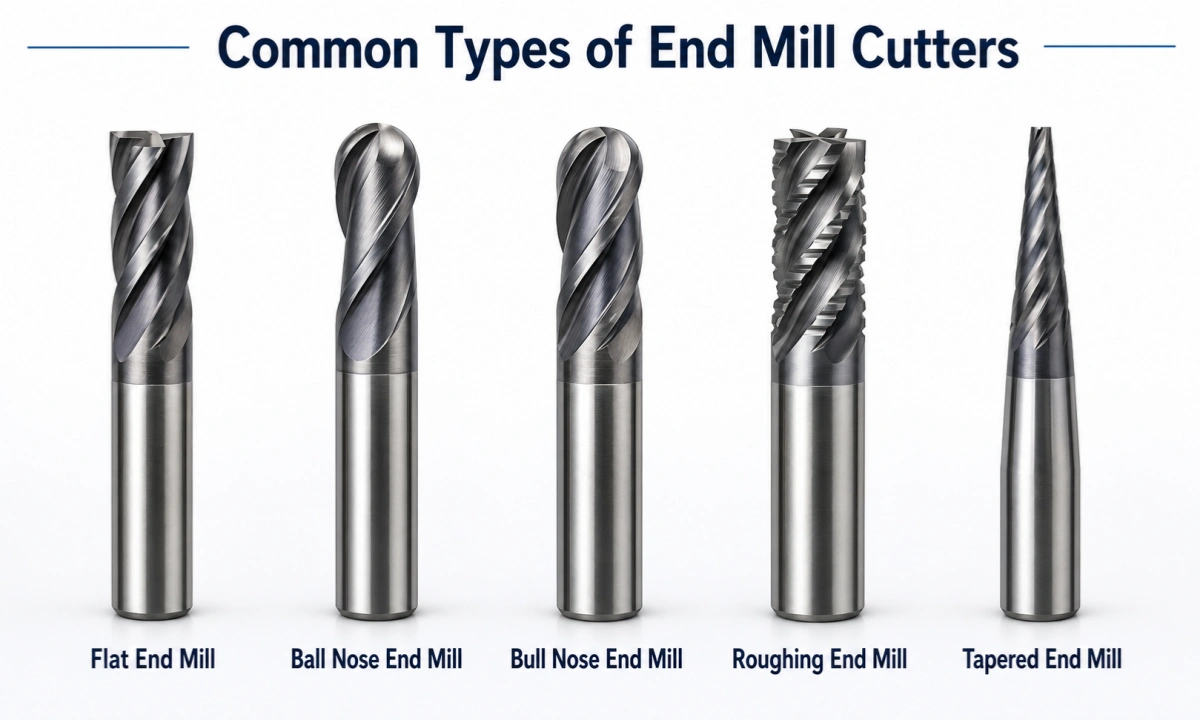
Machine shops usually classify end mill cutter types by tip geometry, cutting purpose, and machining application. Although the market offers many milling cutters, CNC machining commonly uses flat end mills, ball nose end mills, corner radius end mills, roughing end mills, and tapered end mills.
Each type has its own advantages. For example, a flat end mill is commonly used for general milling, while a ball nose end mill is more suitable for 3D contouring and curved surfaces.
That is why understanding cutter type is an important part of tool selection before ordering or machining.
The Most Common End Mill Cutter Types
1. Flat End Mill
A flat end mill is one of the most common tool types in CNC machining. It has a flat cutting tip, so machinists often choose it for slotting, side milling, shoulder milling, and general-purpose machining.
Because it can create a flat-bottom surface, this tool works well for parts that require straight slots, pockets, or sharp-edged features.
Typical uses include:
- slotting
- side milling
- pocket milling
- general machining work
Machine shops use flat end mills for aluminum, steel, and many standard machining materials.
2. Ball Nose End Mill
A ball nose end mill has a rounded cutting tip. This design makes it especially suitable for contouring, profiling, and machining curved or 3D surfaces.
Machinists commonly use this tool for:
- mold and die work
- 3D machining
- curved part surfaces
- finishing operations
Because of its rounded tip, a ball nose end mill can produce smoother transitions on curved shapes. However, it does not usually work as the first choice for sharp-bottom slots.
For basic uses and definitions, you can also read our basic milling tool guide.
3. Corner Radius End Mill
A corner radius end mill combines a flat bottom with rounded corner edges. This design helps improve edge strength and reduce corner chipping during machining.
Compared with a standard flat end mill, a corner radius end mill often offers:
- better edge strength
- smoother corner transitions
- improved stability in some applications
Machine shops commonly use this type for:
- steel machining
- stainless steel machining
- semi-finishing
- finishing work that requires stronger corners
Users often choose this design when they need both flat cutting action and improved tool life.
4. Roughing End Mill
A roughing end mill removes material aggressively. It usually has serrated or specialized cutting geometry that helps break chips into smaller pieces and reduce cutting load.
Machine shops commonly use this type for:
- heavy stock removal
- rough machining before finishing
- improved material removal efficiency
- machining tougher materials under stable cutting conditions
After roughing, machinists often use finishing tools when the part requires a better surface finish.
5. Tapered End Mill
A tapered end mill has a gradually tapered body. Machinists use this tool when straight-wall cutters are not the best option.
Typical uses include:
- angled walls
- deep cavities
- mold work
- special geometry machining
Because of the tapered shape, this cutter can provide better access in narrow or deep machining areas.
Quick Comparison Table of End Mill Cutter Types
| End Mill Cutter Type | Best For | Surface Result | Typical Materials |
|---|---|---|---|
| Flat End Mill | Slotting, side milling, pockets | Flat-bottom surface | Aluminum, steel, general-purpose machining |
| Ball Nose End Mill | 3D contouring, curved surfaces | Smooth curved finish | Mold steel, aluminum, 3D parts |
| Corner Radius End Mill | Stronger edge, smoother transitions | Flat bottom with rounded corners | Steel, stainless steel |
| Roughing End Mill | Fast stock removal | Rougher surface | Steel, cast iron, heavy-duty machining |
| Tapered End Mill | Angled walls, deep cavities | Controlled reach and geometry | Mold work, special parts |
This comparison table can help buyers quickly understand which type is more suitable for a specific machining task.
End Mill Cutter Size Chart and Basic Specifications
Besides cutter type, buyers should also check the main size specifications before ordering. The same tool geometry may perform differently when the diameter, flute length, overall length, or shank size changes.
| Specification | What It Means | Why It Matters |
| Cutter Diameter | The cutting width of the tool | Affects slot width, cutting force, and part feature size |
| Flute Length | The cutting length of the tool | Determines cutting depth and tool rigidity |
| Overall Length | The full length of the cutter | Affects reach, vibration, and machining stability |
| Shank Diameter | The clamping diameter | Must match the tool holder correctly |
| Flute Count | Number of cutting flutes | Affects chip evacuation, rigidity, and surface finish |
| Corner Radius | Rounded corner size on the tool tip | Improves edge strength and surface transition |
| Coating | Surface treatment on the cutting edge | Helps improve wear resistance and tool life |
Standard sizes can meet many general machining needs. However, custom tools may be required for deep cavities, special profiles, long reach machining, non-standard materials, or strict tolerance requirements.
For standard and custom tool supply, you can also visit our product page for CNC milling tools.
End Mill Cutter Types and Uses in CNC Machining
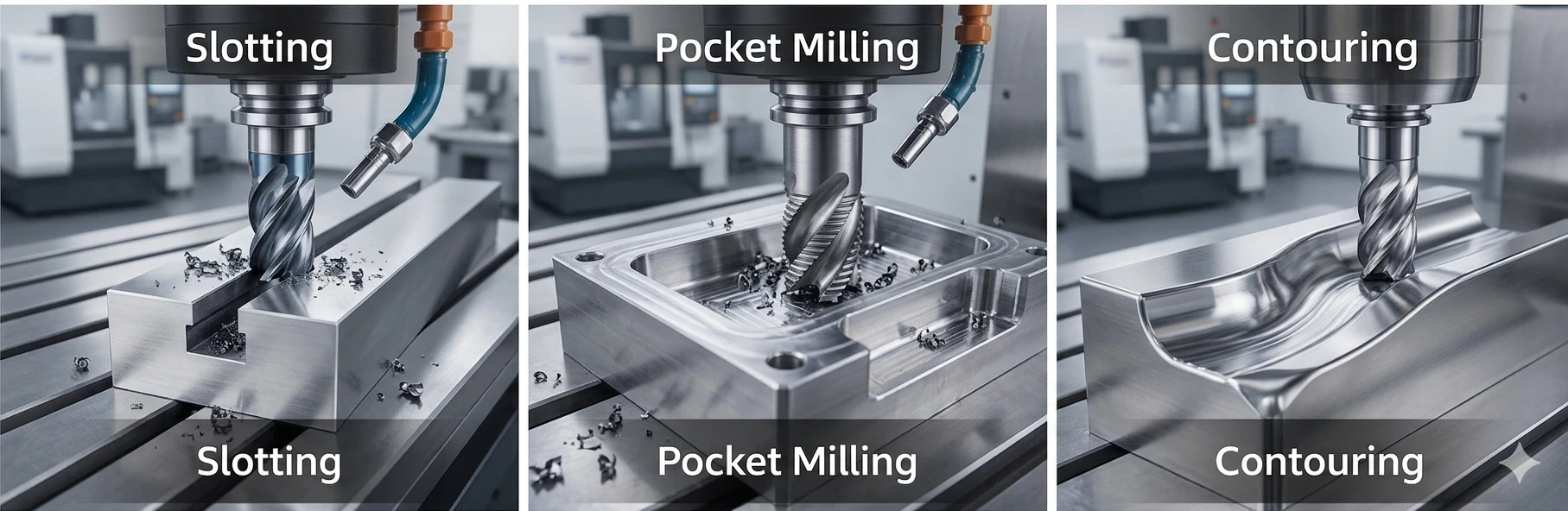
For Slotting and Pocket Milling
Machinists commonly use flat end mills for slotting and pocket milling because these tools can create flat-bottom features and clean side walls.
For Contouring and 3D Surfaces
Ball nose end mills usually work better for contouring and 3D machining because they can follow curved surfaces more smoothly.
For Stronger Corners and Better Tool Life
Machine shops often choose corner radius end mills when the part requires a stronger cutting edge and more stable performance.
For Fast Material Removal
Roughing end mills help remove a large amount of material before finishing.
For Deep or Angled Features
Tapered end mills work well for deep cavities, angled walls, and mold-related machining tasks.
If you want to understand how cutting actually happens during machining, you can also read our CNC milling working guide.
Which End Mill Cutter Type Is Better for Different Materials?
End Mill Types for Aluminum
For aluminum machining, chip evacuation is especially important. Therefore, buyers often choose flat end mills or ball nose tools with suitable flute designs.
In many cases, buyers also pay close attention to flute count. For a deeper comparison, read our flute count comparison guide.
End Mill Types for Steel
For steel machining, rigidity and wear resistance are usually more important. Machine shops often choose flat end mills, corner radius end mills, and roughing tools according to roughing or finishing requirements.
End Mill Types for Stainless Steel
For stainless steel, cutting heat and stability are critical. Many users choose corner radius tools and suitable carbide tools because stronger edges and better wear resistance can improve performance.
For dedicated carbide tools, you can also visit our solid carbide milling tools page.
How to Choose the Right End Mill Cutter Type
1. Check the Machining Operation
The first question is what the cutter needs to do. Slotting, contouring, roughing, finishing, and pocket milling often require different tool types.
2. Check the Workpiece Material
Aluminum, steel, and stainless steel have different machining characteristics. Therefore, buyers should match the cutter type to the material.
3. Check Surface Finish Requirements
If surface quality is especially important, ball nose or corner radius tools may work better in some applications.
4. Check Tool Strength and Rigidity
For heavier cutting conditions, roughing tools or stronger-edge tools may provide better performance.
5. Check Standard or Custom Requirements
Some users need standard tools, while others need customized geometry, coating, or dimensions based on drawings or samples.
If you are looking for standard or OEM solutions, you can also visit our product page for CNC milling tools.
End Mill Cutter Geometry and Main Parts
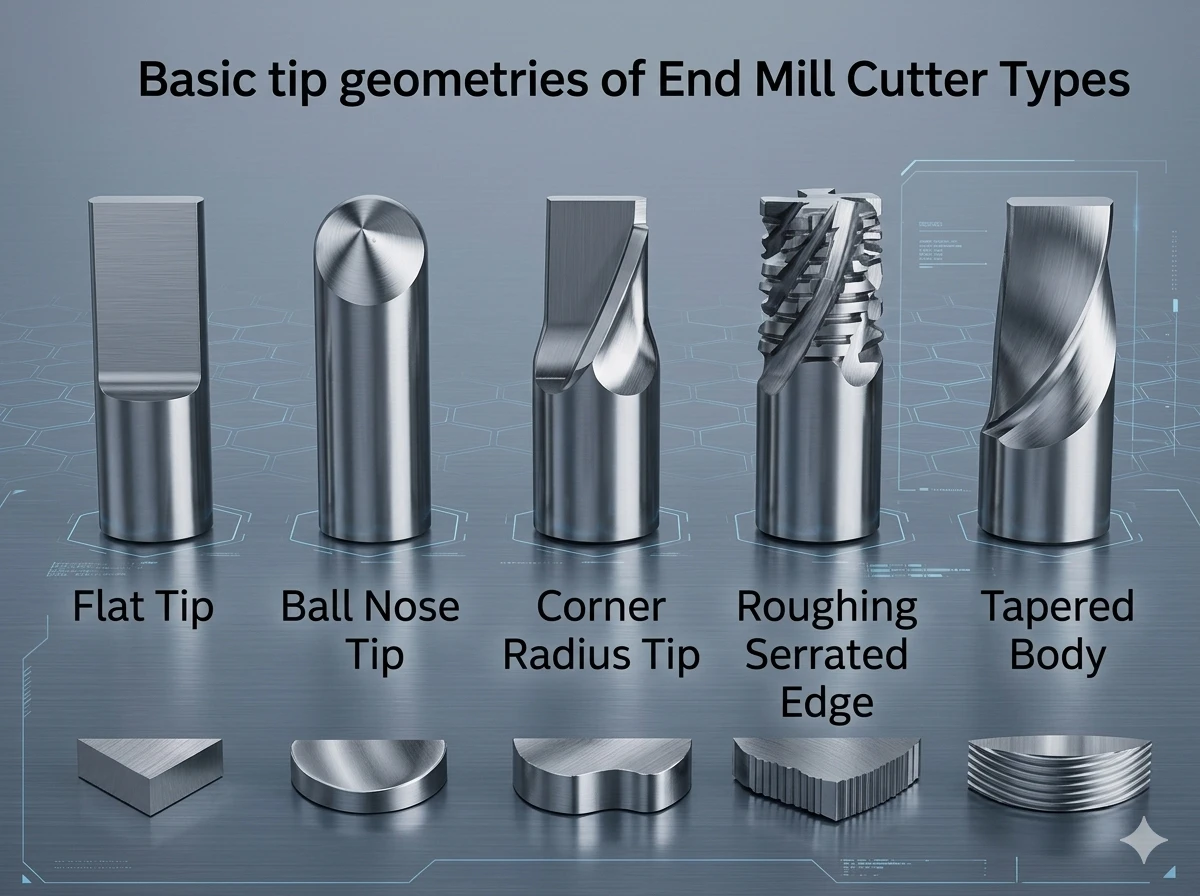
Although different tools may look similar at first glance, buyers can identify most cutter types by tip geometry, flute design, and machining purpose.
For example:
- A flat end mill has a flat cutting tip for slots, pockets, and flat-bottom features.
- A ball nose end mill has a rounded tip for 3D surfaces and curved profiles.
- A corner radius end mill combines a flat bottom with rounded corners for stronger edge performance.
- A roughing end mill uses serrated or special cutting geometry for faster stock removal.
- A tapered end mill has an angled body for deep cavities, mold work, and special reach.
Understanding these geometry differences helps buyers choose the right tool before ordering. It also helps avoid using one cutter type for every material or machining operation.
Common Mistakes When Choosing End Mill Cutter Types
Choosing by appearance only
Some buyers select a cutter only by shape but ignore material, operation, and finish requirements.
Using one type for every material
The best end mill type for aluminum may not be the best option for steel or stainless steel.
Ignoring finishing requirements
A tool suitable for roughing may not deliver the surface quality required for finishing.
Focusing only on cutter type and ignoring flute count
Cutter type is important, but flute count, coating, and tool material should also be considered together.
FAQ
What are the main types of end mill cutters?
The most common types are flat end mills, ball nose end mills, corner radius end mills, roughing end mills, and tapered end mills.
What is the difference between a flat end mill and a ball nose end mill?
A flat end mill is mainly used for flat-bottom slots and general machining, while a ball nose end mill is more suitable for contouring and curved surfaces.
Which end mill type is best for aluminum?
In many cases, flat end mills are commonly used for aluminum, especially when good chip evacuation and general-purpose machining are required.
Which end mill type is used for 3D contouring?
Ball nose end mills are commonly used for 3D contouring because their rounded tip is suitable for curved surfaces.
Are roughing end mills and finishing end mills the same?
No. Roughing end mills are designed for fast material removal, while finishing tools are selected to achieve better surface quality and final accuracy.
How do I choose the right end mill cutter type?
You should consider the machining operation, workpiece material, surface finish requirements, tool strength, and whether standard or custom tooling is needed.
Conclusion
End mill cutter types play an important role in CNC machining performance. Different cutter types are designed for different tasks, and choosing the right one can improve machining efficiency, stability, surface finish, and tool life.
Flat end mills are widely used for general machining. Ball nose end mills are suitable for curved surfaces and contouring. Corner radius end mills help improve edge strength, while roughing end mills are better for heavy stock removal. Tapered end mills are useful for angled or deep features.
When selecting an end mill cutter type, it is always better to consider machining operation, workpiece material, finish requirements, and tool strength together rather than focusing on one factor alone.
CTA
Looking for standard or custom tools for CNC machining?
Visit our product page for CNC milling tools or send us your drawing, size list, material, and coating requirements. OMIST can recommend suitable tools for aluminum, steel, stainless steel, and custom machining applications.