 Precision Milling Cutters,Cutting Tools for CNC Machining Every Material

An end mill flute is the spiral groove on an end mill cutter. It helps form the cutting edge, remove chips, guide coolant, and control cutting performance during CNC milling.
For machinists, engineers, and buyers, flute design is important because it affects chip evacuation, tool strength, surface finish, feed rate, and material suitability. For example, a 2 flute end mill usually gives better chip removal in aluminum. In contrast, a 4 flute end mill often provides better cutting stability in steel.
Therefore, understanding end mill flute count and flute design can help you choose the right milling cutter for different materials and machining operations.
What Does Flute Mean on an End Mill?
An end mill flute is the groove that runs along the cutting part of the tool. Most flutes are spiral, but some special tools may use straight flute designs.
Each flute creates space for chips to leave the cutting area. At the same time, the flute shape also affects cutting edge strength and tool rigidity. Because of this, flute design is not only about chip removal. It also influences the whole cutting process.
In simple terms, the flute has four main functions:
| Function | Why It Matters |
| Cutting edge formation | Each flute helps create a cutting edge |
| Chip removal | The groove allows chips to leave the cut |
| Coolant flow | Coolant can reach the cutting zone more easily |
| Tool strength | Flute depth affects the core strength of the tool |
If you are choosing a general CNC milling tool, you can start with our end mill cutter page.
Why Is End Mill Flute Count Important?
End mill flute count means how many flutes the cutter has. Common options include 2 flute, 3 flute, 4 flute, and 6 flute end mills.
The number of flutes affects chip space and tool strength. Fewer flutes usually provide more chip space, so they work well for soft materials and slotting. However, more flutes give the tool a stronger core and more cutting edges. As a result, they can improve stability and surface finish in harder materials.
| Flute Count | Main Feature | Typical Use |
| 2 Flute | Large chip space | Aluminum, plastic, slotting |
| 3 Flute | Balance of chip removal and finish | Aluminum, non-ferrous metals |
| 4 Flute | Better rigidity and stability | Steel, stainless steel, general milling |
| 6 Flute | More cutting edges | Finishing and harder materials |
Therefore, more flutes are not always better. The best choice depends on the material, cutting depth, machine rigidity, and surface finish requirement.
Common End Mill Flute Types
2 Flute End Mill
A 2 flute end mill has two cutting flutes and larger chip space. For this reason, it is often used for aluminum, plastic, copper, and other soft or non-ferrous materials.
It is also a common choice for slotting because chips need enough room to leave the cutting area. If chip removal is poor, chips may stay in the slot and cause tool wear, poor finish, or tool breakage.
For aluminum, plastics, and slotting applications, you can view our 2 flute end mill page.
3 Flute End Mill
A 3 flute end mill offers a balance between chip evacuation, cutting stability, and surface finish. It has more cutting edges than a 2 flute tool, but it still keeps enough flute space for aluminum and other non-ferrous materials.
Many manufacturers use this cutter when they need better surface finish than a 2 flute cutter while still keeping good chip evacuation. In addition, this tool can be useful for high-speed aluminum machining when the machine, tool holder, and cutting parameters are stable.
For more details, read our what is a 3 flute end mill used for guide.
4 Flute End Mill
A 4 flute end mill is one of the most common choices for steel, stainless steel, and general CNC milling. Compared with a 2 flute tool, it has more cutting edges and a stronger core.
As a result, a 4 flute end mill can provide better stability, better tool strength, and a smoother finish in many steel machining operations. However, it has less chip space than a 2 flute tool, so it may not be the best choice for deep slotting in aluminum.
For steel, stainless steel, and general CNC milling, you can view our 4 flute end mill.
6 Flute End Mill
A 6 flute end mill has more cutting edges and smaller chip space. It is often used for finishing, side milling, and machining harder materials when the chip load is controlled properly.
Because 6 flute tools have more contact with the workpiece, they can help improve surface finish. However, they need stable machining conditions and proper chip evacuation.
For finishing and stable CNC machining, you can view our 6 flute end mill.
How to Choose End Mill Flute Count by Material
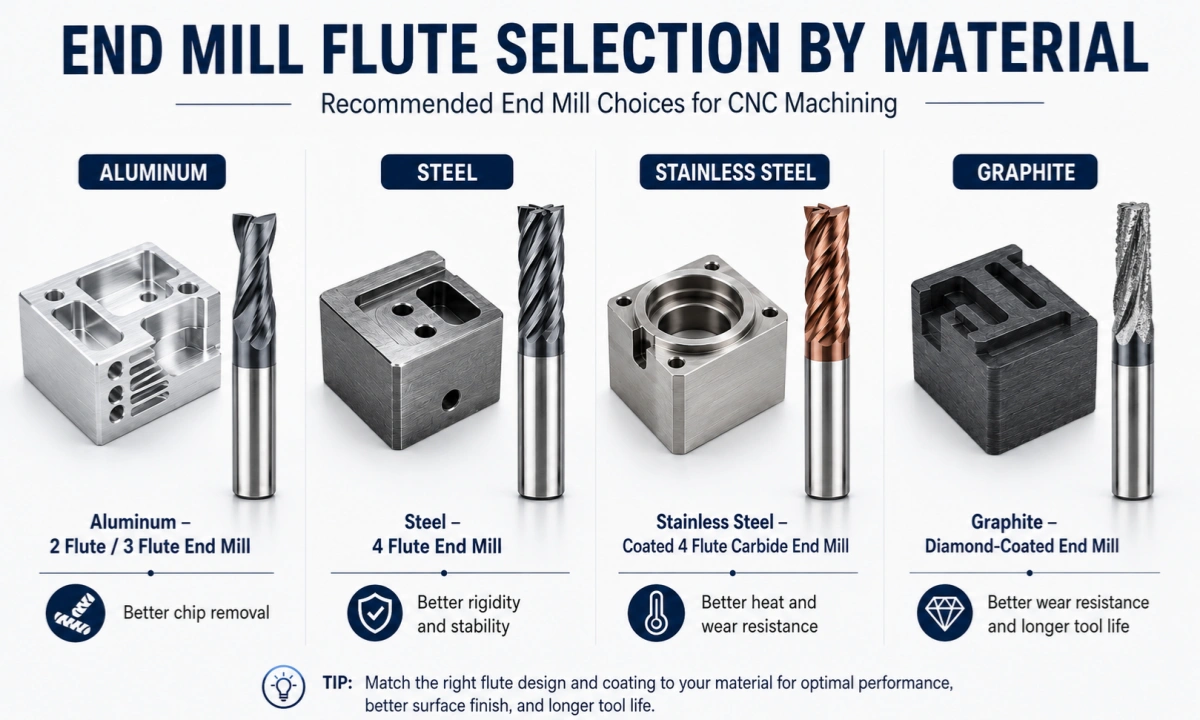
Different materials need different flute designs. Therefore, material should be one of the first factors you check before choosing an end mill flute count.
| Workpiece Material | Recommended Flute Count | Reason |
|---|---|---|
| Aluminum | 2 flute or 3 flute | Better chip removal |
| Plastic | 1 flute or 2 flute | Reduces chip clogging |
| Steel | 4 flute | Better rigidity and stability |
| Stainless Steel | 4 flute or coated carbide end mill | Better heat and wear resistance |
| Hardened Steel | 4 flute or 6 flute | Stronger cutting edge and better finish |
| Graphite | Diamond-coated end mill | Better wear resistance |
End Mill Flute for Aluminum
Aluminum is soft, but it can stick to the cutting edge if chips are not removed quickly. Therefore, 2 flute or 3 flute end mills are usually better choices.
A larger flute space helps move chips away from the cutting zone. In addition, polished flutes can reduce built-up edge and improve cutting stability.
End Mill Flute for Steel
Steel needs stronger tool rigidity and better cutting stability. For this reason, 4 flute end mills are widely used for steel milling.
A 4 flute design provides a stronger core and more cutting edges. Therefore, it can support side milling, profiling, shoulder milling, and finishing in many steel applications.
End Mill Flute for Stainless Steel
Stainless steel can generate heat and work harden during machining. Therefore, the tool should have a sharp cutting edge, good coating, and stable flute design.
In many cases, a coated 4 flute carbide end mill is a practical choice. However, cutting parameters, coolant, and machine rigidity also matter.
For high-performance CNC machining, you can also view our carbide end mill cutter.
End Mill Flute for Graphite
Graphite is abrasive, so tool wear is a major concern. In this case, flute count is important, but coating is even more important.
Diamond-coated end mills can improve wear resistance and extend tool life when machining graphite and other abrasive materials.
For graphite machining, view our diamond-coated end mills.
How Flute Design Affects Cutting Performance
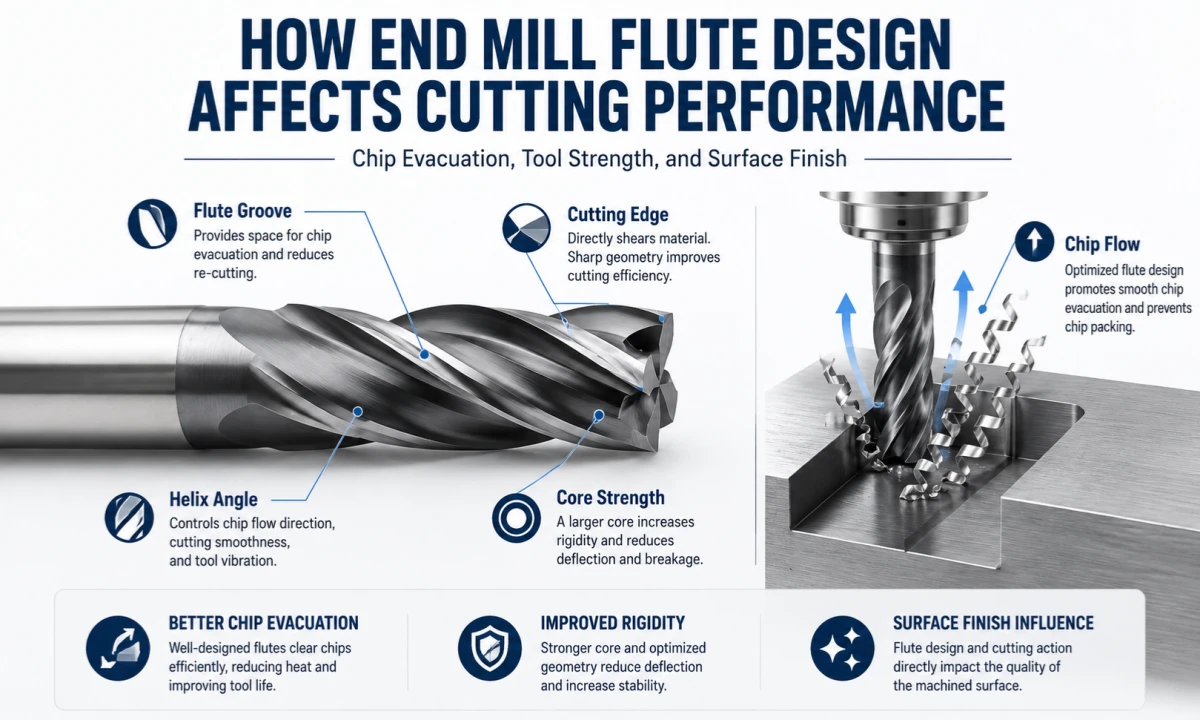
End mill flute design affects more than the number of cutting edges. It also includes flute depth, helix angle, core diameter, flute length, and coating compatibility.
For a broader end mill selection guide, read our endmill tool selection guide.
Chip Evacuation
Chip evacuation is the ability of the tool to remove chips from the cutting area. If chips cannot leave the cut smoothly, they may cause heat, rubbing, poor surface finish, or tool breakage.
Fewer flutes usually provide more chip space. Therefore, 2 flute and 3 flute end mills are often better for aluminum, plastic, and deep slots.
Tool Strength
Tool strength depends partly on the core diameter of the end mill. A tool with deeper flutes has more chip space, but it may have a smaller core. As a result, it may be less rigid.
More flutes usually create a stronger core. Therefore, 4 flute and 6 flute end mills are often better for harder materials and stable side milling.
Surface Finish
More flutes can improve surface finish because more cutting edges contact the workpiece. However, the tool also needs correct feed rate, speed, tool runout, and machine stability.
For finishing operations, 4 flute or 6 flute end mills are often used. Meanwhile, for roughing or slotting, fewer flutes may work better because they remove chips more easily.
Heat Control
Heat control is important in stainless steel, titanium, and hardened steel. If heat stays near the cutting edge, tool wear can increase quickly.
A suitable flute design, coating, coolant method, and cutting speed can help reduce heat and improve tool life.
End Mill Flute Selection by Machining Operation
The machining operation also affects flute selection. A tool used for slotting may not be the best choice for finishing. Therefore, you should match the flute count with the cutting task.
| Machining Operation | Recommended Flute Count | Tool Choice |
| Slotting aluminum | 2 flute or 3 flute | Better chip space |
| Slotting steel | 2 flute or 4 flute | Depends on depth and rigidity |
| Side milling steel | 4 flute | Stronger cutting stability |
| Finishing | 4 flute or 6 flute | Better surface finish |
| Roughing | Roughing end mill | Faster material removal |
| Graphite machining | Diamond-coated end mill | Better wear resistance |
For heavy material removal before finishing, view our roughing end mills.
For Slotting
Slotting needs good chip evacuation because the tool cuts inside a narrow groove. Therefore, 2 flute tools are often preferred for aluminum and soft materials.
For steel slotting, the best choice depends on slot depth, coolant, and machine rigidity.
For Side Milling
Side milling needs tool rigidity and stable cutting. In many cases, 4 flute end mills perform well because they provide good strength and cutting balance.
For Finishing
Finishing needs a smoother surface and stable cutting force. Therefore, 4 flute or 6 flute end mills are often used when chip removal is not a major problem.
Common Mistakes When Choosing End Mill Flutes
Choosing the wrong flute count can reduce tool life and machining quality. Below are some common mistakes to avoid.
| Mistake | Possible Result | Better Choice |
| Using too many flutes for aluminum slotting | Chip clogging and heat | Use 2 flute or 3 flute |
| Using too few flutes for steel finishing | Poor finish or vibration | Use 4 flute or 6 flute |
| Ignoring flute length | Chatter and tool deflection | Use the shortest suitable flute length |
| Choosing only by price | Short tool life | Match tool design to the material |
| Using one tool for all materials | Unstable performance | Select by material and operation |
In short, the best end mill flute design should match the workpiece material, cutting depth, tool path, machine rigidity, and required surface finish.
FAQ About End Mill Flutes
What does flute mean on an end mill?
A flute is the groove on an end mill cutter. It forms the cutting edge, removes chips, and helps coolant reach the cutting area.
Are more flutes better on an end mill?
Not always. More flutes can improve rigidity and surface finish, but they reduce chip space. Fewer flutes usually remove chips better, especially in aluminum and slotting.
What is a 2 flute end mill used for?
Machinists often use a 2 flute end mill for aluminum, plastic, soft materials, and slotting. It has larger chip space, so it can remove chips more easily.
For aluminum machining, see 2 flute end mill.
What is a 4 flute end mill used for?
Machinists often use a 4 flute end mill for steel, stainless steel, side milling, profiling, and general CNC machining. It offers better rigidity and cutting stability than a 2 flute tool.
For steel machining, see 4 flute end mill.
How many flutes are best for aluminum?
For aluminum, 2 flute and 3 flute end mills are usually better choices. They provide more chip space and reduce chip clogging during high-speed machining.
How many flutes are best for steel?
For steel, 4 flute end mills are commonly used because they offer better tool strength and cutting stability. For finishing, 6 flute end mills may also be suitable when the machine setup is stable.
How do I choose the right end mill flute count?
First, check the material. Then, confirm the machining operation, such as slotting, side milling, roughing, or finishing. Finally, choose the flute count, coating, flute length, and tool size based on the cutting condition.
Conclusion
An end mill flute affects chip removal, cutting edge strength, surface finish, feed rate, and tool life. Therefore, choosing the right flute count is important for stable CNC milling.
In general, 2 flute and 3 flute end mills are better for aluminum and soft materials. 4 flute end mills are suitable for steel and general milling. 6 flute end mills are often used for finishing and harder materials. However, the best choice still depends on the material, cutting depth, machine rigidity, and surface requirement.
If you need help choosing the right flute design, Cutterbest can support standard and custom end mill cutters with different flute counts, coatings, flute lengths, and tool sizes.
For general CNC milling, view our carbide end mill cutter.
Aluminum slotting usually needs better chip evacuation, so our 2 flute end mill can be a suitable choice.
When machining steel, view our 4 flute end mill for better rigidity and cutting stability.
For finishing applications, our 6 flute end mill can help improve surface finish and tool stability.