 Fresas de precisión,Herramientas de corte para el mecanizado CNC de todos los materiales

The corner radius vs corner rounding comparison often confuses buyers because the tool names sound similar. Sin embargo, Radio de esquina, Nariz de toro, and Corner Rounding End Mills can produce very different workpiece profiles.
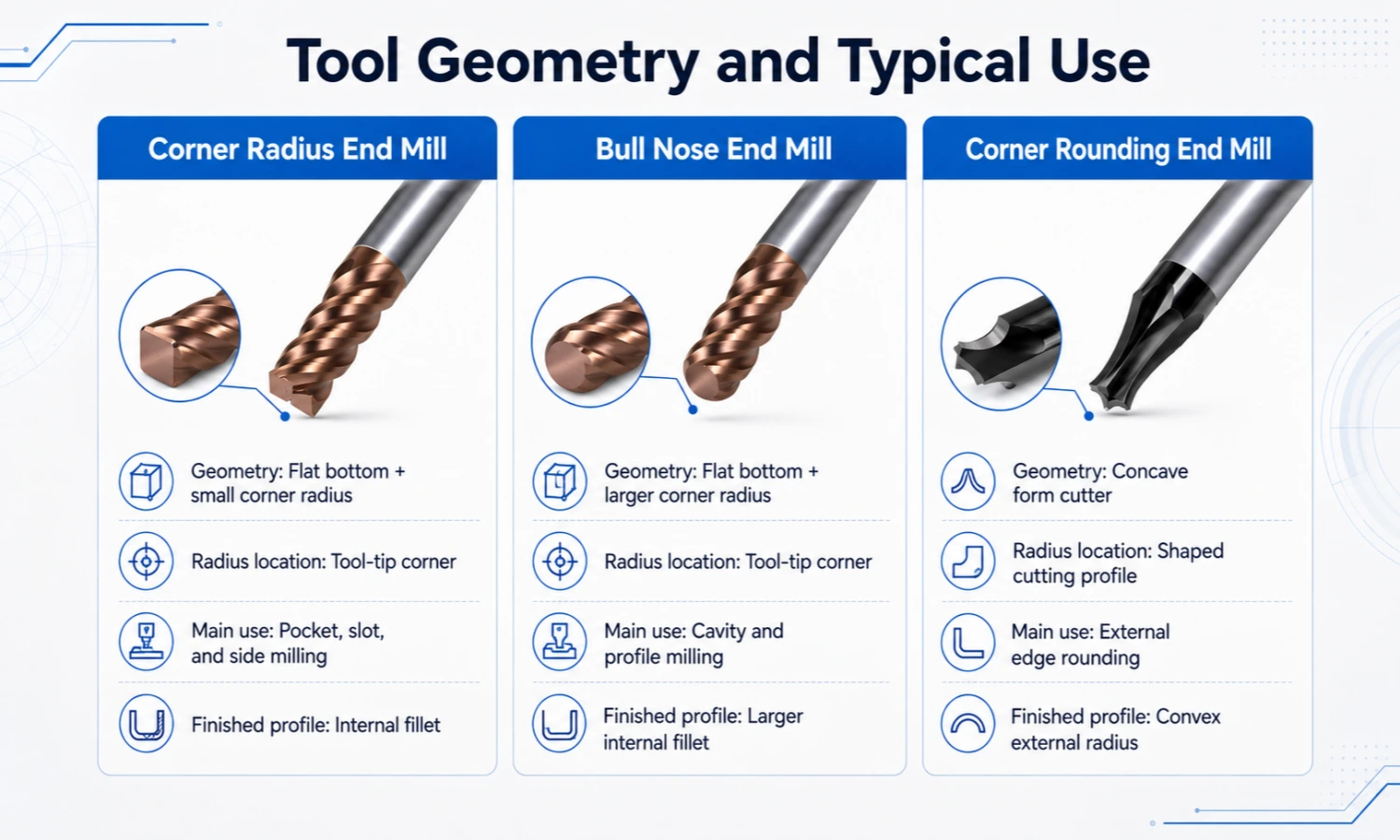
A Corner Radius End Mill and a Bull Nose End Mill normally have a flat or nearly flat bottom. Their radius sits between the bottom and side cutting edges. Por lo tanto, both tools can perform general milling while producing an internal fillet or rounded transition.
A Corner Rounding End Mill is different. It has a concave form-cutting profile that removes a sharp external corner and creates a convex radius on the workpiece edge.
Because suppliers may use different naming systems, buyers should check the cutter geometry, dimensiones, and required finished profile instead of relying only on the product name.
Corner Radius vs Corner Rounding: Respuesta rápida
En la comparación entre radio de esquina y redondeo de esquina, una fresa de extremo con radio de esquina tiene un fondo plano o casi plano con un radio en la esquina de la herramienta. Una fresa de punta redondeada suele tener una geometría similar, aunque algunos proveedores usan el nombre para un cortador con un radio de esquina más notable.
Una fresa para redondear esquinas utiliza un perfil de corte cóncavo para formar un radio convexo en un borde externo accesible de la pieza de trabajo..
¿Por qué a menudo se confunden estos nombres de cortadores??
Los distintos fabricantes no siempre utilizan la misma terminología.
Algunos proveedores utilizan “fresa de extremo de punta toro” y “fresa de extremo de radio de esquina” como nombres intercambiables. Others use “bull nose” for cutters with a larger or more visible tool-corner radius. Sin embargo, there is no globally accepted radius value that separates the two terms.
Corner Rounding End Mills are easier to distinguish because they normally have a shaped concave profile and a different machining purpose.
Por lo tanto, focus on three questions:
- Where is the radius located on the cutter?
- What profile will it produce on the workpiece?
- Is the operation general milling or external edge forming?
How to Identify Each Cutter from a Tool Photo or Catalog
Product names may be inconsistent, but cutter geometry usually provides a clearer answer.
Check the Bottom Geometry
A Corner Radius or Bull Nose End Mill normally keeps a flat or nearly flat central area at the tool tip. The radius appears where the bottom cutting edge meets the side cutting edge.
Because of this geometry, the cutter can still perform pocketing, fresado lateral, ranurado, and other common end-milling operations.
Look for a Concave Form Profile
A Corner Rounding End Mill has a visibly concave cutting profile. Some designs include a pilot or reduced front section, while others use a different head structure.
The formed cutting edge produces a convex radius on the external edge of the workpiece.
Do Not Confuse Bull Nose with Ball Nose
A Bull Nose End Mill normally retains a flat or nearly flat central area, with the radius located at the tool corner.
A Ball Nose End Mill has a fully rounded or hemispherical tip for curved surfaces, contornos del molde, and three-dimensional finishing.
Para una comparación detallada, lee nuestro Fresa de punta toro frente a fresa de punta esférica guía.
What Is a Corner Radius End Mill?
A Corner Radius End Mill is usually a flat-bottom end mill with a rounded transition between the bottom and side cutting edges.
The radius removes the sharp intersection between these cutting edges. Como resultado, the corner can become stronger and less sensitive to chipping than a completely sharp square end mill.
Typical Geometry
A common design includes:
- A flat or nearly flat bottom
- Helical or straight side cutting edges
- A radius at the bottom corner
- Two or more flutes
- Carburo sólido, HSS, or another suitable tool material
The radius belongs to the tool tip. It is not a complete concave form around the cutter head.
Aplicaciones típicas
Corner Radius End Mills are commonly used for:
- Bolsillo, ranura, y fresado lateral
- Mold cavity machining
- fresado de perfiles
- Desbaste, semiacabado, y terminando
- Machining internal fillets
- General CNC milling with a reinforced tool corner
They are especially useful when a part requires a flat machined area together with a rounded internal transition.
When Should You Choose One?
Choose this cutter when the drawing requires a flat or nearly flat bottom, an internal corner radius, and a stronger tool corner than a sharp square end mill.
el radio, diámetro del cortador, longitud de corte, and clearance must still match the workpiece geometry.
¿Qué es una fresa de punta de toro??
A Bull Nose End Mill also has a radius between the bottom and side cutting edges. Por lo tanto, many suppliers treat it as a type of Corner Radius End Mill.
In some product ranges, “bull nose” describes a cutter with a larger or more noticeable corner radius. Sin embargo, this naming practice is not universal.
Typical Geometry
A Bull Nose End Mill usually has:
- A flat or nearly flat central area
- A rounded tool corner
- Stronger corner geometry than a sharp square end mill
- A shape suitable for cavity and profile machining
Unlike a Ball Nose End Mill, it normally keeps a flat or nearly flat area at the center.
Aplicaciones típicas
Bull Nose End Mills are commonly used for:
- Mold cavity and profile milling
- Desbaste y semiacabado
- Larger internal fillets
- Contour machining
- Operations that require a stronger tool corner
The cutter can remove material from flat-bottom or near-flat-bottom features while producing a rounded internal transition.
When Should You Choose One?
A Bull Nose End Mill may be suitable when the part requires an internal fillet, a noticeable corner radius, and a strong tool corner for roughing, semiacabado, o fresado de perfiles.
Para fresado de fondo plano con esquina de herramienta reforzada, ver nuestro Molino de punta de toro.
What Is a Corner Rounding End Mill?
A Corner Rounding End Mill is a form cutter designed to machine a rounded profile on an external workpiece edge.
Its cutting edge has a concave radius. When the cutter moves along an accessible edge, the formed profile removes the sharp corner and produces a convex radius.
Concave Form-Cutting Profile
The concave cutting profile is the clearest identifying feature.
Por ejemplo, an R2.5 cutter may be designed to produce an approximately R2.5 external radius. Sin embargo, the final profile also depends on cutter geometry, machine position, sin, y condiciones de mecanizado.
Some designs include a pilot or reduced front section. Others do not. Por lo tanto, buyers should confirm the complete dimensions before ordering.
Aplicaciones típicas
Corner Rounding End Mills are mainly used for:
- Rounding sharp external edges
- Producing convex edge radii
- Finishing plate and component edges
- Creating decorative or functional edge profiles
- Custom edge-forming operations
They are not normally selected for pocket milling, ranurado, or general flat-bottom machining.
When Should You Choose One?
Choose this cutter when the drawing requires a convex radius on an external edge rather than an internal fillet.
For machining a rounded profile on an external workpiece edge, ver nuestro Fresa para redondear esquinas.
Quick Cutter Selection Guide
The corner radius vs corner rounding difference becomes easier to understand when you compare the required workpiece profile.
| Required Workpiece Profile or Operation | Cortador recomendado |
| Flat-bottom pocket with a small internal fillet | Fresa de extremo de radio de esquina |
| Cavity or profile with a stronger rounded tool corner | Molino de punta de toro |
| Convex radius on an accessible external edge | Fresa para redondear esquinas |
| Fully curved surface or 3D contour finishing | Molino de extremo de punta esférica |
| Angled wall, draft surface, or tapered cavity | Fresa cónica |
A Bull Nose End Mill and a Corner Radius End Mill may have similar geometry, depending on the supplier’s naming system. Por lo tanto, confirm the tool drawing, radio, diámetro del cortador, and required finished profile before ordering.
How to Select the Correct Radius Cutter
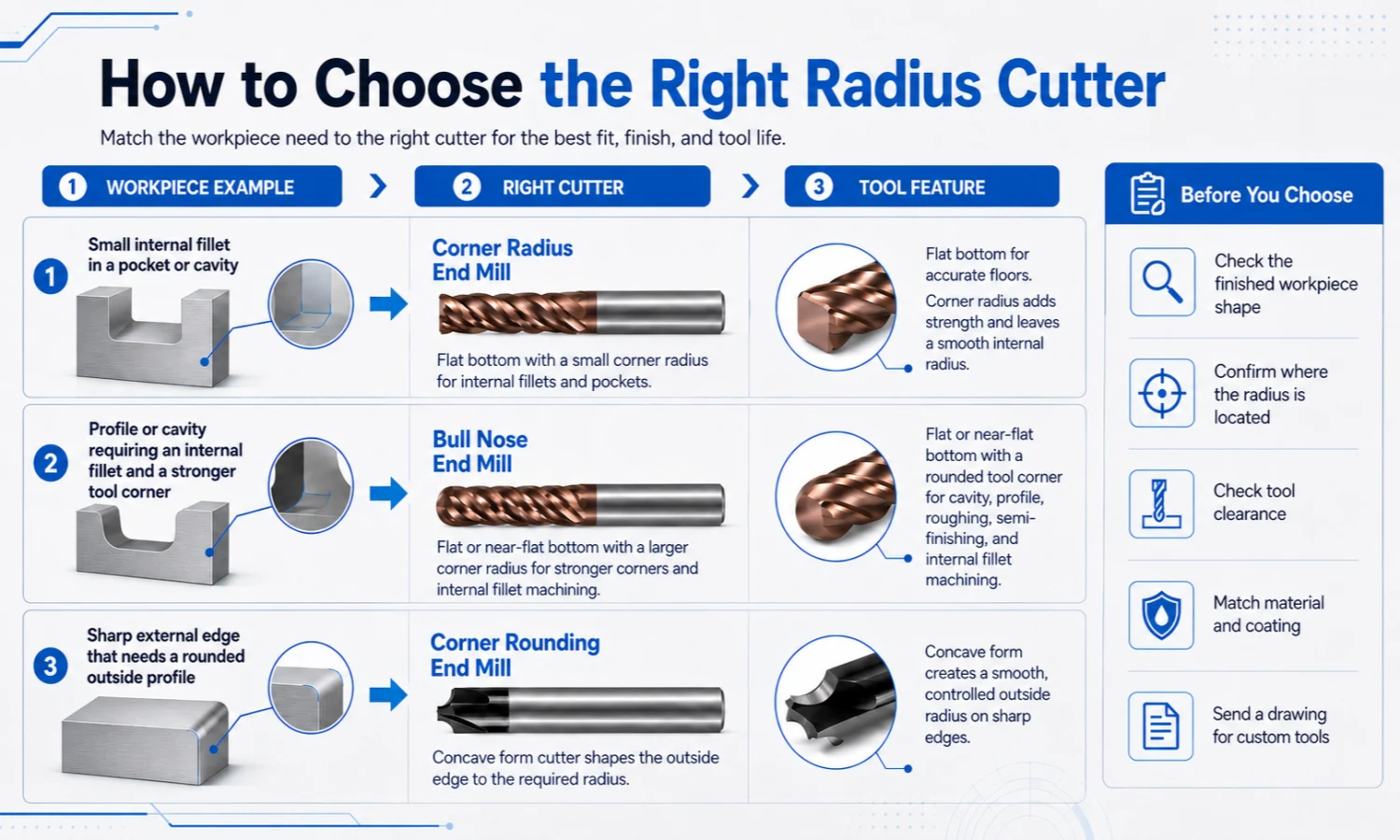
The correct cutter depends first on the finished workpiece shape. After identifying the profile, check the radius, posición de mecanizado, espacio libre de herramientas, material, y operación de corte.
Check the Finished Workpiece Shape
Use the final part profile as the first guide:
- Internal fillet in a flat-bottom cavity: Corner Radius or Bull Nose End Mill
- Convex radius on an external edge: Fresa para redondear esquinas
- Straight angled edge: Chamfer cutter
- Tapered wall or draft angle: Tapered cutter
- Fully curved 3D surface: Molino de extremo de punta esférica
This distinction prevents many cutter-selection mistakes.
Confirm the Required Radius and Tool Dimensions
The cutter radius should match the part drawing. Sin embargo, radius alone is not enough.
Also confirm:
- Diámetro del cortador o cabeza
- Diámetro del mango
- Cutting and overall length
- recuento de flautas
- Alcance de la herramienta
- Muros cercanos, espalda, and fixtures
- Material de la pieza de trabajo
A cutter may have the correct radius but still interfere with another feature.
Consider the Milling Operation
Identify whether the operation is roughing, semiacabado, refinamiento, fresado de bolsillo, mecanizado de cavidades, fresado de perfiles, or edge forming.
Corner Radius and Bull Nose End Mills can perform several general milling operations. A Corner Rounding End Mill performs a more specialized edge-forming operation.
Match the Tool to the Workpiece Material
The material affects the carbide grade, geometría de la flauta, revestimiento, velocidad de corte, tasa de alimentación, y estrategia de refrigerante.
Acero, acero inoxidable, aluminio, cobre, hierro fundido, and hardened mold steel may require different cutter designs. Por lo tanto, provide the exact material and hardness when requesting a recommendation.
Send a Drawing for Special Geometry
A 2D or 3D drawing is particularly useful for deep steps, narrow shoulders, restricted access, adjacent walls, multiple radii, corte interrumpido, y perfiles no estándar.
The drawing helps the supplier evaluate cutter diameter, alcance de la herramienta, espacio libre del cuello, and formed profile before production.
Errores de selección comunes
Choosing Only by Product Name
A Bull Nose End Mill from one supplier may be listed as a Corner Radius End Mill by another.
Por lo tanto, compare the tool drawing, diámetro del cortador, radio, bottom geometry, and flute design.
Treating Every Narrow Cutter Head as a Tapered Cutter
Flute relief, espacio libre del cuello, or formed geometry may make part of the cutter appear narrower. Sin embargo, this does not make it a tapered end mill.
A true tapered cutter has a cutting diameter that changes progressively along the cutting section.
For angled walls, superficies de tiro, and tapered cavities, ver nuestro Cortador cónico.
Ignoring Tool Clearance
A form cutter may have a wide head, reduced neck, or pilot section. Por lo tanto, check nearby shoulders, paredes, accesorios, and part features before machining.
Standard and Custom Radius Cutter Options
Standard cutters cover many common applications. Sin embargo, a custom tool may be necessary when the part has limited clearance, a special radius, or unusual material requirements.
Las opciones disponibles pueden incluir:
- Metric and inch radius sizes
- Two-, three-, four-, or multi-flute designs
- Coated and uncoated cutting edges
- Standard or custom shank diameters
- Short and long-reach configurations
- Custom cutter or head diameters
- Pilot diameters where applicable
- Reduced necks and special clearance
- Application-specific carbide grades and coatings
Product images and published dimensions may be used as references. Sin embargo, the final geometry, dimensiones, tolerancias, revestimiento, and production details should follow the confirmed drawing and quotation.
For additional standard and custom milling solutions, ver nuestro Fresa de carburo rango.
Information to Confirm Before Ordering
Before requesting a quotation, confirm as much of the following information as possible:
- Required finished workpiece profile
- Internal fillet or external edge radius
- Required radius size
- Diámetro del cortador o cabeza
- Diámetro del mango
- Cutting and overall length
- Tool-clearance restrictions
- Material de la pieza y dureza.
- Machine and holder type
- Cantidad requerida
- 2Dibujo D o 3D
These details help determine whether a standard tool is suitable or a custom cutter is required.
Preguntas frecuentes
Is a Bull Nose End Mill the Same as a Corner Radius End Mill?
In many product systems, the terms overlap. Both normally describe a flat or nearly flat end mill with a radius at the tool corner.
Some manufacturers use “bull nose” for a more noticeable radius. Sin embargo, there is no universal dividing value, so check the actual geometry and dimensions.
What Is the Difference Between a Corner Radius and a Corner Rounding End Mill?
A Corner Radius End Mill has a radius between the bottom and side cutting edges. It can perform general milling while producing an internal fillet.
A Corner Rounding End Mill has a concave form-cutting profile. It mainly produces a convex radius on an external workpiece edge.
Which Cutter Should I Use for an External Rounded Edge?
A Corner Rounding End Mill is normally the correct choice for an accessible external edge. Sin embargo, el radio, head diameter, pilot structure, autorización, and workpiece geometry must still be confirmed.
Which Cutter Should I Use for a Mold Cavity Fillet?
A Corner Radius or Bull Nose End Mill is usually more suitable. The final choice depends on cavity depth, required radius, acabado superficial, roughing allowance, y estrategia de mecanizado.
Can These Cutters Be Customized?
Sí. Custom options may include radius, diámetro del cortador, diámetro del vástago, longitud de la herramienta, configuración de flauta, grado de carburo, revestimiento, pilot structure, and special clearance.
A drawing is recommended for non-standard profiles or restricted machining spaces.
Send Your Radius Cutter Drawing
En la práctica, the corner radius vs corner rounding decision depends on the finished profile, radius location, espacio libre de herramientas, material de la pieza de trabajo, y operación de mecanizado. Bull Nose geometry should also be checked because supplier terminology may vary.