 Fraise de précision,Outils de coupe pour l’usinage CNC de chaque matériau

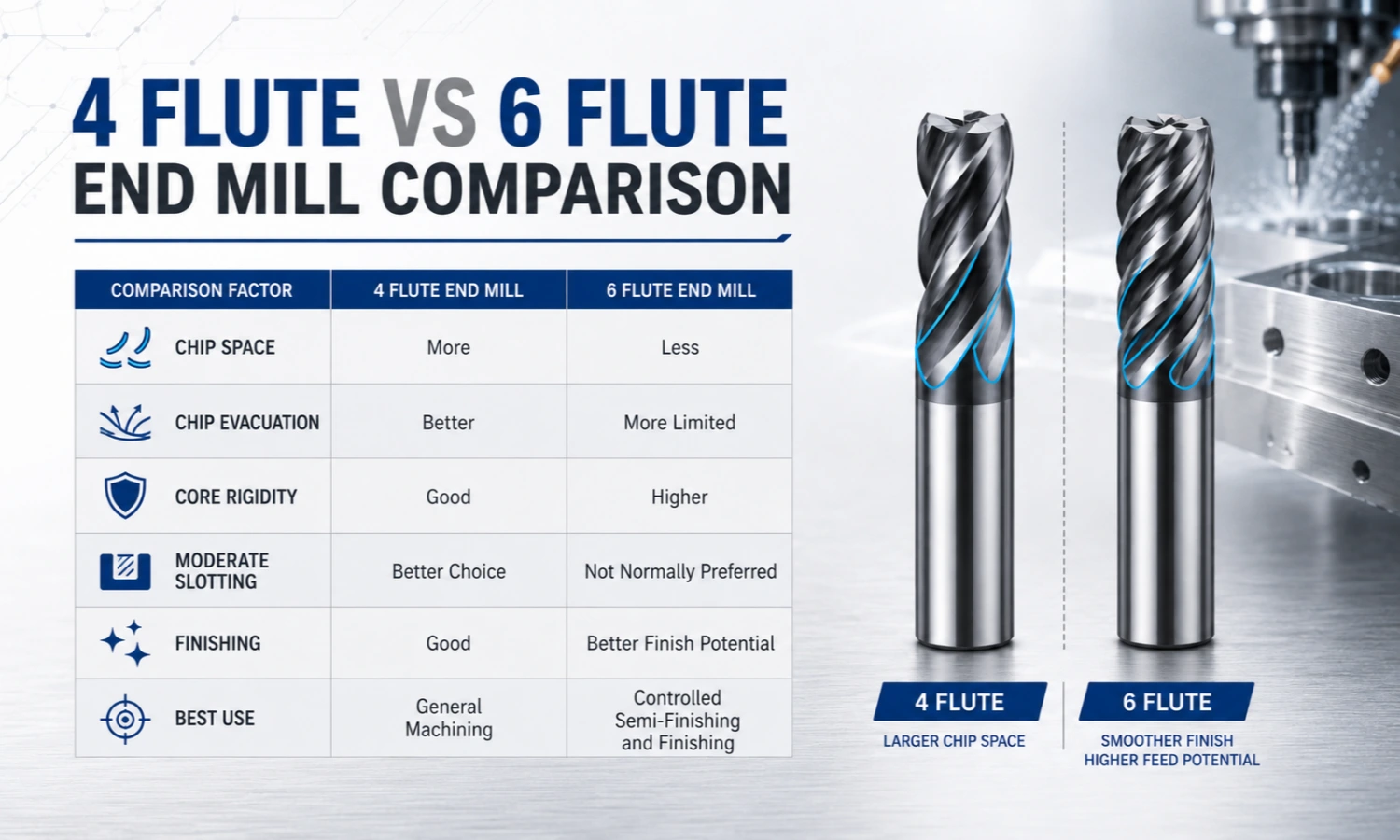
The main difference in a 4 flûte contre 6 flute end mill comparison is the balance between chip evacuation and tool rigidity.
A 4 flute end mill provides more flute space. Donc, it is generally more flexible for moderate slotting, fraisage latéral, fraisage de profil, et conditions de coupe changeantes.
En revanche, un 6 flute end mill has more cutting edges and usually a stronger core. It can provide better stability during controlled semi-finishing and finishing, especially when wall quality and surface finish are the main goals.
Neither flute count is always better. The correct choice depends on the machining operation, volume de copeaux, couper l'engagement, rigidité de la machine, porte-à-faux de l'outil, et finition souhaitée.
Key Differences Between 4 Flûte et 6 Fraises à flûte
4 Fraise en bout de cannelure: More Chip Space and Versatility
A 4 flute end mill has four cutting edges with more space between the flutes than a six-flute design. Par conséquent, chips can leave the cutting zone more easily.
This design provides a practical balance of chip evacuation, force de base, et stabilité de coupe. It is commonly selected for general steel and stainless steel machining, placement modéré, fraisage latéral, fraisage de profil, et semi-finition.
A four-flute cutter is also more forgiving when cutting engagement or machining conditions change during production.
Pour les tailles standards, center-cutting designs, revêtements, et options personnalisées, passez en revue notre 4 fraise en bout de carbure de cannelure.
Pour un guide d’application plus large, lire qu'est-ce qu'un 4 fraise en bout de cannelure utilisée pour.
6 Fraise en bout de cannelure: Higher Rigidity for Finishing
A 6 flute end mill has six cutting edges and less flute space. The additional cutting edges and stronger core can improve rigidity, stabilité du mur, and surface consistency during controlled machining.
Donc, this design is often used for side milling, finition du profil, semi-finition, et finition en acier, stainless steel, et acier allié.
Cependant, l'espace plus petit des flûtes limite l'évacuation des copeaux. A six-flute cutter is not normally the first choice for deep full-width slots, ébauche lourde, or operations that produce a high chip volume.
For product sizes and customization options, passez en revue notre 6 fraise en bout de carbure de cannelure.
For more information about its applications, lire qu'est-ce qu'un 6 fraise en bout de cannelure utilisée pour.
4 Flûte vs 6 Comparaison des fraises à flûte
| Facteur de comparaison | 4 Fraise en bout de cannelure | 6 Fraise en bout de cannelure |
|---|---|---|
| Espace de puce | More | Moins |
| Évacuation des copeaux | Mieux | Plus limité |
| Core Rigidity | Bien | Plus haut |
| Usinage général de l'acier | Plus polyvalent | Plus spécialisé |
| Emplacement modéré | Meilleur choix | Not normally preferred |
| Fraisage latéral | Approprié | Suitable with controlled engagement |
| Fraisage de profil | Approprié | Well suited to stable finishing passes |
| Semi-finition | Approprié | Souvent mieux |
| Finition | Bien | Better finish potential |
| Ebauche lourde | Plus adapté | Pas idéal |
| Configuration de la machine | More forgiving | Fonctionne mieux dans les configurations rigides |
| Meilleure utilisation | General machining and moderate chip removal | Controlled semi-finishing and finishing |
| Use with Caution | Very light finishing where more cutting edges may help | Fentes profondes, mauvaise évacuation des copeaux, long porte-à-faux, ou configurations instables |
This table provides general selection guidance. Actual performance also depends on carbide grade, revêtement, angle d'hélice, diamètre de l'outil, longueur de flûte, état du titulaire, livraison de liquide de refroidissement, et paramètres de coupe.
4 Flûte vs 6 Fraise à flûte pour l'acier
Les deux flûtes peuvent usiner l'acier. Cependant, they suit different operations.
A 4 flute end mill is generally the more flexible option for general steel machining. Its larger flute space supports moderate chip removal, changing cutting engagement, fraisage latéral, fraisage de profil, and light-to-moderate slotting.
A 6 flute end mill becomes more useful when the operation focuses on controlled semi-finishing or finishing. Its additional cutting edges can improve wall quality and surface consistency. Cependant, la machine, titulaire, porte-pièce, and toolpath should remain stable.
Choisir 4 Flute for General Steel Machining
A four-flute cutter is a practical choice when:
- The operation includes moderate slotting.
- Chip evacuation remains important.
- Cutting engagement may change.
- One tool needs to cover several operations.
- The setup is not optimized only for finishing.
Choisir 6 Flute for Controlled Finishing
A six-flute cutter may provide better results when:
- The operation mainly involves semi-finishing or finishing.
- Une meilleure qualité de mur est requise.
- Radial engagement remains light and controlled.
- La machine et le support offrent une bonne rigidité.
- Surface quality matters more than maximum chip space.
Dans de nombreux ateliers, a four-flute design serves as the general-purpose starting point. A six-flute tool offers a more specialized choice when the operation becomes stable and finishing-focused.
4 Flûte vs 6 Fraise à flûte pour acier inoxydable
Stainless steel can generate heat and may work harden when cutting conditions become unstable. Donc, évacuation des copeaux, couper l'engagement, revêtement, géométrie de l'outil, and machine rigidity all matter.
A 4 La fraise à cannelure est généralement un point de départ pratique pour l'usinage général de l'acier inoxydable.. It provides a useful balance between chip space and core strength, so it can handle profile milling, fraisage latéral, moderate material removal, et semi-finition.
A 6 la fraise à flûte est plus spécialisée. It can perform well in controlled semi-finishing and finishing passes where dimensional consistency, qualité du mur, et des surfaces plus lisses sont les principaux objectifs.
Cependant, chip volume and cutting engagement must remain controlled. Sinon, chips and heat may collect around the cutting edges.
For specialized stainless steel finishing, tools with five or more flutes and higher helix angles are also common. Quand même, additional flutes only help when chip evacuation, s'épuiser, tenue de l'outil, and setup rigidity remain under control. Variable-helix or variable-pitch geometry may also improve vibration control.
En général:
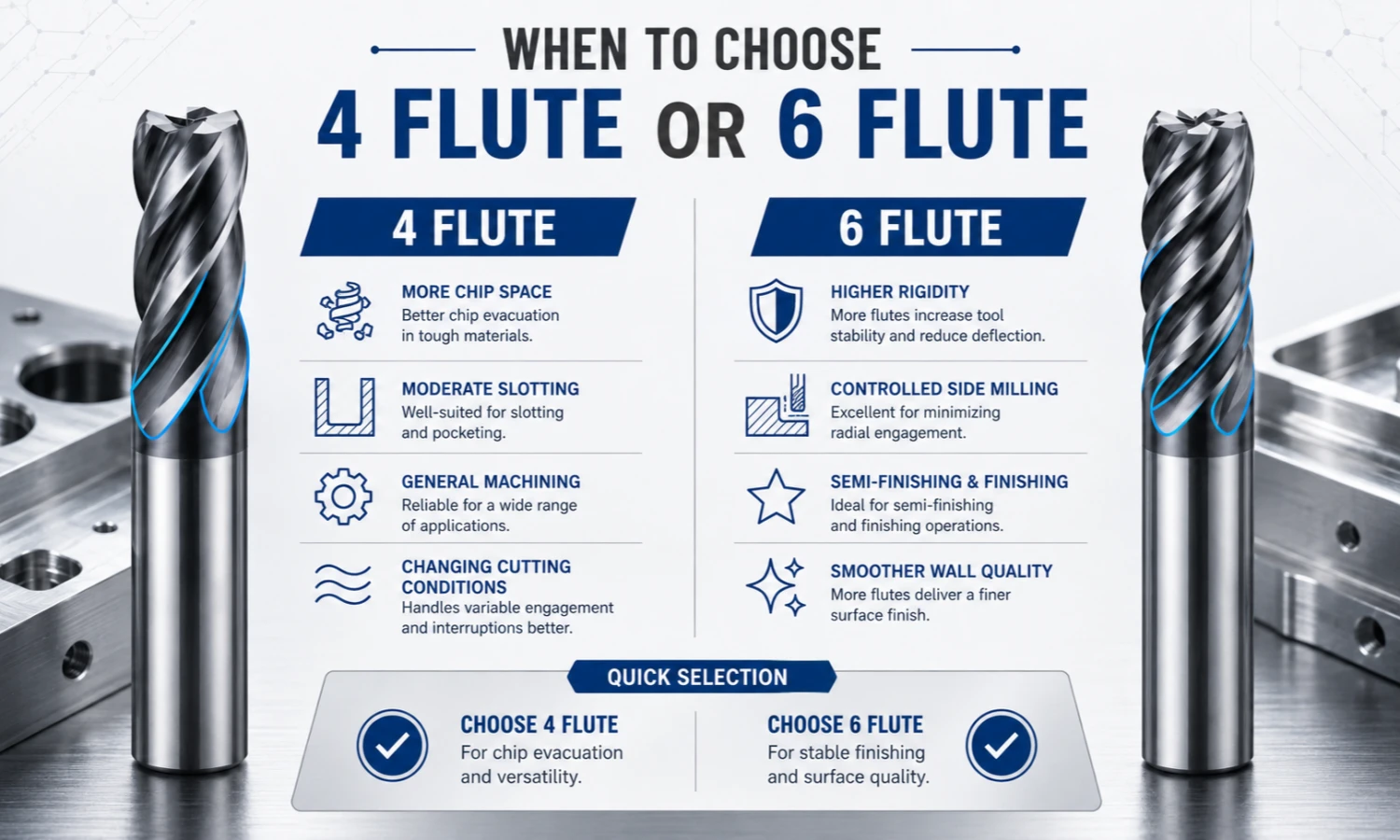
- Choisir 4 flute for greater versatility and more chip space.
- Choisir 6 flûte pour une finition contrôlée et des exigences de qualité de surface plus élevées.
Comment choisir un 4 Flûte ou 6 Flute End Mill in Three Steps
Étape 1: Start with the Machining Operation
D'abord, identify the main operation.
Choisissez un 4 flute end mill when the job includes moderate slotting, changing cutting engagement, or general side and profile milling. Its larger flute space provides a safer path for chips to leave the cutting zone.
Consider a 6 flute end mill when the operation uses controlled side engagement and focuses on semi-finishing or finishing.
Pour une ébauche lourde, a dedicated roughing cutter may be more suitable than either a standard four-flute or six-flute finishing tool.
Étape 2: Check Chip Evacuation and Setup Rigidity
Suivant, review the complete machining setup.
A six-flute cutter performs best when:
- Cutting engagement remains controlled.
- La machine et le support offrent une bonne rigidité.
- Tool overhang is kept as short as practical.
- Coolant or air can reach the cutting zone.
- Chips can leave the workpiece without recutting.
A four-flute tool is generally more forgiving when the setup is less rigid or the cutting conditions change.
A higher flute count cannot correct an unstable holder, porte-à-faux excessif, poor workholding, or blocked chip evacuation.
Étape 3: Set the Surface-Finish Priority
Enfin, decide whether chip control or finishing quality has the higher priority.
Choose four flutes when versatility, évacuation des copeaux, and moderate material removal matter most.
Choose six flutes when the setup is stable and the operation targets wall quality, cohérence dimensionnelle, and a smoother finished surface.
More cutting edges can reduce the load carried by each edge when the feed is set correctly. Cependant, poor chip control or excessive heat can remove this advantage.
What to Check When a 6 Flute End Mill Does Not Improve the Result
A six-flute cutter does not automatically produce a better finish. When the result becomes worse, inspect the complete cutting condition before blaming the tool.
| Machining Sign | Cause possible | First Point to Check |
|---|---|---|
| Chips collect around the cutting edges | Chip volume is too high for the available flute space | Reduce cutting engagement or consider a 4 conception de flûte |
| Cutting temperature rises quickly | Chips remain in the cutting zone or coolant access is limited | Improve chip evacuation and coolant delivery |
| Wall chatter or vibration marks appear | Tool overhang or the complete setup lacks rigidity | Check holder, surplomb, porte-pièce, et parcours d'outil |
| Surface finish does not improve | S'épuiser, alimentation, or cutting engagement is unsuitable | Check runout and adjust the finishing strategy |
| Cutting edges chip unexpectedly | Chip recutting, chaleur, or unstable engagement | Review chip control, revêtement, et conditions de coupe |
These are general troubleshooting signs rather than fixed cutting rules. The correct adjustment depends on the cutter design, matériau de la pièce à usiner, machine, titulaire, and machining parameters.
Practical Selection Examples
General Steel with Moderate Slotting
For moderate slotting or changing cutting engagement in general steel, un 4 flute end mill is normally the more flexible choice.
Its larger flute space supports chip evacuation, while the four-flute core still provides useful rigidity for side and profile milling.
If the operation changes to a light final side-finishing pass, un 6 flute cutter can be evaluated separately.
Stainless Steel Profile Finishing
When stainless steel is machined with light and stable side engagement, a rigid setup, and a clear finishing target, un 6 flute end mill may provide better finishing potential.
Cependant, if chips begin to collect or cutting temperature rises quickly, un 4 flute design may provide a safer balance between flute space and cutting stability.
These examples show why flute count should match the operation instead of being selected only by material name.
Foire aux questions
Quelle est la principale différence entre un 4 flûte et 6 fraise à cannelure?
La principale différence réside dans l'équilibre entre l'évacuation des copeaux et la rigidité..
A 4 flute end mill provides more flute space and greater versatility. En revanche, un 6 flute end mill provides more cutting edges, higher core rigidity, and better finishing potential under stable conditions.
Est-ce un 4 flûte ou 6 fraise à flûte meilleure pour l'acier?
A 4 La fraise à cannelure est généralement meilleure pour l'usinage général de l'acier., placement modéré, et conditions de coupe changeantes.
A 6 flute cutter often performs better during controlled side milling, semi-finition, et finition lorsque la qualité de la surface est l'objectif principal.
When should I avoid using a 6 fraise à cannelure?
A 6 flute end mill is normally not the first choice for deep full-width slots, ébauche lourde, high chip-volume operations, poor coolant access, ou configurations instables.
Its smaller flute space can increase chip recutting and heat when cutting engagement is too high.
Does a higher flute count always produce a better surface finish?
No. A higher flute count can improve finishing potential, but the result also depends on runout, alimentation par dent, géométrie de l'outil, rigidité de la machine, état du titulaire, évacuation des copeaux, and workpiece stability.
If chips or heat remain in the cutting zone, a six-flute cutter may not improve the surface.
Comment choisir entre un 4 flûte et 6 fraise à cannelure?
Start with the machining operation and chip volume. Then check cutting engagement, porte-à-faux de l'outil, état du titulaire, et rigidité de la machine.
Choose four flutes when chip evacuation and versatility matter more. Choose six flutes when the setup is stable and controlled finishing is the main goal.
Conclusion
Lorsqu'on compare un 4 flûte contre 6 fraise à cannelure, start with the machining goal.
A four-flute cutter provides more chip space and greater flexibility for general steel and stainless steel machining, placement modéré, fraisage latéral, et conditions de coupe changeantes.
A six-flute cutter offers higher rigidity and better finishing potential when cutting engagement remains controlled. Donc, it suits stable semi-finishing and finishing operations that require better wall quality and smoother surfaces.
Instead of selecting a cutter by flute count alone, match the tool to the material, volume de copeaux, profondeur de coupe, rigidité de la machine, tenue de l'outil, et finition souhaitée.
Besoin d'aide pour choisir entre 4 Flûte et 6 Fraises à flûte?
Selecting the correct flute count can improve chip control, stabilité de coupe, durée de vie de l'outil, et qualité de surface.
Envoyez-nous votre matière à usiner, dureté du matériau, diamètre de coupe, longueur de flûte, opération d'usinage, exigence de revêtement, et la quantité. You can also provide a drawing, tool reference, or application photo when the specification is incomplete.
We will review the available information and help you select a suitable standard or custom carbide end mill.
Email your requirement directly to sales@cutterbest.com.