 Fraise de précision,Outils de coupe pour l’usinage CNC de chaque matériau

A 6 La fraise à cannelure est principalement utilisée pour le fraisage latéral contrôlé, fraisage de profil, fraisage de contours, semi-finition, et finition. Ses six arêtes coupantes assurent un contact de coupe fréquent, qui peut supporter une bonne rigidité de l'outil, usinage de murs stables, et une passe de finition plus douce.
Cependant, plus de cannelures laissent moins d'espace pour l'évacuation des copeaux. Donc, une fraise standard à six cannelures n'est généralement pas le meilleur choix pour les rainures profondes sur toute la largeur, ébauche lourde, ou coupe agressive dans des matériaux produisant de gros copeaux.
En pratique, un outil à six cannelures fonctionne mieux lorsque la qualité de la surface et la stabilité de coupe comptent plus que l'enlèvement maximal de matière.
Qu'est-ce qu'un 6 Fraise en bout de cannelure?
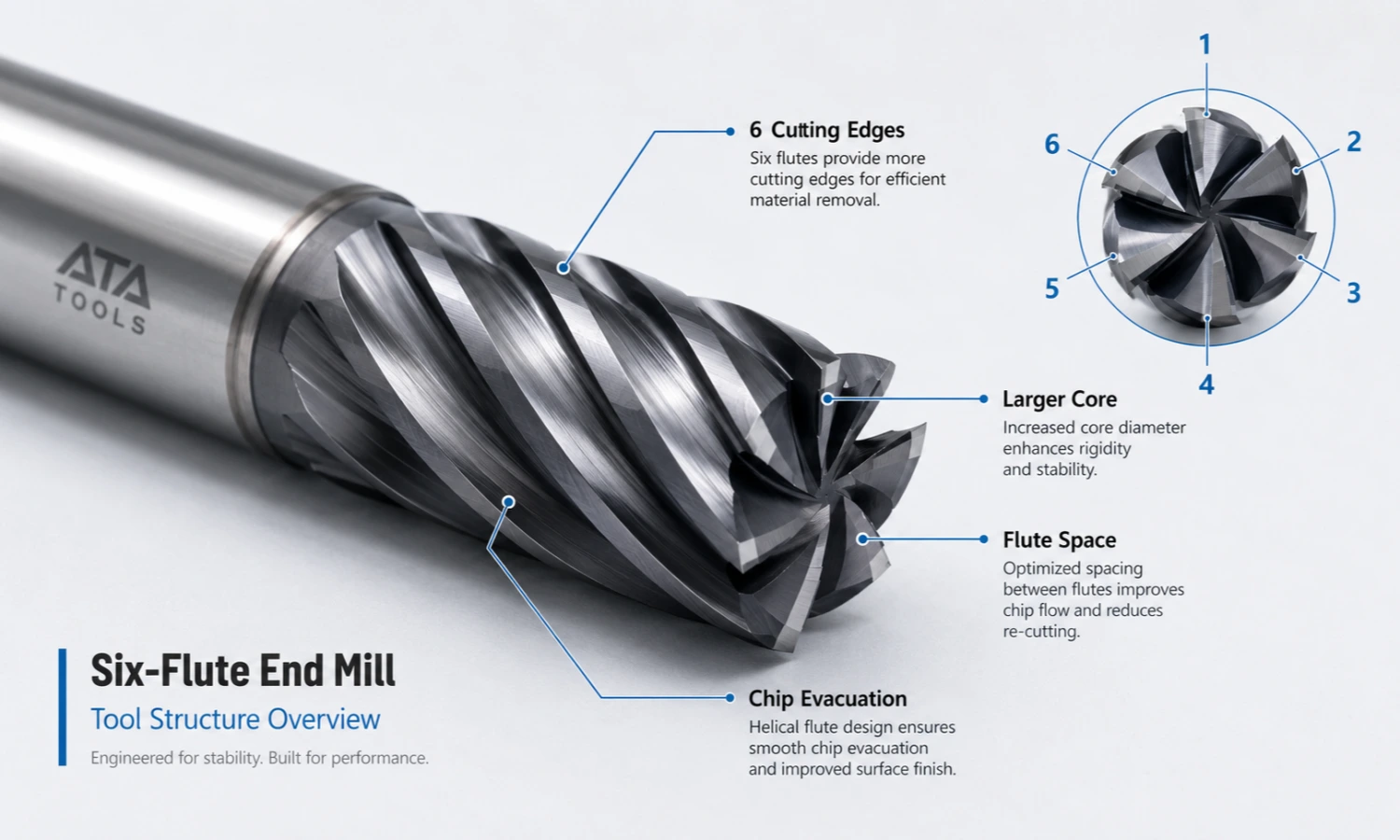
A 6 La fraise à cannelure a six arêtes de coupe autour de sa section de coupe. Chaque tour de broche met six arêtes de coupe en contact avec la pièce à usiner.
Par rapport à un cutter doté de deux ou quatre cannelures, une conception à six cannelures a normalement un noyau d'outil plus grand et des espaces de cannelures plus petits. Le noyau plus grand peut supporter la rigidité de l'outil, tandis que les arêtes de coupe supplémentaires peuvent répartir l'action de coupe sur plus de dents..
Le principal compromis est l’évacuation des copeaux. Les espaces de flûte plus petits contiennent moins de jetons, la fraise a donc besoin d'un engagement contrôlé et d'un chemin dégagé pour que les copeaux quittent la zone de coupe.
Pour cette raison, Les outils à six cannelures fonctionnent généralement mieux en coupe latérale et en finition qu'en rainurage profond ou en ébauche lourde..
Pour une explication générale des types et des structures de fraises, lisez notre guide de fraise en bout.
Principales utilisations d'un 6 Fraise en bout de cannelure
Les meilleures applications impliquent un volume de copeaux contrôlé, conditions stables des machines, et un besoin d'une bonne qualité de mur ou d'une bonne finition de surface.
Fraisage latéral et de profil
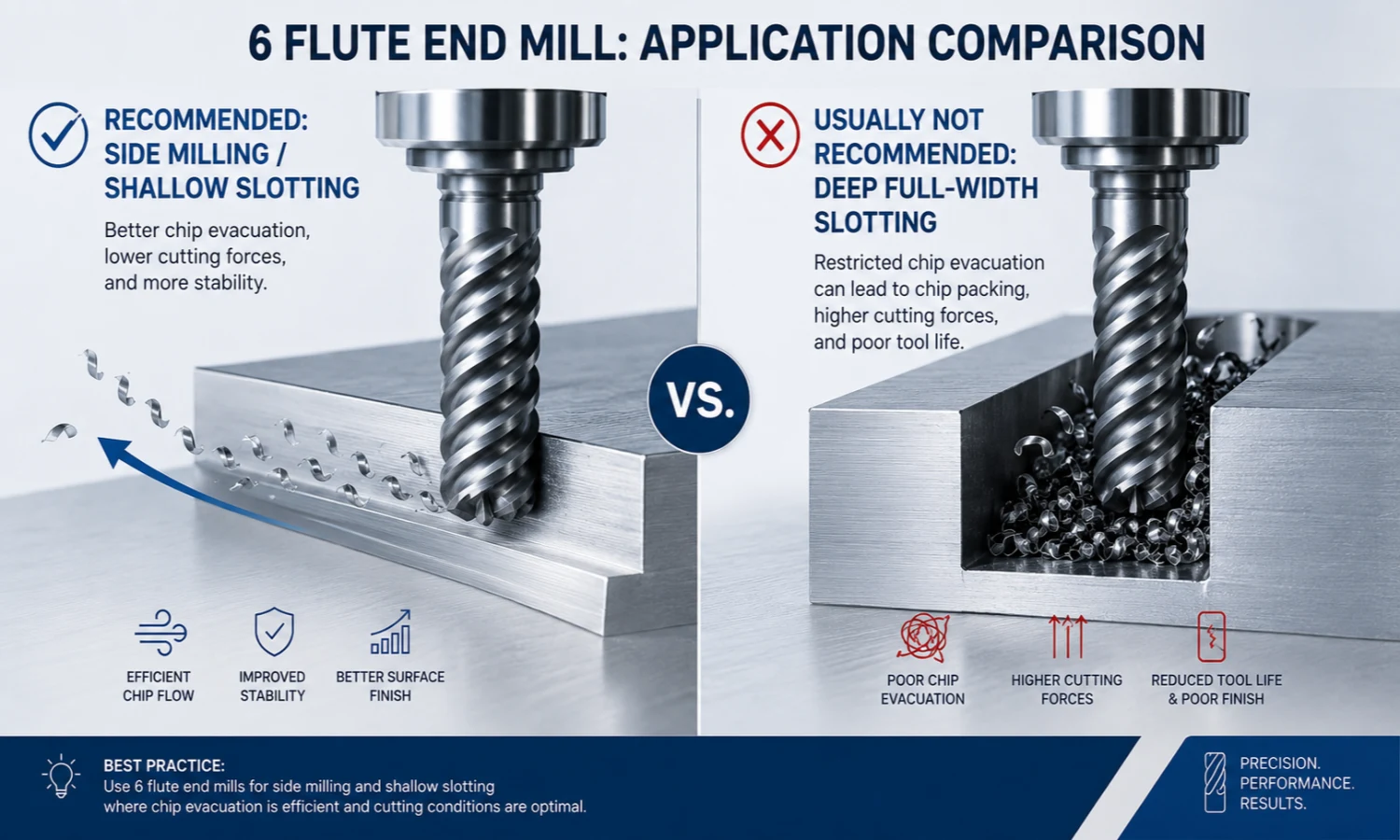
Une fraise à six cannelures fonctionne bien pour le fraisage latéral car seule une partie du diamètre de l'outil s'engage normalement dans la pièce à usiner.. Cela laisse plus de place aux puces pour s'échapper que ne le fait un emplacement pleine largeur..
Les utilisations typiques incluent les parois latérales droites, épaules, profils extérieurs, et caractéristiques des composants de précision. Les arêtes de coupe supplémentaires peuvent également assurer un contact stable avec l'outil lorsque la largeur de coupe radiale reste contrôlée..
Toujours, le résultat dépend de plus que le nombre de flûtes. Faux-rond de l'outil, état du titulaire, rigidité de la machine, largeur de coupe, et le porte-à-faux de l'outil affectent tous la qualité des parois latérales.
Fraisage de contours
Le fraisage de contour consiste à suivre un profil de pièce incurvé ou irrégulier. Un outil rigide à six cannelures peut prendre en charge un contact constant lorsqu'il se déplace le long du contour.
Cela rend la conception utile pour les composants du moule, pièces d'outillage, composants de machines, et autres profils de précision. Cependant, un long porte-à-faux d'outil ou un support instable peut toujours créer des vibrations.
Donc, l'outil doit rester aussi court que l'application le permet, surtout lors de l'usinage de contours raides ou profonds.
Semi-finition
La semi-finition enlève la matière laissée après l'ébauche et prépare la surface pour la passe finale.
Un outil à six cannelures convient à cette étape où le stock restant est contrôlé. Les arêtes de coupe supplémentaires peuvent répartir l'action de coupe et aider à maintenir une géométrie de mur cohérente..
Avant d'utiliser six flûtes, s'assurer que l'opération d'ébauche n'a pas laissé une surépaisseur inégale ou excessive. Un stock important et irrégulier peut surcharger les arêtes de coupe individuelles.
Finition
La finition est l'une des plus courantes 6 applications de fraises à cannelures.
Un plus grand nombre d'arêtes de coupe peuvent laisser des marques de coupe plus fines lorsque la vitesse, alimentation, parcours d'outil, et la configuration de la machine correspondent au matériau. Par conséquent, les fraises à six cannelures sont souvent sélectionnées pour la finition des murs droits, profils, épaules, et surfaces de précision.
Cependant, Le nombre de flûtes à lui seul ne garantit pas une rugosité de surface spécifique. Précision du support, faux-rond de l'outil, état de la machine, stabilité de la pièce, paramètres de coupe, et l'usure de l'outil influence également la surface finale.
Rainurage peu profond et usinage à grande vitesse
Une fraise à six cannelures peut usiner des fentes peu profondes lorsque les copeaux peuvent quitter efficacement la zone de coupe.. Le rainurage léger peut bien fonctionner, surtout lorsque la profondeur axiale et le volume de copeaux restent faibles.
Le rainurage profond sur toute la largeur est différent. Dans ce cas, le couteau reste entouré de matériau, tandis que les espaces de flûte plus petits doivent transporter tous les jetons hors de la fente. Le tassement des copeaux et la chaleur peuvent alors augmenter rapidement.
Les outils à six cannelures peuvent également prendre en charge l'usinage à grande vitesse, mais une vitesse de broche élevée ne suffit pas à elle seule. L'installation complète doit contrôler la chaleur, s'épuiser, vibration, et évacuation des copeaux.
Guide de demande rapide
| Opération d'usinage | Aptitude générale | Considération principale |
|---|---|---|
| Fraisage latéral | Recommandé | Utiliser un engagement radial contrôlé |
| Fraisage de profil | Recommandé | Vérifier la précision du porte-outil et le porte-à-faux de l'outil |
| Fraisage de contours | Recommandé | Maintenir une configuration rigide |
| Semi-finition | Recommandé | Gardez le stock restant cohérent |
| Finition | Recommandé | Contrôler les paramètres de faux-rond et de coupe |
| Rainurage peu profond | Conditionnel | Assurez-vous que les jetons peuvent quitter la fente |
| Fentes profondes sur toute la largeur | Généralement non recommandé | L'espace limité des flûtes limite l'évacuation des copeaux |
| Ebauche lourde | Généralement non recommandé | Un nombre inférieur de flûtes offre plus d'espace pour les puces |
Quels matériaux conviennent pour un 6 Fraise en bout de cannelure?
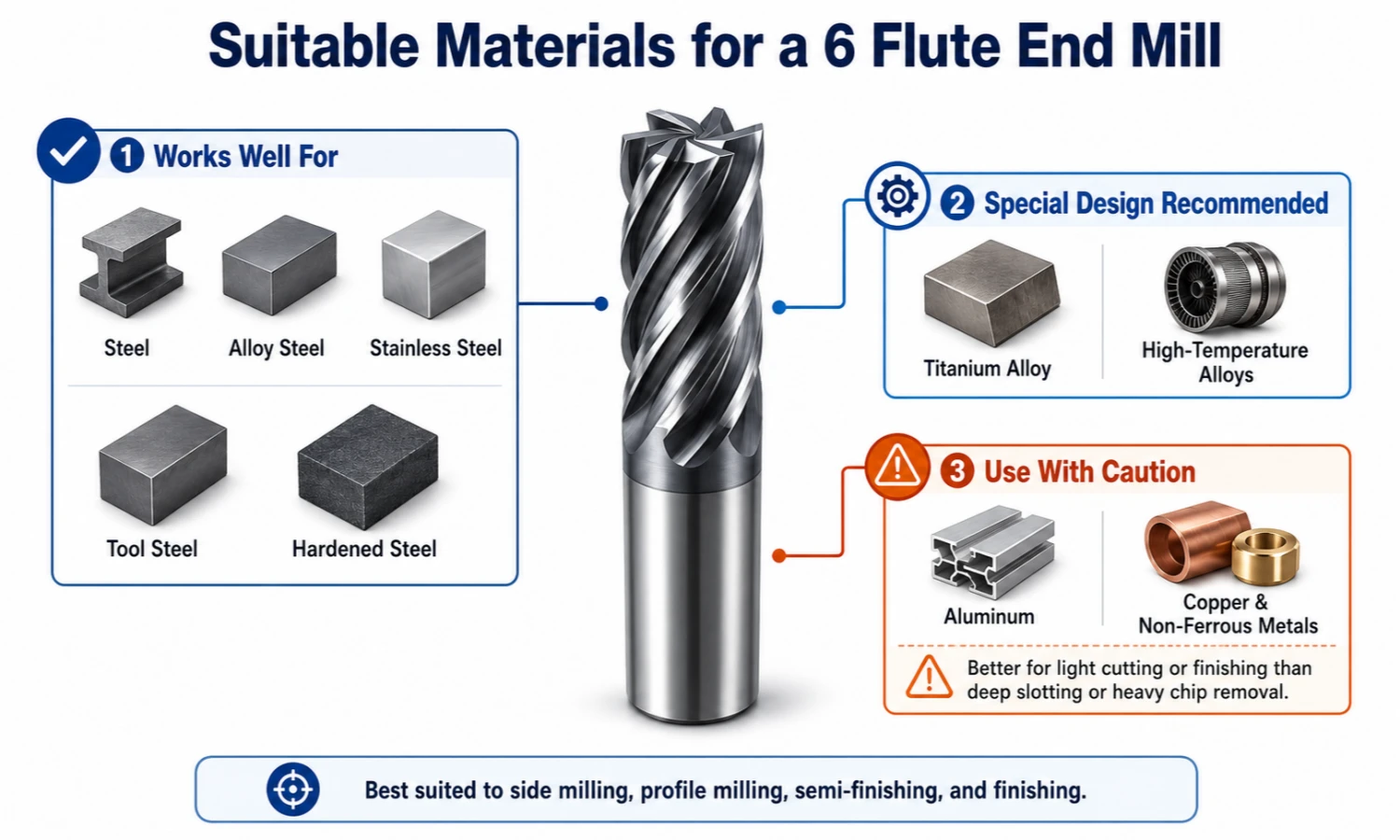
Le bon choix dépend du matériau de la pièce à usiner, dureté, opération de coupe, rigidité de la machine, état du liquide de refroidissement, et conception d'outils.
Un outil conçu pour l'acier ne doit pas automatiquement être utilisé pour l'aluminium ou le titane.. Même si le nombre de flûtes reste le même, la géométrie de pointe et d'autres caractéristiques de l'outil devront peut-être changer.
Acier et acier allié
L'acier et l'acier allié sont des domaines d'application courants pour les outils à six cannelures.
La fraise peut gérer un fraisage latéral contrôlé, fraisage de profil, semi-finition, et finition quand sa qualité carbure, géométrie de coupe, et le revêtement correspondent à la dureté du matériau.
Six cannelures sont particulièrement utiles lorsque l'opération nécessite des murs stables ou une passe de finition propre.. En revanche, l'ébauche lourde nécessite généralement plus d'espace pour les copeaux.
Acier inoxydable
Un coupeur à six cannelures peut usiner 304, 316, et autres nuances d'acier inoxydable. Cependant, l'acier inoxydable peut générer de la chaleur et durcir si l'action de coupe devient instable.
Donc, le coupeur doit maintenir une coupe constante. La géométrie de coupe, revêtement, liquide de refroidissement, vitesse, et l'alimentation doit correspondre à la qualité de l'acier inoxydable et à l'opération d'usinage..
Une conception à six cannelures est généralement plus adaptée pour une coupe latérale et une finition contrôlées que pour un rainurage profond dans l'acier inoxydable..
Acier à outils et acier trempé
Les outils à six cannelures peuvent également usiner l'acier à outils, acier pré-trempé, et acier trempé lorsque la série d'outils correspond à la dureté du matériau.
Les matériaux plus durs nécessitent des nuances de carbure appropriées, résistance des bords, revêtements, et géométrie de coupe. Par conséquent, une fraise standard ne doit pas être considérée comme une solution universelle pour chaque plage de dureté.
Pour matériaux durcis, des conditions de machine stables et un faible faux-rond de l'outil deviennent encore plus importants.
Titane et matériaux difficiles à usiner
Un outil à six cannelures spécialement conçu peut convenir au titane et à d'autres matériaux difficiles à usiner.
Cependant, contrôle de la chaleur, charge de coupe, résistance des bords, livraison de liquide de refroidissement, et le porte-à-faux de l'outil nécessitent une attention particulière. La géométrie standard de coupe de l'acier peut ne pas fournir le meilleur résultat.
Avant de choisir le cutter, examiner la qualité exacte du titane, opération d'usinage, profondeur de coupe, méthode de refroidissement, et état de la machine.
Un 6 Fraise à cannelure en aluminium coupé?
Oui, mais seulement lorsque la fraise utilise une géométrie adaptée à l'aluminium et que l'opération ne crée pas un volume de copeaux excessif.
L'aluminium produit souvent des copeaux plus gros et plus adhésifs que l'acier.. Donc, les fentes profondes et les ébauches lourdes fonctionnent généralement mieux avec deux ou trois cannelures car elles offrent des espaces de cannelures plus grands.
Un outil à six cannelures peut toujours convenir au fraisage latéral léger ou à la finition de l'aluminium lorsqu'il présente des arêtes de coupe tranchantes., contrôle efficace des copeaux, et suffisamment d'espace pour évacuer les copeaux.
Quand devriez-vous choisir un 6 Fraise en bout de cannelure?
Choisissez une fraise à six cannelures lorsque la plupart des conditions suivantes s'appliquent:
- La finition de surface compte plus que l’enlèvement maximal de matière.
- L'opération implique un fraisage latéral, profilage, semi-finition, ou finition.
- La machine et le support offrent une bonne rigidité.
- La largeur de coupe radiale reste maîtrisée.
- Le porte-à-faux de l'outil reste raisonnablement court.
- Les copeaux peuvent quitter efficacement la zone de coupe.
- La conception de la fraise correspond au matériau et à la dureté de la pièce à usiner.
Ces conditions aident l'outil à utiliser ses principaux atouts: rigidité, contact de coupe fréquent, et un usinage des murs cohérent.
Quand est-ce qu'un 6 La fraise à flûte n'est pas le meilleur choix?
Un plus grand nombre d'arêtes de coupe ne permet pas d'avoir une fraise adaptée à chaque opération.. Dans certaines applications, l'espace réduit des flûtes devient un problème plus important que la rigidité de l'outil.
Fentes profondes sur toute la largeur
Pendant le placement sur toute la largeur, la fraise engage le matériau sur tout son diamètre. Les jetons doivent traverser les espaces de la flûte et sortir de la fente.
Parce qu'une conception à six cannelures a des espaces de flûte plus petits, les jetons peuvent s'accumuler dans une fente profonde. Cela peut augmenter la chaleur, charge de coupe, et le risque d'endommagement des bords.
Pour les fentes profondes, un nombre de cannelures inférieur permet généralement une évacuation plus sûre des copeaux.
Ebauche lourde
Une ébauche importante enlève une grande quantité de matière. Par conséquent, il produit plus de copeaux et impose des charges plus élevées sur la fraise.
Un à deux flûtes, trois flûtes, quatre flûtes, ou un outil d'ébauche dédié offre souvent plus d'espace pour le flux des copeaux. Le meilleur choix dépend du matériau et de la stratégie d'ébauche.
Matériaux produisant de gros copeaux
Les matériaux mous tels que l'aluminium peuvent produire des copeaux volumineux ou adhésifs lors d'une coupe agressive..
Dans ces conditions, un couteau à grand nombre de cannelures peut emballer des copeaux à l'intérieur des cannelures. Un nombre de cannelures inférieur gère normalement plus efficacement la coupe d'aluminium lourd.
Configurations instables et long porte-à-faux d'outil
Une conception à six cannelures peut fournir une bonne rigidité du noyau, mais il ne peut pas corriger tous les problèmes de configuration.
Long porte-à-faux, supports usés, un faux-rond élevé, faible tenue de la pièce, ou une machine instable peut quand même provoquer des vibrations et des marques de coupe. Dans les cas graves, ils peuvent également contribuer à l'écaillage des bords.
Donc, réduisez le porte-à-faux et vérifiez la configuration complète avant de modifier le nombre de flûtes.
Quel est le principal inconvénient d'une fraise en bout à grand nombre de cannelures?
Le principal inconvénient d'une fraise à grand nombre de cannelures est l'espace réduit des cannelures..
À mesure que le nombre de flûtes augmente, chaque flûte a généralement moins de place pour transporter des jetons. Cela peut rendre l'évacuation des copeaux plus difficile, surtout lors du rainurage profond, ébauche lourde, ou un enlèvement de matière élevé.
Si les copeaux ne peuvent pas quitter la zone de coupe, ils peuvent être recoupés ou emballés entre l'outil et la pièce à usiner. Par conséquent, la chaleur et la pression de coupe peuvent augmenter.
Le nombre correct de flûtes doit équilibrer trois facteurs:
- Évacuation des copeaux
- Rigidité de l'outil
- Qualité des surfaces
Un outil à six cannelures peut offrir une meilleure rigidité et stabilité de finition, tandis qu'une fraise à cannelure inférieure peut traiter plus efficacement de gros volumes de copeaux.
4 Flûte ou 6 Fraise en bout de cannelure?
Une fraise à quatre cannelures est généralement l'option la plus polyvalente. Il offre un équilibre pratique entre l'espace des puces, rigidité de l'outil, et finition de surface.
Un outil à six flûtes est plus spécialisé. Il convient normalement au fraisage latéral contrôlé, semi-finition, et finition lorsque le contact stable et la qualité du mur comptent plus que l'évacuation maximale des copeaux.
Le choix final dépend du matériau de la pièce à usiner, profondeur de coupe, engagement radial, rigidité de la machine, et objectif d'usinage.
Pour une comparaison détaillée de deux outils, lire 4 flûte contre 6 fraise à cannelure.
Pour un aperçu plus large du nombre de flûtes, lire 2 flûte contre 4 flûte contre 6 fraise à cannelure.
Foire aux questions
Est-ce que « 6 flûtes » signifie un 6 mm Diamètre de coupe?
No. «6 cannelures» fait référence au nombre d'arêtes de coupe.
Le diamètre de coupe est une dimension d'outil distincte. Une fraise à six cannelures peut avoir de nombreux diamètres de coupe différents.
Un 6 La fraise en bout à cannelure peut être utilisée pour le rainurage profond?
Une fraise standard à six cannelures n'est généralement pas le premier choix pour les rainures profondes sur toute la largeur..
Ses espaces de flûte plus petits peuvent restreindre l'évacuation des copeaux. Un couteau à cannelure inférieure offre normalement plus d'espace pour que les copeaux quittent la fente..
Est-ce un 6 Fraise à cannelure idéale pour l'acier inoxydable?
Oui, spécialement pour le fraisage latéral contrôlé, fraisage de profil, semi-finition, et finition.
Cependant, la géométrie de la fraise, revêtement, liquide de refroidissement, vitesse, et l'alimentation doit correspondre à la nuance d'acier inoxydable et à l'opération d'usinage.
Conclusion
Qu'est-ce qu'un 6 fraise en bout de cannelure utilisée pour? Il est principalement utilisé pour le fraisage latéral contrôlé, fraisage de profil, fraisage de contours, semi-finition, et finition.
Ses principaux atouts sont la rigidité des outils, contact de coupe stable, qualité du mur, et performances de finition. Sa principale limitation est l'espace réduit sur la puce.
Donc, évitez de considérer six flûtes comme la meilleure option pour chaque travail. Fentes profondes sur toute la largeur, ébauche lourde, configurations instables, et les opérations de gros copeaux bénéficient généralement de moins de cannelures.
Pour les options d'outils standard et personnalisés, voir notre 6 fraise en bout de carbure de cannelure.