 Fraise de précision,Outils de coupe pour l’usinage CNC de chaque matériau

If you want to know how to choose carbide drill bits pour différents matériaux, start with the workpiece material, not only the drill diameter. A suitable drill also depends on hardness, profondeur du trou, rigidité de la machine, état du liquide de refroidissement, et quantité de production.
Par exemple, acier, stainless steel, aluminium, fonte, and graphite all create different drilling problems. Donc, one drill design cannot fit every material. If buyers choose only by size or coating color, the drill may wear quickly, break easily, or produce unstable hole quality.
Ce guide explique how to choose carbide drill bits for different materials and CNC drilling conditions. It also shows what information buyers should provide before asking for a quotation.
For standard and custom CNC drilling tools, voir notre Forets en carbure.
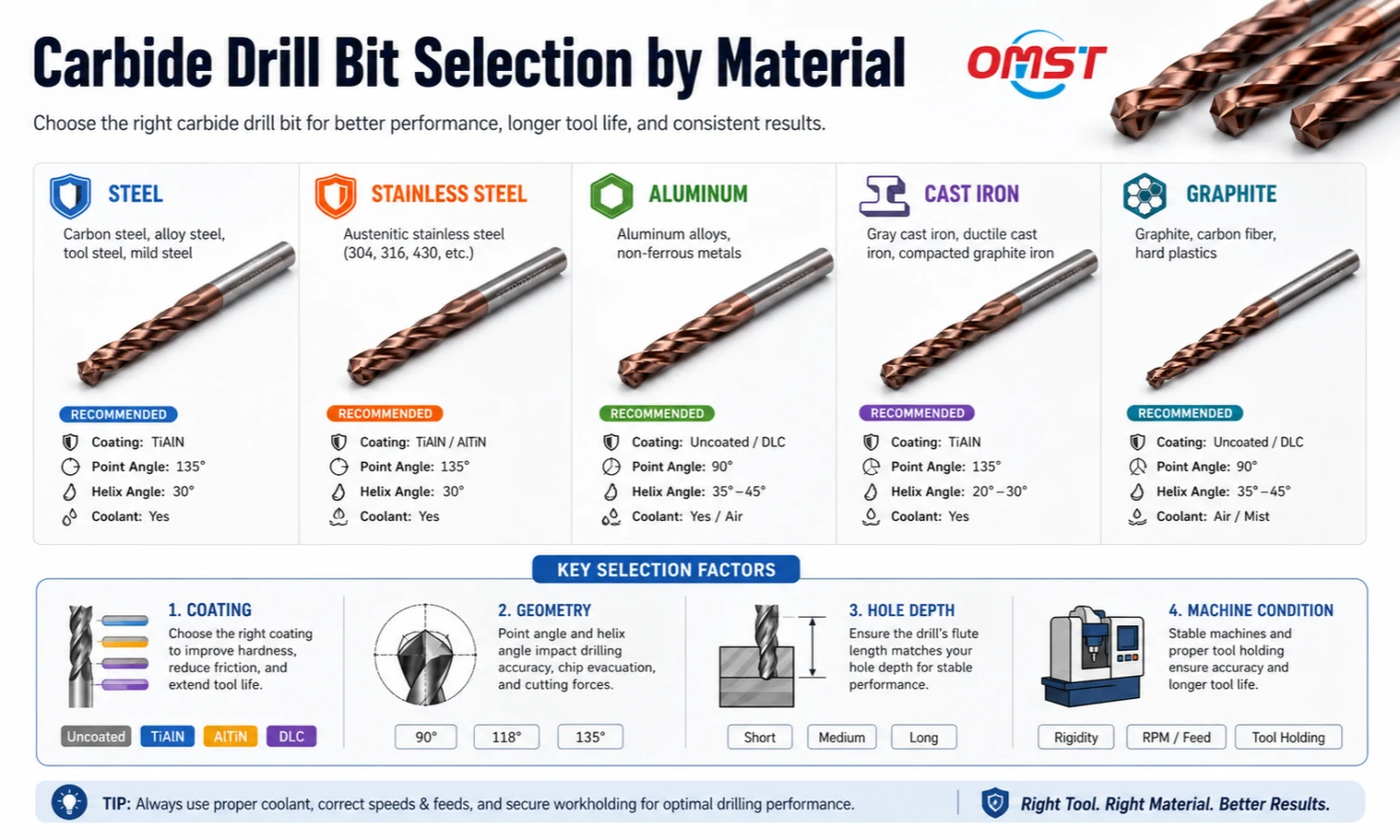
How to Choose Carbide Drill Bits by Workpiece Material
Different materials do not cut in the same way. Some materials create high heat. Some materials stick to the cutting edge. Others are abrasive and wear the drill quickly.
Pour cette raison, buyers should not choose carbide drill bits only by drill diameter. The drill point, conception de flûte, revêtement, nuance de carbure, shank rigidity, and chip evacuation must also match the real machining application.
Different Materials Create Different Drilling Problems
Steel and alloy steel usually require good wear resistance and stable cutting edges. Stainless steel may create heat and work hardening during drilling. Aluminum and copper may create built-up edge or chip adhesion. La fonte peut être abrasive. Graphite is also abrasive and may require a special coating.
Donc, a drill that works well on aluminum may not be the best choice for stainless steel. De même, a general coated carbide drill may not be suitable for graphite drilling.
Do Not Choose a Drill Only by Diameter
Le diamètre est important, but it is only one part of drill selection. Buyers should also confirm:
- Matériau et qualité de la pièce
- Dureté du matériau
- Diamètre du trou
- Profondeur du trou
- Trou traversant ou trou borgne
- Type de machine
- Liquide de refroidissement, air blow, or dust removal condition
- Quantité requise
- Dessin ou échantillon, si disponible
When this information is clear, the drill geometry and coating can be selected more accurately.
Standard Size vs Custom Carbide Drill Bits
Standard carbide drill bits are suitable for many common hole sizes. Cependant, custom carbide drill bits may be needed for special hole depth, small-diameter drilling, non-standard shank size, special coating, or OEM marking.
If the required hole is not a common size, or if the current drill wears too fast, a custom drill may be a better solution.
Forets en carbure pour acier et acier allié
L'acier et l'acier allié sont des matériaux courants dans le perçage CNC. Cependant, their hardness and alloy content can vary a lot. Pour cette raison, buyers should provide the material grade and hardness before choosing the drill.
Recommended Drill Features for Steel
Carbide drill bits for steel should have good rigidity, stable cutting edges, et un revêtement adapté. The drill should also match the machine condition and hole depth.
For general steel drilling, buyers often consider:
- Substrat en carbure monobloc
- Stable drill point geometry
- Wear-resistant coating
- Suitable flute design
- Good chip evacuation
- Proper coolant supply
If the steel has been heat treated, the hardness must be confirmed before tool selection.
Coating Selection for Steel
For steel and alloy steel, coating selection depends on hardness, température de coupe, et quantité de production. TiAlN, Or, or other suitable coatings may be considered according to the application.
Cependant, coating should not be selected only by color. A black, or, blue, or copper-colored drill does not automatically mean it is suitable for the workpiece. Plutôt, the coating should match the material, machine, and drilling condition.
Quelles informations les acheteurs doivent-ils fournir?
Before requesting carbide drill bits for steel, buyers should provide the steel grade, dureté, hole diameter, profondeur du trou, type de machine, état du liquide de refroidissement, et quantité commandée.
This helps the supplier recommend a suitable drill instead of only offering a standard size.
Forets en carbure pour acier inoxydable
Stainless steel is more difficult to drill than many general steels. It may generate heat, create work hardening, and cause chip evacuation problems. Donc, carbide drill bits for stainless steel need stable geometry and good heat control.
Why Stainless Steel Is Difficult to Drill
During drilling, stainless steel can become harder at the cutting area if the tool rubs instead of cutting properly. En outre, poor chip evacuation can damage the cutting edge or reduce hole quality.
À cause de ça, the drill should have enough edge strength, a suitable coating, and a flute design that supports chip removal.
How to Choose the Drill Geometry
When choosing carbide drill bits for stainless steel, buyers should consider the stainless steel grade, profondeur du trou, alimentation en liquide de refroidissement, et rigidité de la machine.
A suitable drill design may include:
- Strong cutting edge
- Stable point geometry
- Suitable flute design
- Coating for heat and wear resistance
- Proper cutting parameters
Dans de nombreux cas, the drill should be selected after the material grade and hole requirement are reviewed.
Common Buyer Mistakes
A common mistake is choosing a drill only by size. Another mistake is choosing only by coating color.
Pour l'acier inoxydable, buyers should first confirm the material grade, dureté, profondeur du trou, et état du liquide de refroidissement. Then the supplier can recommend a more suitable carbide drill bit.
Forets en carbure pour fonte
Cast iron drilling requires good wear resistance and stable cutting edges. Cependant, fonte grise, fonte ductile, et d'autres matériaux moulés peuvent nécessiter des conceptions de forets différentes.
What Makes Cast Iron Different?
La fonte peut être abrasive. It may also create powder-like chips instead of long chips. Donc, the drill should be selected according to the cast iron type and hole requirement.
The drill geometry should support stable cutting and reduce unnecessary edge wear.
Drill Design Considerations
For cast iron, les acheteurs devraient considérer:
- Cast iron type
- Dureté du matériau
- Diamètre du trou
- Profondeur du trou
- Dry or wet machining condition
- Batch production quantity
A suitable carbide drill bit can help improve drilling stability and reduce tool wear when the cutting condition is properly controlled.
When Custom Carbide Drills May Be Needed
Custom carbide drills may be needed when cast iron parts have special hole depth, tolérance stricte, non-standard diameter, or high production volume.
Dans ces cas, a drawing or sample can help confirm the correct drill size and geometry.
Carbide Drill Bits for Aluminum and Copper
Aluminium, cuivre, and other non-ferrous materials need a different selection method. These materials may stick to the cutting edge and create built-up edge during drilling.
Why Non-Ferrous Materials Need Different Drill Selection
Aluminum and copper are softer than steel, but they are not always easier to drill. If chip evacuation is poor, the drill may clog. If the edge geometry is not suitable, the hole finish may be unstable.
Donc, buyers should pay attention to flute design, état de surface, revêtement, et état de coupe.
Coating and Surface Treatment Options
Pour l'aluminium et le cuivre, low-friction coating, flûtes polies, or uncoated carbide may be considered according to the application. Dans certains cas, a coating that works for steel may not be the best choice for aluminum.
Donc, the final coating should be selected according to the alloy grade, profondeur du trou, état du liquide de refroidissement, and required hole finish.
Chip Evacuation and Hole Finish
Chip evacuation is very important for non-ferrous drilling. A suitable flute design can help remove chips and reduce built-up edge. Par conséquent, the drill may produce cleaner holes and more stable machining results.
Carbide Drill Bits for Graphite and Abrasive Materials
Graphite is very different from steel, stainless steel, or aluminum. It is abrasive, and it can wear ordinary cutting edges quickly. En outre, graphite dust may affect chip control and machine cleanliness.
Why Graphite Wears Tools Quickly
Graphite can cause abrasive wear during drilling. If the drill coating and geometry are not suitable, the cutting edge may wear quickly. This can reduce hole accuracy and shorten tool life.
Donc, graphite drilling often requires a tool with good wear resistance and stable cutting geometry.
When to Use a Diamond Coated Drill Bit
For graphite drilling, a CVD diamond coated drill bit may be a suitable option. The diamond coating helps protect the cutting edge during abrasive graphite machining.
Cependant, the final tool design should still depend on graphite grade, hole diameter, profondeur du trou, état de la machine, et les exigences de commande.
For graphite drilling and abrasive non-ferrous applications, voir notre Foret revêtu de diamant.
What Information Is Needed for Graphite Drilling?
When requesting a graphite drill, buyers should provide graphite grade, hole diameter, profondeur du trou, exigence de trou traversant ou de trou borgne, état de la machine, dust removal method, dessin, et la quantité.
This information helps the supplier confirm whether a diamond coated drill bit, custom carbide drill, or another drilling solution is more suitable.
How to Choose Carbide Drill Bits with the Right Coating
Coating selection is one of the most important steps when choosing carbide drill bits. Cependant, coating should always match the workpiece material and cutting condition.
Coating Should Match the Material
Different coatings have different purposes. Some coatings support heat resistance. Some coatings reduce friction. Others improve wear resistance for abrasive materials.
Pour cette raison, coating selection should be based on the material, dureté, température de coupe, chip behavior, état du liquide de refroidissement, et exigence de production.
Coated vs Uncoated Carbide Drill Bits
Coated carbide drill bits may help improve wear resistance and heat resistance. They are often used for steel, stainless steel, fonte, and other demanding applications.
Uncoated carbide drills or polished-flute designs may be considered for some aluminum, cuivre, or special non-ferrous applications. Donc, buyers should not assume that coated tools are always better for every material.
Why Coating Color Is Not Enough
Coating color is only an appearance. It does not fully explain coating type, performances du revêtement, or suitable application.
A buyer may see black, or, blue, cuivre, or dark coatings in a catalog. Cependant, the correct choice still depends on the actual workpiece material and machining condition.
How to Choose Carbide Drill Bits by Hole Depth and Drill Length
Hole depth also affects carbide drill bit selection. A shallow hole and a deep hole may require different flute length, rigidité, and chip evacuation design.
Short Holes and Standard Drills
For shallow through holes or common hole sizes, a standard carbide drill may be enough. Cependant, the material and tolerance should still be confirmed.
If the hole is short and the machine is stable, tool selection is usually easier.
Deep Holes and Long-Flute Drills
Deep hole drilling requires better chip evacuation and stronger process control. If chips cannot leave the hole smoothly, the drill may wear faster or break.
For deep holes, buyers should confirm:
- Profondeur du trou
- Longueur de flûte
- Coolant or air blow condition
- Rigidité des machines
- Faux-rond du porte-outil
- Tolérance de trou requise
Small Diameter and Micro Carbide Drills
Small diameter carbide drill bits require careful tool holding and machine stability. Even a small runout problem may affect hole quality or cause drill breakage.
For micro drilling, buyers should provide detailed hole information and current machining problems. This helps the supplier evaluate whether a standard drill or custom micro carbide drill is needed.
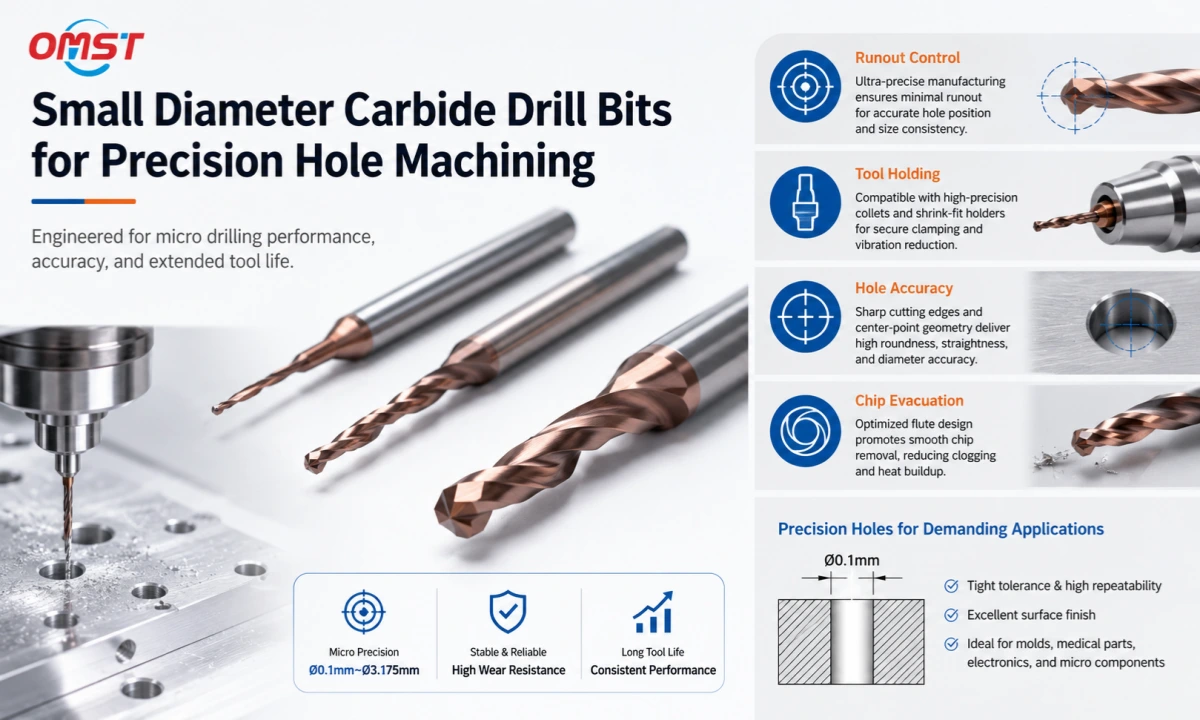
CNC Machine Condition and Cutting Stability
Even a good drill may not perform well if the machine condition is unstable. Donc, drill selection should also consider CNC machine rigidity, tenue de l'outil, liquide de refroidissement, et contrôle des copeaux.
Machine Rigidity and Tool Holding
Machine rigidity affects drilling stability. Tool holder runout also affects hole accuracy and drill life. This is especially important for small-diameter carbide drill bits.
Before selecting a drill, buyers should check machine condition, tool holder accuracy, and fixture stability.
Liquide de refroidissement, Air Blow, or Dust Removal
Coolant and chip control are important for metal drilling. For graphite drilling, dust removal may be more important than coolant.
Donc, buyers should explain whether the process uses coolant, air blow, coupe à sec, or dust collection. This information helps confirm drill geometry and coating selection.
Existing Tool Problems
If the current drill breaks, wears quickly, or produces poor hole quality, buyers should describe the problem. Photos of the worn tool, pièce à usiner, and hole condition can also help.
Common problems include:
- Fast edge wear
- Drill breakage
- Poor hole accuracy
- Bad surface finish
- Chip blockage
- Burrs or unstable hole exit
- Durée de vie courte
Custom Carbide Drill Bits for Special Applications
Standard carbide drill bits are useful for common applications. Cependant, custom carbide drill bits may be better for special machining requirements.
When Standard Drills Are Not Enough
Custom carbide drills may be needed for:
- Diamètre non standard
- Special hole depth
- Long flute design
- Small hole machining
- Special shank size
- Custom point geometry
- Revêtement spécial
- Marquage OEM
- Custom packaging
Dans ces cas, a custom tool can be designed according to the actual workpiece and machine condition.
Drawing-Based or Sample-Based Production
A drawing is helpful for non-standard carbide drill bits. If a drawing is not available, buyers can provide a sample, current tool photo, or detailed machining requirement.
The supplier can then evaluate the drill diameter, longueur de flûte, taille de la tige, longueur totale, revêtement, et géométrie.
OEM and Private Label Support
Pour les distributeurs, entreprises d'outillage, and industrial suppliers, OEM service may be needed. This can include laser marking, customer logo, marquage du modèle, étiquettes, boîtes en plastique, et emballage personnalisé.
If these requirements are needed, they should be confirmed before mass production.
Information Needed Before Quotation
To recommend the right carbide drill bits, the supplier needs enough application information. The more complete the details are, the more accurate the quotation and tool recommendation will be.
| Informations nécessaires | Pourquoi c'est important |
| Matériau de la pièce | Helps confirm carbide grade, revêtement, et géométrie |
| Dureté du matériau | Affects edge strength and coating selection |
| Diamètre du trou | Determines drill diameter and tool rigidity |
| Profondeur du trou | Affects flute length and chip evacuation |
| Trou traversant ou trou borgne | Affecte la conception des points et la stratégie de forage |
| Type de machine | Aide à évaluer la rigidité et l'état de maintien de l'outil |
| Coolant or dust removal condition | Affects chip control and tool performance |
| Dessin ou échantillon | Helps confirm non-standard tool dimensions |
| Quantité | Affects production planning, prix, et délai de livraison |
| Demande de marquage et d'emballage | Aide à confirmer les exigences OEM ou de marque privée |
Recommended Carbide Drill Bit Selection Summary
The table below gives a simple selection reference. It is only a general guide. The final carbide drill bit should still be selected according to the actual material, taille du trou, profondeur du trou, et état d'usinage.
| Matériau de la pièce | Objectif de sélection |
| Acier / acier allié | Résistance à l'usure, résistance à la chaleur, and stable cutting edge |
| Acier inoxydable | Contrôle de la chaleur, résistance des bords, et évacuation des copeaux |
| Fonte | Abrasive wear resistance and stable geometry |
| Aluminium / cuivre | Low friction, flux de copeaux, and reduced built-up edge |
| Graphite | CVD diamond coating and abrasive wear resistance |
| Pièces personnalisées | Drawing-based design and application review |
Outils de coupe en carbure associés
For general CNC drilling applications, voir notre Forets en carbure.
If you need graphite drilling tools, voir notre Foret revêtu de diamant.
For graphite milling and abrasive non-ferrous machining, voir notre Fraises en bout revêtues de diamant.
FAQ About Choosing Carbide Drill Bits
What is the best carbide drill bit for steel?
The best carbide drill bit for steel depends on the steel grade, dureté, hole diameter, profondeur du trou, état du liquide de refroidissement, et quantité de production. A wear-resistant coating and stable cutting geometry are often important for steel drilling.
Which carbide drill bit is better for stainless steel?
Pour l'acier inoxydable, the drill should support heat control, résistance des bords, et évacuation des copeaux. Buyers should provide the stainless steel grade, profondeur du trou, and coolant condition before selecting the drill.
Can carbide drill bits drill aluminum?
Oui, carbide drill bits can drill aluminum. Cependant, aluminum may create built-up edge or chip adhesion. Un design de flûte adapté, polished surface, low-friction coating, or uncoated carbide option may be considered according to the application.
When should I choose a diamond coated drill bit?
A diamond coated drill bit may be considered when drilling graphite or abrasive non-ferrous materials. For graphite drilling, CVD diamond coating can help improve wear resistance. The final choice should depend on graphite grade, taille du trou, état de la machine, et exigence de commande.
Can carbide drill bits be customized?
Oui. Carbide drill bits can be customized by drill diameter, longueur de flûte, diamètre de la tige, longueur totale, géométrie des points, revêtement, marquage, et emballage. Un dessin, échantillon, or detailed machining requirement is helpful.
What information is needed for a carbide drill bit quotation?
Veuillez fournir le matériau de la pièce à usiner, dureté, hole diameter, profondeur du trou, exigence de trou traversant ou de trou borgne, type de machine, état du liquide de refroidissement, dessin, quantité, et exigence d'emballage si disponible.
Conclusion
To understand how to choose carbide drill bits correctly, start with the workpiece material, not only the drill diameter. Acier, stainless steel, fonte, aluminium, cuivre, graphite, and custom parts all require different tool selection methods.
En outre, revêtement, géométrie des points, conception de flûte, profondeur du trou, état du liquide de refroidissement, rigidité de la machine, and order quantity should be reviewed before the final drill is selected.
Send your workpiece material, hole diameter, profondeur du trou, dessin, et la quantité. OMIST will help recommend suitable carbide drill bits, options de revêtement, and custom drilling tool solutions.