 Fraise de précision,Outils de coupe pour l’usinage CNC de chaque matériau

UN fraise latérale vs fraise en bout la décision ne consiste pas simplement à savoir quel outil peut couper une fente. Les deux outils peuvent usiner certaines fonctionnalités qui se chevauchent, mais ni l'un ni l'autre n'est automatiquement le meilleur choix.
Dans ce guide, une fraise latérale fait principalement référence à une fraise latérale ou latérale de type disque avec un alésage ou un montage sur arbre. Il ne s'agit pas simplement d'une fraise en bout effectuant un parcours d'outil de fraisage latéral..
Le choix pratique dépend de l’accès aux fonctionnalités, largeur requise, profondeur de coupe, atteindre, rigidité de la machine et du porte-outil, et si le travail nécessite une opération dédiée ou un processus CNC multi-opérations flexible.
Fraise latérale vs fraise en bout: Comparaison rapide
Utilisez ce tableau comme point de départ plutôt que comme règle de sélection absolue.
| Facteur | Fraise latérale | Fraise en bout |
|---|---|---|
| Structure typique | Coupeur à disque | Fraise à tige |
| Montage typique | Alésage / montage sur tonnelle | Porte-outil de fraise en bout |
| Points forts typiques | Rainures accessibles, machines à sous, épaules, et fonctionnalités latérales | Machines à sous, poches, profils, contours, et des fonctionnalités mixtes |
| Accès aux fonctionnalités fermées | Dépend fortement de l'accès latéral et du dégagement du couteau | Généralement plus adaptable |
| Machines à sous fermées | Généralement limité par l'accès et la géométrie de la fraise | Souvent le meilleur choix de départ |
| Stratégie de largeur | Fixé, choisi, réglable, ou personnalisé selon le design | Diamètre de l'outil plus parcours d'outil et compensation programmés |
| Flexibilité de configuration | Plus dépendant de la disposition des couteaux et de l'arbre | Généralement plus facile dans les flux de travail CNC mixtes |
| Point de départ | Dédié, fonctionnalité accessible sur le côté | Usinage CNC général ou mixte |
Lorsque l'on compare une fraise latérale par rapport à une fraise en bout, largeur de rainure, profondeur, longueur, accéder, état des machines, et la fréquence de fonctionnement affectent tous la décision. Les fraises latérales et les fraises en bout ont donc des applications qui se chevauchent plutôt qu'une simple relation « meilleur ou pire ».
Fraise latérale vs fraise en bout: Différences clés
1. Structure et montage de l'outil
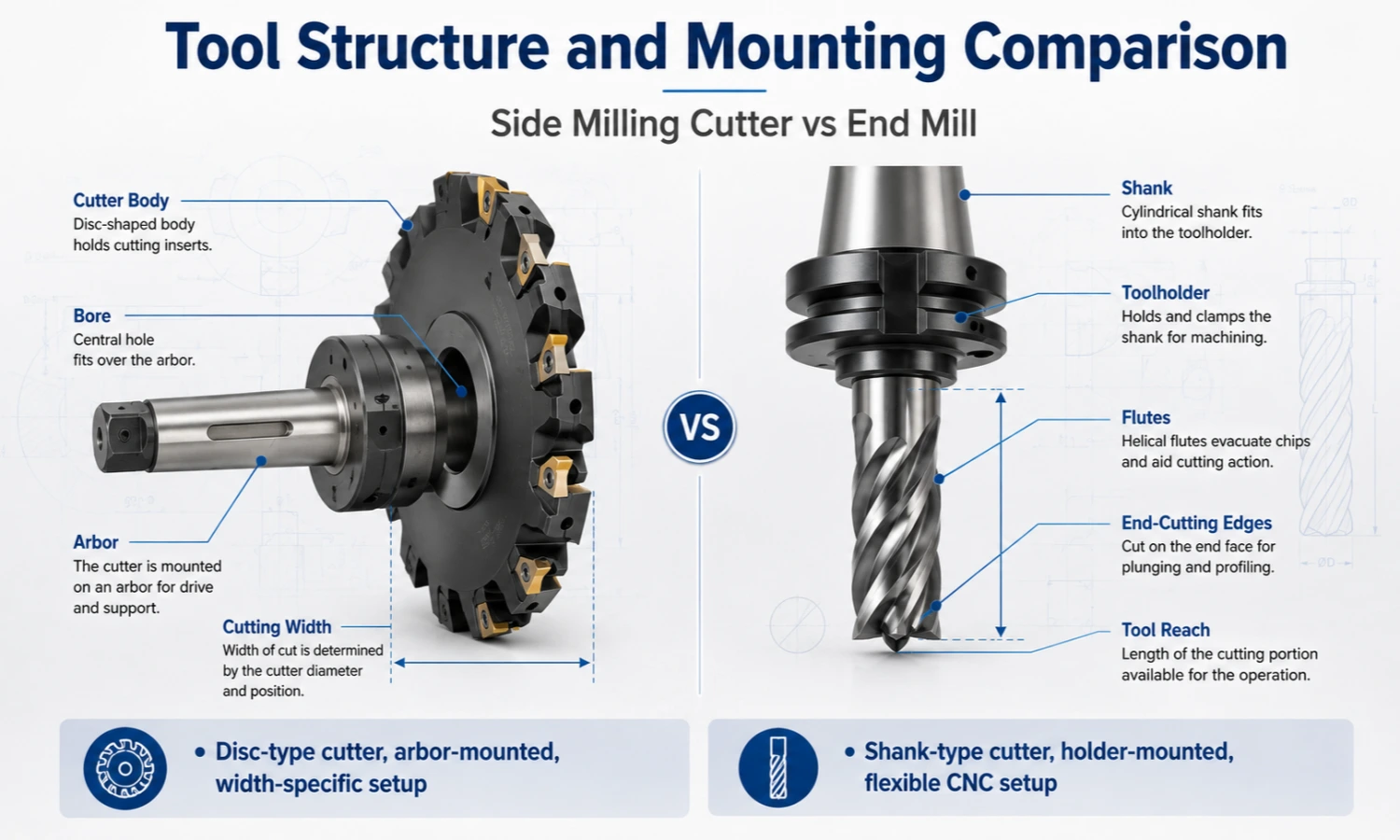
La différence la plus visible est la structure du couteau.
Une fraise latérale typique a un corps en forme de disque avec un alésage central. Il se monte sur un arbre ou une autre interface compatible. Par conséquent, diamètre de coupe, largeur de coupe, taille d'alésage, position de l'arbre, et le dégagement autour de la pièce à usiner peuvent tous affecter l'accès.
La gamme de produits de fraises latérales de CutterBest comprend des configurations indexables de type disque avec des corps de fraise et des inserts en carbure remplaçables. Alésage, largeur de coupe, disposition des insertions, et le montage peut également être révisé en fonction des exigences d'usinage réelles.
Une fraise en bout utilise une tige maintenue dans un porte-outil approprié. En fonction de la machine et de l'application, le système de maintien peut utiliser une pince, mandrin hydraulique, support rétractable, mandrin de fraisage, ou une autre interface compatible.
Donc, les fraises en bout montées sur queue s'adaptent généralement plus facilement aux flux de travail d'usinage CNC standard. Cependant, rigidité du support, s'épuiser, rallonge d'outil, et l'état de la broche influence toujours la stabilité de la coupe.
2. Open-Ended Grooves vs Closed-End Slots: Tool Access
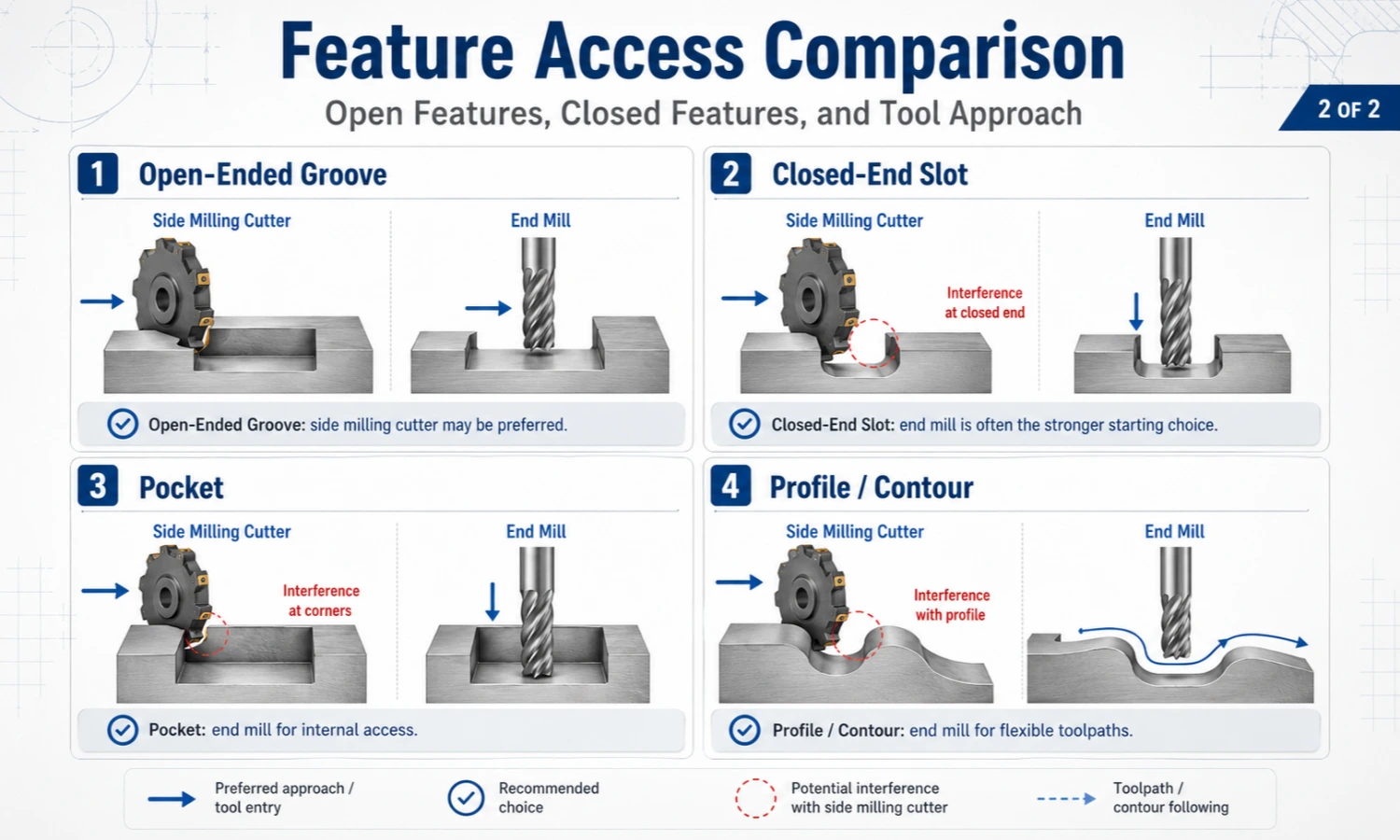
Tool access is often more important than the name of the machining operation.
For an open-ended or side-accessible groove, a disc-type side milling cutter may be a strong starting option. Cependant, the cutter body and arbor need sufficient clearance.
An open groove does not automatically require a side cutter. An end mill can also be practical when the setup favors vertical access, the feature is relatively accessible, or the same tool must perform other operations.
Closed-end slots create a different access condition. Depending on the feature and entry strategy, the tool may need end-cutting capability or a suitable ramping or helical-entry method.
Donc, une fraise en bout est généralement le meilleur choix de départ pour les rainures à extrémité fermée et les éléments fermés lorsque sa géométrie prend en charge la stratégie d'entrée et de coupe prévue. De la même manière, le guidage de fraisage de rainures de Sandvik distingue les applications à fente ouverte pour les fraises latérales et les applications à fente fermée qui nécessitent une solution de fraisage en bout..
3. Profondeur de coupe, Atteindre, Rigidité, et évacuation des copeaux
Une fraise à disque ne doit pas automatiquement être décrite comme rigide alors qu'une fraise en bout est décrite comme flexible.. La rigidité dépend du système d'usinage complet.
Pour une fraise latérale, les facteurs importants comprennent:
- diamètre de coupe;
- diamètre de l'arbre et support;
- position de coupe;
- porte-pièce;
- profondeur de rainure;
- état de la machine;
- évacuation des copeaux.
Pour une fraise en bout, considérer:
- diamètre de l'outil;
- longueur de flûte;
- portée globale;
- type de support;
- porte-à-faux de l'outil;
- couper l'engagement;
- rigidité de la machine et du montage.
Une fraise longue avec un porte-à-faux excessif peut dévier ou vibrer. D'autre part, un arbre mal soutenu ou une configuration de coupe-disque inadaptée peut également perdre en stabilité.
Donc, une rainure profonde ou longue ne doit pas être automatiquement attribuée à l'un ou l'autre outil. Comparer les accès, atteindre, support de coupe, porte-pièce, et retrait des copeaux avant de prendre la décision. Porte-à-faux d'outil, rigidité, forces de coupe, déviation, vibration, et l'évacuation des copeaux sont autant de considérations pertinentes dans le fraisage de rainures..
4. Stratégie de largeur de rainure, Contrôle, et répétabilité
La largeur de rainure est un facteur de sélection important, mais cela nécessite une comparaison minutieuse.
Une fraise latérale peut être sélectionnée avec une largeur de coupe adaptée à la largeur de rainure cible. Selon la conception du coupeur, la largeur peut être fixe, réglable, configuré par insertion, basé sur des espaceurs, ou fabriqué selon une spécification personnalisée.
Cependant, la largeur réglable n'est pas une caractéristique universelle de chaque coupe-disque. Les systèmes de fraisage de rainures spécifiques montés sur arbre sont conçus avec des largeurs de coupe réglables, tandis que d'autres découpeurs utilisent une configuration fixe ou spécifique à l'application.
Avec une fraise en bout, la caractéristique peut être usinée en une seule passe ou avec plusieurs passes programmées, en fonction du diamètre de l'outil et de la largeur de fente requise.
Les dimensions finales peuvent également être affectées par:
- s'épuiser;
- déviation de l'outil;
- usure des outils;
- positionnement des machines;
- porte-pièce;
- compensation de coupe.
Donc, la largeur de la fraise ne garantit pas automatiquement la précision de la rainure finie.
Un couteau configuré autour de la largeur cible peut simplifier le contrôle de la largeur lors de certaines opérations répétées.. Cependant, les deux concepts d'outils peuvent produire des dimensions contrôlées lorsque le processus d'usinage complet est stable.
5. Fonctionnalités incluses, Poches, Profils, et parcours d'outils complexes
Les fraises en bout offrent généralement une plus grande flexibilité lorsque la pièce contient des caractéristiques fermées ou variées.
Les opérations typiques peuvent inclure:
- emplacements fermés;
- poches et cavités;
- fraisage latéral;
- profilage;
- contouring;
- fonctionnalités internes;
- plusieurs opérations compatibles dans un seul programme CNC.
La page actuelle des fraises en bout de CutterBest couvre également le rainurage, profilage, empocher, fraisage latéral, contouring, et finition comme des opérations typiques de fraisage en bout.
Cependant, toutes les géométries de fraises ne prennent pas en charge toutes les stratégies de coupe. Géométrie de coupe centrale, conception de flûte, diamètre, longueur de coupe, et les conditions d'usinage affectent si une fraise particulière peut plonger, rampe, interpoler, ou effectuer une découpe complète.
Pour disponible Fraise en bout choix, voir la page produit concernée.
6. Flexibilité de configuration, Répétabilité du processus, et besoins de production
Une configuration de fraisage latéral dédiée devient plus attrayante lorsque la même rainure accessible ou la même caractéristique latérale se répète au cours d'un cycle de production et que la configuration de la fraise correspond à la largeur requise., atteindre, et approche.
En revanche, une fraise en bout peut être plus pratique lorsque le programme CNC contient plusieurs types de fonctionnalités.
Par exemple, un outil approprié peut effectuer un rainurage compatible, fraisage latéral, empocher, ou des opérations de profilage sans introduire une autre configuration de coupe dédiée.
Cette polyvalence est l'une des raisons pour lesquelles les fraises en bout sont largement utilisées dans l'usinage CNC général..
Cependant, cela ne signifie pas que les fraises latérales appartiennent uniquement à la production de masse ou que les fraises en bout appartiennent uniquement au travail sur prototype.. Chaque outil peut être utilisé dans différents volumes de production. Le meilleur choix dépend si le travail bénéficie davantage d'un processus dédié ou d'une flexibilité d'usinage..
Quand une fraise latérale est-elle un bon choix de départ?
Répété, Rainures accessibles latéralement avec une largeur définie
Une fraise latérale mérite d'être envisagée lorsqu'une rainure est accessible depuis le côté et a une largeur cible clairement définie.
Cela devient plus pertinent lorsque la même fonctionnalité se répète au cours d'un cycle de production, car la configuration de la fraise peut être sélectionnée en fonction des exigences d'usinage..
Avant de choisir le cutter, vérifier:
- accès latéral;
- dégagement du corps de coupe;
- dégagement de l'arbre;
- profondeur de coupe;
- largeur requise;
- configuration de la machine.
Pour disponible fraise latérale configurations, voir la page produit concernée.
Caractéristiques latérales et épaules accessibles
Les couteaux latéraux et latéraux de type disque peuvent également convenir aux surfaces latérales accessibles, épaules, et des caractéristiques de marche lorsque la géométrie fournit suffisamment d'espace d'approche.
Cependant, L'usinage d'épaulements n'est pas automatiquement une application de coupe latérale. Fraises en bout, fraises à épauler indexables, et d'autres types de couteaux peuvent également convenir.
Donc, vérifier la géométrie requise à 90 degrés, atteindre, stabilité du mur, exigence de finition, et accès au cutter avant de faire la sélection.
Opérations d'usinage dédiées ou répétées
Une fraise dédiée peut devenir plus attractive lorsqu'une opération répétée bénéficie d'un diamètre spécifique, largeur de coupe, disposition de montage, ou géométrie de la fraise.
Dans cette situation, la question n'est pas seulement de savoir si une fraise en bout peut couper la fonctionnalité.
Plutôt, déterminer si une fraise dédiée peut faciliter le contrôle du processus d'usinage complet.
Pour changement de pièces ou opérations occasionnelles, la configuration supplémentaire peut offrir peu d'avantages. Pour une fonctionnalité répétée avec une géométrie stable, cependant, une configuration dédiée pourrait mériter un examen plus approfondi.
Quand une fraise en bout est-elle un bon choix de départ?
Machines à sous fermées, Poches, et fonctionnalités internes
Une fraise en bout constitue généralement un point de départ plus solide lorsque la fraise doit travailler à l'intérieur d'un élément fermé..
Une fente fermée nécessite une stratégie d'entrée appropriée et une capacité de coupe en bout. Une poche nécessite un mouvement interne de l'outil, tandis que d'autres fonctionnalités internes introduisent des restrictions supplémentaires d'accès et d'interférence.
Cela rend souvent les fraises en bout montées sur queue plus adaptables dans les configurations verticales des centres d'usinage CNC..
Profils, Contours, et géométrie complexe
Les familles de fraises en bout offrent également une grande flexibilité de parcours d'outil pour les profils et les contours..
Un programme CNC peut guider une fraise autour d'une géométrie externe ou interne plutôt que de s'appuyer sur l'approche à largeur fixe ou à accès latéral d'une fraise à disque..
Différentes géométries de fraises en bout répondent à différentes exigences de contournage. Cependant, une fraise à bout plat, fraise à bout sphérique, outil de nez de taureau, fraise conique, et les fraises à longue portée ne font pas le même travail simplement parce qu'elles appartiennent toutes à la famille des fraises en bout..
Usinage CNC flexible avec plusieurs opérations
Une fraise en bout devient particulièrement utile lorsqu'un outil approprié peut effectuer plusieurs opérations compatibles tout en répondant aux exigences d'usinage..
Par exemple, le processus peut inclure:
- rainurage;
- fraisage latéral;
- profilage;
- empocher.
Dans ce cas, une fraise en bout peut réduire les changements d'outils dédiés et simplifier le flux de travail CNC.
Cette flexibilité est particulièrement utile lorsque la pièce contient plusieurs caractéristiques plutôt qu'une rainure ou une caractéristique latérale répétée..
Fraise latérale ou fraise en bout par tâche d'usinage
Utilisez le tableau suivant comme point de départ pratique, pas une règle absolue.
| Tâche d'usinage | Choix de départ | Condition importante |
| Emplacement fermé | Fraise en bout | Nécessite une stratégie d’entrée et de coupe finale adaptée |
| Fonctionnalité de poche ou fermée | Fraise en bout | Parcours d'outils internes plus flexibles |
| Profil ou contour | Fraise en bout | Convient aux tracés de contour programmés |
| Ouvrir, rainure accessible sur le côté | Une fraise latérale peut être préférée | Confirmer le dégagement de l'arbre, largeur, et approche |
| Rainure répétée avec largeur cible contrôlée | Une fraise latérale peut être préférée | Dépend de la configuration et de la configuration du coupeur |
| Fente générale dans le travail CNC à fonctionnalités mixtes | Fraise en bout souvent préférée | Surtout lors de l'usinage de poches ou de profils |
| Surface latérale ou épaule | Cela dépend | Vérifier la géométrie, atteindre, stabilité du mur, et terminer |
| Rainure profonde ou longue | Cela dépend | Comparer les accès, surplomb, soutien, rigidité, et évacuation des copeaux |
| Géométrie de rainure personnalisée | Cela dépend | Un outillage dédié peut être envisagé si le processus le justifie |
Si l'exigence principale est une large surface plane ou de référence plutôt qu'une rainure, poche, ou fonctionnalité latérale, la question de sélection change. Consultez notre guide pour fraisage latéral vs fraisage de face pour cette comparaison.
Une fraise en bout peut-elle remplacer une fraise latérale?
Parfois, mais pas toujours.
Une fraise en bout peut remplacer une fraise latérale lorsqu'elle peut atteindre la fonction, générer la géométrie requise, et rencontrer les dimensions, stabilité, finition, et les exigences en matière de temps de cycle.
Cependant, le remplacement est une décision de processus, pas seulement une décision géométrique. En pratique, Le choix de la fraise latérale par rapport à la fraise en bout doit être basé sur la configuration d'usinage complète plutôt que sur la profondeur de rainure ou le type d'outil uniquement..
Considérer:
- largeur et profondeur de rainure;
- accès ouvert ou fermé;
- portée requise;
- rigidité de l'arbre ou du support;
- porte-pièce;
- évacuation des copeaux;
- répétition de la production;
- autres opérations sur la même pièce.
Si une fraise en bout nécessite une portée excessive ou un parcours d'outil inefficace, un couteau latéral dédié peut mériter d'être envisagé. D'autre part, si un coupe-disque crée des problèmes d'accès ou ajoute une configuration inutile, la fraise en bout peut rester la solution la plus pratique.
Comment choisir entre une fraise latérale et une fraise en bout
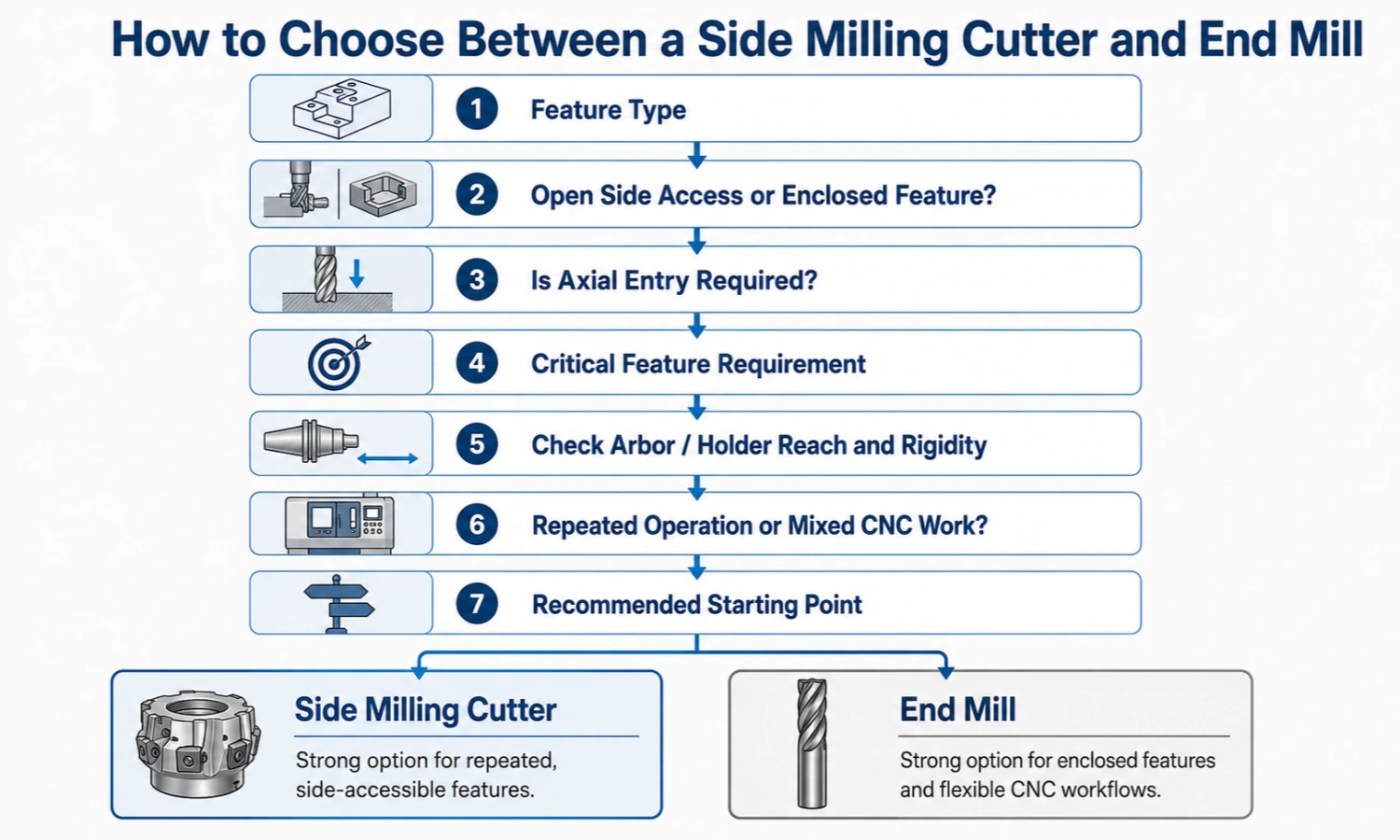
Étape 1: Identifiez la fonctionnalité
Commencez par le dessin, pas l'outil.
La caractéristique est-elle une rainure ouverte, emplacement fermé, poche, épaule, surface latérale, ou profil?
La géométrie des fonctionnalités permet de réduire immédiatement les options de coupe disponibles.
Étape 2: Vérifier l'accès à l'outil
Suivant, déterminer comment la fraise peut physiquement atteindre l'élément.
Demander:
- Un accès latéral est-il disponible ??
- Une entrée axiale est-elle requise?
- Y a-t-il suffisamment d'espace pour le corps de coupe?
- Y a-t-il suffisamment d'espace pour l'arbre ou le support?
- Le luminaire ou la pièce à travailler interférera-t-il avec la fraise?
Un outil de coupe qui ne peut pas s'approcher correctement de l'élément n'est pas une option pratique.
Étape 3: Identifier les exigences en matière de fonctionnalités critiques
Ne vous concentrez pas sur le type d'outil avant d'identifier ce qui compte le plus sur le dessin.
L'exigence critique peut inclure:
- largeur de rainure;
- profondeur;
- géométrie du mur;
- état des coins;
- finition;
- portée de l'outil;
- répétabilité;
- exigence de cycle.
Le concept de fraise doit prendre en charge la fonctionnalité qui contrôle la décision d'usinage.
Étape 4: Machine à vérifier, Porte-outils, et rigidité
Évaluer le système de coupe complet.
Pour une fraise latérale, revoir la tonnelle, alésage, position de coupe, interface machine, fixation, et dégagement disponible.
Pour une fraise en bout, type de titulaire d'avis, surplomb, longueur de coupe, diamètre, état de la broche, et maintien de la pièce.
Dans les deux cas, support stable et évacuation efficace des copeaux.
Étape 5: Pensez à la flexibilité de l'usinage et à la répétition de la production
Enfin, considérer comment l’opération s’intègre dans l’ensemble du processus de production.
Si la même fonctionnalité accessible latéralement est répétée au cours d'une exécution de production, une fraise latérale dédiée peut constituer une option de processus pratique.
Si la pièce change fréquemment ou si un outil CNC doit usiner plusieurs fonctionnalités compatibles, une fraise en bout peut offrir une plus grande flexibilité.
Le choix de départ doit correspondre à la pièce complète, machine, installation, et les exigences de production - pas simplement le coupeur avec la liste d'applications la plus longue.
FAQ
Une fraise en bout peut-elle être utilisée pour le fraisage latéral?
Oui. Les fraises en bout ont des arêtes de coupe périphériques et sont couramment utilisées pour le fraisage latéral. Cependant, engagement radial approprié, portée de l'outil, rigidité du support, géométrie de la flûte, et les conditions de coupe dépendent de l'application. Un porte-à-faux excessif ou une configuration instable peut augmenter la déflexion et les vibrations.
Une fraise en bout peut-elle remplacer une fraise latérale?
Parfois. Une fraise en bout peut être un remplacement pratique lorsqu'elle peut atteindre la fonction et répondre à la géométrie requise, qualité, stabilité, et temps de cycle. Un couteau latéral dédié peut toujours être judicieux lors de la coupe en largeur, accès latéral, montage, ou une opération répétée crée un cas de processus plus solide.
Quel coupeur est le meilleur pour les fentes et les poches fermées?
Une fraise en bout est généralement le meilleur choix de départ car elle peut fournir l'accès axial et interne requis lorsque la géométrie sélectionnée prend en charge la stratégie d'entrée et de coupe prévue.. Le choix final dépend toujours de la géométrie des entités, atteindre, et conditions d'usinage.
Quelle fraise est la meilleure pour les rainures profondes ou longues?
Ça dépend. Comparer l'accès aux rainures, diamètre de coupe, portée de l'outil, arbre ou support de support, rigidité de la machine, porte-pièce, et évacuation des copeaux. La profondeur de rainure à elle seule ne constitue pas une raison suffisante pour sélectionner automatiquement un type de fraise..
Une fraise latérale offre-t-elle toujours une meilleure précision de la largeur de fente?
Non. Un couteau configuré autour de la largeur cible peut simplifier le contrôle de la largeur dans certaines applications., mais la précision finale dépend toujours de l'état et de l'usure de la fraise, montage, s'épuiser, capacité de la machine, porte-pièce, déviation de l'outil, et conditions de coupe.
Le choix entre une fraise latérale et une fraise en bout commence par la fonctionnalité de la pièce et l'accès aux outils disponibles.. Si vous avez besoin d'aide pour examiner une candidature spécifique, envoie ton dessin, matériau de la pièce à usiner, dimensions de la rainure ou de la fente, tolérance, informations sur la machine, et les exigences de production pour sales@cutterbest.com pour un examen de la sélection des couteaux.