 Fraise de précision,Outils de coupe pour l’usinage CNC de chaque matériau

Ce 2 flûte contre 4 flûte contre 6 Le guide des fraises à cannelures explique comment le nombre de cannelures affecte l'espace des copeaux., taille typique du noyau, couper les contacts, potentiel d'alimentation, et finition de surface.
Utiliser deux cannelures lorsque le volume des copeaux est la principale contrainte. Choisissez quatre cannelures lorsque vous avez besoin d'un couteau polyvalent équilibré. Sélectionnez six cannelures lorsque l'engagement est contrôlé et que davantage de contacts de coupe permettent un fraisage latéral ou une finition stable..
Le choix final dépend également du matériau de la pièce à usiner, diamètre de coupe, profondeur de coupe, engagement radial, porte-à-faux de l'outil, état du titulaire, rigidité de la machine, et finition de surface requise.
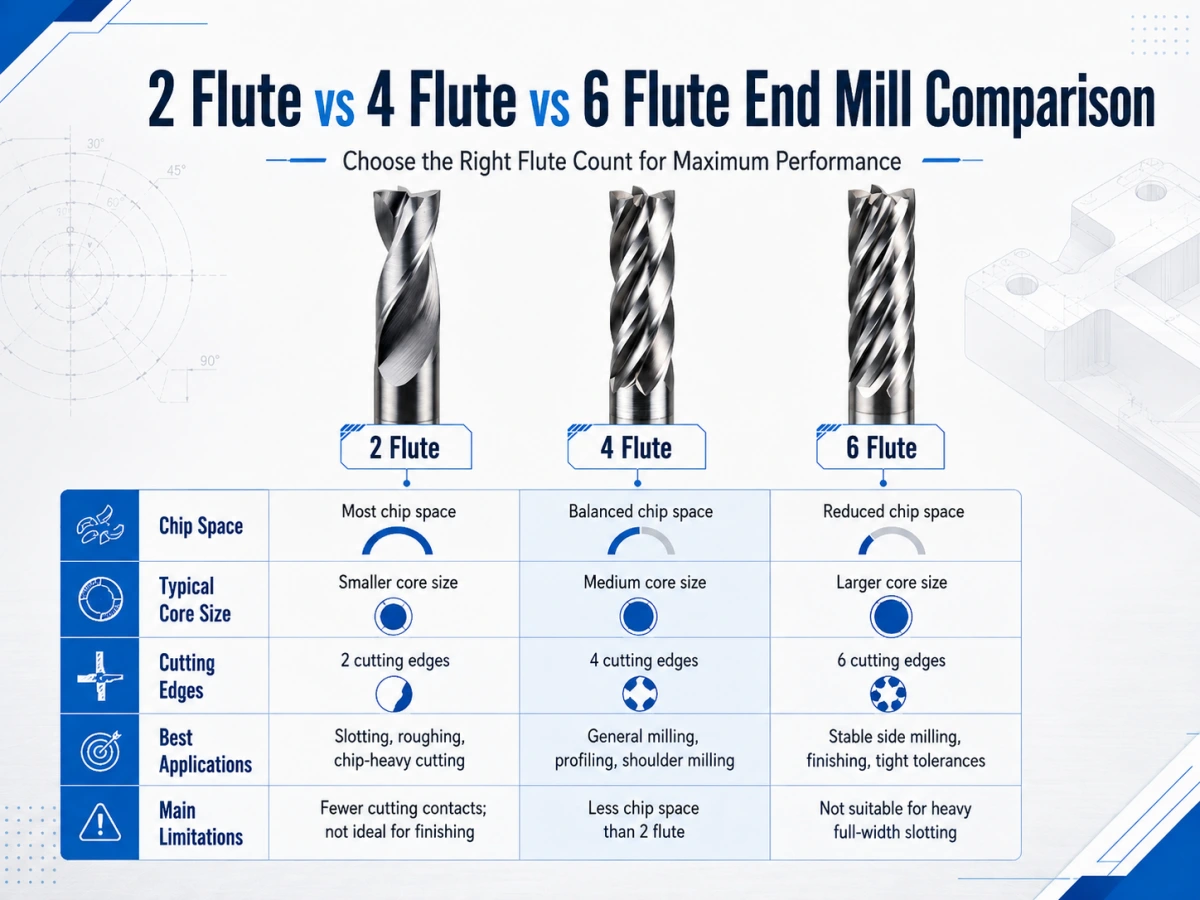
Rapide 2 Flûte vs 4 Flûte vs 6 Comparaison des fraises à flûte
| Comparaison | 2 Flûte | 4 Flûte | 6 Flûte |
|---|---|---|---|
| Espace de puce | La plupart | Équilibré | Réduit |
| Tranchants | 2 | 4 | 6 |
| Taille typique du noyau | Plus petit | Moyen | Plus grand |
| Application commune | Rainurage et découpe avec gros copeaux | Fraisage et profilage généraux | Fraisage latéral et finition stables |
| Principal avantage | Évacuation des copeaux plus facile | Équilibre de l'espace des puces et du nombre de bords | Plus de contacts coupants |
| Principale limite | Moins de contacts coupants | Moins d'espace pour les puces que 2 flûtes | Ne convient pas aux emplacements lourds sur toute la largeur |
Ce sont des orientations de conception typiques. Le diamètre réel du noyau et la rigidité de l'outil dépendent également de la profondeur de la cannelure, diamètre de coupe, angle d'hélice, longueur de flûte, diamètre du col, et la géométrie complète de l'outil.
Pourquoi le nombre de flûtes modifie les performances de coupe
Le nombre de flûtes modifie principalement trois parties du processus de coupe:
- Espace de puce
- Compte de pointe
- Taille typique du noyau
Une fraise avec moins de cannelures a normalement des rainures de flûte plus larges.. L'espace supplémentaire permet d'éloigner les copeaux plus gros d'une fente ou d'une poche avant qu'ils ne soient recoupés..
Ceci est particulièrement important dans le cas de l'aluminium, plastiques, et autres matériaux pouvant produire des copeaux volumineux ou continus. Lorsque les rainures des flûtes sont trop petites, les copeaux peuvent s'accumuler à l'intérieur de la zone de coupe, augmentation de la friction, chaleur, et risque de casse d'outils.
Une fraise avec plus de cannelures fournit plus de contacts de coupe à chaque tour de broche. Il peut prendre en charge des vitesses d'avance calculées plus élevées et une finition plus cohérente lorsque l'engagement est contrôlé..
Cependant, plus de flûtes laissent également moins de place aux chips. Donc, augmenter le nombre de cannelures sans revoir l'opération de coupe peut rendre les performances pires plutôt que meilleures.
Pour des explications détaillées sur la profondeur de la flûte, diamètre du noyau, angle d'hélice, pas inégal, et longueur de flûte, lisez notre guide de sélection des flûtes de fraise en bout.
Comment le nombre de flûtes affecte la vitesse d'alimentation
Le nombre de cannelures fait partie du calcul de l'avance:
Vitesse d'avance = RPM × Nombre de cannelures × Charge de copeaux par dent
Avec la même vitesse de broche et la même charge de copeaux par dent, l'augmentation du nombre de cannelures augmente la vitesse d'avance calculée.
Par exemple, un outil à 4 dents a deux fois plus de contacts de coupe par tour qu'un outil à 2 dents. Cependant, cela ne signifie pas que la vitesse d'avance réelle peut toujours être doublée.
L'augmentation réalisable est limitée par:
- Évacuation des copeaux
- Engagement des outils
- Puissance de broche
- Rigidité des machines
- Précision du support
- Serrage de la pièce
- Géométrie de l'outil
- Matériau de la pièce
Un plus grand nombre de cannelures ne crée pas une capacité d'alimentation illimitée. Commencez toujours par les paramètres recommandés pour la série d'outils spécifique., diamètre de coupe, matériel, et opération d'usinage.
À quoi sert une fraise en bout à 2 cannelures ??
Une fraise à 2 cannelures fournit deux arêtes de coupe et des rainures de cannelure relativement grandes. Cette conception donne aux copeaux plus d'espace pour quitter la zone de coupe.
Les outils à deux cannelures sont généralement sélectionnés pour:
- Usinage de l'aluminium
- Usinage du laiton et du cuivre
- Usinage du plastique
- Fentes pleine largeur
- Poches profondes
- Ébauche de matériaux tendres
- Opérations générant un volume de copeaux élevé
Pendant le placement sur toute la largeur, tout le diamètre de la fraise engage la pièce à usiner. Par conséquent, l'outil doit éliminer un grand volume de copeaux à travers les rainures des cannelures.
Une conception à 2 cannelures réduit le risque que les copeaux restent coincés dans une fente étroite. Cela peut aider à contrôler la chaleur, bord bâti, et recoupe de copeaux.
Cependant, deux cannelures offrent moins de contacts de coupe que quatre ou six cannelures. Donc, un outil à 2 dents peut avoir une vitesse d'avance et un potentiel de finition inférieurs pour la même vitesse de broche et la même charge de copeaux par dent.
Une conception à deux cannelures ne signifie pas non plus automatiquement que la fraise peut plonger directement dans la pièce à usiner.. Rampe, entrée hélicoïdale, ou une plongée limitée nécessite une géométrie de coupe centrale appropriée et un parcours d'outil compatible.
Voir standard et personnalisé 2 options de fraises à flûte.
Pour des applications plus détaillées, lire qu'est-ce qu'un 2 fraise en bout de cannelure utilisée pour.
Qu'en est-il des fraises à 3 cannelures pour l'aluminium ??
Les fraises à trois cannelures sont également largement utilisées pour l'aluminium et d'autres matériaux non ferreux..
Ils offrent un tranchant de plus qu'un couteau à 2 cannelures tout en conservant plus d'espace pour les copeaux que de nombreux modèles à 4 cannelures.. Donc, ils peuvent offrir un équilibre utile de:
- Évacuation des copeaux
- Rigidité de l'outil
- Potentiel d'alimentation
- Compte de pointe
- Finition superficielle
Choisissez deux cannelures lorsque le volume de copeaux est élevé, la poche ou la fente est profonde, ou l'évacuation des copeaux est difficile.
Choisissez trois cannelures pour le fraisage général de l'aluminium lorsque l'évacuation des copeaux est stable et que vous avez besoin de plus de contacts de coupe ou d'un potentiel de finition amélioré..
Arêtes de coupe tranchantes, surfaces de flûte polies, et un revêtement approprié à faible friction ou une surface non revêtue sont également importants lors de l'usinage de l'aluminium..
À quoi sert une fraise en bout à 4 cannelures ??
Une fraise à 4 cannelures offre un équilibre pratique entre l'espace des copeaux, compte de pointe, taille du noyau, et polyvalence générale de fraisage.
Les outils à quatre cannelures sont couramment utilisés pour:
- Usinage de l'acier au carbone
- Usinage des aciers alliés
- Fraisage général de l'acier inoxydable
- Fraisage latéral
- Fraisage d'épaulement
- Profilage
- Semi-finition
- Usinage CNC général
Comparé à un coupeur à 2 cannelures, un outil à 4 cannelures fournit plus de contacts de coupe par tour de broche. Il peut prendre en charge une vitesse d'avance calculée plus élevée lorsque la charge de copeaux par dent et les conditions de coupe restent adaptées..
Les cannelures supplémentaires réduisent également l'espace disponible pour les puces. Pour cette raison, une fraise à 4 cannelures n'est peut-être pas le premier choix pour les fentes profondes sur toute la largeur ou les poches en aluminium riches en copeaux.
Un outil à 4 dents peut toujours usiner l'aluminium pendant le fraisage latéral ou la finition légère lorsque:
- Les bords tranchants sont tranchants
- Les surfaces des flûtes sont lisses
- L'engagement radial est contrôlé
- L'air ou le liquide de refroidissement atteint la zone de coupe
- Les copeaux quittent la pièce de manière fiable
Pour rainures profondes en aluminium, 2-Les outils à cannelures ou à 3 cannelures offrent normalement plus d'espace pour les copeaux.
Pour l'acier et l'acier inoxydable, Le nombre de cannelures doit être pris en compte avec la géométrie du revêtement et du contrôle des vibrations.. Les conceptions à hélice variable ou à pas inégal peuvent aider à interrompre les forces de coupe répétitives lors du fraisage latéral et du profilage..
Le revêtement doit également correspondre à la qualité du carbure, matériau de la pièce à usiner, dureté, température de coupe, et état du liquide de refroidissement.
Voir standard et personnalisé 4 options de fraises à flûte.
À quoi sert une fraise en bout à 6 cannelures ??
Une fraise à 6 cannelures fournit six arêtes de coupe et plus de contacts de coupe par tour de broche.
De nombreux outils à 6 cannelures utilisent un noyau relativement gros. Cependant, la rigidité réelle dépend de la géométrie complète, y compris la profondeur de la flûte, diamètre de coupe, angle d'hélice, longueur de flûte, diamètre du col, et préparation des bords.
Les outils à six cannelures sont généralement sélectionnés pour:
- Fraisage latéral stable
- Engagement radial léger
- Profilage
- Semi-finition
- Finition
- Finition de l'acier trempé avec une série d'outils adaptée
- Applications nécessitant une qualité de surface constante
Une fraise à 6 cannelures fonctionne mieux lorsque le volume des copeaux est contrôlé et que la machine, titulaire, et la configuration de la pièce sont stables.
Parce que les rainures des flûtes sont plus petites, 6-les outils de flûte ne sont normalement pas le premier choix pour:
- Fentes profondes sur toute la largeur
- Poches lourdes
- Coupe en plongée agressive
- Opérations d'ébauche générant un volume de copeaux important
Six cannelures ne doivent pas être sélectionnées uniquement parce que la pièce est dure. La qualité du matériau, opération d'usinage, revêtement, nuance de carbure, engagement radial, précision du support, et l'évacuation des copeaux sont tout aussi importantes.
Fraises à six cannelures pour le fraisage à haute efficacité
Les outils à six dents et autres outils à plusieurs dents sont également utilisés dans le fraisage trochoïdal ou à haut rendement..
Ces parcours d'outils utilisent normalement:
- Engagement radial léger
- Engagement axial plus important
- Engagement contrôlé de la fraise
- Épaisseur de copeaux constante
- Mouvement fluide de l'outil dans les coins
Parce que l'engagement radial est réduit, chaque flûte enlève un petit éclat. Cela peut rendre pratique un nombre de cannelures plus élevé, même pendant les opérations d'enlèvement de matière..
Cependant, le fraisage à haute efficacité nécessite une fraise compatible, Stratégie de FAO, titulaire, machine, et paramètres de coupe. Un outil de finition standard à 6 dents ne doit pas être automatiquement utilisé pour chaque opération d'ébauche dynamique..
Les outils spécialisés peuvent utiliser sept cannelures ou plus pour un fraisage et une finition contrôlés à haute efficacité, mais ces conceptions sont en dehors des 2 flûtes principales, 4-flûte, et comparaison à 6 flûtes abordée dans ce guide.
Voir standard et personnalisé 6 options de fraises à flûte.
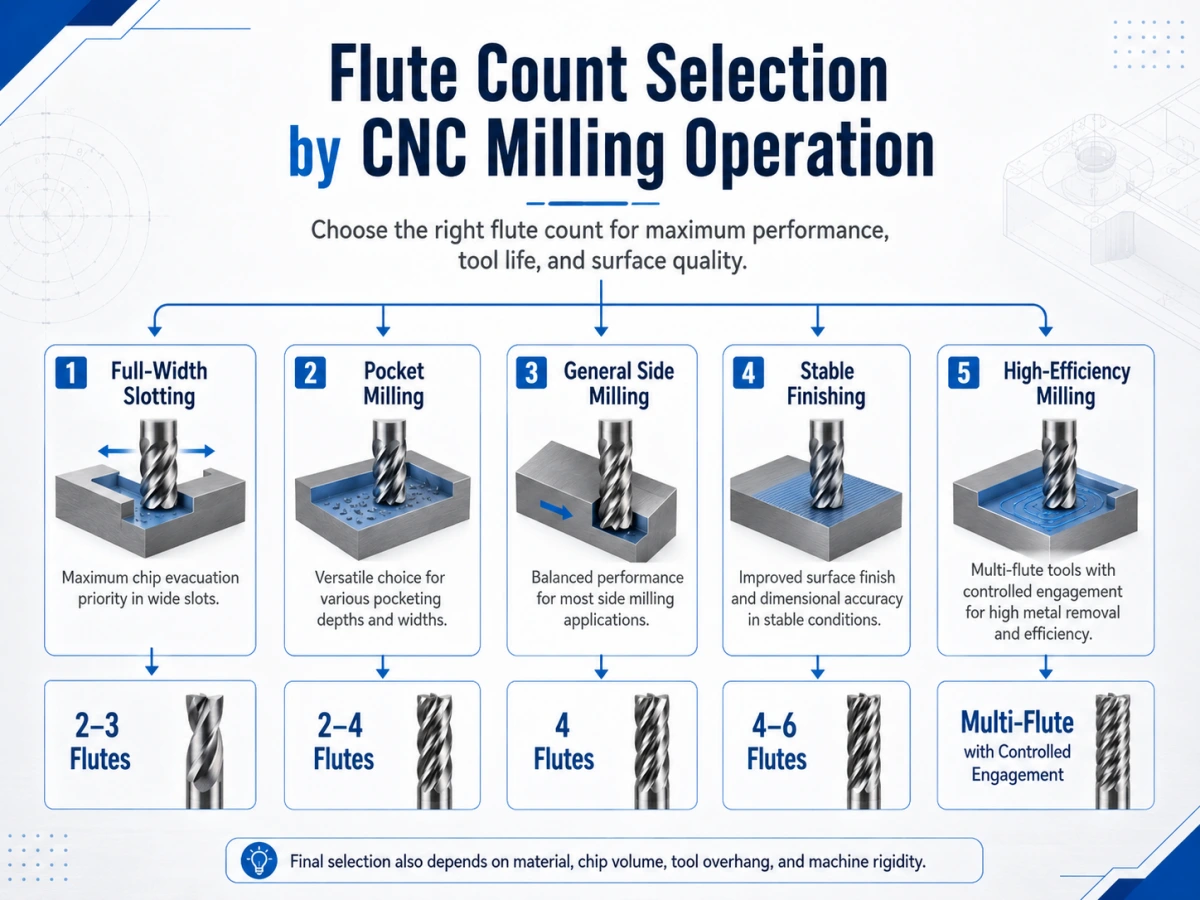
Comment choisir par opération de fraisage CNC
L'opération d'usinage fournit souvent une direction de sélection plus claire que le matériau seul.
Fentes pleine largeur
La fente sur toute la largeur crée un volume de copeaux élevé car le diamètre complet de la fraise engage la pièce à usiner.
Utilisez un nombre de flûtes inférieur lorsque:
- Les jetons sont gros
- La fente est profonde
- L’accès au liquide de refroidissement ou à l’air est limité
- L'emballage des copeaux a provoqué une panne d'outil précédente
Pour l'aluminium et autres matériaux non ferreux, 2-les outils de flûte fournissent une direction de sélection commune. Une fraise à 3 cannelures peut également bien fonctionner lorsque l'évacuation des copeaux reste stable.
Pour rainures en acier, 2-flûte, 3-flûte, ou des outils à 4 cannelures peuvent être utilisés en fonction de la profondeur de la fente, diamètre de coupe, série d'outils, rigidité de la machine, et conditions d'élimination des copeaux.
Un outil à 6 cannelures n'est généralement pas adapté aux rainures lourdes sur toute la largeur, car les rainures plus petites peuvent emprisonner les copeaux..
Fraisage de poche
Le fraisage de poches peut inclure une rampe, entrée hélicoïdale, coupe latérale, engagement de coin, et finition du bas.
Pour les matières douces et les poches profondes, un couteau à 2 cannelures offre plus d'espace pour les copeaux.
Un outil à 3 dents peut offrir un équilibre entre l'évacuation des copeaux et le potentiel d'avance lors de l'usinage général de poches en aluminium..
Un outil à 4 cannelures peut convenir aux poches moins profondes ou aux opérations de coupe latérale lorsque les copeaux peuvent quitter la cavité de manière fiable.
Lorsqu’une entrée axiale est requise, confirmer que l'outil a une géométrie de coupe centrale appropriée. Le nombre de flûtes à lui seul ne confirme pas la capacité de plongée.
Fraisage latéral et profilage
Le fraisage latéral utilise normalement moins d'engagement radial que le rainurage pleine largeur. Donc, 4-Les fraises à flûtes et à 6 cannelures deviennent plus pratiques.
Utilisez quatre cannelures comme direction équilibrée pour le fraisage latéral et le profilage général de l'acier..
Utilisez six flûtes lorsque:
- L’engagement radial est léger ou contrôlé
- Le support a un faible faux-rond
- Le porte-à-faux de l'outil est limité
- L'évacuation des copeaux est stable
- La configuration de la machine et de la pièce à usiner est rigide
- Plus de contacts de coupe prennent en charge la finition requise
La géométrie à hélice variable ou à pas inégal peut également contribuer à réduire les vibrations lors du fraisage latéral..
Ebauche
L'ébauche nécessite suffisamment d'espace de goujure pour le volume de copeaux attendu.
Utilisez une fraise à 2 cannelures pour dégrossir l'aluminium, plastiques, et autres applications où l'évacuation des copeaux est la principale contrainte.
Pour l'ébauche de l'acier, un 3 flûtes, 4-flûte, ou une fraise d'ébauche dédiée peut fournir un meilleur équilibre entre résistance des bords et enlèvement de matière.
Les fraises d'ébauche à géométrie dentée ou brise-copeaux divisent les copeaux en sections plus petites et peuvent réduire la résistance de coupe..
L'ébauche dynamique ou trochoïdale peut également prendre en charge un nombre de goujures plus élevé car l'engagement radial reste contrôlé.
Donc, ne sélectionnez pas le nombre de flûtes uniquement à partir du mot « ébauche ». Revoir le matériel, stratégie de coupe, fiançailles, volume de copeaux, et géométrie complète de l'outil.
Semi-finition et finition
La semi-finition et la finition utilisent normalement un engagement plus léger et se concentrent sur la précision dimensionnelle et la qualité de la surface..
Les outils à quatre cannelures fournissent une direction équilibrée pour de nombreuses opérations de finition générales.
Les fraises à six cannelures offrent plus de contacts de coupe et peuvent permettre une finition plus lisse lorsque:
- Les copeaux peuvent quitter la zone de coupe
- Le faux-rond est contrôlé
- Les bords de coupe sont tranchants et cohérents
- Le porte-à-faux de l'outil est court
- Le flux et l’engagement restent stables
Plus de cannelures ne peuvent pas corriger un tranchant usé, support inexact, luminaire instable, ou profil d'extrémité incorrect.
Sélection rapide par matériau de pièce
| Pièce à usiner et fonctionnement | Direction suggérée | Raison principale |
|---|---|---|
| Fentes en aluminium et poches profondes | 2 Flûtes | Espace maximum pour les puces |
| Fraisage général de l'aluminium | 2–3 Flûtes | Equilibre des contacts d'évacuation des copeaux et de coupe |
| Fraisage latéral en aluminium ou finition légère | 3–4 Flûtes | Plus de contacts de coupe lorsque le flux de copeaux est stable |
| Fraisage général de l'acier | 4 Flûtes | Équilibre entre l'espace des puces et le nombre de pointes |
| Rainurage en acier inoxydable | 3–4 Flûtes | Plus d'espace pour les chips et le contrôle de la chaleur |
| Fraisage latéral en acier inoxydable | 4–6 Flûtes | Plus de contacts coupants sous engagement contrôlé |
| Finition en acier trempé | 4–6 Flûtes | Potentiel de coupe et de finition stable |
| Plastiques et matériaux souples | 1–2 Flûtes | Évacuation des copeaux plus facile |
Bien que cet article se concentre sur les instruments à 2 flûtes, 4-flûte, et outils à 6 cannelures, d'autres comptes de flûtes sont également disponibles.
Par exemple, une fraise à 3 cannelures est importante dans l'usinage de l'aluminium, tandis qu'un coupe-flûte en O à une seule cannelure peut convenir à certains plastiques et matériaux souples.
Différentes opérations sur le même matériau peuvent également nécessiter un nombre de flûtes différent. Le rainurage pleine largeur en acier inoxydable et le fraisage latéral léger en acier inoxydable ne doivent pas automatiquement utiliser la même fraise..
Pour une sélection détaillée basée sur les matériaux, lire comment choisir une fraise en carbure.
Erreurs courantes de sélection du nombre de flûtes
En supposant que plus de flûtes soient toujours meilleures
Plus de cannelures fournissent plus d'arêtes de coupe, mais ils réduisent l'espace des puces.
Un nombre de cannelures plus élevé fonctionne mieux lorsque le volume et l'engagement des copeaux sont contrôlés.. Cela peut provoquer un tassement des copeaux lors des poches profondes et des fentes sur toute la largeur.
En supposant que plus de cannelures permettent proportionnellement plus d'alimentation
Un plus grand nombre de cannelures augmente la vitesse d'avance calculée lorsque le régime et la charge de copeaux par dent restent inchangés.
Cependant, l'augmentation réelle de l'alimentation est limitée par:
- Espace de puce
- Charge de coupe
- Puissance de broche
- Rigidité des machines
- Précision du support
- Stabilité de la pièce
N'augmentez pas l'alimentation uniquement en multipliant le rapport de nombre de flûtes. Commencez par les paramètres recommandés pour l'outil spécifique et ajustez-les en fonction de la formation des copeaux., charge de broche, son, qualité de surface, et l'usure des outils.
En utilisant 6 Flûtes pour rainures lourdes
Un outil à 6 cannelures a moins d'espace pour les copeaux que les modèles à 2 et 4 cannelures.
Lors d'un rainurage intensif sur toute la largeur, des copeaux peuvent rester à l'intérieur de la rainure et provoquer une nouvelle coupe, chaleur, dommages aux bords, ou casse d'outil.
En utilisant 4 Flûtes pour poches en aluminium à forte teneur en copeaux
Une fraise à 4 cannelures permet d'usiner l'aluminium, mais il se peut qu'il ne fournisse pas suffisamment d'espace pour les puces pour des poches profondes ou des emplacements pleine largeur.
Choisir 2 ou 3 flûtes lorsque l'évacuation des copeaux est difficile.
Sélection uniquement par matériau de pièce
Le matériel est important, mais l'opération change aussi le bon choix.
Un outil à 4 cannelures peut convenir au fraisage latéral de l'acier, tandis qu'un nombre de flûtes inférieur peut être meilleur pour une fente en acier profonde.
Ignorer le porte-à-faux et le faux-rond de l'outil
Un porte-à-faux excessif réduit la rigidité. Le faux-rond provoque une charge inégale entre les arêtes de coupe.
Un outil à 6 cannelures ne peut pas fournir une finition stable si un seul tranchant supporte la majeure partie de la charge de coupe..
En supposant que chaque fraise en bout à 2 cannelures est une coupe centrale
Le nombre de cannelures ne confirme pas la capacité de coupe centrale.
Vérifiez la géométrie de l'extrémité avant d'utiliser une fraise pour la plongée, rampe, ou entrée hélicoïdale.
FAQ
Une fraise en bout à 4 cannelures peut-elle couper de l'aluminium?
Oui. Une fraise en bout à 4 cannelures peut usiner l'aluminium pendant le fraisage latéral ou la finition légère lorsque l'outil a des arêtes de coupe tranchantes., surfaces de flûte lisses, et évacuation fiable des copeaux.
Pour poches profondes et fentes sur toute la largeur, une fraise à 2 ou 3 cannelures offre normalement plus d'espace pour les copeaux.
Quand dois-je choisir 3 Flûtes au lieu de 2 Flûtes pour aluminium?
Choisissez trois cannelures lorsque l'évacuation des copeaux reste fiable et que vous avez besoin de plus de contacts de coupe, une plus grande rigidité, potentiel de vitesse d'alimentation plus élevé, ou des performances de finition améliorées.
Choisissez deux cannelures lorsque le volume de copeaux est élevé, la poche ou la fente est profonde, ou l'évacuation des copeaux est difficile.
Une fraise à 6 cannelures est-elle uniquement destinée à la finition?
No. Une fraise en bout à 6 cannelures peut également effectuer un fraisage latéral contrôlé, profilage, semi-finition, et certaines opérations de broyage à haut rendement.
Cependant, ce n'est normalement pas le premier choix pour l'ébauche lourde ou le rainurage profond sur toute la largeur, car l'espace pour les copeaux est limité.
Quel nombre de flûtes est le meilleur pour le rainurage pleine largeur?
Utilisez un nombre de cannelures inférieur lorsque l'emplacement sur toute la largeur crée un volume de copeaux élevé.
Deux ou trois cannelures sont courantes pour l'aluminium. Les fentes en acier peuvent utiliser deux, trois, ou quatre cannelures selon la profondeur de la fente, diamètre de coupe, rigidité de la machine, et livraison de liquide de refroidissement.
Un nombre de cannelures plus élevé permet-il une vitesse d'avance plus élevée?
Avec la même vitesse de broche et la même charge de copeaux par dent, un nombre de cannelures plus élevé augmente la vitesse d'avance calculée.
L'avance réelle dépend toujours de l'évacuation des copeaux, charge de coupe, puissance de broche, précision du support, géométrie de l'outil, et rigidité de la machine.
Une fraise en bout à 2 cannelures peut-elle plonger?
Certaines fraises à 2 cannelures prennent en charge la rampe, entrée hélicoïdale, ou plongée limitée.
La fraise doit avoir une géométrie de coupe centrale appropriée, et la méthode de saisie programmée doit correspondre à la conception de l'outil et au matériau de la pièce à usiner..
Guides de fraises connexes
Pour des comparaisons plus détaillées et des informations de sélection, visite:
Guide de sélection des flûtes de fraise en bout
4 flûte contre 6 fraise à cannelure
Guide de sélection des fraises en bout
Comment choisir une fraise en carbure
Besoin d'aide pour choisir le bon nombre de flûtes?
Envoyez-nous votre dessin, modèle d'outil, matériau de la pièce à usiner, ou problème d'usinage actuel. Avec 16 années d'expérience dans la fabrication d'outils de coupe, nous pouvons examiner les informations disponibles et vous aider à confirmer une direction de fraise standard ou personnalisée appropriée.
Consultez nos standards et nos personnalisés page produit de la fraise en bout
Pour discuter de votre candidature, envoyez-nous un e-mail à sales@cutterbest.com.