 精密フライスカッター,あらゆる材料を加工するCNC用の切削工具

これ 2 フルート対 4 フルート対 6 flute end mill guide explains how flute count affects chip space, typical core size, cutting contacts, feed-rate potential, そして表面仕上げ.
Use two flutes when chip volume is the main constraint. Choose four flutes when you need a balanced general-purpose cutter. Select six flutes when engagement is controlled and more cutting contacts support stable side milling or finishing.
The final choice also depends on the workpiece material, カッター径, 切込み深さ, ラジアルかみ合い, 工具オーバーハング, ホルダーの状態, 機械剛性, および必要な表面仕上げ.
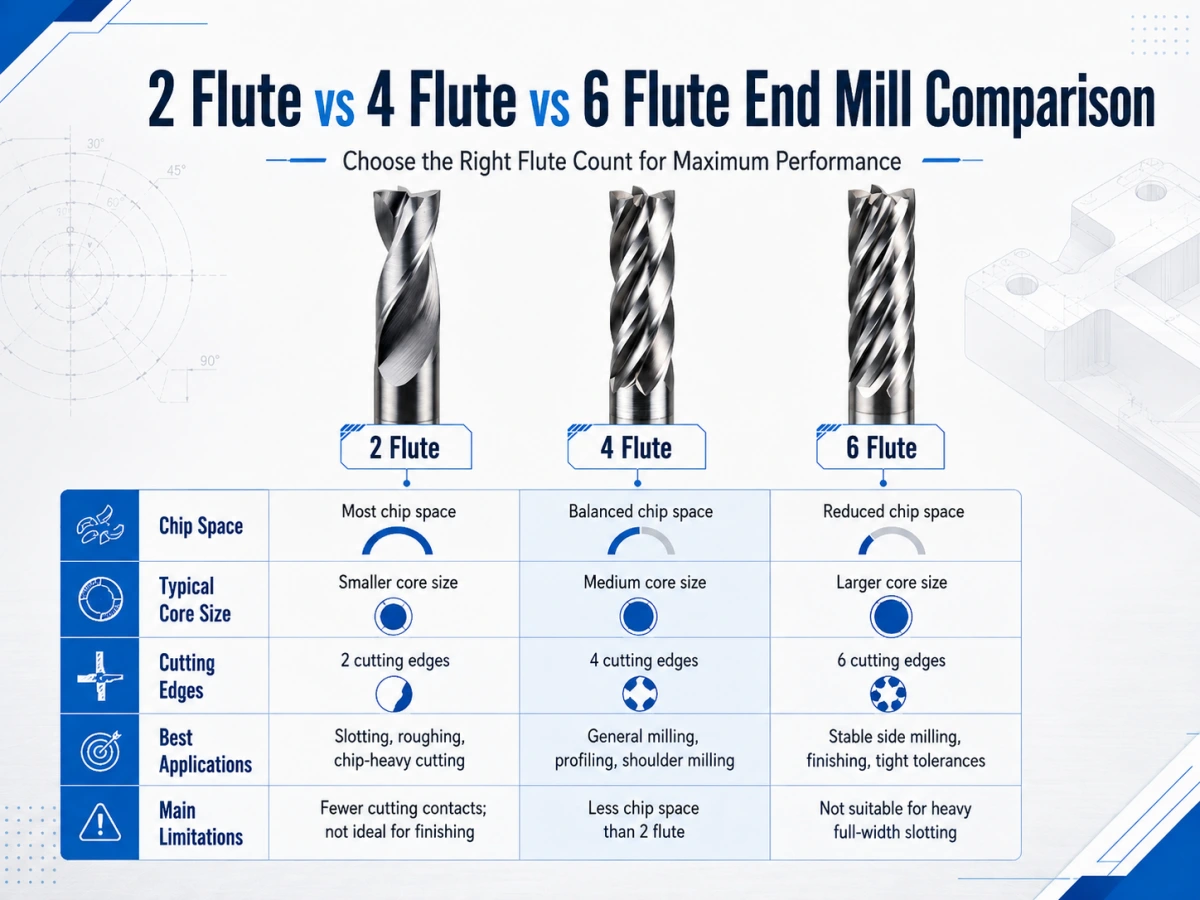
Quick 2 フルートvs 4 フルートvs 6 フルートエンドミルの比較
| Comparison | 2 フルート | 4 フルート | 6 フルート |
|---|---|---|---|
| チップスペース | Most | Balanced | Reduced |
| 刃先 | 2 | 4 | 6 |
| Typical Core Size | より小さい | Medium | Larger |
| 共通アプリケーション | Slotting and chip-heavy cutting | General milling and profiling | Stable side milling and finishing |
| 主な利点 | 切りくず排出が容易 | チップスペースとエッジ数のバランス | さらなる切断コンタクト |
| 主な制限事項 | Fewer cutting contacts | Less chip space than 2 フルート | Not suitable for heavy full-width slotting |
These are typical design directions. Actual core diameter and tool rigidity also depend on flute depth, カッター径, ねじれ角, 刃の長さ, 首の直径, and the complete tool geometry.
Why Flute Count Changes Cutting Performance
Flute count mainly changes three parts of the cutting process:
- チップスペース
- 最先端のカウント
- Typical core size
刃数が少ないカッターは通常、より広い刃溝を持っています. The additional space helps carry larger chips away from a slot or pocket before they are re-cut.
This is especially important in aluminum, プラスチック, and other materials that can produce large or continuous chips. When the flute grooves are too small, chips may pack inside the cutting zone, increasing friction, 熱, and tool-breakage risk.
A cutter with more flutes provides more cutting contacts during each spindle revolution. It can support higher calculated feed rates and more consistent finishing when engagement is controlled.
しかし, more flutes also leave less room for chips. したがって, increasing the flute count without reviewing the cutting operation can make performance worse rather than better.
For detailed explanations of flute depth, コア径, ねじれ角, unequal pitch, and flute length, 私たちのを読んでください エンドミル刃選択ガイド.
刃数が送り速度に与える影響
Flute count is part of the feed-rate calculation:
送り速度 = RPM × 刃数 × 1 刃当たりの切りくず負荷
同じ主軸速度と刃当りの切りくず負荷において, increasing the number of flutes increases the calculated feed rate.
例えば, a 4-flute tool has twice as many cutting contacts per revolution as a 2-flute tool. しかし, this does not mean that the actual feed rate can always be doubled.
The achievable increase is limited by:
- 切りくず排出
- Tool engagement
- Spindle power
- 機械剛性
- ホルダー精度
- ワーククランプ
- 工具形状
- ワーク材質
More flutes do not create unlimited feed-rate capacity. Always begin with the recommended parameters for the specific tool series, カッター径, 材料, および機械加工作業.
What Is a 2-Flute End Mill Best For?
A 2-flute end mill provides two cutting edges and relatively large flute grooves. This design gives chips more space to leave the cutting zone.
Two-flute tools are commonly selected for:
- アルミ加工
- Brass and copper machining
- プラスチック加工
- 全幅スロッティング
- Deep pocketing
- Roughing soft materials
- Operations that generate a high chip volume
全幅スロッティング中, the entire cutter diameter engages the workpiece. 結果として, the tool must remove a large volume of chips through the flute grooves.
A 2-flute design reduces the risk of chips becoming trapped inside a narrow slot. This can help control heat, 構築されたエッジ, and chip re-cutting.
しかし, two flutes provide fewer cutting contacts than four or six flutes. したがって, a 2-flute tool may have lower feed-rate and finishing potential under the same spindle speed and chip load per tooth.
A two-flute design also does not automatically mean that the cutter can plunge directly into the workpiece. Ramping, ヘリカルエントリー, or limited plunging requires suitable center-cutting geometry and a compatible toolpath.
標準とカスタムを表示する 2 フルートエンドミルのオプション.
For more detailed applications, 読む とは何ですか 2 に使用されるフルートエンドミル.
What About 3-Flute End Mills for Aluminum?
Three-flute end mills are also widely used for aluminum and other non-ferrous materials.
They provide one more cutting edge than a 2-flute cutter while retaining more chip space than many 4-flute designs. したがって, they can offer a useful balance of:
- 切りくず排出
- 工具剛性
- Feed-rate potential
- 最先端のカウント
- 表面仕上げ
Choose two flutes when chip volume is high, the pocket or slot is deep, or chip evacuation is difficult.
Choose three flutes for general aluminum milling when chip removal is stable and you need more cutting contacts or improved finishing potential.
鋭い刃先, polished flute surfaces, and a suitable low-friction coating or uncoated surface are also important when machining aluminum.
What Is a 4-Flute End Mill Best For?
A 4-flute end mill offers a practical balance between chip space, 最先端のカウント, core size, and general milling versatility.
Four-flute tools are commonly used for:
- Carbon steel machining
- Alloy steel machining
- 一般的なステンレス鋼のフライス加工
- 側面フライス加工
- 肩削り加工
- プロファイリング
- 中仕上げ
- General CNC machining
Compared with a 2-flute cutter, a 4-flute tool provides more cutting contacts per spindle revolution. It can support a higher calculated feed rate when the chip load per tooth and cutting conditions remain suitable.
The additional flutes also reduce the available chip space. このため, a 4-flute cutter may not be the first choice for deep full-width slots or chip-heavy aluminum pockets.
A 4-flute tool can still machine aluminum during side milling or light finishing when:
- The cutting edges are sharp
- The flute surfaces are smooth
- Radial engagement is controlled
- Air or coolant reaches the cutting zone
- Chips leave the workpiece reliably
For deep aluminum slots, 2-flute or 3-flute tools normally provide more chip space.
鋼・ステンレス用, flute count should be considered together with coating and vibration-control geometry. Variable-helix or unequal-pitch designs can help interrupt repetitive cutting forces during side milling and profiling.
The coating should also match the carbide grade, ワーク材質, 硬度, 切断温度, そして冷却水の状態.
標準とカスタムを表示する 4 フルートエンドミルのオプション.
What Is a 6-Flute End Mill Best For?
A 6-flute end mill provides six cutting edges and more cutting contacts per spindle revolution.
Many 6-flute tools use a relatively large core. しかし, actual rigidity depends on the complete geometry, including flute depth, カッター径, ねじれ角, 刃の長さ, 首の直径, and edge preparation.
Six-flute tools are commonly selected for:
- Stable side milling
- Light radial engagement
- プロファイリング
- 中仕上げ
- 仕上げ
- Hardened steel finishing with a suitable tool series
- Applications requiring consistent surface quality
A 6-flute cutter works best when chip volume is controlled and the machine, ホルダー, and workpiece setup are stable.
Because the flute grooves are smaller, 6-flute tools are normally not the first choice for:
- 全幅の深い溝加工
- Heavy pocketing
- Aggressive plunge cutting
- Roughing operations that generate a large chip volume
Six flutes should not be selected only because the workpiece is hard. The material grade, 機械加工作業, コーティング, 超硬グレード, ラジアルかみ合い, ホルダ精度, and chip evacuation are equally important.
Six-Flute End Mills in High-Efficiency Milling
Six-flute and other multi-flute tools are also used in high-efficiency or trochoidal milling.
These toolpaths normally use:
- Light radial engagement
- Greater axial engagement
- Controlled cutter engagement
- Consistent chip thickness
- Smooth tool movement through corners
Because the radial engagement is reduced, each flute removes a smaller chip. This can make a higher flute count practical even during material-removal operations.
しかし, high-efficiency milling requires a compatible cutter, CAM戦略, ホルダー, 機械, および切断パラメータ. A standard 6-flute finishing tool should not automatically be used for every dynamic roughing operation.
Specialized tools may use seven or more flutes for controlled high-efficiency milling and finishing, but those designs are outside the main 2-flute, 4-フルート, and 6-flute comparison covered in this guide.
標準とカスタムを表示する 6 フルートエンドミルのオプション.
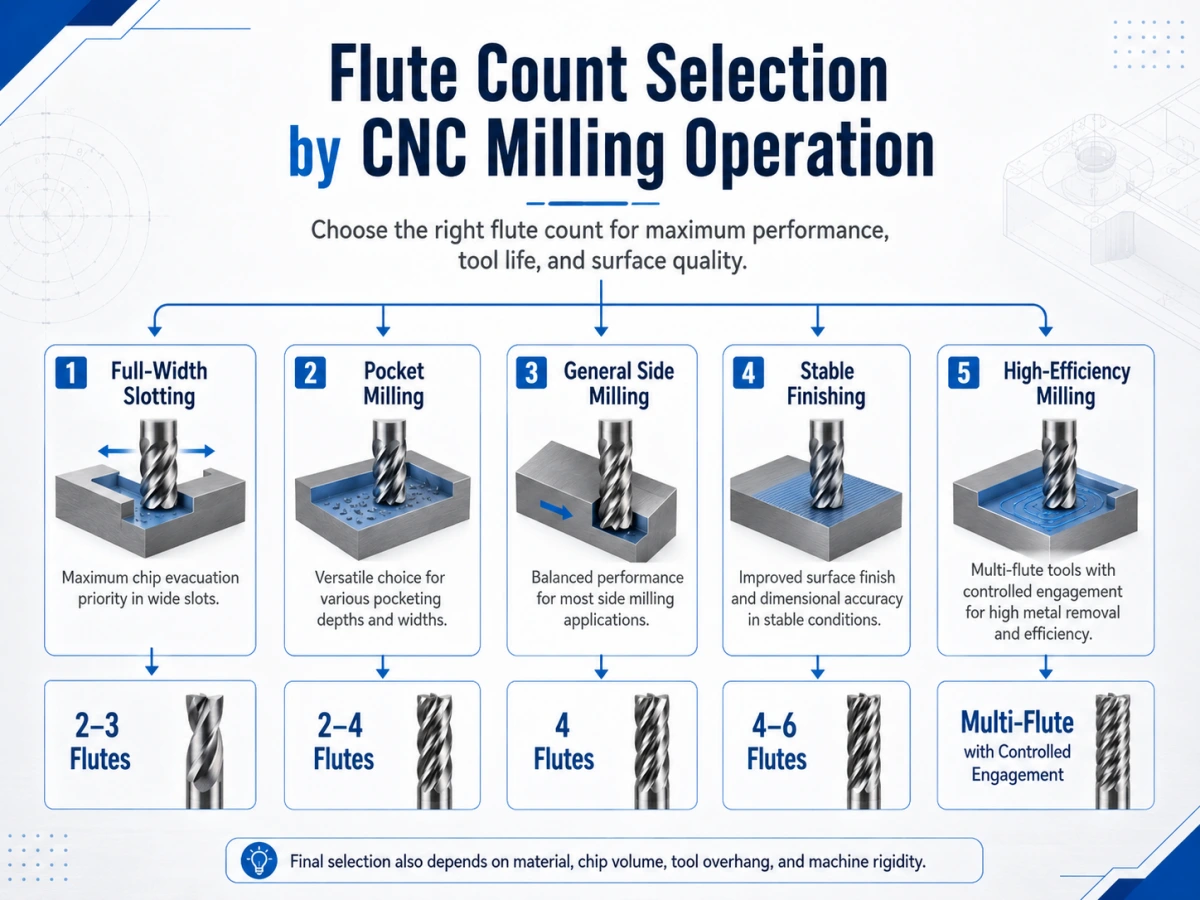
How to Choose by CNC Milling Operation
The machining operation often provides a clearer selection direction than the material alone.
全幅のスロット加工
Full-width slotting creates a high chip volume because the complete cutter diameter engages the workpiece.
Use a lower flute count when:
- Chips are large
- The slot is deep
- Coolant or air access is limited
- Chip packing has caused previous tool failure
For aluminum and other non-ferrous materials, 2-flute tools provide a common selection direction. A 3-flute cutter can also work well when chip evacuation remains stable.
鋼の溝加工用, 2-フルート, 3-フルート, or 4-flute tools may be used depending on slot depth, カッター径, tool series, 機械剛性, and chip-removal conditions.
A 6-flute tool is generally not suitable for heavy full-width slotting because the smaller flute grooves can trap chips.
ポケットミーリング
Pocket milling may include ramping, ヘリカルエントリー, サイドカット, コーナーエンゲージメント, そして底面仕上げ.
For soft materials and deep pockets, a 2-flute cutter provides more space for chips.
A 3-flute tool can offer a balance of chip evacuation and feed-rate potential during general aluminum pocketing.
A 4-flute tool may suit shallower pockets or side-cutting operations when chips can leave the cavity reliably.
When axial entry is required, confirm that the tool has suitable center-cutting geometry. Flute count alone does not confirm plunging capability.
側面フライス加工とプロファイリング
Side milling normally uses less radial engagement than full-width slotting. したがって, 4-flute and 6-flute cutters become more practical.
Use four flutes as a balanced direction for general steel side milling and profiling.
Use six flutes when:
- ラジアルエンゲージメントは軽いか制御されています
- The holder has low runout
- Tool overhang is limited
- Chip evacuation is stable
- The machine and workpiece setup are rigid
- More cutting contacts support the required finish
Variable-helix or unequal-pitch geometry can also help reduce chatter during side milling.
荒加工
Roughing requires enough flute space for the expected chip volume.
Use a 2-flute cutter for roughing aluminum, プラスチック, and other applications where chip evacuation is the main constraint.
For steel roughing, a 3-flute, 4-フルート, or dedicated roughing end mill may provide a better balance of edge strength and material removal.
Roughing end mills with serrated or chipbreaker geometry divide chips into smaller sections and may reduce cutting resistance.
Dynamic or trochoidal roughing can also support higher flute counts because radial engagement remains controlled.
したがって, do not select the flute count only from the word “roughing.” Review the material, 切断戦略, 婚約, チップ量, 完全な工具形状.
中仕上げと仕上げ
Semi-finishing and finishing normally use lighter engagement and focus on dimensional accuracy and surface quality.
Four-flute tools provide a balanced direction for many general finishing operations.
Six-flute cutters provide more cutting contacts and can support a smoother finish when:
- Chips can leave the cutting zone
- Runout is controlled
- Cutting edges are sharp and consistent
- Tool overhang is short
- Feed and engagement remain stable
More flutes cannot correct a worn cutting edge, inaccurate holder, unstable fixture, or incorrect end profile.
Quick Selection by Workpiece Material
| Workpiece and Operation | Suggested Direction | 主な理由 |
|---|---|---|
| Aluminum Slotting and Deep Pockets | 2 フルート | 最大チップスペース |
| General Aluminum Milling | 2–3フルート | Balance of chip evacuation and cutting contacts |
| Aluminum Side Milling or Light Finishing | 3–4フルート | More cutting contacts when chip flow is stable |
| 一般的な鋼フライス加工 | 4 フルート | Balance of chip space and cutting-edge count |
| ステンレス鋼の溝加工 | 3–4フルート | More room for chips and heat control |
| Stainless Steel Side Milling | 4–6フルート | More cutting contacts under controlled engagement |
| 硬化鋼仕上げ | 4–6フルート | Stable cutting and finishing potential |
| Plastics and Soft Materials | 1–2フルート | 切りくず排出が容易 |
Although this article focuses on 2-flute, 4-フルート, and 6-flute tools, other flute counts are also available.
例えば, a 3-flute end mill is important in aluminum machining, while a single-flute O-flute cutter may suit certain plastics and soft materials.
Different operations on the same material may also require different flute counts. Stainless steel full-width slotting and stainless steel light side milling should not automatically use the same cutter.
より詳細な材質選定をしたい場合, 読む 超硬エンドミルカッターの選び方.
Common Flute Count Selection Mistakes
フルートは多ければ多いほど良いと仮定する
より多くの刃がより多くの切れ味を提供します, しかし、チップスペースが減少します.
A higher flute count works best when chip volume and engagement are controlled. It can cause chip packing during deep pockets and full-width slotting.
Assuming More Flutes Allow Proportionally More Feed
More flutes increase the calculated feed rate when RPM and chip load per tooth remain unchanged.
しかし, the actual feed increase is limited by:
- チップスペース
- 切削負荷
- Spindle power
- 機械剛性
- ホルダー精度
- Workpiece stability
Do not increase the feed only by multiplying the flute-count ratio. Begin with parameters recommended for the specific tool and adjust them according to chip formation, 主軸負荷, sound, 表面品質, and tool wear.
Using 6 Flutes for Heavy Slotting
A 6-flute tool has less space for chips than 2-flute and 4-flute designs.
During heavy full-width slotting, chips may remain inside the groove and cause re-cutting, 熱, エッジダメージ, または工具の破損.
Using 4 Flutes for Chip-Heavy Aluminum Pockets
A 4-flute cutter can machine aluminum, but it may not provide enough chip space for deep pockets or full-width slots.
選ぶ 2 又は 3 flutes when chip evacuation is difficult.
Selecting Only by Workpiece Material
素材は重要です, but the operation also changes the correct choice.
A 4-flute tool may suit steel side milling, while a lower flute count may be better for a deep steel slot.
Ignoring Tool Overhang and Runout
過剰なオーバーハングは剛性を低下させます. Runout causes uneven loading between cutting edges.
A 6-flute tool cannot provide stable finishing if one cutting edge carries most of the cutting load.
Assuming Every 2-Flute End Mill Is Center Cutting
Flute count does not confirm center-cutting capability.
Check the end geometry before using a cutter for plunging, ランピング, またはヘリカルエントリー.
FAQ
4枚刃エンドミルはアルミニウムを切断できますか?
はい. A 4-flute end mill can machine aluminum during side milling or light finishing when the tool has sharp cutting edges, smooth flute surfaces, and reliable chip evacuation.
For deep pockets and full-width slotting, a 2-flute or 3-flute cutter normally provides more chip space.
When Should I Choose 3 Flutes Instead of 2 Flutes for Aluminum?
Choose three flutes when chip evacuation remains reliable and you need more cutting contacts, greater rigidity, higher feed-rate potential, or improved finishing performance.
Choose two flutes when chip volume is high, the pocket or slot is deep, or chip evacuation is difficult.
Is a 6-Flute End Mill Only for Finishing?
No. A 6-flute end mill can also perform controlled side milling, プロファイリング, 中仕上げ, and certain high-efficiency milling operations.
しかし, it is normally not the first choice for heavy roughing or deep full-width slotting because chip space is limited.
Which Flute Count Is Best for Full-Width Slotting?
Use a lower flute count when full-width slotting creates a high chip volume.
Two or three flutes are common for aluminum. Steel slotting may use two, 三つ, or four flutes depending on slot depth, カッター径, 機械剛性, and coolant delivery.
Does a Higher Flute Count Allow a Higher Feed Rate?
同じ主軸速度と刃当りの切りくず負荷において, a higher flute count increases the calculated feed rate.
The actual feed rate still depends on chip evacuation, 切削負荷, spindle power, ホルダ精度, 工具形状, と機械剛性.
Can a 2-Flute End Mill Plunge?
Some 2-flute end mills support ramping, ヘリカルエントリー, または限定的な急落.
The cutter must have suitable center-cutting geometry, and the programmed entry method must match the tool design and workpiece material.
Related End Mill Guides
より詳細な比較と選択情報については、, 訪問:
End mill flute selection guide
Need Help Choosing the Right Flute Count?
あなたの図面を私たちに送ってください, ツールモデル, ワーク材質, or current machining problem. と 16 長年の切削工具製造経験, we can review the available information and help confirm a suitable standard or custom end mill direction.
当社の標準とカスタムをご覧ください エンドミルカッター製品ページ
アプリケーションについて話し合うには, までメールでお問い合わせください sales@cutterbest.com.