 정밀 밀링 커터,모든 재료를 가공하는 CNC용 절삭 공구

An end mill size chart helps you compare common metric, fractional inch, and decimal inch cutter diameters before choosing a tool. Cutting diameter is usually the first size to check, but it is not the only dimension that matters.
생크 직경, length of cut, 전체 길이, and tool reach may also affect whether a cutter fits the holder and can reach the required feature.
A common example is 6 mm versus 1/4 inch:
6 mm is not the same as 1/4 inch.
6 mm = approximately 0.2362″
1/4″ = 0.2500″ = exactly 6.35 mm
If a drawing, slot width, or finished dimension depends on cutter diameter, that 0.35 mm difference may matter.
End Mill Size Chart at a Glance
The end mill size chart below covers commonly referenced metric and inch diameters. It is designed for quick reference rather than as a complete list of every available standard or custom size.
Actual shank diameter, LOC, OAL, neck geometry, and other dimensions vary by tool series.
Common Metric End Mill Sizes
This table is useful when a drawing, CAM program, or purchase specification is given in millimeters.
| Metric Diameter | Exact Decimal Inch |
|---|---|
| 1 mm | 0.0394″ |
| 1.5 mm | 0.0591″ |
| 2 mm | 0.0787″ |
| 2.5 mm | 0.0984″ |
| 3 mm | 0.1181″ |
| 4 mm | 0.1575″ |
| 5 mm | 0.1969″ |
| 6 mm | 0.2362″ |
| 8 mm | 0.3150″ |
| 10 mm | 0.3937″ |
| 12 mm | 0.4724″ |
| 16 mm | 0.6299″ |
| 20 mm | 0.7874″ |
| 25 mm | 0.9843″ |
These are common reference diameters rather than a complete inventory list. 더 작게, intermediate, larger, and non-standard dimensions may also be available depending on the tool series.
Common Inch and Fractional End Mill Sizes
Fractional inch sizes remain common on US drawings and tooling specifications. Decimal values are useful when the size must be entered into CAM software or compared with metric dimensions.
| Fractional Inch | Decimal Inch | Exact Metric |
|---|---|---|
| 1/32″ | 0.03125″ | 0.7938 mm |
| 1/16″ | 0.06250″ | 1.5875 mm |
| 3/32″ | 0.09375″ | 2.3813 mm |
| 1/8″ | 0.12500″ | 3.1750 mm |
| 5/32″ | 0.15625″ | 3.9688 mm |
| 3/16″ | 0.18750″ | 4.7625 mm |
| 1/4″ | 0.25000″ | 6.3500 mm |
| 5/16″ | 0.31250″ | 7.9375 mm |
| 3/8″ | 0.37500″ | 9.5250 mm |
| 1/2″ | 0.50000″ | 12.7000 mm |
| 5/8″ | 0.62500″ | 15.8750 mm |
| 3/4″ | 0.75000″ | 19.0500 mm |
| 1″ | 1.00000″ | 25.4000 mm |
This table covers frequently referenced fractional sizes. It does not mean that these are the only inch end mill sizes available.
Small and Micro End Mill Sizes
Small-diameter tools need more attention than a simple diameter conversion.
이 가이드에서는, tools below 1 mm are treated as micro end mills for reference rather than as an absolute industry definition. For these cutters, 목 직경, 도달하다, 생크 크기, toolholding, 런아웃, and machine stability can become especially important.
In our end mill catalog, micro-diameter and deep-groove tools use additional dimensional fields such as Reach and Neck diameter. This is a good example of why cutting diameter alone may not fully describe a small cutter.
Metric to Inch End Mill Size Chart and Conversion
Use the end mill size chart above to identify the nominal diameter first, then check the exact conversion before choosing a nearby metric or inch tool.
Metric and inch dimensions can be converted accurately because:
1 inch = 25.4 mm
The calculation is simple. The more important question is whether a nearby commercial cutter can actually replace the specified size.
How to Read Metric, Fractional, and Decimal Sizes
Take a 1/4″ end mill as an example.
First convert the fraction to decimal inches:
1/4″ = 0.2500″
Then convert inches to millimeters:
0.2500 × 25.4 = 6.35 mm
에이 6 mm cutter converts in the opposite direction:
6 ÷ 25.4 = approximately 0.2362″
The numbers are close, but the tools do not have the same cutting diameter.
Nearby Metric and Inch Sizes: Do Not Assume They Are Equivalent
The following pairs are often compared because the dimensions are relatively close. The fractional values shown are common reference sizes from this chart, not the mathematically nearest fractional size among every inch tool available on the market.
| Metric Size | Nearby Common Fractional Reference | Fractional Size in mm | Diameter Difference* | Practical Effect if the Toolpath Is Unchanged |
|---|---|---|---|---|
| 3 mm | 1/8″ | 3.175 mm | +0.175 mm | Larger cutter may remove more material |
| 6 mm | 1/4″ | 6.350 mm | +0.350 mm | Larger cutter may overcut a controlled feature |
| 8 mm | 5/16″ | 7.9375 mm | −0.0625 mm | Smaller cutter may leave additional stock |
| 10 mm | 3/8″ | 9.525 mm | −0.475 mm | Smaller cutter may leave additional stock |
| 12 mm | 1/2″ | 12.700 mm | +0.700 mm | Larger cutter may remove more material |
| 16 mm | 5/8″ | 15.875 mm | −0.125 mm | Smaller cutter may leave additional stock |
| 20 mm | 3/4″ | 19.050 mm | −0.950 mm | Smaller cutter may leave additional stock |
| 25 mm | 1″ | 25.400 mm | +0.400 mm | Larger cutter may remove more material |
*Positive means the fractional cutter is larger than the metric cutter. Negative means it is smaller.
This table shows nominal diameter differences only. Actual machining results are also affected by tool compensation, 런아웃, 편향, 도구 마모, 프로그래밍된 도구 경로.
If the cutter diameter changes, update the tool definition and review the part tolerance before machining.
왜 6 mm Is Not the Same as 1/4 인치
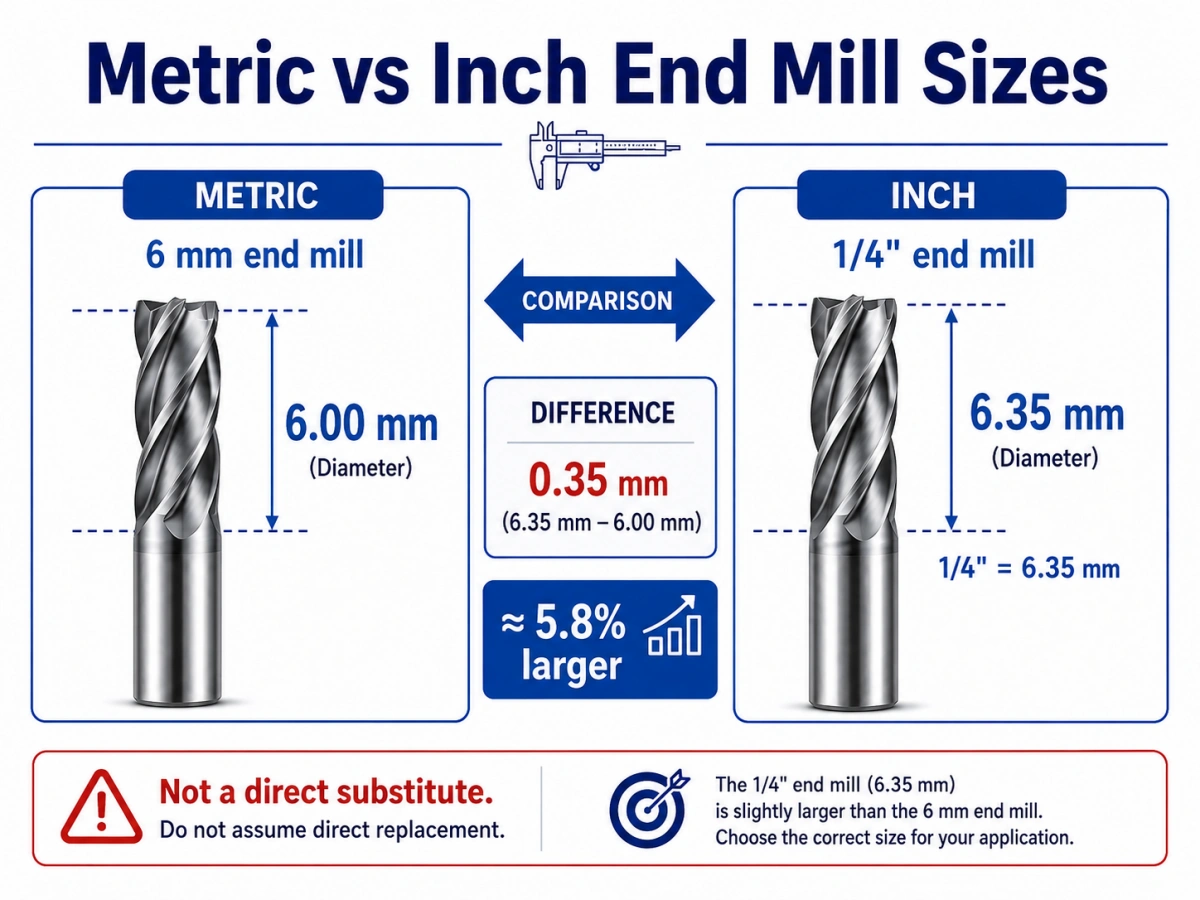
에이 6 mm end mill has a nominal cutting diameter of 6.000 mm. A 1/4″ cutter measures 6.350 mm.
The difference is 0.350 mm.
Imagine a slot that is programmed around a 6 mm 커터. If a 1/4″ tool is installed without updating the tool definition or machining strategy, the larger cutter can remove additional material.
For rough machining, a different available cutter may sometimes be evaluated by changing the toolpath and leaving suitable stock for later operations. For a finished slot, 벽, fit, or tolerance-controlled feature, the required dimension must be reviewed first.
What Does End Mill Size Mean?
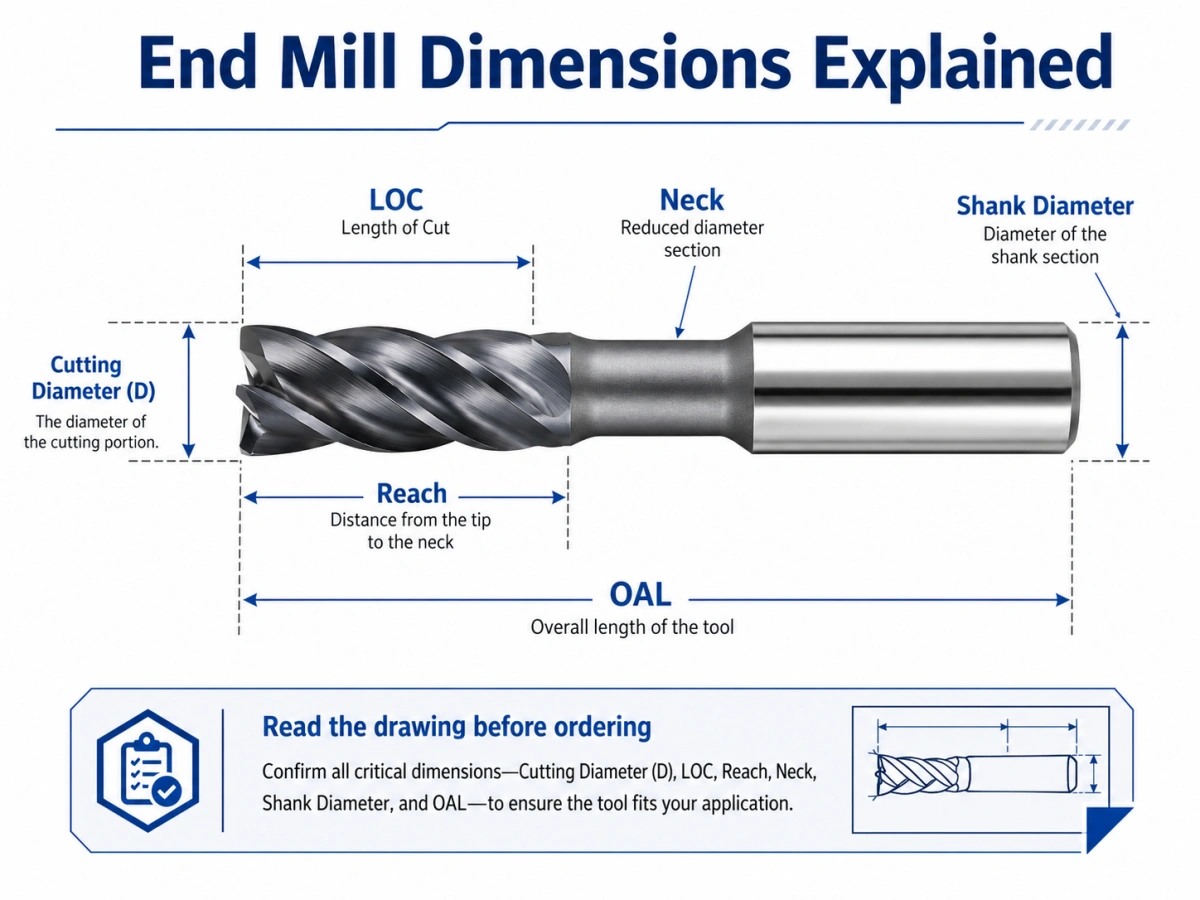
“End mill size” usually refers first to cutting diameter. A complete tool specification includes several dimensions, though.
Across our end mill catalog, dimensional tables use fields such as Cut D or R, LOC, 정강이, and OAL. Micro-diameter and long-reach series may also include Reach and Neck dimensions.
절단 직경 (디)
Cutting diameter is the nominal diameter defined by the cutter’s cutting edges as the tool rotates.
예를 들어, a D 6 end mill has a nominal cutting diameter of 6 mm.
This dimension affects slot width, access to small features, internal corner radius, 엄격, and material removal capability. It is normally the first dimension checked against the part drawing.
생크 직경 (d)
The shank is the section clamped by the collet or toolholder.
에이 6 mm cutting diameter does not guarantee a 6 mm shank on every tool. Necked, long-reach, miniature, and special cutters may use different cutting and shank diameters.
Check the actual shank specification before selecting the holder.
Length of Cut (LOC)
LOC is the axial length of the cutting-edge section.
The flute length needs to cover the required machining depth with suitable clearance. Choosing much more flute length than necessary may reduce tool rigidity.
LOC should not be confused with the recommended axial depth of cut in one pass. Machining depth depends on the cutter design, 공작물 재료, 도구 경로, 기계, 보유자, 및 절단 조건.
For more information about flute structure, 우리를 보아라 엔드밀 플루트 설계 및 선택 가이드.
전체 길이 (OAL) vs Tool Overhang
OAL is the complete physical length of the cutter.
공구 오버행, sometimes called stickout, is different. It is the length of the tool extending from the holder after setup.
예를 들어, two cutters can have the same OAL, but the operator may set different overhangs for each tool. Keeping unnecessary overhang short improves rigidity and helps reduce deflection and chatter.
Reach and Neck Diameter for Deep or Narrow Features
Some necked, deep-groove, and long-reach tool series include reach and neck dimensions.
Check the product drawing or specification table for the exact meaning, because manufacturers and tool series may label reach-related dimensions differently.
In practical terms, these fields help determine whether a cutter can access a deep or narrow area without the larger shank interfering with nearby walls.
Reach, LOC, OAL, and actual tool overhang are separate dimensions and should not be treated as interchangeable.
How to Read End Mill Dimensions
Consider a specification written as:
디 6 × LOC 15 × Shank 6 × OAL 50
It means:
| Dimension | 값 |
|---|---|
| 절단 직경 (디) | 6 mm |
| Length of Cut (LOC) | 15 mm |
| 생크 직경 | 6 mm |
| 전체 길이 (OAL) | 50 mm |
This example makes the main dimensions easy to identify.
Do not rely only on the order of four numbers, though. Manufacturers may arrange dimensions differently. Read the labeled drawing or specification fields before ordering or programming the cutter.
Can Metric and Inch End Mills Be Interchanged?
An end mill size chart can help identify nearby metric and inch cutters, but a nearby size is not automatically a direct replacement.
Three checks matter most: 절단 직경, shank compatibility, and part tolerance.
Match Cutting Diameter to the Part Feature
For a slot, cutter diameter is closely related to the required width.
For a pocket, a larger cutter can provide useful rigidity and material removal, but it still has to enter every required area.
Internal corners impose another limit. Because an end mill leaves an internal radius, the cutter must be small enough to create the required corner geometry.
Fine details may require a smaller diameter. 동시에, smaller cutters are more sensitive to deflection, 런아웃, and unstable setups.
Match the Actual Shank to the Collet or Toolholder
Do not decide holder compatibility only by calling a tool “metric” or “inch.”
대신에, 비교하다:
- Actual shank diameter
- Collet or holder nominal size
- Manufacturer-specified clamping range
- Required clamping length
- Tool condition and holder condition
예를 들어, a 1/4″ shank measures 6.35 mm. 에이 6 mm collet should not be assumed to clamp it safely unless the collet manufacturer specifically allows that diameter.
Check Tolerance Before Replacing a Nearby Size
A small diameter difference can still affect a finished feature.
If a different cutter is being considered, check the drawing tolerance, remaining stock, finishing allowance, tool compensation, 프로그래밍된 도구 경로.
For a controlled final dimension, update the tool information rather than treating a nearby metric or inch size as an invisible substitution.
How to Choose the Right End Mill Size
The chart narrows the possible diameters. The part geometry then determines which size can actually be used.
Choose a Diameter That Fits the Feature
For a slot, begin with the target slot width.
For a pocket, choose a cutter that can enter the narrowest required region. A larger tool may be more rigid, while a smaller tool provides better access to detailed geometry.
Internal corner requirements also limit cutter diameter because the tool creates a radius rather than a perfectly sharp inside corner.
The best diameter is not simply the largest tool that fits the machine. It must fit the part.
Use the Shortest Practical LOC
Choose an LOC that covers the required cutting depth with reasonable margin instead of automatically selecting the longest flute option.
A shorter cutting section generally provides a more rigid tool structure.
Deep cavities may require a necked or long-reach design. In that case, review the complete geometry rather than simply choosing a standard cutter with very long flutes.
Minimize Unnecessary Tool Overhang
Keep the actual overhang as short as practical.
Extra extension can increase:
- 공구 편향
- 끽끽 우는 소리
- 차원 변화
- 표면 마감 불량
- Tool breakage risk
There is no single overhang-to-diameter rule that applies to every job. 공작물 재료, 커터 기하학, holder rigidity, 도구 참여, and machine condition all affect the result.
Confirm Shank and Holder Compatibility
Before loading the tool, confirm that the holder can clamp the actual shank correctly.
Once the basic dimensions are confirmed, 재료, 플루트 수, 코팅, and cutter geometry can be selected separately.
For the complete selection process, 읽다 how to choose the right end mill.
After Confirming the Size: Choose the Tool Type
Diameter and length do not define the complete cutter. The end profile also needs to match the machining operation.
| 도구 유형 | 일반 선발 방향 |
|---|---|
| 정사각형 / 플랫엔드밀 | Flat-bottom slots, 주머니, 어깨, 그리고 프로파일링 |
| 볼 노즈 엔드밀 | 곡면, 금형, 그리고 3D 컨투어링 |
| 코너 반경 / 불 노즈 엔드밀 | Applications that benefit from a strengthened cutting corner |
| 러핑엔드밀 | Higher stock removal before finishing |
This is only a quick next-step reference. For a fuller comparison, 보다 end mill cutter types.
Standard vs Custom End Mill Sizes
Common standard end mill sizes in metric and inch systems cover many CNC applications, but special parts often require dimensions outside standard catalog combinations.
Custom requirements may include:
- 비표준 절단 직경
- Different shank diameter
- Special LOC
- Extended or shortened OAL
- Necked or long-reach geometry
- Special end profile
- Drawing-defined dimensions
Our catalog includes square, 공 코, 코너 반경, micro-diameter, 알류미늄, hardened-steel, 구리, 석묵, and other application-specific end mill series. Their dimensional combinations vary because the required geometry changes with the tool type and application.
For standard and drawing-based tooling, 우리의 보기 standard and custom end mill cutters.
Information for a Custom End Mill Inquiry
If available, send:
- 절단 직경 (디)
- 생크 직경 (d)
- Length of Cut (LOC)
- 전체 길이 (OAL)
- Tool type or end profile
- 공작물 재료
- Drawing and tolerance requirement
- 코팅 요구 사항, if specified
- 수량
You do not need to know every specification before contacting us. Send the drawing or information you already have, and the remaining details can be reviewed during the quotation process.
FAQ About End Mill Sizes
What are the most common end mill sizes?
Common sizes depend on the tooling system, market, 기계, 및 적용. The end mill size chart above includes frequently referenced metric diameters such as 3, 4, 6, 8, 10, 그리고 12 mm, as well as fractional sizes such as 1/8″, 1/4″, 3/8″, and 1/2″. Many intermediate, miniature, larger, and custom sizes are also available.
What is the difference between a 6 mm and a 1/4 inch end mill?
에이 6 mm end mill measures 6.000 mm. A 1/4″ end mill measures 6.350 mm. The nominal diameter difference is 0.350 mm, so they should not automatically be treated as the same cutter.
Does end mill size mean cutting diameter or shank diameter?
The quoted size usually refers first to cutting diameter. Shank diameter is a separate specification and can differ from the cutting diameter on some tool designs.
Can I use an inch end mill with a metric-sized collet?
Check the actual shank diameter against the collet manufacturer’s permitted clamping range. Do not rely only on whether the cutter is described as metric or inch.
How do I convert fractional end mill sizes to millimeters?
Convert the fraction to decimal inches and multiply by 25.4. 예를 들어, 1/4″ equals 0.2500″, 그리고 0.2500 × 25.4 = 6.35 mm.
How do I choose flute length and overall length?
Select enough LOC and reach to access the required feature while keeping the cutter and actual overhang as short as practical. Extra length should be added only when the part geometry requires it.
Is a larger end mill always better?
아니요. A larger cutter can offer useful rigidity and material-removal capacity, but it may not fit narrow slots, small pockets, 미세한 세부 사항, or tight internal corners. The part feature determines the usable diameter.
Can you manufacture a non-standard end mill size?
Non-standard cutting diameters, shanks, LOC, OAL, neck geometry, 최종 프로필, 코팅, and other drawing-defined requirements can be evaluated according to the application.
Need a Standard or Custom End Mill Size?
If you already know the required diameter and dimensions, send us the specification for review.
For a non-standard cutter, you can also send a drawing, 사이즈 목록, sample information, 또는 가공 요구 사항. We will review the available information and confirm the dimensions needed for quotation.