 Freze de precizie,Scule de tăiere pentru prelucrarea CNC a fiecărui material

A flat end mill is a rotating milling cutter with a flat cutting profile and defined outer corners. Its end cutting edges remove material near the tool bottom, while the peripheral flutes cut along the side of the workpiece. This geometry helps create flat surfaces, ziduri drepte, and clear bottom-to-wall transitions.
Cu toate acestea, the end profile alone does not determine machining performance. Număr de flaut, diametrul miezului, unghiul helixului, lungimea de tăiere, pregătirea marginilor, acoperire, and tool overhang all affect how the cutter behaves under load.
Two tools with the same cutting diameter can therefore produce very different results. A low-flute-count design may evacuate aluminum chips efficiently, while a higher-flute-count cutter may provide the rigidity needed for steel machining or finishing.
For available tool materials, dimensiuni, flaut numără, acoperiri, și opțiuni personalizate, revizuiește-ne moara plată pagina produsului.
Geometria frezei plate: The Features That Matter
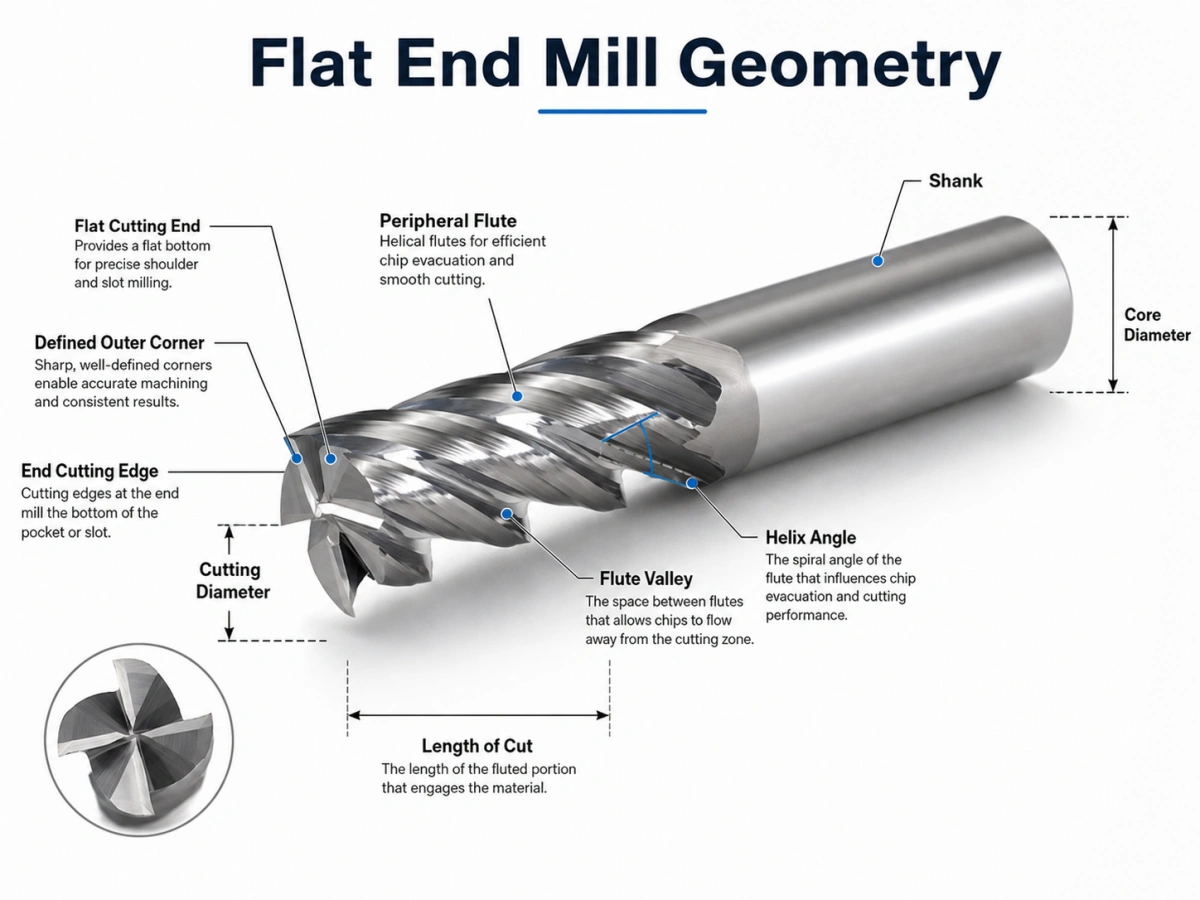
A flat end mill is more than a cutter with a flat bottom. Its performance depends on the relationship between the cutting corners, flute valleys, core, unghiul helixului, end cutting edges, and peripheral flutes.
Flat Cutting End and Outer Corners
The cutting end has a generally flat profile. Its outer corners connect the end cutting edges with the peripheral cutting edges.
A sharp corner creates a clear transition between the bottom and side wall. Cu toate acestea, it also concentrates cutting stress. Corner chipping becomes more likely when the setup has excessive runout, consolă lungă, tăiere întreruptă, or aggressive engagement.
When the part drawing allows a corner radius, a bull nose design can strengthen the cutting corner. When the component requires a sharper internal transition, a flat end profile remains the more suitable option.
End and Peripheral Cutting Edges
The end cutting edges remove material near the tool bottom. Their detailed geometry also affects how the cutter enters the workpiece.
Do not assume that every flat end mill can plunge directly into solid material. Some designs support controlled plunging, rampă, sau intrare elicoidală. Other tools may require side entry or an existing opening.
Peripheral cutting edges run along the outside diameter. They influence side-wall accuracy, radial cutting action, formarea așchiilor, forțe de tăiere, și finisarea suprafeței.
Flute Valley and Core Diameter
The flute valley provides space for chip flow. Între timp, the core is the solid material that supports the cutting edges.
This creates a practical trade-off:
- Larger flute valleys improve chip evacuation.
- A larger core increases tool rigidity.
- More cutting edges may improve productivity or surface quality.
- Too many flutes can cause chip packing in deep slots.
A lower flute count is often selected when chip volume is high. A higher flute count is more common when radial engagement is lower and rigidity or finishing performance matters more.
Unghiul Helix
The helix angle controls how gradually the cutting edge enters the material and how cutting forces move through the cutter.
Typical starting points include:
- Around 35°–40° for general machining and stronger cutting edges
- Around 45° for smoother cutting and finishing
- Higher helix angles for improved chip flow, with greater axial force
- Lower helix angles for stronger edges and lower lifting force
These values are not fixed rules. Diametrul sculei, materialul piesei de prelucrat, număr de flaut, logodnă, and machine rigidity still determine the final geometry.
Cutting Length and Tool Overhang
Long cutting edges improve reach, but they reduce rigidity. Ca urmare, the cutter becomes more sensitive to deflection, a alerga afară, and vibration.
Use the shortest practical flute length and tool overhang whenever possible. A rigid holder, runout scăzut, and a strong shank also improve stability.
A short-flute, long-neck design can often reach a deep feature with better rigidity than a fully fluted long cutter.
How Does a Flat End Mill Cut?
The spindle rotates the cutter while the CNC machine controls its movement relative to the workpiece. Each cutting edge enters the material, forms a chip, and leaves the cutting zone.
The end edges act near the tool bottom. Între timp, the peripheral flutes cut the side of the feature. The actual load distribution depends on axial depth, angrenare radială, metoda de intrare, și calea sculei.
Chip Formation and Evacuation
Each cutting edge shears a chip from the workpiece. The flute must then carry the chip away before the next edge reaches the same area.
Poor chip evacuation may cause:
- Recuparea așchiilor
- Căldură excesivă
- Marginea încorporată
- Daune de ultimă oră
- Finisaj slab al suprafeței
Chip control becomes especially important during deep pocket machining, fante pe toată lățimea, prelucrarea aluminiului, and other high-volume cutting operations.
Air blast, lichid de răcire, or another suitable chip-removal method should match the material and machining process. The main objective is simple: chips must leave the cutting zone quickly and consistently.
Practical Geometry Choices by Material
The following tables provide practical starting points. Final selection still depends on the material grade, duritate, diametrul sculei, starea mașinii, metoda lichidului de răcire, și calea sculei.
Typical Geometry by Workpiece Material
| Piesa de prelucrat | Geometrie tipică | Main Risk |
| Aluminum and non-ferrous alloys | 2– 3 flute, văi mari de flaut, sharp or polished edges | Chip welding and built-up edge |
| General steel | 4 or more flutes with a stronger core | Căldură, wear, and deflection |
| Oţel inoxidabil | Rigid tool, stable edge, controlled engagement | Heat and work hardening |
| Fontă | Wear-resistant substrate and reinforced edge | Uzură abrazivă |
| Oțel călit | Strong core, consolă scurtă, reinforced edge | Chipping and rapid wear |
Typical Coating Direction
| Piesa de prelucrat | Coating Direction | Focus de selecție |
| Aluminum and non-ferrous alloys | Neacoperit, DLC, TiB2, or another suitable option | Frecare redusă și aderență redusă |
| General steel | TiAlN, Altin, sau acoperire specifică aplicației | Heat and wear resistance |
| Oţel inoxidabil | Heat-resistant coating selected by material grade | Stable cutting and heat control |
| Fontă | Wear-resistant coating | Abrasion resistance |
| Oțel călit | High-temperature coating selected by actual HRC | Edge strength and heat resistance |
Pentru aluminiu, chip space, margini ascuțite, and low material adhesion are usually the main priorities. Două- or three-flute designs often provide more room for chip evacuation.
For general steel, rigidity and heat resistance usually become more important. Four or more flutes may work well when chip load and radial engagement remain under control.
For hardened steel, always provide the actual hardness. HRC 45, HRC 55, și HRC 65 require different tool materials, preparate de margine, acoperiri, și parametrii de tăiere.
Coating and Edge Preparation
Uncoated or polished tools often suit aluminum, cupru, și alte materiale neferoase. Their sharp, low-friction surfaces help reduce built-up edge.
TiAlN and AlTiN coatings are widely used for steel, oţel inoxidabil, oțel pentru scule, and other heat-intensive applications. Cu toate acestea, coating selection must still match the exact workpiece grade and machining conditions.
DLC and similar low-friction coatings are often considered for aluminum and other non-ferrous materials because they can reduce material adhesion.
Edge preparation matters as much as coating. A very sharp edge lowers cutting force but may chip during hard or interrupted cutting. A light hone strengthens the edge, although it also increases cutting force.
Flat End Mill Troubleshooting Guide
| Problemă | Likely Cause | Practical Correction |
| Chatter | Consolă lungă, weak holding, or high engagement | Shorten overhang and reduce engagement |
| Tapered wall | Tool deflection or excessive cutting load | Use a shorter tool or add a finishing pass |
| Ambalare cip | Too many flutes or poor chip removal | Use fewer flutes and improve chip evacuation |
| Marginea încorporată | Unsuitable edge, acoperire, or chip load | Use a sharper edge and suitable lubrication |
| ciobirea colțurilor | A alerga afară, impact, sau tăiere întreruptă | Reduce entry shock and check runout |
| Poor finish | Chatter, recutting, or deflection | Improve rigidity and remove chips effectively |
How to Reduce Chatter and Deflection
Start with the mechanical setup:
- Reduce tool overhang.
- Use the shortest practical cutting length.
- Improve holder and workpiece rigidity.
- Reduce radial or axial engagement.
- Avoid sudden full engagement in internal corners.
- Leave a controlled finishing allowance.
Do not reduce feed to an extremely low value without checking chip load. Feeding too slowly can cause the cutting edge to rub instead of cut. This increases heat and may worsen surface finish.
How to Improve Chip Evacuation
For deep slots and high chip volume:
- Choose fewer flutes or larger flute valleys.
- Direct air or coolant into the cutting zone.
- Prevent chips from being cut again.
- Reduce axial depth when chips cannot escape.
- Consider chipbreaker geometry for long chips.
Flat End Mill vs Square End Mill
In many solid end mill catalogs, “flat end mill” and “square end mill” describe the same general geometry: a flat cutting end with defined outer corners.
The terms emphasize different details:
- “Flat” describes the bottom profile.
- “Square” describes the corner where the end and peripheral cutting edges meet.
Buyers should still confirm the drawing. Some suppliers distinguish between a sharp corner, a small protective chamfer, and a small corner radius.
A square end mill is also different from a square shoulder milling cutter. A square shoulder cutter describes a tool or milling system designed to produce a 90° shoulder. It may use indexable inserts and may not resemble a solid flat end mill.
Flat End Mill vs Bull Nose and Ball Nose Geometry
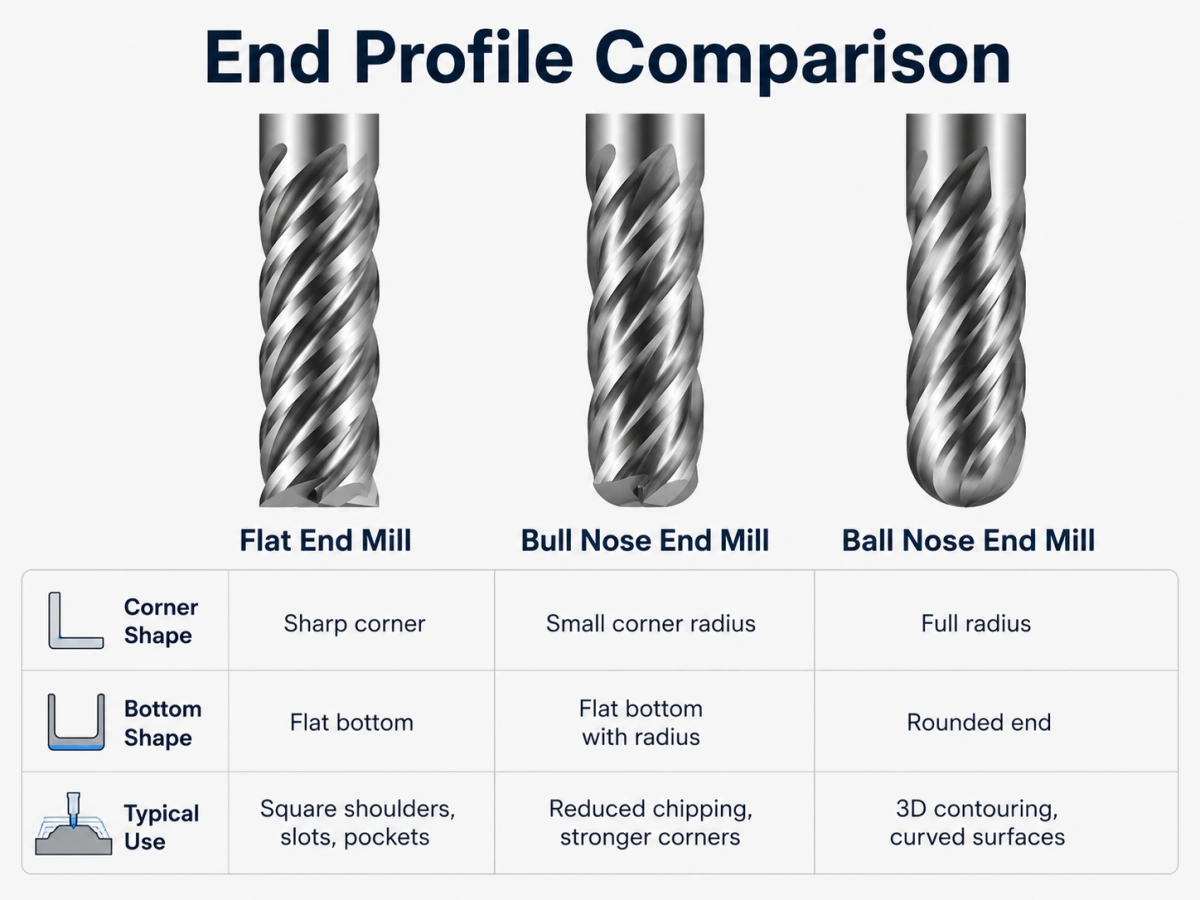
Plat, Nasul de taur, and Ball Nose Comparison
| Tool Profile | Sfârșitul Geometriei | Main Effect |
| Moara plată | Flat end with defined corners | Produces flat bottoms and sharper transitions |
| Taur Nose End Mill | Flat center with corner radii | Strengthens corners and reduces chipping |
| Moara de capăt cu nas bilă | Fully rounded end | Supports curved and 3D surface machining |
A bull nose end mill strengthens the cutting corner, while a flat profile preserves a sharper internal transition. For a more detailed comparison, citire bull nose vs flat end mill.
For fully rounded cutting-end geometries, revizuiește-ne freze cu cap bilă.
What Information Should You Send to a Tool Supplier?
A professional recommendation requires more than the tool diameter.
Send the following information:
- Workpiece material and exact grade
- Duritatea materialului, including HRC when applicable
- Diametrul de tăiere
- Lungimea flautului
- Lungime totală
- Diametrul tijei
- Required reach or neck length
- Număr de flaut
- Machining operation and entry method
- Coolant or dry-cutting condition
- Required tolerance and surface finish
- Cantitatea comandata
- Desenarea sculei sau desenul piesei
This information helps the supplier evaluate the tool material, geometria flautului, unghiul helixului, pregătirea marginilor, acoperire, and rigidity.
For non-standard dimensions or application-specific tools, revizuiește-ne freze la comandă service.
Întrebări frecvente
What is another name for a flat end mill?
Many suppliers also use the term square end mill. Some catalogs use flat bottom end mill, although the drawing should confirm the actual corner geometry.
Are all flat end mills made of solid carbide?
Nu. Tool material and construction can be selected according to the workpiece, maşină, production volume, conditii de taiere, și cerințele clienților.
Can flat end mills have different flute counts?
Da. Două, trei, patru, six, and custom flute counts are possible. The correct choice depends on chip volume, rigiditate, logodnă, material, și cerințele de finisare a suprafeței.
Is every flat end mill suitable for direct plunging?
Nu. Direct plunging depends on the center and end-cutting geometry. Confirm whether the tool supports plunging, rampă, intrare elicoidală, intrare laterală, or machining from an existing opening.
Concluzie
A flat end mill is defined by its flat cutting profile and defined outer corners. Its performance depends on the relationship between flute valley, puterea miezului, unghiul helixului, lungimea de tăiere, pregătirea marginilor, acoperire, și surplombarea sculei.
The machining result also provides useful clues. Chatter points toward instability or excessive engagement. Tapered walls suggest deflection. Chip packing indicates poor evacuation. Corner damage may show that the edge geometry or cutting load does not match the job.
Understanding these signals helps engineers select a more suitable cutter. It also gives purchasing teams the information needed to request an accurate quotation.
Discuss Your Flat End Mill Requirement
Examinați standardele noastre și personalizate moara plată opțiuni pentru diferite materiale de scule, dimensiuni, flaut numără, unghiurile elicei, acoperiri, și condițiile de prelucrare.
Vă rugăm să trimiteți materialul piesei de prelucrat, duritate, dimensiunile sculei, operatie de prelucrare, cantitate, și desen dacă este disponibil.
E-mail: sales@cutterbest.com