 Прецизионные фрезы,Режущие инструменты для обработки любого материала с ЧПУ

Знакомство
The бычий нос против фрезы с плоским концом comparison mainly comes down to cutting-corner geometry. Both cutters can machine flat-bottom features, but a bull nose end mill has a defined corner radius, while a flat end mill has a sharp cutting corner.
That difference affects the geometry left on the finished part. If the drawing allows or specifies a radiused transition, a bull nose end mill may be the better match. If the feature requires a sharp 90-degree internal corner or square shoulder, a flat end mill is usually the more direct choice.
The correct selection therefore depends on the drawing, feature geometry, required corner condition, доступ к инструменту, and tolerance rather than on one cutter being universally “better.”
Быстрый ответ: Бычий нос против фрезы с плоским концом
Выберите Концевая фреза с бычьим носом when the feature allows or requires a corner radius or radiused bottom-to-wall transition.
Выберите плоская концевая фреза when the drawing requires a sharp 90-degree internal corner, квадратное плечо, or sharp lower corner.
A part that contains both radiused transitions and sharp square features may require both cutter geometries in different operations.
Бычий нос против фрезы с плоским концом: Ключевые различия
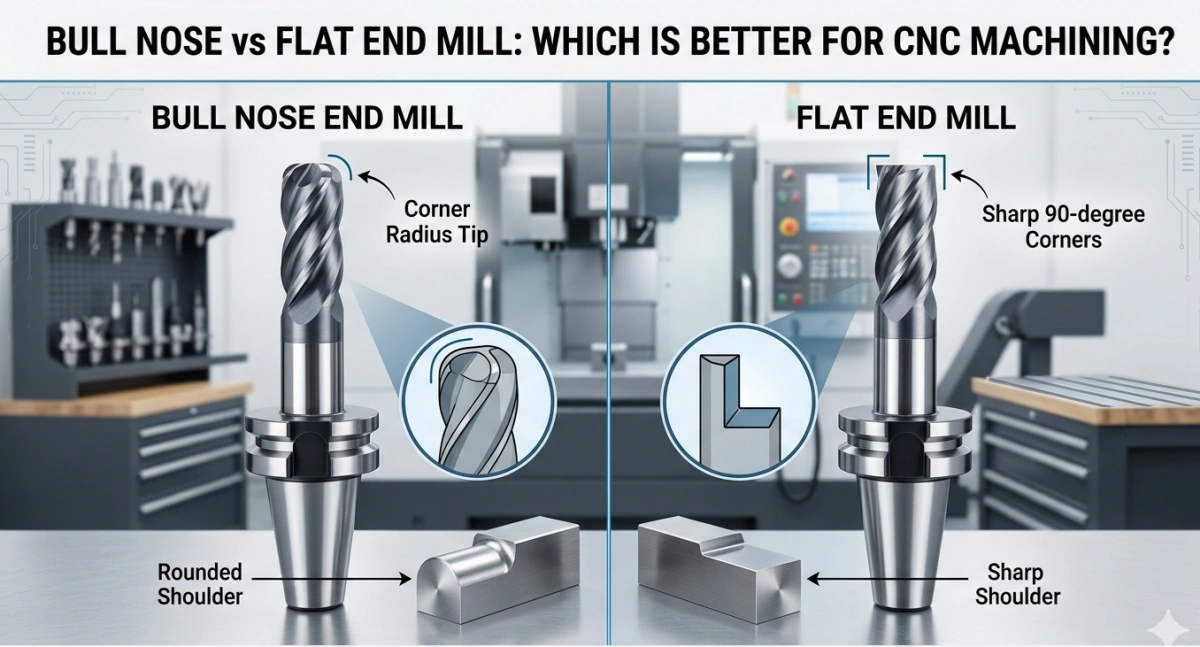
The table below compares the feature geometry each cutter is intended to produce. Actual cutter selection also depends on the drawing, available tool diameter, терпимость, feature accessibility, и настройка обработки.
| Точка сравнения | Бычий нос / Концевая фреза углового радиуса | Плоский / Квадратная концевая мельница |
|---|---|---|
| Cutting Corner | Flat bottom with a corner radius | Flat bottom with a sharp cutting corner |
| Bottom Geometry | Flat bottom with a radiused bottom-to-wall transition | Flat bottom with a sharp bottom-to-wall transition |
| Internal Corner Result | Leaves or follows a radiused internal transition | Used where a sharp 90-degree internal corner is required |
| Square Shoulder | Not suitable when the shoulder must remain sharp | Suitable when a sharp square shoulder is required |
| Слоты / Square Features | Use when the feature allows a radius at the lower corners | Suitable where the feature requires sharp lower corners |
| Corner Condition on Drawing | Use when a radius is allowed or specified | Use when a sharp corner is required |
| Main Selection Trigger | Required radiused transition | Required sharp 90-degree corner or square shoulder |
How Corner Geometry Changes the Machined Feature

A bull nose end mill has a flat cutting bottom with a corner radius between the bottom cutting edge and the side cutting edge. Как результат, the machined feature reflects a radiused transition rather than a sharp lower corner.
A flat end mill also has a flat cutting bottom, but its cutting corner is sharp rather than radiused. This geometry is used when the part drawing calls for a sharp internal corner, квадратное плечо, or other feature that does not allow a specified corner radius.
This distinction is more important than simply asking which cutter is stronger or more durable. The cutter should match the required geometry on the finished part.
A flat end mill also does not guarantee a mathematically perfect zero-radius internal corner in every situation. Диаметр инструмента, cutter condition, траектория инструмента, accessibility, and drawing tolerance can all affect the final feature.
Какую концевую фрезу выбрать?
Выбирайте концевую фрезу с закругленной головкой, когда
A bull nose end mill is generally the more suitable geometry when:
- The drawing allows or specifies a corner radius
- The feature requires a radiused bottom-to-wall transition
- A stepped or shoulder feature allows a radius at the lower corner
- The required geometry combines a flat bottom with radiused corners
- A sharp 90-degree lower corner is not required
The cutter diameter, угловой радиус, достигать, and other dimensions must still match the part geometry.
For available dimensions and configurations, видеть Концевая фреза с бычьим носом.
Choose a Flat End Mill When
A flat end mill is generally the more direct choice when:
- The drawing requires a sharp 90-degree internal corner
- A square shoulder must remain sharp
- A slot or square-bottom feature requires sharp lower corners
- The feature does not allow a corner radius
- The part geometry specifically calls for a sharp-corner flat-bottom cutter
The achievable corner still depends on cutter diameter, доступ к инструменту, траектория инструмента, и толерантность.
For available configurations, видеть Плоская концевая фреза.
When Both Tools May Be Used
Some parts contain both radiused transitions and sharp square features. В этих случаях, different cutter geometries may be used for different features or machining stages.
This should not be treated as one fixed roughing or finishing sequence. The actual process depends on the drawing, запасы, терпимость, accessibility, and CAM strategy.
Бычий нос / Corner Radius vs Flat / Square Terminology
Tool names can vary between catalogs, regions, и поставщики.
Термин Концевая фреза с бычьим носом commonly describes a flat-bottom end mill with a corner radius, пока концевая фреза углового радиуса is another widely used catalog term for this geometry.
Так же, плоская концевая фреза и square end mill are commonly used for sharp-corner, flat-bottom end mill profiles.
Поэтому, searches such as corner radius vs square end mill, corner radius end mill vs flat end mill, и bull nose vs square end mill often refer to the same basic comparison covered on this page: a radiused cutting corner versus a sharp cutting corner.
These naming conventions can vary between manufacturers, so the final tool should always be confirmed by its actual geometry and dimensions.
Related Tool Comparisons
This page compares a corner-radius flat-bottom cutter with a sharp-corner flat-bottom cutter.
If you need to compare a bull nose cutter with a fully rounded cutting end, видеть Концевая фреза с бычьим носом и концевая фреза со сферическим носом.
For product specifications and custom configurations, см. наш Концевая фреза с бычьим носом и Плоская концевая фреза product pages.
Вопросы и ответы
What is the main difference between a bull nose and flat end mill?
Both cutters can have a flat cutting bottom. The main difference is the cutting corner. A bull nose end mill has a corner radius, while a flat end mill has a sharp cutting corner.
Which end mill should I use for a sharp internal corner?
Use a flat or square end mill when the drawing requires a sharp 90-degree internal corner or square shoulder.
The actual achievable corner also depends on cutter diameter, доступ к инструменту, траектория инструмента, и толерантность.
Which end mill should I use when a corner radius is allowed or required?
A bull nose or corner radius end mill is usually the more direct choice when the drawing allows or specifies a radiused transition at the bottom or shoulder of the feature.
The required R value should be confirmed from the drawing or machining requirement.
Can a bull nose end mill replace a flat end mill?
Not when the finished feature requires a sharp corner that does not allow a radius.
The two cutters can overlap in some machining operations, but their cutting corners produce different feature geometry.
Is corner radius vs square end mill the same comparison?
It is a closely related comparison. In many tooling catalogs, bull nose and corner radius refer to flat-bottom cutters with radiused corners, в то время как плоские и квадратные концевые фрезы относятся к профилям с острыми углами и плоским дном..
Названия различаются у разных производителей, поэтому фактическая геометрия фрезы все равно должна быть подтверждена.
Заключение
Основное различие между фрезами с закругленным концом и фрезами с плоским концом заключается в требуемой геометрии углов на готовой детали.. Выбирайте концевую фрезу с закругленным концом или угловым радиусом, если на чертеже разрешен или указан радиусный переход., и выбирайте плоскую или квадратную концевую фрезу, если требуется острый угол 90 градусов или квадратный уступ.
Если вы не уверены, какая геометрия соответствует вашей детали, пришлите свой рисунок, размеры критических элементов, и требования к обработке к нам электронная почта или свяжитесь с нами напрямую по WhatsApp на рассмотрение.