 Прецизионные фрезы,Режущие инструменты для обработки любого материала с ЧПУ

Side milling vs face milling is mainly a question of which surface or feature you need to machine.
Side milling primarily uses the cutter’s peripheral cutting edges to machine features such as vertical walls, плечи, канавки, и слоты. Торцевое фрезерование, напротив, mainly produces broad flat surfaces, with the cutter axis generally perpendicular to the machined face.
These operations solve different machining problems. Side milling also overlaps with the broader concept of peripheral milling, although terminology may vary with the cutter type, настройка машины, и приложение.
Боковое фрезерование против торцевого фрезерования: Быстрое сравнение
The table below shows the main differences at a glance.
| Фактор | Боковое фрезерование | Торцевое фрезерование |
|---|---|---|
| Primary purpose | Machine side features and localized geometry | Machine broad flat surfaces |
| Surface or feature produced | Боковые стенки, плечи, канавки, слоты | Flat faces, top surfaces, datum surfaces |
| Main cutting area | Primarily peripheral cutting edges | Primarily cutting edges on the cutter face |
| Cutter axis relationship | Generated side surface is generally parallel to the cutter axis | Machined face is generally perpendicular to the cutter axis |
| Typical applications | Боковые стенки, плечи, слоты, канавки, external profiles | Облицовка, leveling, planar stock removal, surface preparation |
| Typical cutter type | Side milling cutter or another suitable peripheral cutter | Торцевая фреза |
| Best choice when | Side geometry is the main requirement | A broad planar surface is the main requirement |
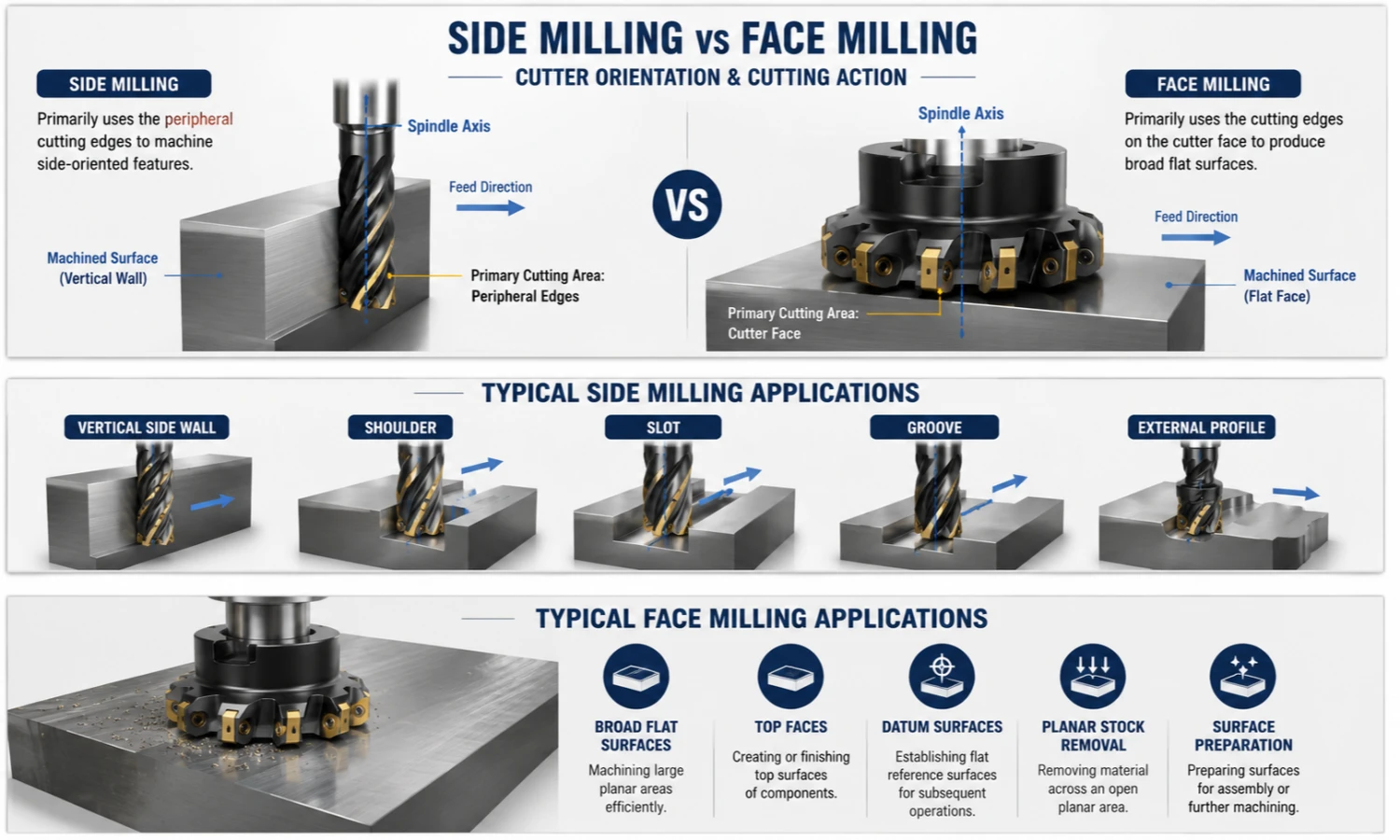
This comparison provides a useful starting point. Однако, геометрия детали, доступ к инструменту, жесткость машины, работа, and surface requirements can affect the final choice.
What Is Side Milling?
Side milling is a milling operation in which the cutter’s peripheral cutting edges perform most of the work on the target feature. Поэтому, it is commonly used when a part requires machining along a side surface rather than across a large open face.
The term often overlaps with peripheral milling, in which cutting occurs mainly along the cutter circumference. Однако, the two terms should not always be treated as exact synonyms because tool design and application can affect how manufacturers describe the process.
На практике, side milling is used to create or finish side-oriented features.
Typical Side Milling Applications
Common side milling applications include:
- Vertical side surfaces
- Плечи
- Слоты
- Канавки
- External profiles
- Accessible pocket walls
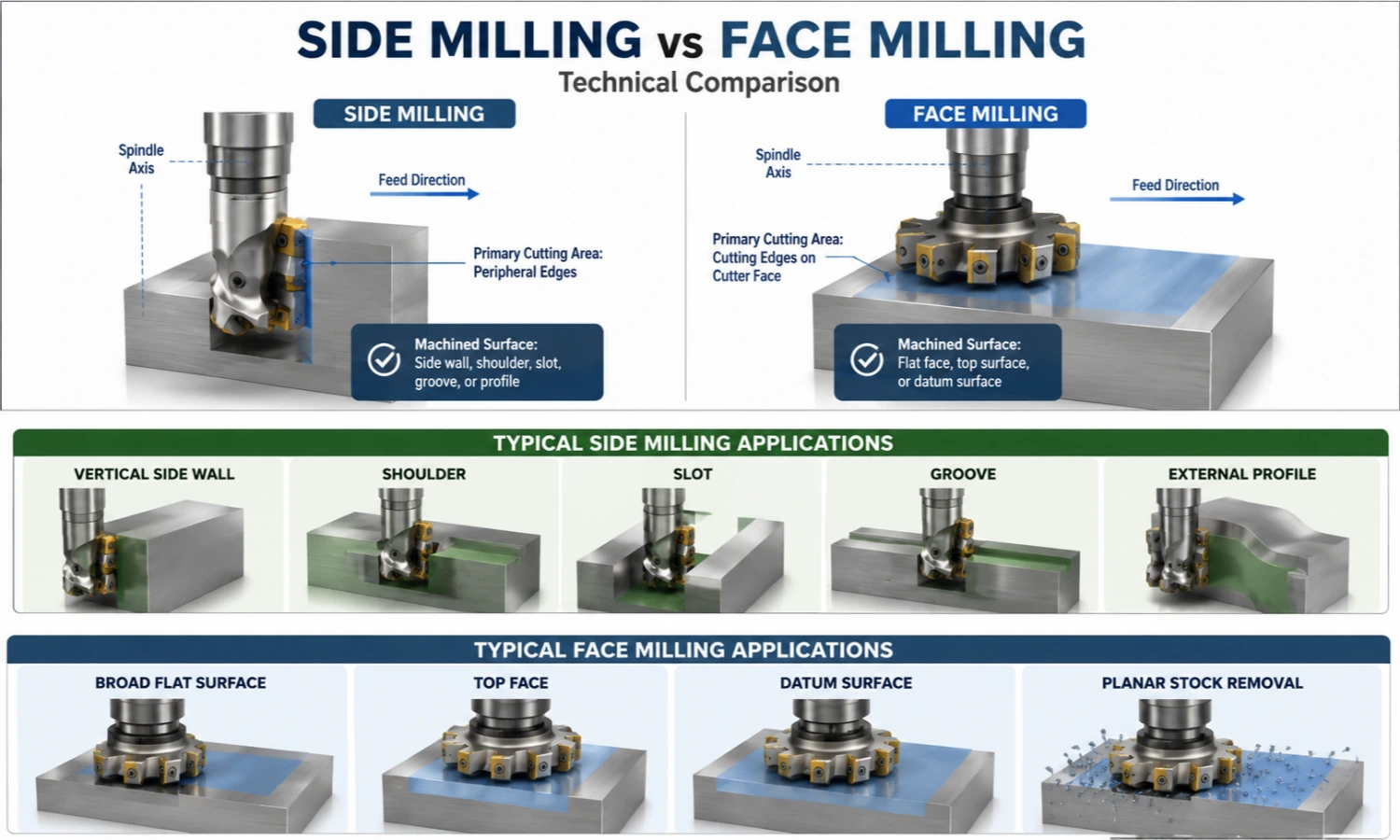
Side milling is particularly useful when the feature requires controlled side geometry.
For grooves, плечи, and other side-oriented features, a dedicated Боковая фреза may provide a suitable tool configuration for the operation.
What Is Face Milling?
Face milling mainly produces a flat surface across the face of a workpiece. During the operation, the cutter axis is generally perpendicular to the surface being machined.
Because the cutter can cover a relatively broad area, machinists often use face milling for leveling stock, preparing a top face, removing material from an open planar surface, or establishing a datum surface for later operations.
Однако, face milling should not be judged only by surface finish or material removal rate. Диаметр фрезы, геометрия, материал заготовки, возможности машины, работа, закончиться, and cutting conditions can all affect the result.
Typical Face Milling Applications
Типичные области применения включают в себя:
- Broad flat surfaces
- Top faces
- Datum surfaces
- Planar stock removal
- Surface preparation
These applications are typically based on an accessible planar surface.
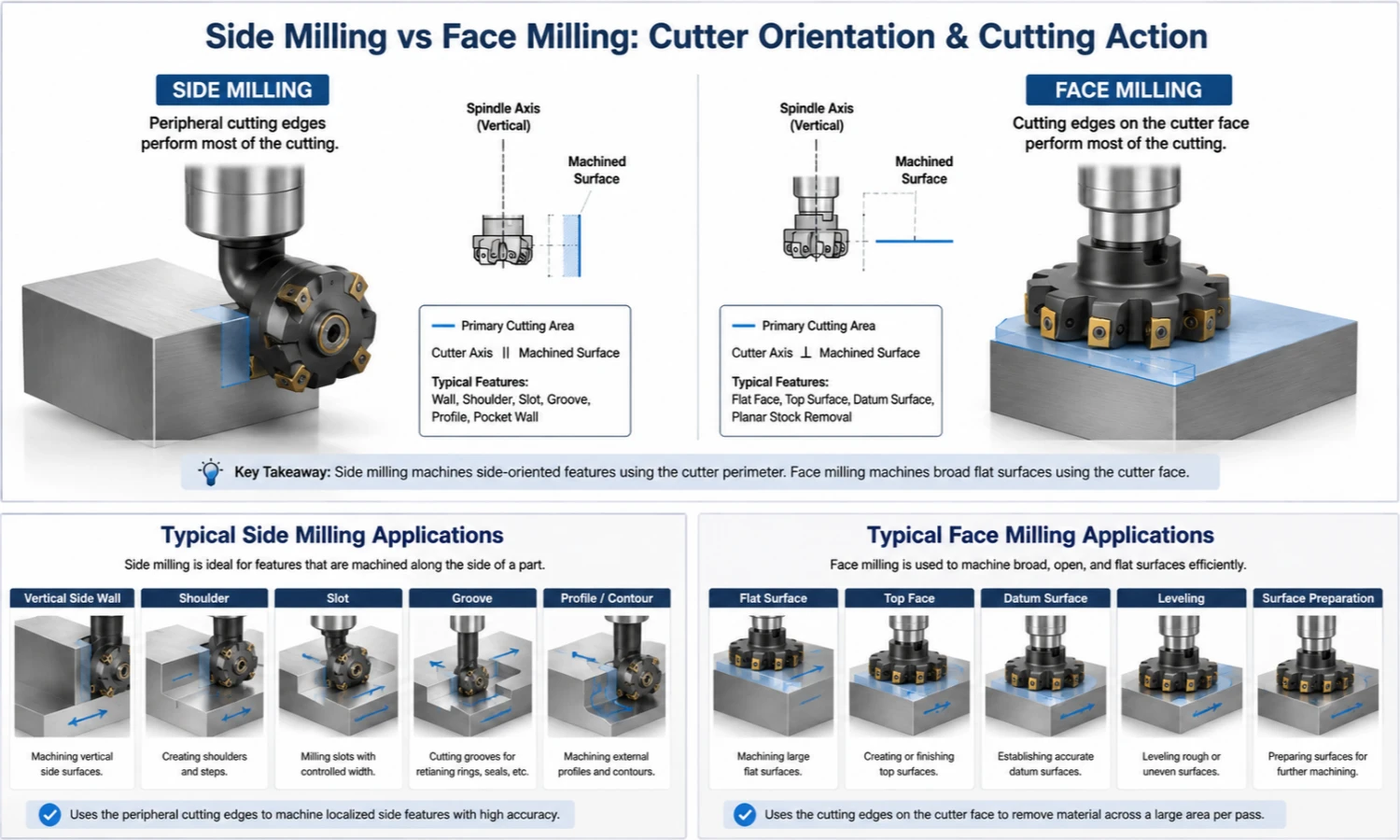
For open planar machining, использовать Торцевая фреза selected for the required surface coverage, доступ, и условия обработки.
Key Differences Between Side Milling and Face Milling
The quick comparison shows what each operation does. The following points explain why they behave differently in practice.
1. Machined Surface and Part Geometry
Part geometry is usually the first factor to check.
Side milling suits features that extend along the side of a component. These may include vertical walls, плечи, канавки, слоты, and external profiles.
Face milling serves a different purpose. It is generally selected when the drawing calls for an open planar surface, top face, or datum.
Как результат, the correct process often becomes clearer once you identify the orientation and shape of the target feature.
2. Primary Cutting Edge Engagement
При боковом фрезеровании, the peripheral cutting edges perform most of the cutting on the target surface.
In face milling, cutting edges positioned on the face of the cutter primarily generate the planar surface. Depending on the cutter geometry, other parts of the cutting edge may also participate.
По этой причине, it is more accurate to describe the primary cutting action rather than assume that only one portion of the cutter ever contacts the workpiece.
3. Cutter Orientation and Tool Access
Tool access can change the best machining strategy even when the desired geometry looks simple on a drawing.
A broad, open face usually gives a face mill enough clearance to sweep across the surface. В отличие, a deep shoulder, narrow groove, pocket wall, or localized side feature may require a cutter that can approach the feature from another direction.
Поэтому, ask two questions before choosing the operation:
- Can the cutter physically reach the feature?
- Can the machine and fixture support the required cutting direction?
Кроме того, if the component requires a true 90-degree shoulder, the cutter geometry must support that feature. A general face-milling cutter should not automatically be assumed to produce every square-shoulder condition.
4. Material Removal Area and Productivity Considerations
Face milling often works well when material must be removed across a broad, open surface because a larger cutter can cover more area per pass.
Боковое фрезерование, on the other hand, concentrates cutting along walls, канавки, слоты, плечи, and other localized features.
That does not mean one operation is always more productive than the other. Productivity depends on cutter size, траектория инструмента, возможности машины, workpiece rigidity, работа, материал, and the amount of stock to remove.
Поэтому, compare the machining task rather than looking for one universally faster process.
5. Surface and Dimensional Requirements
The dimensional priorities also differ.
With side milling, the main requirements may include:
- Wall position
- Side dimensions
- Slot width
- Shoulder geometry
- Profile accuracy
With face milling, the priorities may shift toward:
- Flatness
- Datum quality
- Surface consistency
- Planar finish
Тем не менее, face milling does not automatically guarantee a better finish in every case. Surface quality also depends on cutter geometry, закончиться, ультрасовременное состояние, Параметры обработки, состояние машины, and workholding stability.
How to Choose Between Side Milling and Face Milling
A practical selection method starts with the feature shown on the drawing rather than with the cutter itself.
Choose Side Milling When…
Consider side milling when the part requires:
- A vertical wall
- A groove
- A slot
- A shoulder
- A side profile
- Localized machining along the side of a feature
This method is especially useful when the required geometry cannot be efficiently reached by sweeping a larger cutter across the top face.
Choose Face Milling When…
Face milling is generally the more direct choice when the task involves:
- A broad flat surface
- Leveling an uneven top face
- Establishing a datum surface
- Removing stock across a planar area
- Preparing a surface for later machining
В этих ситуациях, the operation matches the geometry of the feature and allows the cutter to work across an open area.
Use Both Operations When the Part Requires Different Features
Many components do not require a simple either-or decision.
Например, one part may need a flat reference surface together with a shoulder, боковая стенка, or groove. В этой ситуации, face milling and side milling can complement each other.
A machining sequence may establish a planar surface before machining side-oriented features. Однако, the preferred order depends on the datum strategy, настраивать, работа, tolerance requirements, and part stability.
Поэтому, side milling and face milling are often complementary operations rather than competing operations.
Matching the Milling Operation to the Right Cutter Type
Once the required operation is clear, cutter selection becomes easier.
| Part Feature | Milling Direction | Typical Cutter Direction |
| Wall, слот, groove, плечо | Боковое фрезерование | Cutter designed for side or peripheral cutting |
| Broad flat face or datum surface | Торцевое фрезерование | Cutter designed for face milling |
| Flat and side features on one part | Combined operations | Use each cutter for its intended feature |
For side-oriented features, выбирать a suitable cutter for side-oriented features according to the required width, доступ, feature geometry, и условия обработки.
For broad planar machining, an indexable cutter for open planar machining may be suitable when the part provides enough access for the operation.
In either case, the final tool choice should also consider the workpiece material, возможности машины, работа, available space, и требования к чертежам.
Selection Factors That Can Change the Best Choice
Part geometry provides the starting point; setup conditions determine whether that initial choice is practical.
Do not use one cutter for every feature. A tool that can technically reach several surfaces may not be the most suitable option for each one.
Do not choose only by material removal rate. A high removal rate has limited value if the cutter cannot reach the feature properly or control the required geometry.
Check tool access, работа, и жесткость машины. Limited access, long reach, or weak clamping can influence both the operation and cutter choice.
Do not assume face milling always gives the best finish. The selected process should first match the target surface. Then cutter geometry, условия резания, устойчивость машины, and workholding will influence the final result.
Боковое фрезерование против торцевого фрезерования: Что вам следует выбрать?
Use the part feature as the final decision guide:
- Broad flat surface or datum face → Face milling
- Wall, плечо, слот, groove, or side profile → Side milling
- Both planar and vertical features → Combine the two operations where appropriate
When comparing боковое фрезерование против торцевого фрезерования, the right choice depends first on part geometry and then on tool access, работа, возможности машины, и требования к поверхности.
If you need help matching a cutter to your drawing, материал, и требования к механической обработке, send the application details to sales@cutterbest.com for a tooling recommendation.
Часто задаваемые вопросы
What is the main difference between side milling and face milling?
Основное различие заключается в обрабатываемом элементе и основном режущем процессе.. При боковом фрезеровании в основном используются периферийные режущие кромки для создания боковых элементов, например стенок., плечи, слоты, и канавки. Торцевое фрезерование в основном создает широкие плоские поверхности., with the cutter axis generally perpendicular to the machined face.
Как боковое фрезерование связано с периферийным фрезерованием??
Боковое фрезерование перекрывается с более широкой концепцией периферийного фрезерования, поскольку оба метода в основном полагаются на режущие кромки по окружности фрезы.. Однако, терминология может варьироваться в зависимости от типа фрезы и применения. В этом руководстве, Боковое фрезерование в основном относится к обработке деталей с боковой ориентацией..
Как боковое фрезерование связано с концевым фрезерованием?
Концевая фреза может выполнять боковую резку, используя свои периферийные кромки., поэтому торцевое фрезерование может включать в себя операции бокового фрезерования. Однако, концевые фрезы также могут выполнять обработку карманов, профилирование, нарастание, и немного местных порезов лица. Поэтому, боковое фрезерование не следует рассматривать как идентичное всем операциям концевого фрезерования..
Можно ли использовать боковое и торцевое фрезерование на одной и той же детали??
Да. Многие детали содержат как плоские, так и боковые элементы.. Торцевое фрезерование может создать плоскую опорную или верхнюю поверхность., в то время как боковое фрезерование позволяет обрабатывать стены, плечи, канавки, или слоты. Точная последовательность зависит от конструкции детали., базовая стратегия, настраивать, и требования к допускам.
Когда для финишной обработки поверхности предпочтительнее торцевое фрезерование?
Торцевое фрезерование часто предпочтительнее, когда целью является открытое пространство., широкая плоская поверхность, требующая постоянной плоскостности или внешнего вида поверхности. Однако, фактическая обработка также зависит от геометрии фрезы, закончиться, ультрасовременное состояние, Параметры обработки, материал, состояние машины, и работа.