 หัวกัดที่มีความแม่นยํา,เครื่องมือตัดสําหรับเครื่องจักรกลซีเอ็นซีทุกวัสดุ

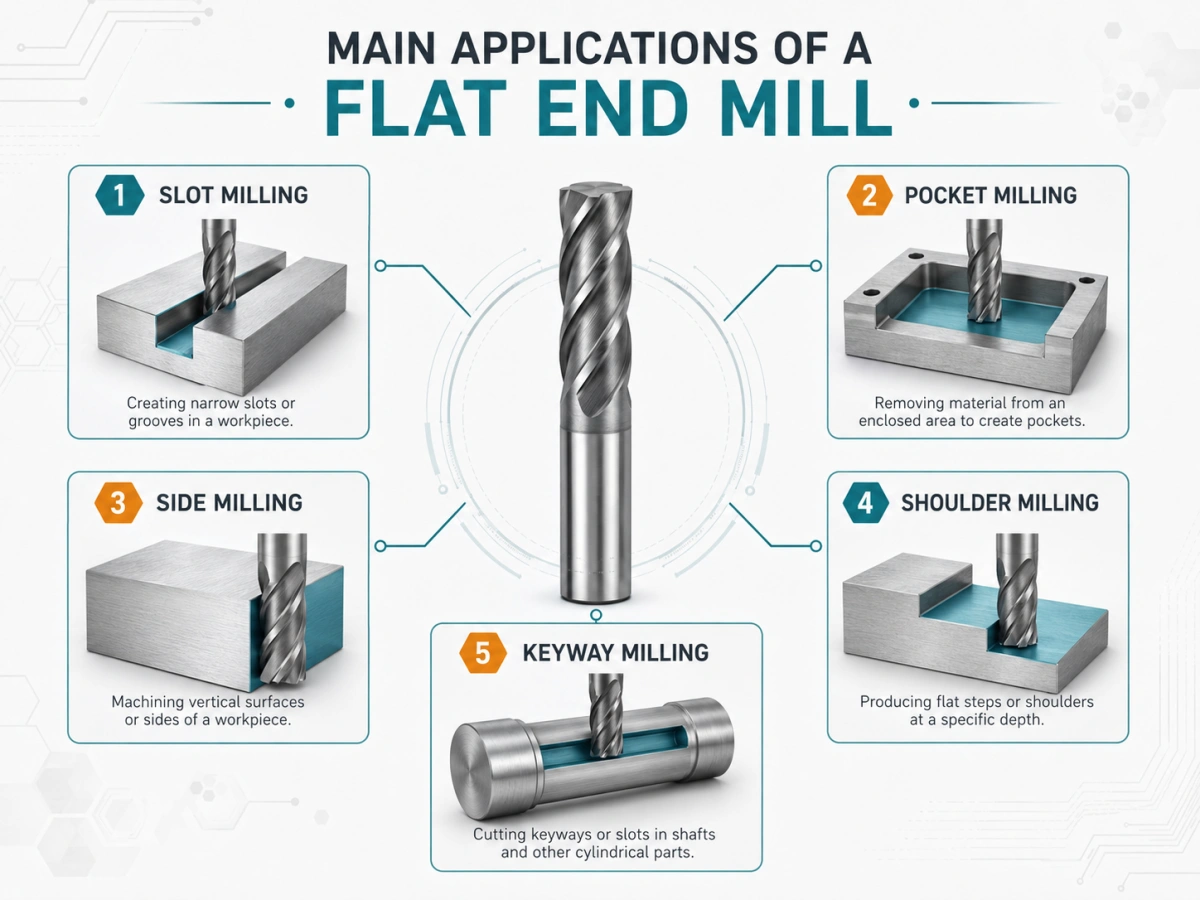
What is a flat end mill used for? ในเครื่องจักรซีเอ็นซี, it is mainly used to produce slots, กระเป๋าด้านล่างแบน, ผนังด้านข้างตรง, ไหล่สี่เหลี่ยม, รูกุญแจ, ขั้นตอน, และคุณสมบัติ 2D หรือ 2.5D อื่นๆ. Its end cutting edges remove material from the bottom of a feature, while the peripheral flutes machine the side walls.
Choose this tool when the drawing requires a flat bottom, a straight wall, or a defined bottom-to-wall transition. The final result still depends on material, ความลึก, ปริมาณชิป, การเข้าถึงเครื่องมือ, and entry method.
A lower-flute-count cutter may suit a deep aluminum slot because chips need room to escape, while a stronger-core tool may suit light side milling or finishing in steel.
For a detailed explanation of the geometry and cutting structure, อ่าน what a flat end mill is.
Available sizes, การนับขลุ่ย, วัสดุ, การเคลือบ, and custom options are listed on our ดอกเอ็นมิลล์แบบแบน หน้าผลิตภัณฑ์.
What Is a Flat End Mill Used For in CNC Machining?
The following operations represent the most common flat end mill uses in CNC machining. Machinists choose the cutter when the part needs a flat surface, a straight wall, or both.
การกัดสล็อต
During slot milling, the cutter removes material across its full diameter and produces a slot with a flat bottom. Because both sides of the tool are engaged, full-width slotting creates a high chip volume. Chip evacuation must be planned before cutting begins.
For aluminum and other long-chipping materials, a lower flute count often provides more flute space. In deep slots, direct air or coolant into the cutting zone. If chips still cannot escape, reduce the depth per pass or use a staged toolpath.
การกัดกระเป๋า
Flat end mills can rough and finish flat-bottom pockets. Machinists can enter the pocket by ramping, การแก้ไขแบบขดลวด, ทางเข้าด้านข้าง, direct plunging with a suitable cutter, or through a pre-drilled hole.
Tool reach is critical in deep pockets. A cutter that is much longer than necessary is more likely to deflect under radial load. ดังนั้น, the shortest practical cutting length and overhang should be used.
การกัดข้างและโปรไฟล์
ในการกัดข้าง, the peripheral flutes cut straight walls, โปรไฟล์ภายนอก, and steps. ความยาวตัด, การสู้รบในแนวรัศมี, ยื่นออกมา, ผู้ถือหมดแรง, and machine rigidity affect wall accuracy. Use a separate finishing pass when the operation requires tighter tolerances.
ไหล่, Keyways, and Steps
A flat end profile can machine a bottom and vertical wall in the same toolpath, which suits shoulders, รูกุญแจ, channels, recesses, and steps. For tight width tolerance, rough the feature first and finish both sides separately.
Finishing Flat Bottom Surfaces
A finishing pass can clean the bottom of a pocket or recess. Leave a small allowance after roughing and remove chips before the final pass to prevent scratches and edge damage.
A flat end mill can also machine a small open flat surface. For a large open face, อย่างไรก็ตาม, a face mill may remove material more efficiently and provide a more productive cutting path.
Flat End Mill Application Guide
| แอปพลิเคชัน | คุณสมบัติทั่วไป | Main Concern |
| การกัดสล็อต | Full or open slot | การอพยพของชิป |
| การกัดกระเป๋า | Flat-bottom pocket | Entry and reach |
| การกัดข้าง | Straight wall or profile | ความแข็งแกร่ง |
| การกัดบ่า | Bottom with vertical wall | Corner accuracy |
| Keyway milling | Narrow groove | Width tolerance |
| Bottom finishing | Pocket bottom or recess | การตัดชิป |
Can a Flat End Mill Plunge?
Some flat end mills can plunge directly into the workpiece, but this capability should not be assumed. Direct plunging depends on the end-cutting and center geometry. A center-cutting design can remove material near the tool axis, while another design may not cut effectively at the center.
Direct Plunging
Direct plunging moves the cutter vertically into solid material. It loads the end edges heavily and makes chip removal difficult. Use direct plunging only when the tool supports axial entry and the setup is suitable.
กระโจน, Helical Entry, and Pre-Drilling
Ramping and helical entry distribute the load more gradually than a straight plunge, so they are often preferred for pocket entry. A pre-drilled hole or side entry may be more suitable for a deep pocket, a non-center-cutting tool, a low-rigidity setup, or a feature with limited chip space. Confirm the recommended entry method before production.
Application Notes by Workpiece Material
วัสดุอลูมิเนียมและอโลหะ
สำหรับอะลูมิเนียม, chip space and adhesion are major concerns. Lower flute counts, large flute valleys, and sharp or polished edges help long chips leave the cut. Select an uncoated, เนื้อหาดาวน์โหลด, TiB2, or another suitable non-ferrous option according to the alloy and process.
For tools designed with more chip space, ตรวจสอบของเรา 2 ดอกเอ็นมิลล์ขลุ่ย ตัวเลือก.
เหล็กและสแตนเลส
Steel machining needs a balance between chip space and rigidity. Four-flute tools are common for general work, while Consider TiAlN, อัลทิน, or another heat-resistant coating for the exact grade and process.
Stainless steel retains heat and can work-harden. Maintain a stable chip load, limit overhang, and remove chips reliably rather than simply increasing speed.
For general-purpose steel machining, ตรวจสอบของเรา 4 ดอกเอ็นมิลล์ขลุ่ย ตัวเลือก.
ไทเทเนียมและโลหะผสมทนความร้อน
Titanium alloys concentrate heat at the cutting edge. Use a rigid setup, เรขาคณิตที่มั่นคง, controlled radial engagement, and reliable chip removal. Speed and feed must be based on the alloy, เส้นผ่านศูนย์กลางของเครื่องมือ, การนับขลุ่ย, การเคลือบ, การว่าจ้าง, และสภาพเครื่อง.
Cast Iron and Hardened Steel
Cast iron is abrasive, so wear resistance and edge strength are important. Hardened steel requires the actual hardness to be confirmed because HRC 45, HRC 55, และเหล็กแผ่นรีดร้อน 65 are different cutting conditions. A short overhang and stable toolpath are especially important for harder materials.
How Flute Count Changes the Application
จำนวนขลุ่ยจะเปลี่ยนพื้นที่ชิป, ความแข็งแกร่งหลัก, และจำนวนคมตัด. Select the flute count according to the operation rather than applying one fixed rule to every material.
| สภาพการตัด | Typical Flute Count | เหตุผลหลัก |
| High chip volume | Lower flute count | พื้นที่ชิปมากขึ้น |
| การกัดทั่วไป | Medium flute count | Balanced rigidity |
| Light engagement | Higher flute count | More cutting edges |
| ตกแต่ง | Medium to higher count | Stable edge contact |
For controlled, higher-flute-count applications, ตรวจสอบของเรา 6 ดอกเอ็นมิลล์ขลุ่ย หน้าผลิตภัณฑ์.
When Should You Use Another Cutter?
Curved or 3D Surfaces
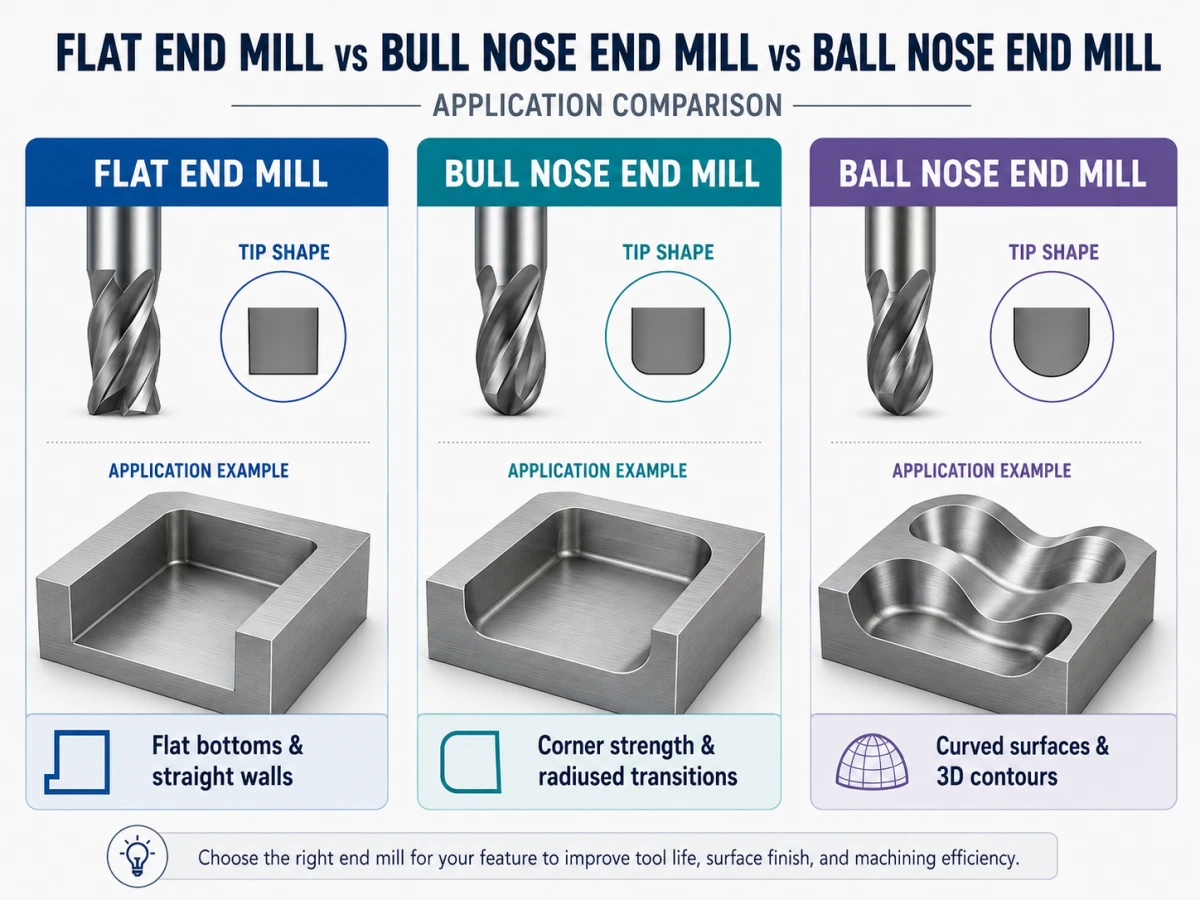
A ball nose end mill is generally more suitable for molds, ตาย, พื้นผิวโค้ง, และรูปทรงสามมิติ. Its rounded end maintains gradual contact as the surface angle changes. A flat cutter may leave steps or visible tool marks on the same geometry.
For curved and 3D machining, ตรวจสอบของเรา ดอกเอ็นมิลจมูกบอล.
A Corner Radius Is Allowed or Required
A bull nose end mill keeps a flat center section but adds radiused outer corners. The radius strengthens the cutting corner and reduces stress concentration. It may therefore provide better tool life when the part drawing allows a fillet between the wall and bottom.
เพื่อการเปรียบเทียบโดยละเอียด, อ่าน บูลโนสกับดอกเอ็นมิลล์แบบแบน.
Controlled Chamfering or Deburring
A flat end mill can lightly break an edge through a programmed toolpath, but a chamfer mill normally provides more predictable angle control and deburring.
Very Deep or Non-Standard Features
Deep pockets may require a long-neck, reduced-neck, หรือการออกแบบที่กำหนดเอง. Because extra reach increases deflection, keep the cutting length no longer than necessary.
For non-standard reach, ขนาด, or geometry, ตรวจสอบของเรา ดอกเอ็นมิลล์แบบกำหนดเอง service.
Basic Flat End Mill Selection Checklist
- Machining feature: Confirm whether the operation involves a slot, กระเป๋า, wall, ไหล่, รูกุญแจ, ขั้นตอน, or flat-bottom surface.
- Required result: Confirm the bottom shape, wall accuracy, สภาพมุม, ความอดทน, and surface-finish requirement.
- วัสดุชิ้นงาน: Provide the exact material grade and hardness.
- ความลึกของการตัด: Use only the flute length and reach required by the feature.
- Chip volume: Full slotting needs more chip space than light side milling.
- วิธีการเข้า: Confirm direct plunging, ลาด, รายการลาน, ทางเข้าด้านข้าง, or pre-drilling.
- Machine and holding condition: Check spindle condition, ผู้ถือหมดแรง, ส่วนที่ยื่นออกมาของเครื่องมือ, and workpiece rigidity.
Common Application Mistakes
- Using too many flutes in a deep slot, which reduces chip space and increases the risk of recutting.
- Using a tool that is much longer than necessary, which increases deflection and chatter.
- Assuming every flat end mill can plunge directly into solid material.
- Expecting a true zero-radius internal corner between two vertical walls. A rotating cutter always leaves a radius related to its diameter.
How to Improve the Machining Result
Reduce Burrs at the Slot or Pocket Edge
ตรวจสอบความคมชัดของขอบ, วิ่งหมด, โหลดชิป, and the final toolpath. A light finishing pass and effective chip removal can reduce burrs.
Improve Pocket-Floor Flatness
Leave a controlled finishing allowance, remove chips before the final pass, and use the shortest practical tool. Runout or deflection can produce steps and an uneven pocket floor.
Control Chatter and Tapered Walls
Shorten overhang, improve rigidity, reduce radial engagement, and avoid sudden full engagement in internal corners. Use a separate finishing pass when wall accuracy matters.
Prevent Cutting Overload and Chip Packing
Match flute space to chip volume, direct air or coolant into the cut, and reduce axial depth when chips cannot escape. Avoid feeds so low that the edge rubs.
คำถามที่พบบ่อย
Can a flat end mill cut a flat-bottom pocket?
ใช่. Flat-bottom pocketing is one of its main applications. การเข้าถึงเครื่องมือ, entry method, การอพยพของชิป, and finishing allowance must still be considered.
Can a flat end mill make a square internal corner?
It can produce a defined transition between a bottom surface and a vertical wall. อย่างไรก็ตาม, the corner between two vertical walls will retain a radius based on the cutter diameter.
Can a flat end mill plunge directly into material?
Some designs can plunge directly, while others cannot. The correct method depends on the center and end-cutting geometry.
Which flute count is better for slot milling?
Lower flute counts are often preferred for high chip-volume slotting because they provide more flute space. The final choice still depends on material, ความลึกของช่อง, เส้นผ่านศูนย์กลางของเครื่องมือ, และระบบจ่ายน้ำหล่อเย็นหรืออากาศ.
When should a ball nose tool be used instead?
Use a ball nose end mill for curved surfaces, 3รูปทรง D, and features with changing surface angles. Use a flat end profile when a flat bottom or defined shoulder is required.
บทสรุป
A flat end mill is mainly used for slots, กระเป๋าด้านล่างแบน, ผนังตรง, ไหล่, รูกุญแจ, ขั้นตอน, และคุณสมบัติ 2D หรือ 2.5D อื่นๆ. Its end cutting edges machine the bottom, while the peripheral flutes machine the side walls.
Successful cutting depends on the required shape, วัสดุ, การอพยพของชิป, เข้าถึง, entry method, การนับขลุ่ย, และความเสถียรของเครื่องจักร. Select a ball nose, จมูกวัว, face mill, chamfer mill, or custom cutter when the geometry falls outside the strengths of a standard flat end profile.
Discuss Your Flat End Mill Application
Review our standard and custom ดอกเอ็นมิลล์แบบแบน options for different dimensions, การนับขลุ่ย, วัสดุเครื่องมือ, การเคลือบ, และข้อกำหนดด้านเครื่องจักร.
Please send your workpiece material, ความแข็ง, ขนาดเครื่องมือที่ต้องการ, การทำงานของเครื่องจักร, feature depth, ความอดทนที่จำเป็น, ปริมาณ, และการวาดภาพถ้ามี.
อีเมล: sales@cutterbest.com