 Fresas de precisión,Herramientas de corte para el mecanizado CNC de todos los materiales

¿Para qué se utiliza una fresa de extremo plano?? En mecanizado CNC, se utiliza principalmente para producir ranuras, bolsillos de fondo plano, paredes laterales rectas, hombros cuadrados, chaveteros, pasos, y otras funciones 2D o 2,5D. Sus bordes cortantes finales eliminan material de la parte inferior de una característica., mientras que las ranuras periféricas mecanizan las paredes laterales.
Elija esta herramienta cuando el dibujo requiera un fondo plano, una pared recta, o una transición definida del fondo a la pared. El resultado final aún depende del material., profundidad, volumen de chip, alcance de la herramienta, y método de entrada.
Un cortador con menor número de flautas puede ser adecuado para una ranura de aluminio profunda porque las virutas necesitan espacio para escapar, mientras que una herramienta con núcleo más fuerte puede ser adecuada para fresado lateral ligero o acabado en acero.
Para una explicación detallada de la geometría y la estructura de corte., leer que es una fresa de extremo plano.
Tallas disponibles, flauta cuenta, materiales, revestimientos, y las opciones personalizadas se enumeran en nuestro molino de extremo plano página del producto.
¿Para qué se utiliza una fresa de extremo plano en el mecanizado CNC??
The following operations represent the most common flat end mill uses in CNC machining. Machinists choose the cutter when the part needs a flat surface, una pared recta, or both.
Fresado de ranuras
During slot milling, the cutter removes material across its full diameter and produces a slot with a flat bottom. Because both sides of the tool are engaged, full-width slotting creates a high chip volume. Chip evacuation must be planned before cutting begins.
For aluminum and other long-chipping materials, a lower flute count often provides more flute space. In deep slots, direct air or coolant into the cutting zone. If chips still cannot escape, reduce the depth per pass or use a staged toolpath.
Fresado de bolsillo
Flat end mills can rough and finish flat-bottom pockets. Machinists can enter the pocket by ramping, interpolación helicoidal, entrada lateral, inmersión directa con un cortador adecuado, o a través de un agujero previamente perforado.
El alcance de la herramienta es fundamental en bolsillos profundos. Un cortador que es mucho más largo de lo necesario tiene más probabilidades de deformarse bajo carga radial.. Por lo tanto, Se debe utilizar la longitud de corte y el voladizo más cortos y prácticos..
Fresado lateral y de perfiles
En fresado lateral, las flautas periféricas cortan paredes rectas, perfiles exteriores, y pasos. Longitud de corte, compromiso radial, sobresalir, agotamiento del soporte, y la rigidez de la máquina afectan la precisión de la pared. Utilice una pasada de acabado independiente cuando la operación requiera tolerancias más estrictas..
Espalda, Chaveteros, y pasos
Un perfil de extremo plano puede mecanizar una pared inferior y una pared vertical en la misma trayectoria, que se adapta a los hombros, chaveteros, canales, lo más hondo, y pasos. Para tolerancia de ancho ajustada, Primero desbaste la característica y termine ambos lados por separado..
Acabado de superficies de fondo plano
Una pasada de acabado puede limpiar el fondo de un bolsillo o hueco.. Deje un pequeño margen después del desbaste y elimine las virutas antes de la pasada final para evitar rayones y daños en los bordes..
Una fresa de extremo plano también puede mecanizar una pequeña superficie plana abierta.. Para una cara grande y abierta, sin embargo, una fresa frontal puede eliminar material de manera más eficiente y proporcionar una ruta de corte más productiva.
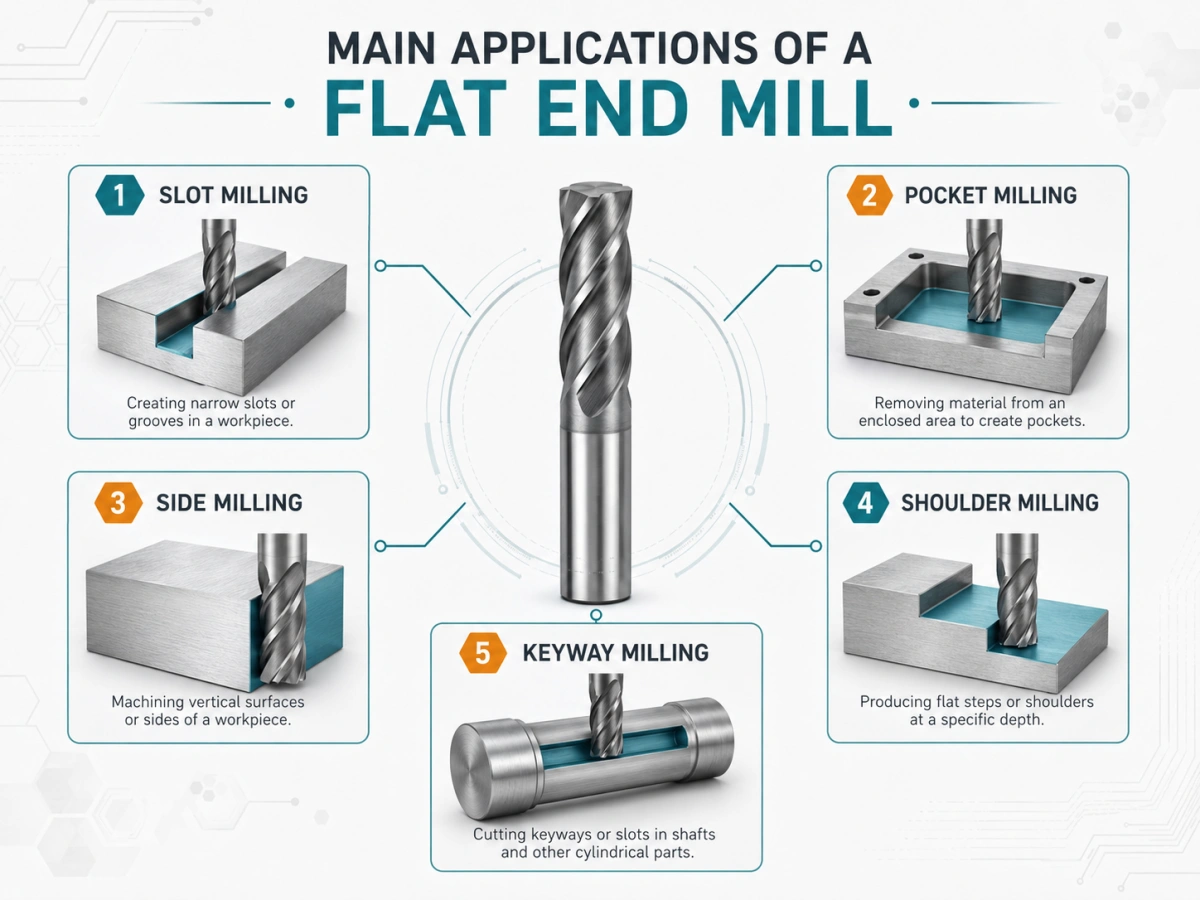
Guía de aplicación de fresas de extremo plano
| Solicitud | Característica típica | Preocupación principal |
| Fresado de ranuras | Ranura completa o abierta | Evacuación de virutas |
| Fresado de cajeras | Bolsillo de fondo plano | Entrada y alcance |
| fresado lateral | Pared recta o perfil | Rigidez |
| Fresado en hombro | Fondo con pared vertical | Precisión de esquina |
| Fresado de chaveteros | Ranura estrecha | Tolerancia de ancho |
| Acabado inferior | Fondo de bolsillo o hueco | Recorte de viruta |
¿Puede hundirse una fresa de extremo plano??
Algunas fresas de extremo plano pueden hundirse directamente en la pieza de trabajo., pero esta capacidad no debe asumirse. La inmersión directa depende de la geometría del corte final y del centro.. Un diseño de corte central puede eliminar material cerca del eje de la herramienta, mientras que otro diseño puede no cortar eficazmente en el centro.
Inmersión directa
La inmersión directa mueve la cortadora verticalmente hacia el material sólido.. Carga mucho los bordes finales y dificulta la eliminación de virutas.. Utilice la inmersión directa sólo cuando la herramienta admita la entrada axial y la configuración sea adecuada.
rampa, Entrada helicoidal, y preperforación
La rampa y la entrada helicoidal distribuyen la carga de manera más gradual que una inmersión recta., por lo que a menudo se prefieren para la entrada de bolsillo. Un orificio previamente perforado o una entrada lateral pueden ser más adecuados para un bolsillo profundo., una herramienta de corte no central, una configuración de baja rigidez, o una característica con espacio de chip limitado. Confirme el método de entrada recomendado antes de la producción..
Notas de aplicación por material de pieza de trabajo
Aluminio y Materiales No Ferrosos
Para aluminio, el espacio del chip y la adhesión son preocupaciones importantes. Recuentos de flautas más bajos, grandes valles de flauta, y los bordes afilados o pulidos ayudan a que las virutas largas salgan del corte. Seleccione un sin recubrimiento, contenido descargable, TiB2, u otra opción no ferrosa adecuada según la aleación y el proceso.
Para herramientas diseñadas con más espacio para virutas, revisa nuestro 2 fresa de ranura opciones.
Acero y Acero Inoxidable
El mecanizado de acero necesita un equilibrio entre espacio de viruta y rigidez. Las herramientas de cuatro flautas son comunes para trabajos generales., mientras considera TiAlN, Altin, u otro recubrimiento resistente al calor para el grado y proceso exactos.
El acero inoxidable retiene el calor y puede endurecerse. Mantenga una carga de chip estable, límite de voladizo, y eliminar virutas de forma fiable en lugar de simplemente aumentar la velocidad.
Para mecanizado de acero de uso general, revisa nuestro 4 fresa de ranura opciones.
Titanio y aleaciones resistentes al calor
Las aleaciones de titanio concentran el calor en el filo. Utilice una configuración rígida, geometría estable, acoplamiento radial controlado, y eliminación fiable de virutas. La velocidad y el avance deben basarse en la aleación., diámetro de la herramienta, recuento de flauta, revestimiento, compromiso, y condición de la máquina.
Hierro fundido y acero endurecido
El hierro fundido es abrasivo., por lo que la resistencia al desgaste y la resistencia de los bordes son importantes. El acero endurecido requiere que se confirme la dureza real porque HRC 45, HRC 55, y CDH 65 son diferentes condiciones de corte. Un voladizo corto y una trayectoria de herramienta estable son especialmente importantes para materiales más duros..
Cómo el conteo de flautas cambia la aplicación
El recuento de flautas cambia el espacio del chip, fuerza central, y el número de filos de corte. Seleccione el número de canales según la operación en lugar de aplicar una regla fija a cada material..
| Condición de corte | Conteo típico de flauta | Razón principal |
| Alto volumen de viruta | Recuento de flautas más bajo | Más espacio para chips |
| fresado general | Cuenta de flauta media | Rigidez equilibrada |
| Compromiso ligero | Mayor número de flautas | Más bordes cortantes |
| Acabado | Recuento medio a alto | Contacto de borde estable |
Para controlado, aplicaciones con mayor número de flautas, revisa nuestro 6 fresa de ranura página del producto.
¿Cuándo debería utilizar otro cortador??
Superficies curvas o 3D
Una fresa de punta esférica suele ser más adecuada para moldes., muere, superficies curvas, y contornos 3D. Su extremo redondeado mantiene un contacto gradual a medida que cambia el ángulo de la superficie.. Un cortador plano puede dejar escalones o marcas de herramienta visibles en la misma geometría..
Para mecanizado curvo y 3D, revisa nuestro Fresas de punta esférica.
Se permite o requiere un radio de esquina
Una fresa de punta redondeada mantiene una sección central plana pero agrega esquinas exteriores redondeadas. El radio fortalece la esquina de corte y reduce la concentración de tensiones.. Por lo tanto, puede proporcionar una mejor vida útil de la herramienta cuando el dibujo de la pieza permite un filete entre la pared y el fondo..
Para una comparación detallada, leer fresa de punta toro versus fresa plana.
Chaflanado o desbarbado controlado
Una fresa de extremo plano puede romper ligeramente un borde a través de una trayectoria programada, pero un molino de chaflán normalmente proporciona un control de ángulo y un desbarbado más predecibles..
Funciones muy profundas o no estándar
Los bolsillos profundos pueden requerir un cuello largo, cuello reducido, o diseño personalizado. Porque el alcance adicional aumenta la desviación, Mantenga la longitud de corte no más larga de lo necesario..
Para alcance no estándar, dimensiones, o geometría, revisa nuestro fresas personalizadas servicio.
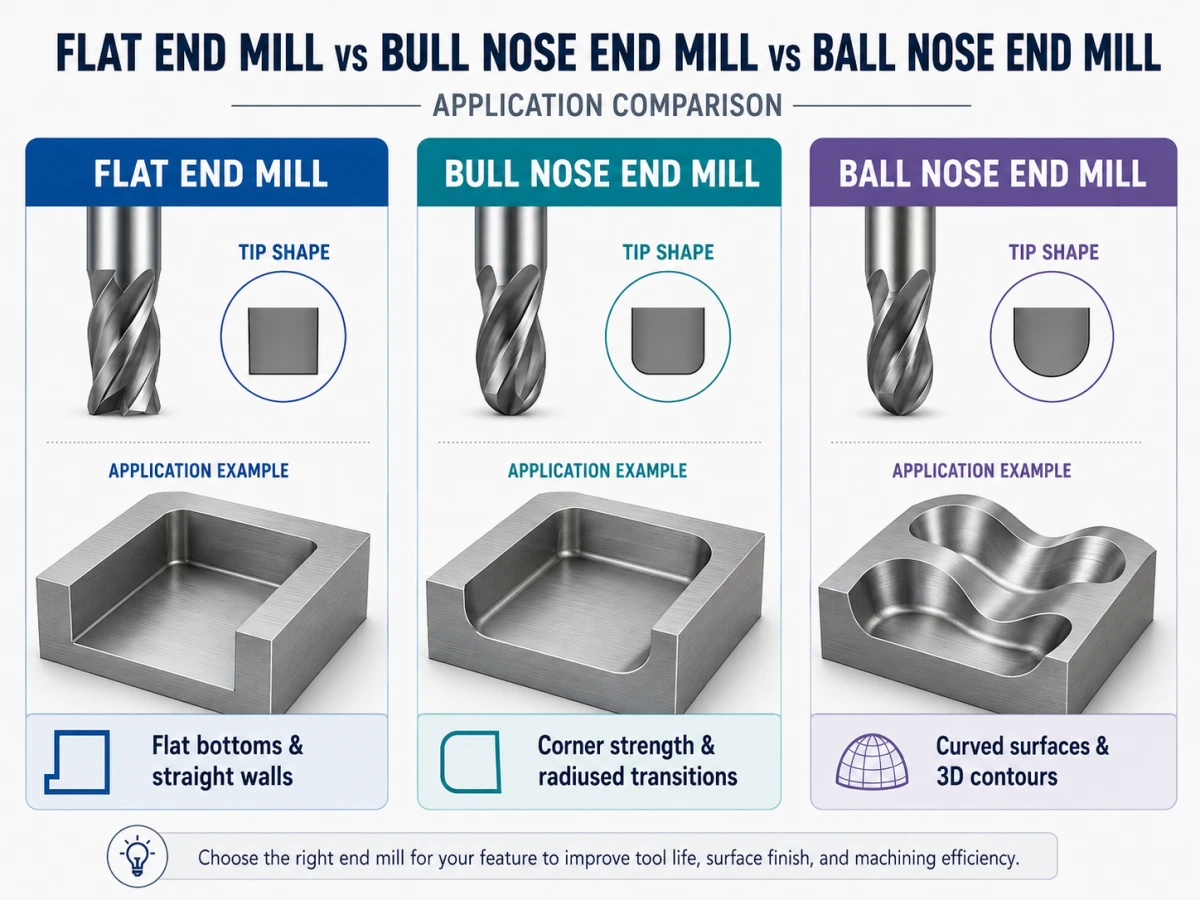
Lista de verificación básica para la selección de fresas de extremo plano
- característica de mecanizado: Confirmar si la operación implica un slot, bolsillo, muro, hombro, chavetero, paso, o superficie de fondo plano.
- Resultado requerido: Confirma la forma inferior, precisión de la pared, condición de esquina, tolerancia, y requisito de acabado superficial.
- Material de la pieza de trabajo: Proporcionar el grado y dureza exactos del material..
- Profundidad de corte: Utilice sólo la longitud y el alcance de la flauta requeridos por la característica.
- Volumen de virutas: El ranurado completo necesita más espacio para virutas que el fresado lateral ligero.
- Método de entrada: Confirmar inmersión directa, rampa, entrada helicoidal, entrada lateral, o preperforación.
- Estado de la máquina y de mantenimiento: Comprobar el estado del husillo, agotamiento del soporte, saliente de la herramienta, y rigidez de la pieza de trabajo.
Errores comunes de aplicación
- Usar demasiadas flautas en una ranura profunda, lo que reduce el espacio del chip y aumenta el riesgo de recorte.
- Usar una herramienta que es mucho más larga de lo necesario, lo que aumenta la desviación y la vibración.
- Suponiendo que cada fresa de extremo plano pueda sumergirse directamente en material sólido.
- Esperando una verdadera esquina interna de radio cero entre dos paredes verticales. Una fresa giratoria siempre deja un radio relacionado con su diámetro..
Cómo mejorar el resultado del mecanizado
Reduzca las rebabas en la ranura o en el borde del bolsillo
Comprobar la nitidez del borde, sin, carga de chip, y la trayectoria final. Una pasada de acabado ligera y una eliminación eficaz de las virutas pueden reducir las rebabas..
Mejorar la planitud del piso bolsillo
Dejar un margen de acabado controlado, Retire las virutas antes del pase final., y utilizar la herramienta práctica más corta. El descentramiento o la desviación pueden producir escalones y un piso de cavidad desigual.
Controle las vibraciones y las paredes cónicas
Acortar el voladizo, mejorar la rigidez, reducir el compromiso radial, y evitar un compromiso total repentino en las esquinas internas. Utilice una pasada de acabado independiente cuando la precisión de la pared sea importante.
Evite la sobrecarga de corte y el empaquetado de virutas
Haga coincidir el espacio de la flauta con el volumen de la viruta, dirija aire o refrigerante al corte, y reducir la profundidad axial cuando las virutas no pueden escapar. Evite avances tan bajos que el borde roce.
Preguntas frecuentes
¿Puede una fresa de extremo plano cortar una cavidad de fondo plano??
Sí. El embolsado de fondo plano es una de sus principales aplicaciones.. Alcance de la herramienta, método de entrada, evacuación de viruta, y el margen de acabado aún debe considerarse.
¿Puede una fresa de extremo plano hacer una esquina interna cuadrada??
Puede producir una transición definida entre una superficie inferior y una pared vertical.. Sin embargo, la esquina entre dos paredes verticales conservará un radio basado en el diámetro del cortador.
¿Puede una fresa de extremo plano sumergirse directamente en el material??
Algunos diseños pueden hundirse directamente, mientras que otros no pueden. The correct method depends on the center and end-cutting geometry.
Which flute count is better for slot milling?
Lower flute counts are often preferred for high chip-volume slotting because they provide more flute space. The final choice still depends on material, profundidad de la ranura, diámetro de la herramienta, y suministro de refrigerante o aire.
When should a ball nose tool be used instead?
Use a ball nose end mill for curved surfaces, 3contornos D, and features with changing surface angles. Use a flat end profile when a flat bottom or defined shoulder is required.
Conclusión
A flat end mill is mainly used for slots, bolsillos de fondo plano, paredes rectas, espalda, chaveteros, pasos, y otras funciones 2D o 2,5D. Its end cutting edges machine the bottom, mientras que las ranuras periféricas mecanizan las paredes laterales.
Successful cutting depends on the required shape, material, evacuación de viruta, alcanzar, método de entrada, recuento de flauta, y estabilidad de la máquina. Select a ball nose, nariz de toro, face mill, chamfer mill, or custom cutter when the geometry falls outside the strengths of a standard flat end profile.
Discuss Your Flat End Mill Application
Revise nuestros estándares y personalizados. molino de extremo plano opciones para diferentes dimensiones, flauta cuenta, materiales de herramientas, revestimientos, y requisitos de mecanizado.
Por favor envíe el material de su pieza de trabajo., dureza, dimensiones requeridas de la herramienta, operación de mecanizado, profundidad de característica, tolerancia requerida, cantidad, y dibujo si esta disponible.
Email: sales@cutterbest.com