 Fraise de précision,Outils de coupe pour l’usinage CNC de chaque matériau

Donc, à quoi sert une fraise à bout sphérique? Machinists mainly use this rounded-end CNC cutter for 3D contour milling, finition de cavité de moule, usinage de surfaces courbes, freeform profiles, and precision finishing.
Contrairement à une fraise à bout plat, a ball nose tool has a fully rounded cutting tip. Donc, it can follow slopes, radii, cavités, and complex three-dimensional surfaces more smoothly. This geometry also helps create gradual transitions and a more consistent finish on curved parts.
For standard and custom diameters, la flûte compte, revêtements, and carbide grades, voir notre fraises à bout sphérique en carbure.
Qu'est-ce qu'une fraise à bout sphérique?
A ball nose end mill is a rotary milling cutter with a hemispherical cutting end. For a standard full ball-end design, the nose radius is normally half of the cutting diameter.
Par exemple, a cutter with a 6mm cutting diameter normally has a 3mm ball radius. Because the cutting edge curves around the tip, different points of the edge contact the workpiece as the tool follows a CNC path.
This geometry works well for curved surfaces. Cependant, it does not efficiently create flat-bottom pockets, épaules carrées, or straight slot bottoms.
Some buyers also use the name coupeur de broyeur à boulets for the same general rounded-end CNC tool.
Common CNC Applications of a Ball Nose End Mill
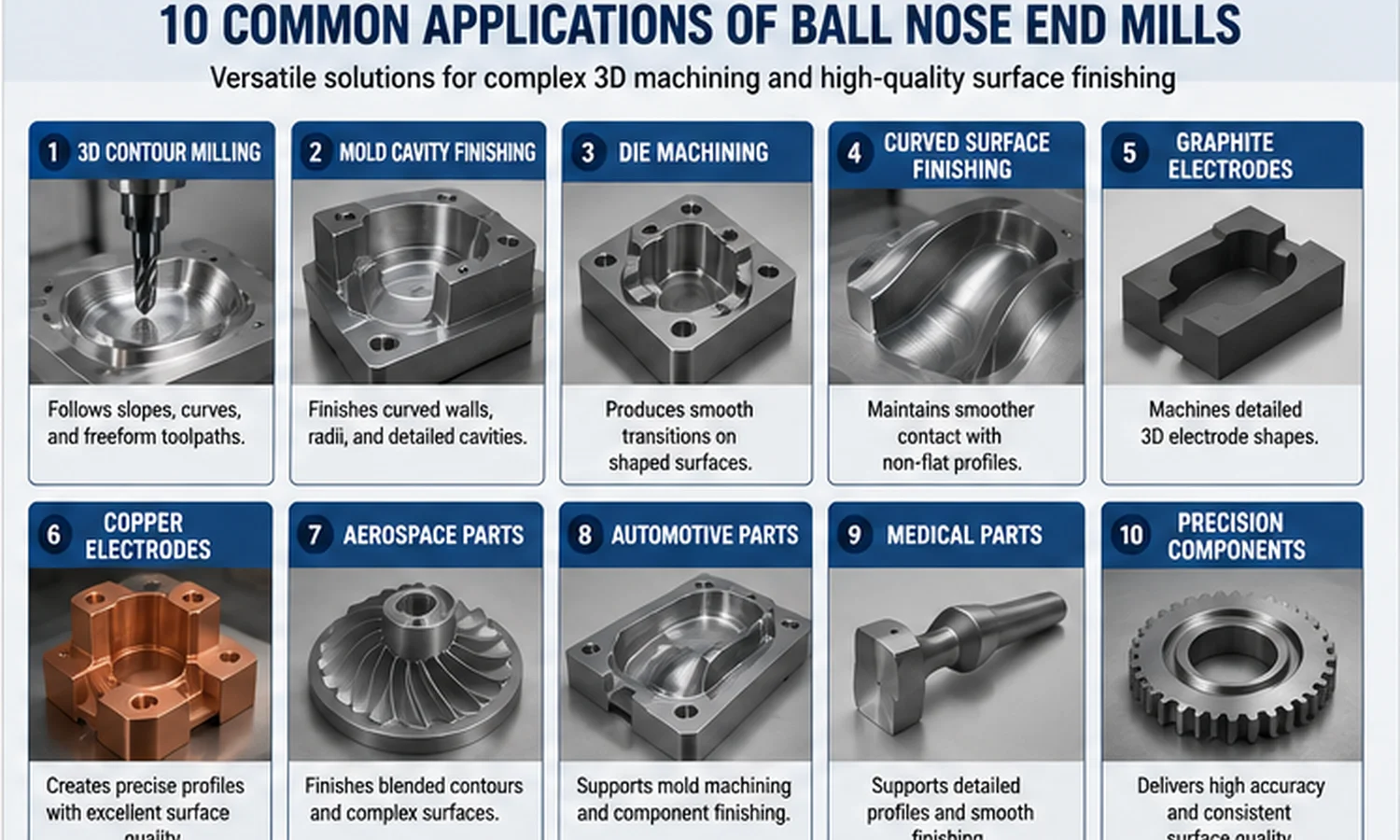
Ball nose end mills are most useful when the workpiece has curved geometry, blended transitions, or complex three-dimensional surfaces.
Ten common applications include:
- 3Fraisage du contour D
- Finition des cavités du moule
- Die and mold machining
- Curved surface finishing
- Radius and profile machining
- Sculpted and freeform machining
- Usinage d'électrodes de graphite
- Copper electrode machining
- Aerospace and automotive part finishing
- Medical and precision component machining
The table below summarizes the main applications.
| CNC Application | Pourquoi utiliser une fraise à bout sphérique? |
| 3Fraisage de contours D | Follows slopes, courbes, and freeform CNC toolpaths |
| Mold Cavity Finishing | Finishes curved walls, radii, and detailed cavities |
| Die Machining | Produces smooth transitions on shaped surfaces |
| Curved Surface Finishing | Maintains smoother contact with non-flat profiles |
| Graphite Electrodes | Machines detailed 3D electrode shapes |
| Aerospace and Automotive Parts | Finishes blended contours and complex surfaces |
| Medical and Precision Parts | Supports detailed profiles and controlled finishing |
A smaller diameter can reach narrow cavities and fine details. Entre-temps, a larger diameter can improve machining efficiency on broader surfaces.
The final cutter selection should match the part geometry, required finish, cavity depth, rigidité de la machine, and programmed toolpath.
Fraise à bout sphérique pour le fraisage de contours 3D
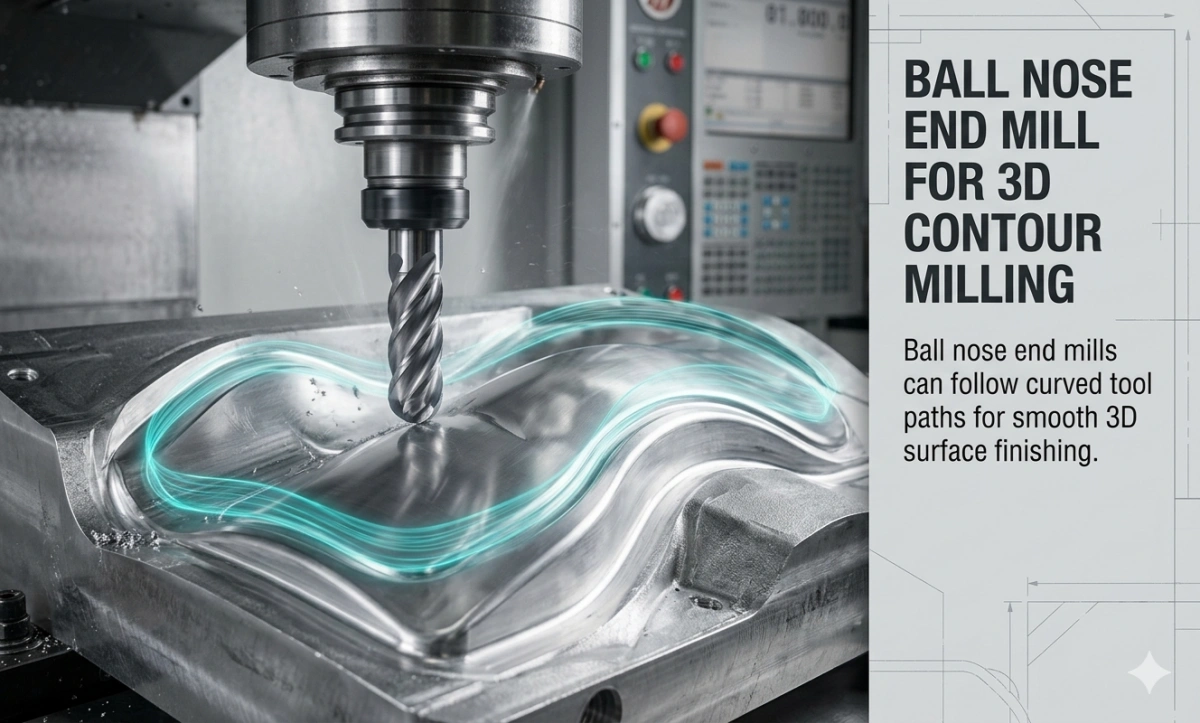
L'une des utilisations les plus courantes d'une fraise à bout sphérique est le fraisage de contours 3D..
During 3D contouring, the cutting tool must follow slopes, courbes, et surfaces de forme libre. A flat end mill may create uneven contact or visible marks on these areas. Par contre, the rounded cutting end follows the changing surface angle more naturally.
Typical 3D contour applications include:
- Cavités de moisissures
- Surfaces de produits incurvées
- Formes sculptées
- Profils CNC complexes
- Prototype parts
- Freeform components
After roughing removes most of the material, the ball nose cutter can complete semi-finishing or final finishing passes. A suitable step-over and stable toolpath help improve the surface before polishing or final treatment.
Fraise à bout sphérique pour la finition des moules et des matrices
Mold and die components often contain cavities, radii, curved walls, et profils détaillés. Donc, mold makers commonly use ball nose end mills during the finishing stage.
D'abord, a flat or roughing cutter removes most of the stock. Suivant, the rounded-end cutter machines the remaining curved areas and blended transitions.
Common mold applications include:
- Moules à injection
- Moules de moulage sous pression
- Moules automobiles
- Matrices d'estampage
- Inserts de moule
- Medical molds
- Precision tooling
Tool stability is especially important during mold finishing. Excessive cutter overhang, poor holder condition, or unsuitable cutting parameters may cause vibration and visible surface marks.
Donc, select the shortest practical tool length and keep the machine setup rigid.
Fraise à bout sphérique pour l'usinage de surfaces courbes
A ball nose cutter works well on rounded, sloped, and non-flat surfaces because its geometry maintains smoother contact with the workpiece.
This makes it useful for:
- Aerospace components
- Automotive parts
- Medical implants and instruments
- Decorative products
- Moules en aluminium
- Precision mechanical components
- Complex prototypes
Dans ces applications, le but n'est pas seulement d'enlever du matériel. Qualité des surfaces, cohérence dimensionnelle, and smooth toolpath transitions also matter.
Par conséquent, machinists often choose a ball nose cutter for the final machining stage rather than heavy stock removal.
Fraise à bout sphérique pour l'usinage du graphite et des électrodes
Graphite and copper electrodes often contain detailed cavities, narrow radii, et des formes 3D complexes. Donc, rounded-end cutters can help machine these profiles accurately.
Pour le graphite, wear resistance and dust control are important. The cutter may require a suitable carbide grade, revêtement, and sharp edge design.
For copper, sharp cutting edges and smooth flutes can help reduce material adhesion and improve the finished surface.
Before selecting the tool, provide:
- Electrode material and grade
- Drawing or 3D model
- Required surface finish
- Diamètre de coupe
- Machining depth
- Quantité
These details help determine the suitable geometry, nuance de carbure, revêtement, and tool length.
Ball Nose Milling Strategy for a Better Surface Finish
The cutter alone does not determine the final finish. Toolpath strategy also has a major effect.
D'abord, use a small and consistent step-over during finishing. A smaller step-over reduces scallop height, although it also increases machining time.
Suivant, avoid unnecessary cutter overhang. A shorter and more rigid setup reduces vibration and helps maintain a consistent surface.
En outre, consider the effective cutting speed near the center of the ball end. The tool center has a lower cutting speed than the outer cutting edge. Donc, an appropriate toolpath or slight tool inclination may reduce rubbing near the center.
Enfin, match the feed rate, vitesse de broche, revêtement, and cutting depth to the workpiece material and machine condition. Trial cuts may be required for demanding surfaces.
Fraise à bout sphérique vs fraise à bout plat
A ball nose end mill and a flat end mill have different cutting geometries and machining purposes.
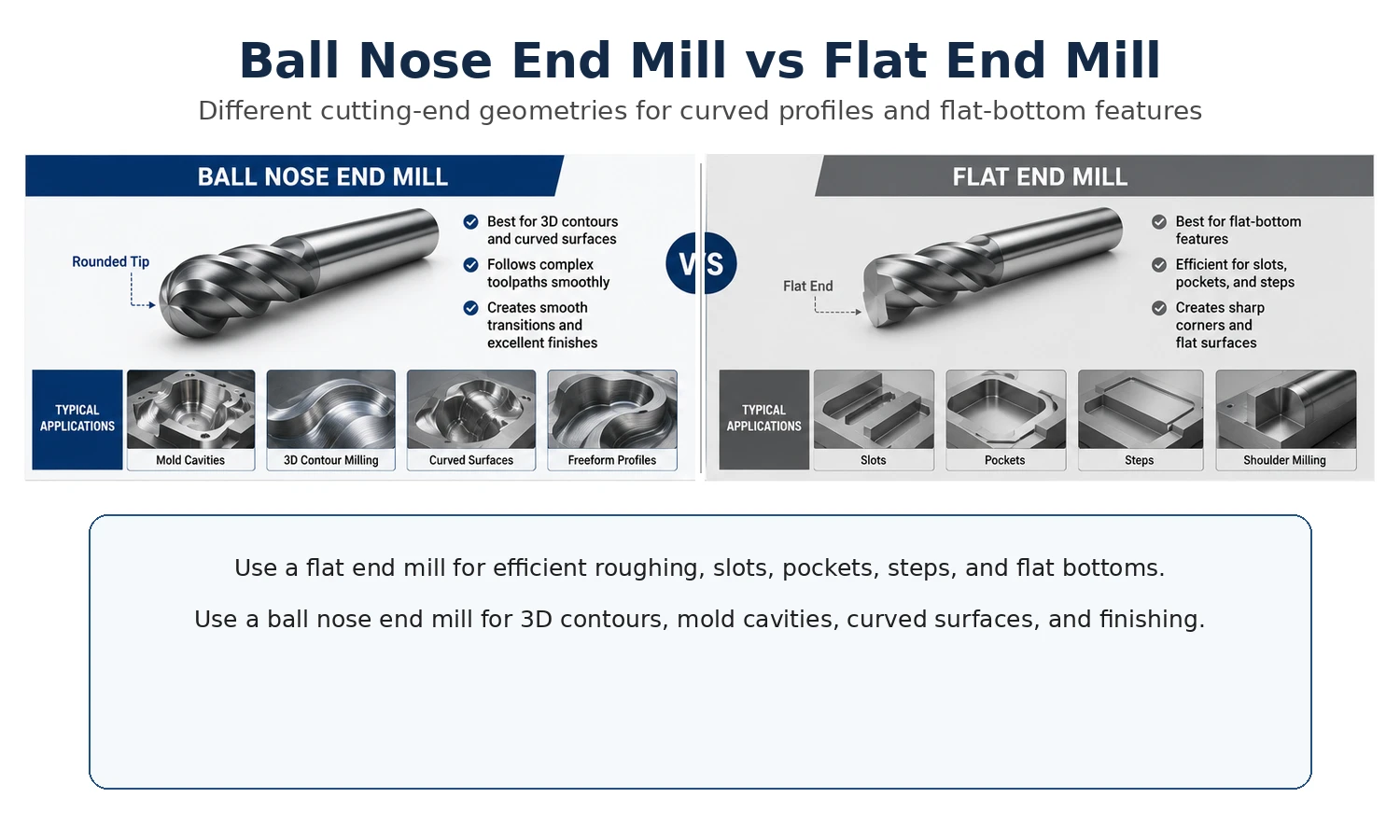
The two tools are often used together. A flat end mill can remove material efficiently during roughing. After that, a ball nose cutter finishes radii, curved cavities, et profils complexes.
For flat-bottom machining, voir notre flat end mill product.
Fraise à bout sphérique vs fraise à nez sphérique
Une fraise à bout sphérique a une pointe de coupe entièrement arrondie. Donc, it works well for smooth 3D finishing, curved profiles, et surfaces de forme libre.
A bull nose end mill has a flat center with rounded corners. Par conséquent, il offre un support de coin plus solide et fonctionne bien pour la semi-finition, profils étagés, and flat areas that require a corner radius.
Pour une comparaison détaillée, lire fraise à nez sphérique vs fraise à nez sphérique.
Comment choisir une fraise à bout sphérique
The correct tool depends on the workpiece material, diamètre de coupe, machining depth, conception de flûte, revêtement, et état de la machine.
Matériau de la pièce
When machining aluminum and copper, sharp cutting edges and efficient chip evacuation can help reduce built-up edges.
Acier, acier inoxydable, and mold materials usually require a suitable carbide grade and heat-resistant coating to improve wear resistance and tool life.
Graphite machining has different requirements. Donc, usure des outils, revêtement, dust control, and edge sharpness should all be considered.
Cutter Diameter and Tool Length
Choose a diameter that matches the workpiece radius, detail size, and available machining space.
En outre, use the shortest practical flute length and overall length. Excessive overhang reduces rigidity and may cause vibration.
Nombre de flûtes
Two-flute designs provide more chip space and often suit aluminum, cuivre, graphite, et des matériaux plus doux.
Four-flute designs provide more cutting edges and may improve stability during steel machining and finishing operations.
Coating and Machine Stability
The coating should match the workpiece material, dureté, cutting temperature, and coolant condition.
Cependant, even the correct coating cannot compensate for excessive runout, poor holder condition, or an unstable machine setup.
For more detailed selection guidance, lire comment choisir une fraise à bout sphérique.
FAQ
What are the main uses of a ball nose end mill?
It is mainly used for 3D contour milling, finition de cavité de moule, usinage de surfaces courbes, finition des matrices, électrodes de graphite, freeform profiles, and precision CNC finishing.
Une fraise à bout sphérique peut-elle couper des surfaces planes?
It can machine some flat areas, but it does not efficiently create a fully flat-bottom profile. A flat end mill usually works better for flat-bottom pockets, machines à sous, steps, et les épaules.
Une fraise à bout sphérique est-elle bonne pour l'usinage de moules?
Oui. Mold makers commonly use ball nose end mills to finish curved cavities, radii, detailed profiles, and complex three-dimensional surfaces.
What materials can ball nose end mills machine?
Ils peuvent usiner l'acier, acier inoxydable, aluminium, cuivre, graphite, fonte, acier moulé, and many alloy materials. Cependant, the carbide grade, revêtement, conception de flûte, and cutting parameters should match the workpiece.
Can a ball nose end mill machine cast iron?
Oui. A carbide ball nose end mill can machine cast iron, especially on curved surfaces, moules, and 3D profiles. Cependant, the carbide grade, revêtement, conception de flûte, and cutting parameters should match the specific cast iron grade.
Quelle est la différence entre les fraises à bout sphérique et les fraises à nez arrondi?
A ball nose end mill has a fully rounded tip for 3D finishing and curved surfaces. A bull nose end mill has a flat center with rounded corners, so it provides stronger edge support for semi-finishing and corner-radius machining.
Send Your Ball Nose End Mill Requirement
En résumé, this rounded-end cutter is mainly selected for CNC applications that require smooth 3D contours, finition du moule, surfaces courbes, électrodes de graphite, et profils de précision.
Need a standard or custom carbide cutter for your CNC machining project?
Send your diameter, longueur de flûte, longueur totale, taille de la tige, nombre de flûtes, revêtement, matériau de la pièce à usiner, dureté, dessin, et la quantité. Our team will review the application and provide a suitable tool proposal and quotation.
Send your requirements to sales@cutterbest.com.