 Fraise de précision,Outils de coupe pour l’usinage CNC de chaque matériau

Ce guide de sélection de fraises explique comment choisir une fraise par opération d'usinage., profil final, matériau de l'outil, nombre de flûtes, revêtement, dimensions, et configuration de la machine. Choisir le mauvais outil peut entraîner une mauvaise évacuation des copeaux, bavarder, usure rapide des bords, erreurs dimensionnelles, bris d'outil, ou une finition de surface incohérente.
Ce guide est écrit pour les machinistes, ingénieurs de procédés, chefs d'atelier, distributeurs, et les acheteurs qui ont besoin d'un point de départ pratique avant de sélectionner ou de demander une fraise en bout.
Qu'est-ce qu'une fraise en bout?
Une fraise en bout est un outil de coupe rotatif utilisé pour le rainurage, empocher, profilage, fraisage latéral, ébauche, finition, et contour 3D. Contrairement à un foret standard, il peut couper à la fois avec les bords coupants d'extrémité et extérieurs.
Certaines conceptions à coupe centrale prennent en charge la rampe, entrée hélicoïdale, ou plongée limitée. Cependant, la géométrie du centre et la méthode d'entrée doivent être adaptées à l'opération.
Pour une explication de base, lire qu'est-ce qu'une fraise en bout.
Guide de sélection rapide des fraises
Le tableau ci-dessous fournit des instructions de départ pratiques. La sélection finale de l'outil doit toujours refléter la qualité de la pièce, diamètre de coupe, profondeur de coupe, état du titulaire, rigidité de la machine, et procédé d'élimination des copeaux.
| Situation d'usinage | Direction de l'outil de démarrage | Raison principale |
|---|---|---|
| Fentes en aluminium ou poches profondes | 2–3 Flûtes, Bord tranchant, Flûtes polies | Plus d'espace pour les puces et moins de risque d'emballage des puces |
| Fraisage latéral général de l'acier | 4 Flûtes, Noyau solide, Revêtement résistant à la chaleur | Equilibre de rigidité, nombre de bords, et évacuation des copeaux |
| Fraisage ou finition latérale en acier inoxydable | 4–6 Flûtes, Géométrie à hélice variable ou à pas inégal | Aide à contrôler les vibrations, chaleur, et coupe instable |
| Ebauche lourde | Nombre de flûtes inférieur ou moyen, Géométrie d'ébauche ou de brise-copeaux | Plus d'espace pour les copeaux et une charge de coupe contrôlée |
| Terminer avec un engagement léger | Nombre de flûtes plus élevé et géométrie stable | Plus de contacts de coupe et une meilleure consistance de la surface |
| Fentes et poches à fond plat | Fraise à bout plat | Produit un fond plat et des parois droites |
| 3D Contours et cavités de moule | Fraise à bout sphérique | L'extrémité arrondie suit les surfaces courbes |
| Semi-finition et coins plus solides | Fraise en bout à nez arrondi ou à rayon de coin | Le rayon renforce le coin de coupe extérieur |
| Caractéristiques profondes avec profondeur de coupe limitée | Outil à col long avec longueur de flûte minimale nécessaire | Réduit la déflexion par rapport à une flûte trop longue |
Utilisez cette matrice comme premier filtre. Après cela, confirmer le profil final, matériau de l'outil, nombre de flûtes, revêtement, dimensions, et configuration de la machine.
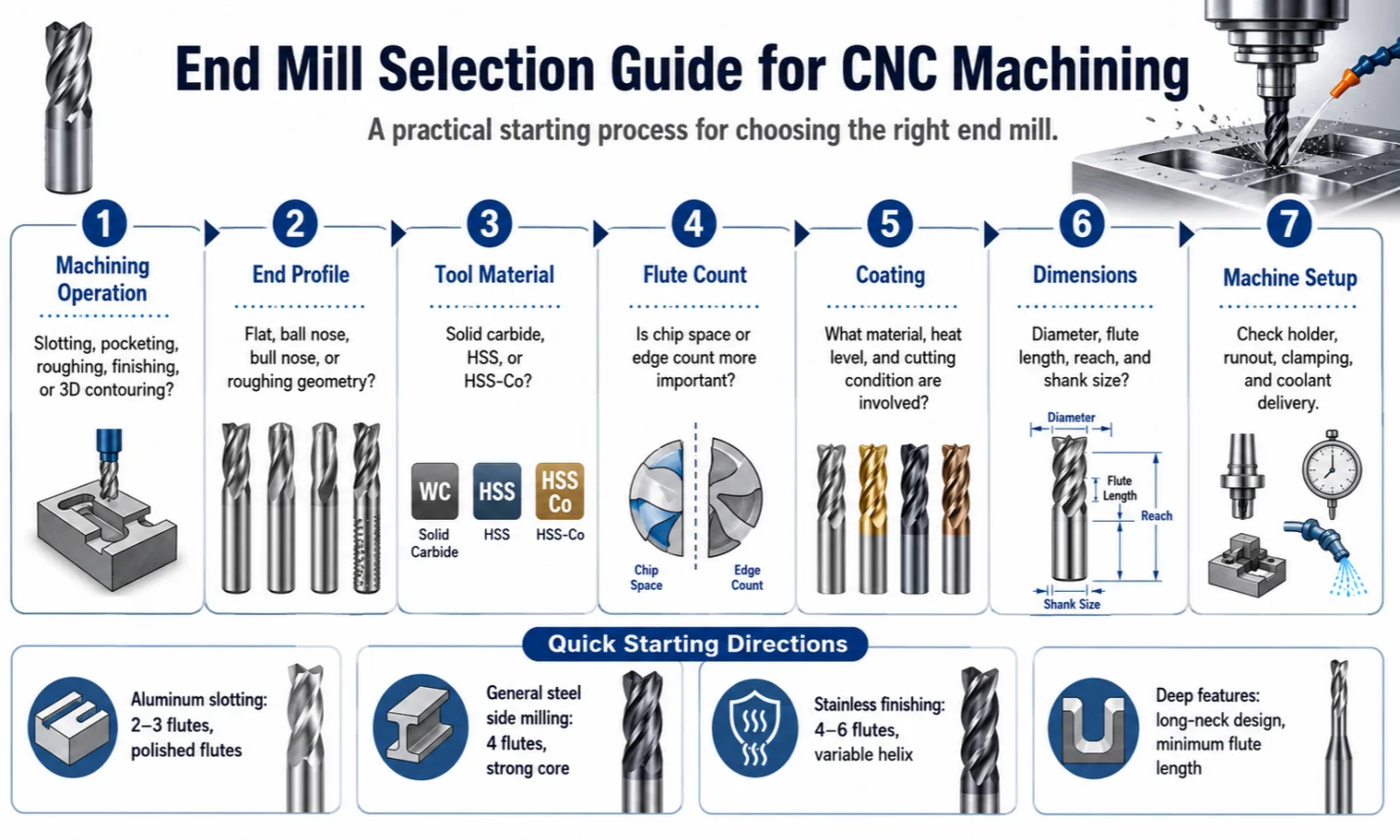
Étape 1: Choisissez une fraise en bout par opération CNC
L'opération d'usinage doit guider la première décision car elle détermine le sens de coupe, volume de copeaux, fiançailles, et surface requise.
Rainurage
La fente sur toute la largeur crée un volume de copeaux élevé car la fraise engage le matériau sur tout son diamètre.
Lors de la découpe d'une fente pleine largeur, donner la priorité à l'espace des puces avant d'augmenter le nombre de flûtes. Commencez avec moins de cannelures lorsque les copeaux sont gros ou que l'évacuation est difficile.
Un outil de rainurage approprié nécessite normalement:
- Assez d'espace pour la flûte
- Évacuation fiable des copeaux
- Une conception à coupe centrale lorsqu'une entrée directe est requise
- Porte-à-faux d'outil court et stable
- Résistance des bords adaptée au matériau
Pour l'aluminium ou d'autres matériaux produisant des copeaux plus gros, 2–3 flûtes fournissent un point de départ pratique. Pour l'acier, le nombre final de flûtes dépend également de la profondeur de la fente, engagement radial, diamètre de coupe, et distribution de liquide de refroidissement ou d'air.
Si des puces restent à l'intérieur de la fente, n'augmentez pas immédiatement l'alimentation et ne modifiez pas le revêtement. Vérifiez d’abord l’espace de la flûte, profondeur de coupe, direction de l'air ou du liquide de refroidissement, et porte-à-faux de l'outil.
Fraisage de poche
Le fraisage de poches peut combiner le ramping, entrée hélicoïdale, coupe latérale, engagement de coin, et finition du bas.
Utilisez une fraise à coupe centrale lorsque l'entrée programmée nécessite une coupe à proximité du centre de l'outil.. Cependant, la coupe centrale ne transforme pas une fraise en bout en foret standard. La géométrie de l'outil et la stratégie d'entrée CAM doivent prendre en charge le mouvement.
Les poches profondes nécessitent également une élimination fiable des copeaux. Les copeaux piégés peuvent être recoupés, ce qui augmente la chaleur et peut endommager le tranchant.
Lorsque la poche est profonde mais que la profondeur de coupe réelle est courte, choisissez un outil à long col plutôt qu'une fraise avec une flûte inutilement longue.
Fraisage latéral et profilage
Le fraisage latéral sollicite les arêtes de coupe extérieures. Par conséquent, engagement radial, rigidité de la fraise, s'épuiser, et la précision des parois latérales devient importante.
Utilisez une fraise à bout plat pour les parois et les épaulements droits. Choisissez un outil à nez arrondi ou à rayon de coin lorsque le coin extérieur a besoin de plus de force.
Pour le fraisage général des côtés de l'acier, un outil à 4 cannelures fournit un équilibre pratique entre le nombre de bords, force de base, et espace pour les puces.
Pour un engagement radial plus léger et une finition stable, 5–6 cannelures peuvent augmenter le nombre de contacts de coupe. Cependant, l'évacuation des copeaux doit rester stable.
Ebauche
L'ébauche produit une charge de coupe et un volume de copeaux élevés. Donc, la fraise a besoin de suffisamment d'espace pour les flûtes et d'une structure de bord capable de gérer l'engagement.
Pour l'ébauche traditionnelle, choisissez un nombre de cannelures inférieur ou moyen lorsque l'élimination des copeaux est difficile. La géométrie d'ébauche ou de brise-copeaux divise les copeaux en sections plus petites et peut réduire la résistance de coupe.
Pour parcours d'outils dynamiques ou trochoïdaux avec engagement radial plus léger, un nombre de cannelures plus élevé peut devenir pratique car chaque flûte enlève un copeau plus petit tandis que l'outil suit une trajectoire d'engagement contrôlée.
La stratégie CAM, rigidité de la machine, état du titulaire, et la géométrie des outils doivent fonctionner ensemble. Un outil d'ébauche haute performance ne peut pas compenser un serrage faible ou un porte-à-faux excessif..
Finition
La finition nécessite une géométrie stable, faux-rond contrôlé, arêtes de coupe constantes, et un profil d'outil qui correspond à la surface requise.
Lorsque l'engagement radial est léger et que l'évacuation des copeaux reste stable, plus de cannelures augmentent le nombre de contacts de coupe et peuvent permettre une finition plus lisse.
Avant de changer le cutter, inspecter:
- Usure de pointe
- Précision du support
- Porte-à-faux d'outil
- Serrage de la pièce
- Cohérence des aliments
- Forme de coin requise
Un outil usé ou un support instable peut produire une mauvaise finition même lorsque le nombre de flûtes est correct..
3D Contournage et usinage de moules
Les fraises à bout sphérique sont largement utilisées pour les surfaces courbes, cavités de moule, meurt, et finition 3D. Leur extrémité arrondie suit les surfaces complexes plus efficacement qu'une extrémité coupante plate..
Les outils à nez arrondi conviennent à la semi-finition et au profilage lorsque des coins extérieurs plus solides sont requis. Leur rayon de coin renforce le tranchant tout en conservant une zone centrale plus plate.
Pour acier de moule trempé, adapter la série d'outils à la dureté réelle de la pièce. Un outil destiné aux matériaux jusqu'à HRC45 peut utiliser une nuance de carbure différente, préparation des bords, et revêtement de celui conçu pour HRC60 ou HRC65.
Étape 2: Sélectionnez le profil final
| Fin du profil | Caractéristique principale | Application commune |
|---|---|---|
| Fraise à bout plat | Extrémité coupante plate avec coins extérieurs pointus | Machines à sous, poches, épaules, surfaces planes, et parois latérales |
| Fraise à bout sphérique | Extrémité coupante entièrement arrondie | 3Contours D, surfaces courbes, meurt, et finition des cavités du moule |
| Fraise à nez arrondi | Extrémité plate avec coins extérieurs arrondis | Profilage, semi-finition, usinage de moules, et des coins plus forts |
| Fraise d'ébauche | Arêtes de coupe dentelées ou brise-copeaux | Enlèvement de matière élevé et usinage grossier |
| Fraise en bout à coupe centrale | Les bords coupants s'étendent à travers ou près du centre | Certaines rampes, entrée hélicoïdale, et opérations de saisie de poche |
Sélectionnez le profil en fonction de la fonctionnalité à usiner.
Une fraise à bout plat produit des éléments à fond plat et des parois droites. Une fraise à nez sphérique suit les surfaces courbes. Un outil à nez arrondi renforce le coin extérieur et convient souvent à la semi-finition.
Une fraise à coupe centrale peut prendre en charge des mouvements d'entrée spécifiques, mais sa capacité de plongée dépend de la géométrie du centre, diamètre de coupe, matériau de la pièce à usiner, et parcours d'outil programmé.
Pour une comparaison plus détaillée, lisez notre types de fraises en bout et guide d'utilisation.
Étape 3: Choisissez le carbure monobloc ou le HSS
Le matériau de l'outil affecte la rigidité, dureté, résistance à l'usure, potentiel de vitesse de coupe, et le coût.
Fraises en carbure monobloc
Le carbure monobloc offre une grande rigidité, bonne résistance à l'usure, et des performances dimensionnelles stables dans des conditions d'usinage appropriées.
Choisissez le carbure monobloc lorsque l'application l'exige:
- Usinage CNC à des vitesses de coupe plus élevées
- Précision dimensionnelle stable
- Acier, acier inoxydable, fonte, ou usinage de l'acier moulé
- Des séries de production plus longues
- Qualité de surface constante
- Diamètres de fraises petits ou moyens avec une rigidité machine suffisante
Le carbure est moins tolérant aux chocs, voile excessif, serrage instable, et de fortes vibrations. Donc, la machine et le support doivent supporter l'outil.
Pour les options en carbure monobloc, voir notre page produit de la fraise en bout en carbure.
Fraises HSS et HSS-Co
Le HSS et le HSS au cobalt offrent une plus grande ténacité et peuvent mieux tolérer les vibrations ou les coupes interrompues dans certaines applications..
Choisissez HSS ou HSS-Co lorsque:
- La machine fonctionne à une vitesse de broche inférieure
- La configuration a une rigidité limitée
- La coupe est interrompue
- Un cutter personnalisé plus grand est requis
- La quantité commandée est petite
- La robustesse compte plus que la vitesse de coupe maximale
Pour une machine à faible rigidité, HSS-Co peut mieux tolérer les vibrations et les coupes interrompues que le carbure monobloc. Cependant, le carbure offre généralement une rigidité et une résistance à l'usure plus élevées lorsque la configuration est stable.
Le choix final doit refléter la machine, pièce à usiner, taille de coupe, opération de coupe, quantité, et objectif de coût.
Étape 4: Choisissez le nombre de flûtes
Le nombre de flûtes modifie l'espace des puces, force de base, capacité d'alimentation, et le nombre d'arêtes de coupe.
| Nombre de flûtes | Direction générale de la sélection |
|---|---|
| 2 Flûtes | Espace maximum pour les puces; utile lorsque l'évacuation des copeaux est la première priorité |
| 3 Flûtes | Équilibre entre l'espace des puces, rigidité, et un comptage de pointe |
| 4 Flûtes | Direction commune pour le fraisage général de l'acier et la coupe latérale |
| 5–6 Flûtes | Plus d'arêtes de coupe pour un fraisage latéral stable ou une finition avec engagement contrôlé |
Utilisez 2 à 3 cannelures lorsque l'espace des puces est la priorité principale. Cela s'applique souvent aux fentes en aluminium, poches profondes, et les opérations qui produisent des puces plus grosses.
Utiliser 4 flûtes comme point de départ pratique pour de nombreuses applications générales d'acier et de fraisage latéral.
Choisissez 5 à 6 cannelures lorsque l'engagement radial est plus léger, la machine est rigide, et l'évacuation des copeaux est déjà contrôlée.
Un plus grand nombre de cannelures ne rend pas automatiquement un outil adapté aux matériaux plus durs. En fente pleine largeur, trop de cannelures peuvent emprisonner les copeaux et provoquer de la chaleur, dommages aux bords, ou casse d'outil.
Pour une explication plus approfondie, lisez notre guide de sélection des flûtes de fraise en bout.
Pour une comparaison directe, lire 2 flûte contre 4 flûte contre 6 fraise à cannelure.
Étape 5: Choisissez des fraises en bout avec ou sans revêtement
Le revêtement affecte la friction, résistance à la chaleur, résistance à l'usure, adhérence du matériau, et une protection de pointe.
Utilisez le tableau suivant comme direction de sélection plutôt que comme règle fixe.
| Direction de la pièce | Revêtement ou direction de la surface | Considération principale |
|---|---|---|
| Aluminium et matériaux non ferreux | Non couché, Brillant, Contenu téléchargeable, ou revêtement approprié à faible friction | Réduit l’adhérence et favorise le flux des copeaux |
| Acier au carbone et allié | TiAlN, Or, ou revêtement résistant à la chaleur approprié | Résistance à la chaleur et protection des bords |
| Acier inoxydable | AlCrN, TiAlN, Or, ou revêtement spécifique à l'application | Chaleur, porter, et stabilité de coupe |
| Graphite et composites abrasifs | Outils diamantés | Résistance à l'usure abrasive |
| Applications générales à faible vitesse | Options TiN ou non revêtues | Lubrification et protection générale contre l’usure |
Aluminium et matériaux non ferreux
Pour l'aluminium, commencer par un bord tranchant, flûte polie, et surface non revêtue ou à faible friction.
Un revêtement à haute résistance thermique n’est pas automatiquement adapté à l’aluminium. Si la surface augmente l'adhérence du matériau, Des bords accumulés et un mauvais écoulement des copeaux peuvent se produire.
Acier
Pour acier au carbone et allié, TiAlN, Or, TiSiN, ou un autre revêtement résistant à la chaleur approprié peut protéger le tranchant.
À mesure que la dureté de la pièce et la température de coupe augmentent, nuance de carbure, préparation des bords, et le revêtement deviennent plus importants.
Acier inoxydable
Pour l'acier inoxydable, choisissez un revêtement et une géométrie qui prennent en charge le contrôle de la chaleur et la stabilité de la coupe.
AlCrN, TiAlN, ou AlTiN peut fournir des indications de départ utiles, mais le choix final doit correspondre à la qualité de l'acier inoxydable, opération, nombre de flûtes, état du liquide de refroidissement, et charge de coupe.
Outils diamantés
Les fraises en bout diamantées conviennent au graphite, composites, matériaux non ferreux abrasifs, et autres applications spécifiques.
N'utilisez pas de revêtement diamanté comme choix universel pour tous les métaux. La chimie de la pièce et les conditions de coupe doivent être compatibles.
Le revêtement exact doit correspondre à la qualité du carbure, géométrie de l'outil, qualité de la pièce, opération de coupe, et état du liquide de refroidissement.
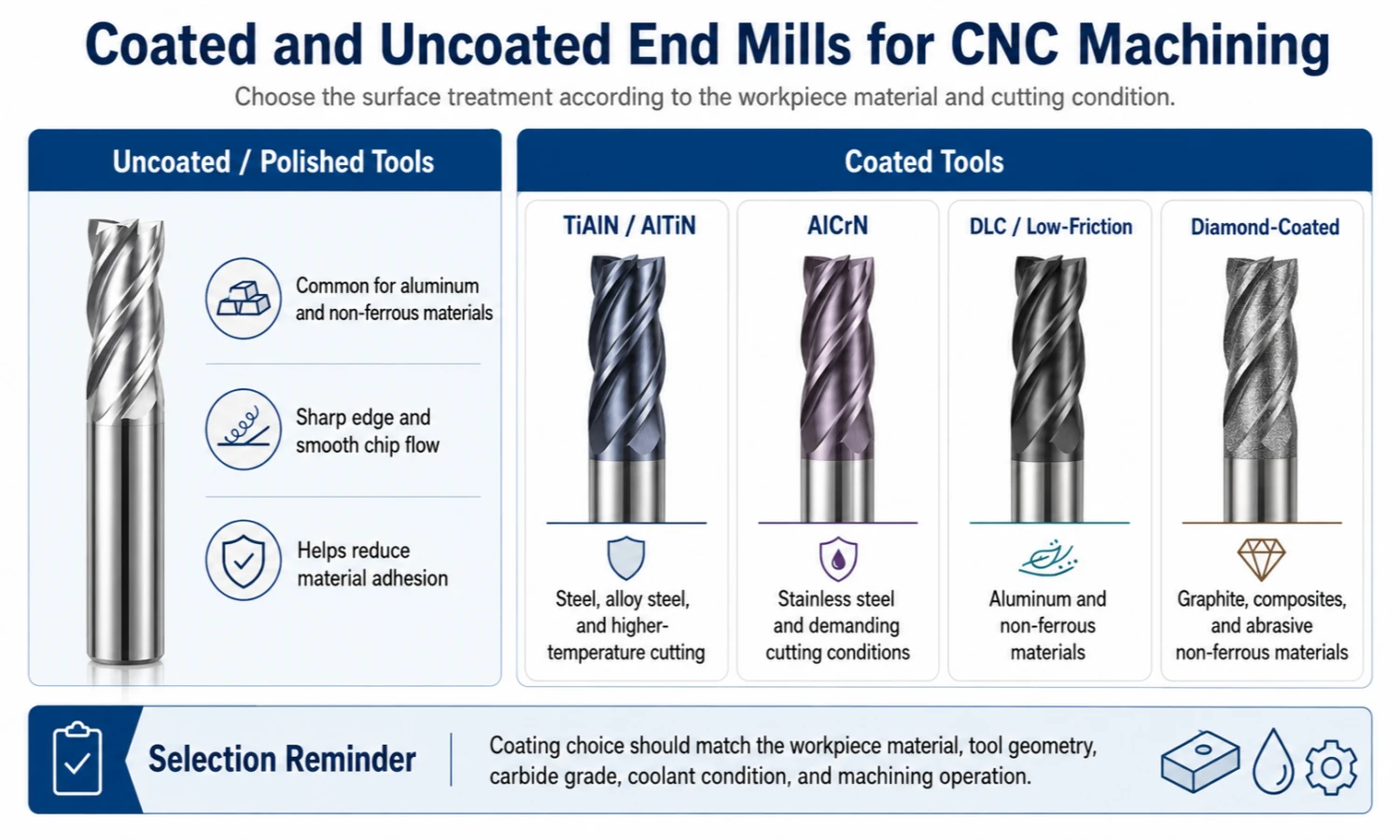
Étape 6: Confirmer les dimensions et la géométrie
Le diamètre de la fraise n'est qu'une partie des spécifications de l'outil.
Avant de commander, confirmer:
- Diamètre de coupe
- Longueur de flûte
- Longueur totale
- Diamètre de la tige
- Profondeur d'usinage requise
- Portée de l'outil
- Rayon d'angle
- Angle d'hélice
- Nombre de flûtes
- Exigence de coupe centrale
- Tolérance dimensionnelle
Utiliser l'outil pratique le plus court qui atteint la zone d'usinage.
Si la portée requise est longue mais la profondeur de coupe est courte, choisissez un outil à long col plutôt qu'une fraise avec une flûte inutilement longue. Une section de coupe plus courte peut offrir une meilleure rigidité.
Une longueur excessive de la flûte ou une longueur totale augmente le risque de:
- Bavarder
- Déviation de l'outil
- Erreur dimensionnelle
- Usure inégale
- Écaillage des coins
- Casse d'outil
Choisissez une fraise personnalisée lorsque les dimensions ou la géométrie standard ne peuvent pas atteindre la fonction ou atteindre le diamètre requis, rayon de coin, tolérance, revêtement, ou cible de l'application.
Étape 7: Machine à vérifier, Titulaire, et conditions de serrage
La bonne fraise en bout peut toujours avoir des performances médiocres dans une configuration instable.
Porte-à-faux d'outil
Le long porte-à-faux réduit la rigidité. Maintenir l'outil aussi près du support que la profondeur d'usinage le permet.
Avant de changer le revêtement ou le nombre de flûtes, vérifiez si le couteau s'étend plus loin que nécessaire.
Extrémité du support
Le faux-rond peut obliger un tranchant à supporter plus de charge que les autres. Cela provoque une usure inégale et peut conduire à une mauvaise finition de surface, écaillage, ou panne prématurée.
Inspecter le support, collet, propreté de la tige, et l'assise de l'outil lorsqu'une flûte présente plus d'usure que les autres.
Rigidité des machines
État de la broche, précision du support, structure de la machine, et le serrage de la pièce affectent tous le résultat.
Un outil en carbure rigide ne peut pas corriger le mouvement de la pièce ou du support..
Livraison de copeaux et de liquide de refroidissement
L'air ou le liquide de refroidissement doit atteindre la zone de coupe.
Une mauvaise livraison peut laisser des jetons dans des poches et des fentes profondes. L'outil recoupe ensuite ces copeaux, ce qui augmente la chaleur et endommage le bord.
Serrage de la pièce
Le mouvement de la pièce à usiner peut ressembler à un problème d'outil.
Avant de changer le cutter, confirmer que le dispositif maintient la pièce en toute sécurité et que le parcours d'outil ne crée pas de vibrations inutiles.
Comment le matériau de la pièce affecte la sélection de la fraise en bout
Le matériau de la pièce reste important, mais il doit être considéré en même temps que l'opération d'usinage.
- L'aluminium a besoin d'arêtes vives et de suffisamment d'espace pour les copeaux.
- Les aciers au carbone et alliés nécessitent des bords de coupe plus solides et une résistance à l'usure..
- L'acier inoxydable a besoin d'une coupe stable pour contrôler la chaleur et l'écrouissage.
- La fonte a besoin d'une bonne résistance à l'abrasion.
- L'acier pour moules et outils nécessite une série d'outils adaptée à la dureté réelle.
- Les alliages de titane nécessitent un contrôle minutieux de la chaleur et un engagement stable.
Pour une sélection détaillée basée sur les matériaux, lire comment choisir une fraise en carbure.
Problèmes de sélection et de configuration de la fraise en bout
| Symptôme | Cause possible | Première direction de réglage |
|---|---|---|
| Pack de jetons à l'intérieur de la fente | Trop de flûtes, espace de flûte insuffisant, mauvaise évacuation des copeaux | Réduire le nombre de flûtes, améliorer la distribution d'air ou de liquide de refroidissement, et vérifiez la longueur de la flûte |
| Casse d'outil | Emballage de copeaux, porte-à-faux excessif, support instable, engagement lourd | Améliorer l'élimination des copeaux, raccourcir la portée, vérifier le serrage, et réduire l'engagement instable |
| Marques de bavardage | Long porte-à-faux, configuration faible, forces de coupe répétitives | Raccourcir l'outil, améliorer le serrage, et considérons la géométrie à hélice variable |
| Mauvaise finition de surface | Bord usé, s'épuiser, alimentation instable, profil d'extrémité inapproprié | Inspecter l'outil et le support, stabiliser la coupe, et sélectionnez le bon profil |
| Usure rapide des bords | Mauvaise qualité de carbure, revêtement, ou état de coupe | Faites correspondre la qualité et le revêtement au matériau, dureté, chaleur, et fonctionnement |
| Écaillage des coins | Coin pointu sous forte charge, vibration, coupe interrompue | Considérez un rayon de coin et améliorez la stabilité de l'installation |
| Bord rapporté en aluminium | Frottement élevé, bord mat, surface rugueuse de la flûte, mauvais débit de copeaux | Utilisez une géométrie polie et améliorez l'évacuation des copeaux |
Un problème d'usinage peut avoir plusieurs causes. Changer uniquement le nombre de revêtements ou de flûtes peut ne pas résoudre le problème..
Commencez par la configuration, flux de copeaux, état de l'outil, et engagement. Évaluez ensuite si la géométrie de l'outil doit changer.
Erreurs courantes de sélection des fraises en bout
Choisir par diamètre uniquement
Deux fraises en bout de même diamètre peuvent avoir des longueurs de flûte différentes, la flûte compte, profils d'extrémité, nuances de carbure, revêtements, et applications.
Consultez toujours la spécification complète.
Ignorer l'évacuation des copeaux
Une mauvaise évacuation des copeaux provoque de la chaleur, recoupe de copeaux, bord bâti, bavarder, et casse d'outil.
Ce problème est particulièrement fréquent lors du slotting pleine largeur, poches profondes, et usinage de l'aluminium.
Utiliser trop de porte-à-faux d’outils
Une portée excessive réduit la rigidité.
Utiliser l'outil le plus court qui atteint en toute sécurité la profondeur d'usinage. Si la fonctionnalité est profonde, envisager une conception à col long avec la longueur de coupe minimale nécessaire.
Choisir plus de flûtes sans vérifier l'espace de la puce
Un plus grand nombre d'arêtes de coupe améliore la capacité d'avance et l'uniformité de la surface lorsque l'engagement est léger et que le flux de copeaux reste stable.
En fente profonde, cependant, un nombre excessif de cannelures peut piéger les copeaux et endommager la fraise.
Choisir un revêtement par son nom uniquement
Un revêtement plus cher n’est pas automatiquement meilleur.
Faites correspondre le revêtement avec le matériau, nuance de carbure, géométrie, liquide de refroidissement, température de coupe, et fonctionnement.
Utiliser une fraise en bout pour chaque opération
Une fraise à dégrossir, outil de finition, fraise à rainurer, et la fraise à nez sphérique effectuent différents travaux.
Choisissez la fraise en bout en fonction de la caractéristique et de l'étape d'usinage plutôt que d'utiliser un outil général pour chaque opération.
FAQ
Une fraise en bout peut-elle percer un trou?
Certaines fraises à coupe centrale prennent en charge la rampe, entrée hélicoïdale, ou plongée limitée. Cependant, ils ne devraient pas remplacer automatiquement un foret.
Confirmer la géométrie centrale, diamètre de coupe, matériau de la pièce à usiner, et méthode d'entrée programmée avant d'utiliser une fraise en bout pour l'entrée axiale.
Dois-je choisir du carbure ou du HSS pour une machine à faible rigidité?
HSS ou HSS-Co peuvent offrir plus de ténacité et de tolérance aux vibrations sur une machine à vitesse inférieure ou moins rigide.
Le carbure offre une plus grande rigidité et résistance à l'usure, mais il a besoin d'un support stable, faux-rond contrôlé, et serrage fiable.
Pourquoi une fraise se brise-t-elle pendant le rainurage?
Les causes courantes incluent l'emballage des puces, nombre excessif de flûtes, trop de porte-à-faux de l'outil, serrage instable, engagement lourd, et une mauvaise alimentation en liquide de refroidissement ou en air.
Vérifiez l'évacuation des copeaux et la stabilité de l'installation avant de supposer que la nuance carbure est le seul problème..
Quand dois-je choisir une fraise à hélice variable?
Choisissez une géométrie à hélice variable ou à pas inégal lorsque les forces de coupe répétitives créent des vibrations lors du fraisage latéral, profilage, ou finition.
La conception peut réduire les vibrations, mais cela nécessite toujours un support rigide et un serrage stable de la pièce.
Quand dois-je utiliser une fraise à long col au lieu d'une fraise à longue cannelure?
Utilisez un outil à col long lorsque la fonction nécessite une portée supplémentaire mais uniquement une section de coupe courte..
La longueur réduite de la flûte offre normalement plus de soutien qu'un tranchant inutilement long..
Quelles informations sont utiles lors de la demande d'une fraise personnalisée?
Envoyer les dimensions d'outils disponibles, dessin, image du produit, matériau de la pièce à usiner, opération d'usinage, fonctionnalité requise, modèle d'outil actuel, quantité, et tout problème d'usinage existant.
Vous n'avez pas besoin de préparer chaque détail avant de contacter le fournisseur. Les spécifications manquantes peuvent être confirmées lors du processus de devis.
Besoin d'aide pour sélectionner la bonne fraise?
La fraise droite dépend de l'opération d'usinage, matériau de la pièce à usiner, forme des caractéristiques, dimensions requises, configuration de la machine, et cible d'état de surface.
Envoyez-nous votre dessin, modèle d'outil, dimensions requises, image du produit, échantillon, ou informations d'usinage disponibles. Avec 16 années d'expérience dans la fabrication d'outils de coupe, nous pouvons examiner l'application et vous aider à confirmer une direction d'outil standard ou personnalisée appropriée.
Consultez nos standards et nos personnalisés page produit de la fraise en bout.
Pour discuter de votre candidature, envoyez-nous un e-mail à sales@cutterbest.com.