 Fraise de précision,Outils de coupe pour l’usinage CNC de chaque matériau

Introduction
Qu'est-ce qu'une fraise à nez arrondi? Il s'agit d'une fraise à fond plat avec un rayon défini aux coins coupants. Cette géométrie est également couramment décrite dans les catalogues d'outillage comme un fraise en bout à rayon de coin, bien que le nom puisse varier selon les fabricants.
Le fond plat permet à la fraise d'usiner les surfaces inférieures, tandis que les coins arrondis créent une transition arrondie du bas au mur au lieu d'un résultat de coin de coupe net..
Les fraises à nez arrondi sont couramment utilisées pour le contourage, fraisage de profil, usinage de cavités, semi-finition, et autres opérations CNC où la géométrie de la pièce autorise ou nécessite un rayon de coin.
Qu'est-ce qu'une fraise à nez arrondi?
Une fraise à nez arrondi a un fond plat avec coins arrondis entre le tranchant inférieur et le tranchant latéral.
Cette géométrie le distingue de deux autres profils de fraises courants. Une fraise carrée ou plate a un coin coupant pointu, tandis qu'une fraise à bout sphérique a une extrémité coupante entièrement arrondie. Une fraise à nez arrondi maintient le fond plat tout en ajoutant un rayon de coin défini.
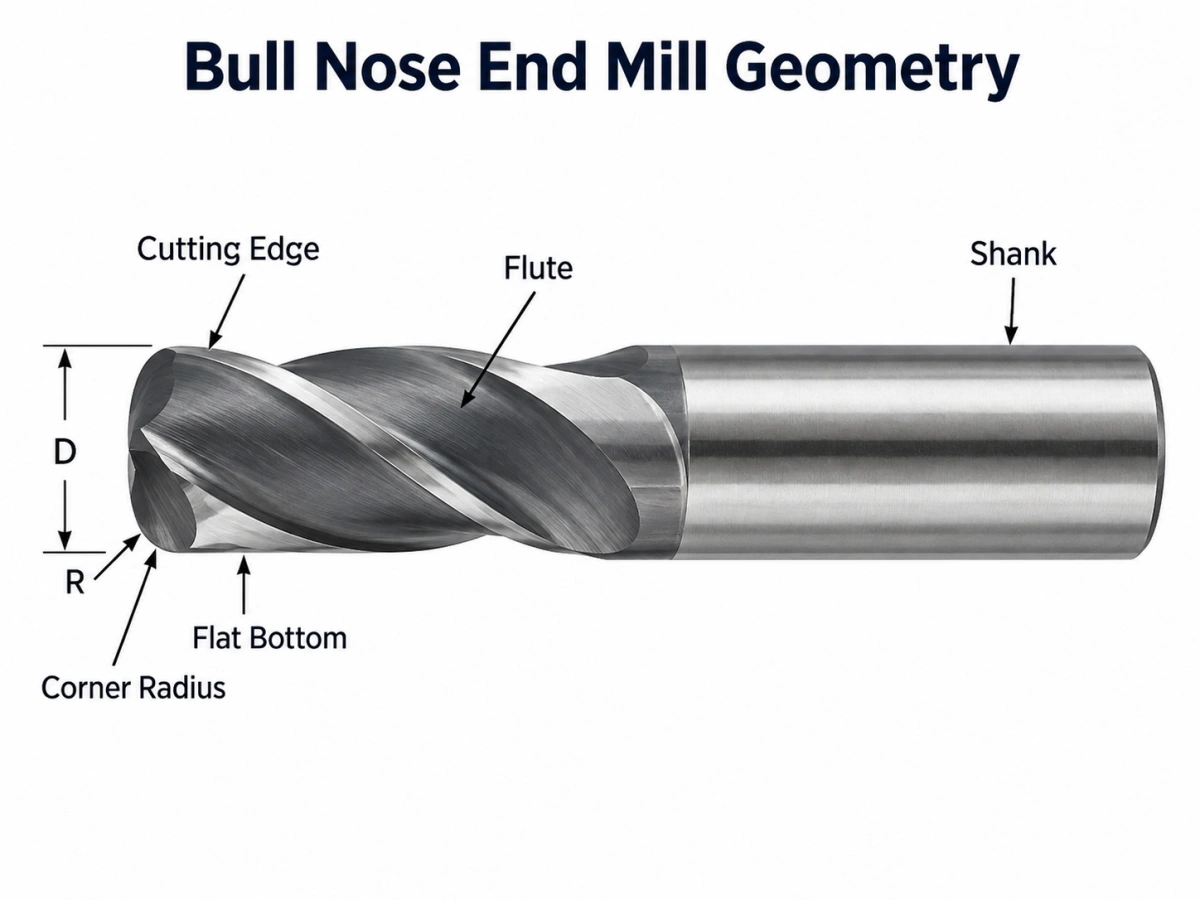 Par conséquent, l'outil est utile lorsqu'une pièce nécessite une fonction plate ou étagée ainsi qu'une transition rayonnée du bas au mur.
La fraise exacte doit encore correspondre aux dimensions requises de la pièce, géométrie des coins, atteindre, et conditions d'usinage.
Terminologie des fraises en bout à nez arrondi et des fraises en bout à rayon de coin
Les termes fraise à nez arrondi et fraise en bout à rayon de coin décrivent souvent une géométrie de fraise à fond plat étroitement liée avec des coins de coupe arrondis.
« Fraise en bout à rayon de coin » est un terme courant dans le catalogue car il décrit directement la géométrie de l'outil.. La « fraise à nez arrondi » est également largement utilisée par les acheteurs, machinistes, et fournisseurs.
Cependant, les conventions de dénomination peuvent varier selon les fabricants. Certains catalogues peuvent utiliser les termes différemment ou séparer les familles de produits en fonction de la taille du rayon., série, ou demande.
Pour cette raison, ne vous fiez pas uniquement au nom du produit. Confirmer le diamètre réel de la fraise, rayon de coin, géométrie de la flûte, et autres dimensions requises avant de commander.
Pour les configurations de produits disponibles, voir notre Fraise à nez arrondi.
Pourquoi le rayon du coin est important
Le rayon d'angle est situé à l'endroit où le fond plat de la fraise passe au bord de coupe latéral..
Ce rayon modifie la géométrie produite lors de la transition du bas vers la paroi de l'élément usiné.. Au lieu de laisser la géométrie à coins pointus associée à une fraise à profil carré, la géométrie du nez de taureau crée ou suit une transition arrondie.
Le rayon requis doit donc correspondre au dessin et à la géométrie de la pièce finie..
Un rayon plus grand ou plus petit ne doit pas être choisi uniquement à partir d'une règle générale. La valeur R exacte dépend de la fonctionnalité requise, dimensions de la fraise, exigence d'usinage, et conception de pièces.
À quoi sert une fraise à nez arrondi?
Les fraises à nez arrondi sont utilisées dans les applications de fraisage CNC où la géométrie de la pièce bénéficie d'un fond plat combiné à un rayon d'angle..
Les applications typiques incluent:
- Fraisage de contours
- Fraisage de profil
- Semi-finition
- Usinage de cavités
- Usinage de moules et de matrices
- Fonctions étagées avec coins inférieurs arrondis
- Transitions du bas au mur où un rayon d'angle est requis
Le même type de fraise peut être utilisé pour différents matériaux de pièce à usiner, mais la configuration finale de l'outil doit correspondre au matériau et aux conditions d'usinage.
Par exemple, nuance de carbure, géométrie de la flûte, revêtement ou traitement de surface, dimensions de l'outil, et la conception de la coupe peut varier en fonction de l'application réelle.
Donc, le nom de l'outil à lui seul ne détermine pas la configuration d'usinage complète.
Sélection de base de fraises à nez arrondi
La sélection d'une fraise arrondie commence par la géométrie de la pièce plutôt que par une règle générale de performance..
Géométrie des pièces et des coins
D'abord, vérifie le dessin.
Confirmez si la fonctionnalité:
- Nécessite un rayon de coin
- Permet une transition arrondie
- Nécessite un fond plat
- A suffisamment d'accès pour le diamètre de coupe sélectionné
- Nécessite plutôt un coin interne pointu
Si le dessin nécessite un résultat de coin de coupe net à 90 degrés sans rayon spécifié, une géométrie en nez de taureau n'est peut-être pas le bon choix pour cette fonctionnalité.
Dimensions de l'outil
Le diamètre de la fraise et le rayon du coin doivent correspondre à la fonction à usiner..
Longueur de coupe, portée de l'outil, taille de la tige, et la géométrie globale de l'outil doit également être adaptée à la configuration de la pièce et de la machine..
Cette page ne répertorie pas toutes les combinaisons de tailles possibles car les configurations standard et personnalisées varient. Pour les dimensions réelles et les options de produits disponibles, voir le Fraise à nez arrondi fiche produit.
Exigence de pièce à usiner et d'usinage
Après avoir confirmé la géométrie de base, la configuration finale de la fraise dépend de la pièce à usiner et des exigences d'usinage.
Différentes applications peuvent nécessiter une géométrie de flûte différente, revêtement ou traitement de surface, longueur de l'outil, conception à coupe centrale, ou exigences de tolérance.
Pour les applications non standards, les informations de dessin et d'usinage constituent la meilleure base pour confirmer l'outil final.
Comparaisons des fraises en bout associées
Une fraise à nez arrondi est parfois comparée à d'autres profils de fraises, mais chaque comparaison a une question de sélection différente.
Si vous avez besoin d'une comparaison précise, voir Bull Nose vs fraise à bout plat.
Pour la différence entre une fraise arrondie à fond plat et une extrémité coupante entièrement arrondie, voir Fraise à nez sphérique vs fraise à nez sphérique.
Nez de taureau / les fraises à rayon d'angle sont également différentes des fraises à arrondir les coins. Voir Rayon de coin vs fraise en bout d'arrondi de coin.
FAQ
Qu'est-ce qu'une fraise à nez arrondi?
Une fraise à nez arrondi est une fraise à fond plat avec un rayon défini aux coins coupants. Le rayon d'angle crée une transition arrondie entre le fond usiné et la paroi latérale.
À quoi sert une fraise à nez arrondi?
Les utilisations typiques incluent le fraisage de contours, fraisage de profil, semi-finition, usinage de cavités, usinage de moules et de matrices, et des caractéristiques qui nécessitent une transition arrondie du bas au mur.
L'application réelle dépend de la géométrie de la pièce et de la configuration de l'outil..
Une fraise à nez arrondi est-elle la même chose qu'une fraise à rayon d'angle?
Les termes sont souvent utilisés pour désigner des fraises à fond plat étroitement liées avec des coins coupants arrondis., et « fraise en bout à rayon de coin » est une description courante dans le catalogue pour cette géométrie..
Cependant, la terminologie peut varier selon les fabricants, le rayon réel et la géométrie de la fraise doivent donc toujours être confirmés.
Comment choisir une fraise arrondie?
Commencez par le dessin de la pièce et la géométrie des coins requise.
Confirmer le diamètre de la fraise, rayon de coin, portée requise, et d'autres dimensions. Tenez ensuite compte du matériau de la pièce à usiner et des exigences d'usinage lors de la confirmation de la géométrie finale de la flûte., revêtement ou traitement de surface, et conception d'outils.
Pour dimensions standards ou configurations personnalisées, se référer au Fraise à nez arrondi fiche produit.
Une fraise à nez arrondi est-elle la même chose qu'une fraise à arrondir les coins?
No.
Une fraise en bout à nez arrondi ou à rayon de coin a un rayon sur les coins coupants de l'outil lui-même. Une fraise à arrondir les coins est une fraise de forme différente utilisée pour produire un profil arrondi sur le bord d'une pièce à usiner..
Pour la distinction détaillée, voir Rayon de coin vs fraise en bout d'arrondi de coin.
Conclusion
Une fraise à nez arrondi combine un fond de coupe plat avec des coins de coupe arrondis. Il est couramment utilisé lorsque la pièce nécessite une fonction plate ou étagée ainsi qu'une transition rayonnée du bas au mur..
Le bon cutter dépend du dessin, rayon de coin, dimensions de l'outil, pièce à usiner, et les exigences d'usinage plutôt que sur une configuration fixe.
Si vous avez besoin d'aide pour confirmer une fraise à nez arrondi pour votre part, envoyez vos besoins en matière de dessin ou d'usinage par e-mail ou contactez-nous directement au WhatsApp.