 Прецизионные фрезы,Режущие инструменты для обработки любого материала с ЧПУ

Этот 2 флейта против 4 флейта против 6 flute end mill guide explains how flute count affects chip space, typical core size, cutting contacts, feed-rate potential, и качество поверхности.
Use two flutes when chip volume is the main constraint. Choose four flutes when you need a balanced general-purpose cutter. Select six flutes when engagement is controlled and more cutting contacts support stable side milling or finishing.
The final choice also depends on the workpiece material, диаметр фрезы, глубина резания, радиальное зацепление, вылет инструмента, состояние держателя, жесткость машины, и требуемая обработка поверхности.
Quick 2 Флейта против 4 Флейта против 6 Сравнение концевых фрез с флейтой
| Comparison | 2 Флейта | 4 Флейта | 6 Флейта |
|---|---|---|---|
| Чип Космос | Most | Balanced | Уменьшенный |
| Режущие кромки | 2 | 4 | 6 |
| Typical Core Size | Меньший | Medium | Larger |
| Общее приложение | Slotting and chip-heavy cutting | General milling and profiling | Стабильное боковое фрезерование и чистовая обработка |
| Основное преимущество | Easier chip evacuation | Balance of chip space and edge count | Больше обрезных контактов |
| Основное ограничение | Fewer cutting contacts | Less chip space than 2 Флейты | Not suitable for heavy full-width slotting |
These are typical design directions. Actual core diameter and tool rigidity also depend on flute depth, диаметр фрезы, угол спирали, длина канавки, диаметр шейки, and the complete tool geometry.
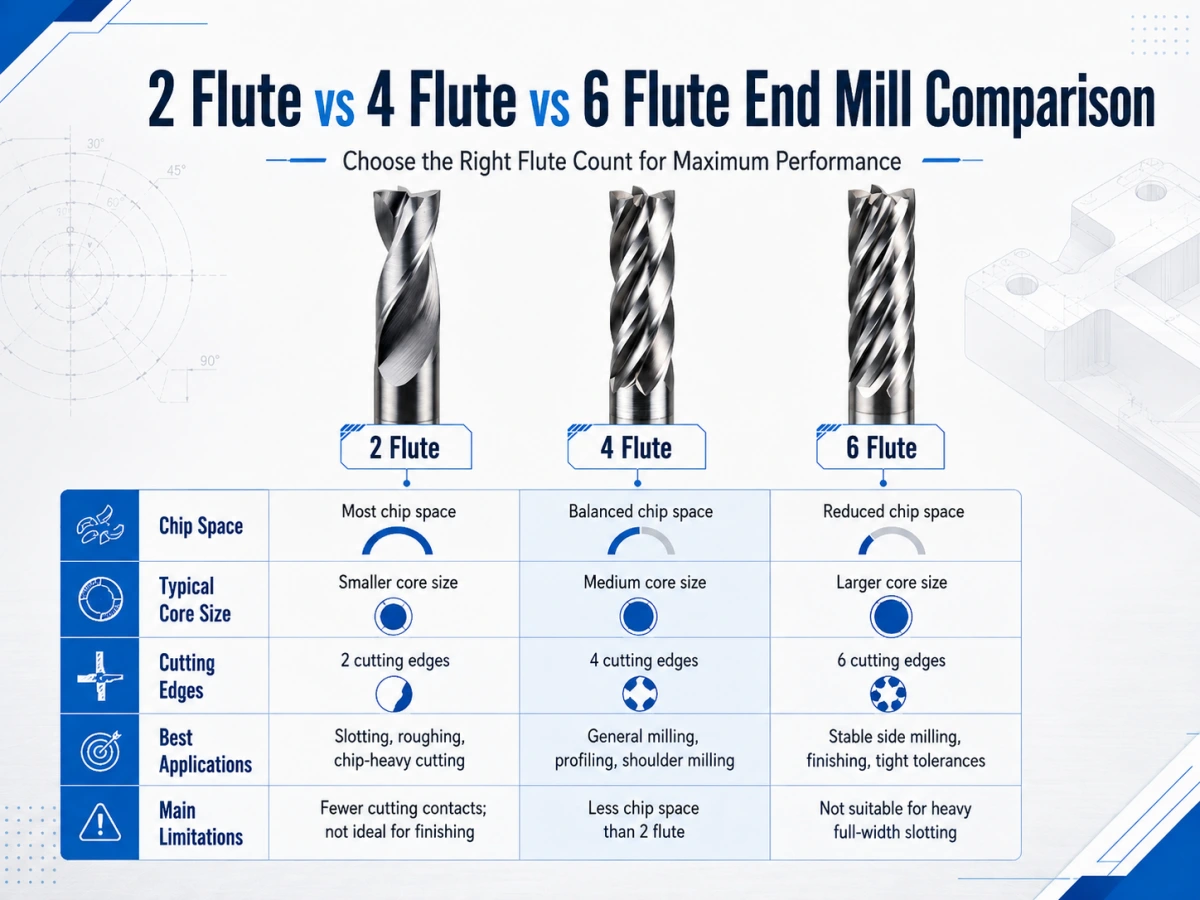
Why Flute Count Changes Cutting Performance
Flute count mainly changes three parts of the cutting process:
- Chip space
- Cutting-edge count
- Typical core size
A cutter with fewer flutes normally has wider flute grooves. The additional space helps carry larger chips away from a slot or pocket before they are re-cut.
This is especially important in aluminum, Пластмасс, and other materials that can produce large or continuous chips. When the flute grooves are too small, chips may pack inside the cutting zone, increasing friction, нагревать, and tool-breakage risk.
A cutter with more flutes provides more cutting contacts during each spindle revolution. It can support higher calculated feed rates and more consistent finishing when engagement is controlled.
Однако, more flutes also leave less room for chips. Поэтому, increasing the flute count without reviewing the cutting operation can make performance worse rather than better.
For detailed explanations of flute depth, диаметр сердечника, угол спирали, неравный тон, and flute length, прочитайте наш руководство по выбору канавок концевой фрезы.
How Flute Count Affects Feed Rate
Flute count is part of the feed-rate calculation:
Feed Rate = RPM × Flute Count × Chip Load per Tooth
При той же скорости шпинделя и нагрузке стружки на зуб, increasing the number of flutes increases the calculated feed rate.
Например, a 4-flute tool has twice as many cutting contacts per revolution as a 2-flute tool. Однако, this does not mean that the actual feed rate can always be doubled.
The achievable increase is limited by:
- Эвакуация стружки
- Tool engagement
- Spindle power
- Жесткость машины
- Точность держателя
- Зажим заготовки
- Геометрия инструмента
- Материал заготовки
More flutes do not create unlimited feed-rate capacity. Always begin with the recommended parameters for the specific tool series, диаметр фрезы, материал, и операции механической обработки.
What Is a 2-Flute End Mill Best For?
A 2-flute end mill provides two cutting edges and relatively large flute grooves. This design gives chips more space to leave the cutting zone.
Two-flute tools are commonly selected for:
- Обработка алюминия
- Brass and copper machining
- Обработка пластмасс
- Полная ширина пазов
- Deep pocketing
- Черновая обработка мягких материалов
- Operations that generate a high chip volume
During full-width slotting, the entire cutter diameter engages the workpiece. Как результат, the tool must remove a large volume of chips through the flute grooves.
A 2-flute design reduces the risk of chips becoming trapped inside a narrow slot. This can help control heat, застроенный край, and chip re-cutting.
Однако, two flutes provide fewer cutting contacts than four or six flutes. Поэтому, a 2-flute tool may have lower feed-rate and finishing potential under the same spindle speed and chip load per tooth.
A two-flute design also does not automatically mean that the cutter can plunge directly into the workpiece. Рампинг, винтовой вход, or limited plunging requires suitable center-cutting geometry and a compatible toolpath.
View standard and custom 2 варианты концевых фрез с канавками.
For more detailed applications, читать что такое 2 концевая фреза с флейтой, используемая для.
What About 3-Flute End Mills for Aluminum?
Three-flute end mills are also widely used for aluminum and other non-ferrous materials.
They provide one more cutting edge than a 2-flute cutter while retaining more chip space than many 4-flute designs. Поэтому, they can offer a useful balance of:
- Эвакуация стружки
- Tool rigidity
- Feed-rate potential
- Cutting-edge count
- Surface finish
Choose two flutes when chip volume is high, the pocket or slot is deep, or chip evacuation is difficult.
Choose three flutes for general aluminum milling when chip removal is stable and you need more cutting contacts or improved finishing potential.
Острые режущие кромки, polished flute surfaces, and a suitable low-friction coating or uncoated surface are also important when machining aluminum.
What Is a 4-Flute End Mill Best For?
A 4-flute end mill offers a practical balance between chip space, передовой счет, core size, and general milling versatility.
Four-flute tools are commonly used for:
- Carbon steel machining
- Alloy steel machining
- General stainless steel milling
- Боковое фрезерование
- Фрезерование уступов
- Профилирование
- Получистовая обработка
- General CNC machining
Compared with a 2-flute cutter, a 4-flute tool provides more cutting contacts per spindle revolution. It can support a higher calculated feed rate when the chip load per tooth and cutting conditions remain suitable.
The additional flutes also reduce the available chip space. По этой причине, a 4-flute cutter may not be the first choice for deep full-width slots or chip-heavy aluminum pockets.
A 4-flute tool can still machine aluminum during side milling or light finishing when:
- The cutting edges are sharp
- The flute surfaces are smooth
- Radial engagement is controlled
- Air or coolant reaches the cutting zone
- Chips leave the workpiece reliably
For deep aluminum slots, 2-flute or 3-flute tools normally provide more chip space.
Для стали и нержавеющей стали, flute count should be considered together with coating and vibration-control geometry. Variable-helix or unequal-pitch designs can help interrupt repetitive cutting forces during side milling and profiling.
The coating should also match the carbide grade, материал заготовки, твердость, температура резки, и состояние охлаждающей жидкости.
View standard and custom 4 варианты концевых фрез с канавками.
What Is a 6-Flute End Mill Best For?
A 6-flute end mill provides six cutting edges and more cutting contacts per spindle revolution.
Many 6-flute tools use a relatively large core. Однако, actual rigidity depends on the complete geometry, including flute depth, диаметр фрезы, угол спирали, длина канавки, диаметр шейки, and edge preparation.
Six-flute tools are commonly selected for:
- Stable side milling
- Light radial engagement
- Профилирование
- Получистовая обработка
- Отделка
- Hardened steel finishing with a suitable tool series
- Applications requiring consistent surface quality
A 6-flute cutter works best when chip volume is controlled and the machine, держатель, and workpiece setup are stable.
Because the flute grooves are smaller, 6-flute tools are normally not the first choice for:
- Deep full-width slotting
- Heavy pocketing
- Aggressive plunge cutting
- Roughing operations that generate a large chip volume
Six flutes should not be selected only because the workpiece is hard. The material grade, операция механической обработки, покрытие, марка твердого сплава, радиальное зацепление, точность держателя, and chip evacuation are equally important.
Six-Flute End Mills in High-Efficiency Milling
Six-flute and other multi-flute tools are also used in high-efficiency or trochoidal milling.
These toolpaths normally use:
- Light radial engagement
- Greater axial engagement
- Controlled cutter engagement
- Consistent chip thickness
- Smooth tool movement through corners
Because the radial engagement is reduced, each flute removes a smaller chip. This can make a higher flute count practical even during material-removal operations.
Однако, high-efficiency milling requires a compatible cutter, CAM-стратегия, держатель, машина, и параметры резки. A standard 6-flute finishing tool should not automatically be used for every dynamic roughing operation.
Specialized tools may use seven or more flutes for controlled high-efficiency milling and finishing, but those designs are outside the main 2-flute, 4-флейта, and 6-flute comparison covered in this guide.
View standard and custom 6 варианты концевых фрез с канавками.
How to Choose by CNC Milling Operation
The machining operation often provides a clearer selection direction than the material alone.
Полная ширина прорезей
Full-width slotting creates a high chip volume because the complete cutter diameter engages the workpiece.
Use a lower flute count when:
- Chips are large
- The slot is deep
- Coolant or air access is limited
- Chip packing has caused previous tool failure
Для алюминия и других цветных металлов, 2-flute tools provide a common selection direction. A 3-flute cutter can also work well when chip evacuation remains stable.
Для долбления стали, 2-флейта, 3-флейта, or 4-flute tools may be used depending on slot depth, диаметр фрезы, tool series, жесткость машины, и условия удаления стружки.
A 6-flute tool is generally not suitable for heavy full-width slotting because the smaller flute grooves can trap chips.
Карманное фрезерование
Pocket milling may include ramping, винтовой вход, боковая резка, угловое взаимодействие, и нижняя отделка.
For soft materials and deep pockets, a 2-flute cutter provides more space for chips.
A 3-flute tool can offer a balance of chip evacuation and feed-rate potential during general aluminum pocketing.
A 4-flute tool may suit shallower pockets or side-cutting operations when chips can leave the cavity reliably.
When axial entry is required, confirm that the tool has suitable center-cutting geometry. Flute count alone does not confirm plunging capability.
Боковое фрезерование и профилирование
Side milling normally uses less radial engagement than full-width slotting. Поэтому, 4-flute and 6-flute cutters become more practical.
Use four flutes as a balanced direction for general steel side milling and profiling.
Use six flutes when:
- Radial engagement is light or controlled
- The holder has low runout
- Tool overhang is limited
- Chip evacuation is stable
- The machine and workpiece setup are rigid
- More cutting contacts support the required finish
Variable-helix or unequal-pitch geometry can also help reduce chatter during side milling.
Черновая обработка
Roughing requires enough flute space for the expected chip volume.
Use a 2-flute cutter for roughing aluminum, Пластмасс, and other applications where chip evacuation is the main constraint.
For steel roughing, a 3-flute, 4-флейта, or dedicated roughing end mill may provide a better balance of edge strength and material removal.
Roughing end mills with serrated or chipbreaker geometry divide chips into smaller sections and may reduce cutting resistance.
Dynamic or trochoidal roughing can also support higher flute counts because radial engagement remains controlled.
Поэтому, do not select the flute count only from the word “roughing.” Review the material, стратегия резки, обручение, объем чипа, and complete tool geometry.
Получистовая и чистовая отделка
Semi-finishing and finishing normally use lighter engagement and focus on dimensional accuracy and surface quality.
Four-flute tools provide a balanced direction for many general finishing operations.
Six-flute cutters provide more cutting contacts and can support a smoother finish when:
- Chips can leave the cutting zone
- Runout is controlled
- Cutting edges are sharp and consistent
- Tool overhang is short
- Feed and engagement remain stable
More flutes cannot correct a worn cutting edge, inaccurate holder, unstable fixture, or incorrect end profile.
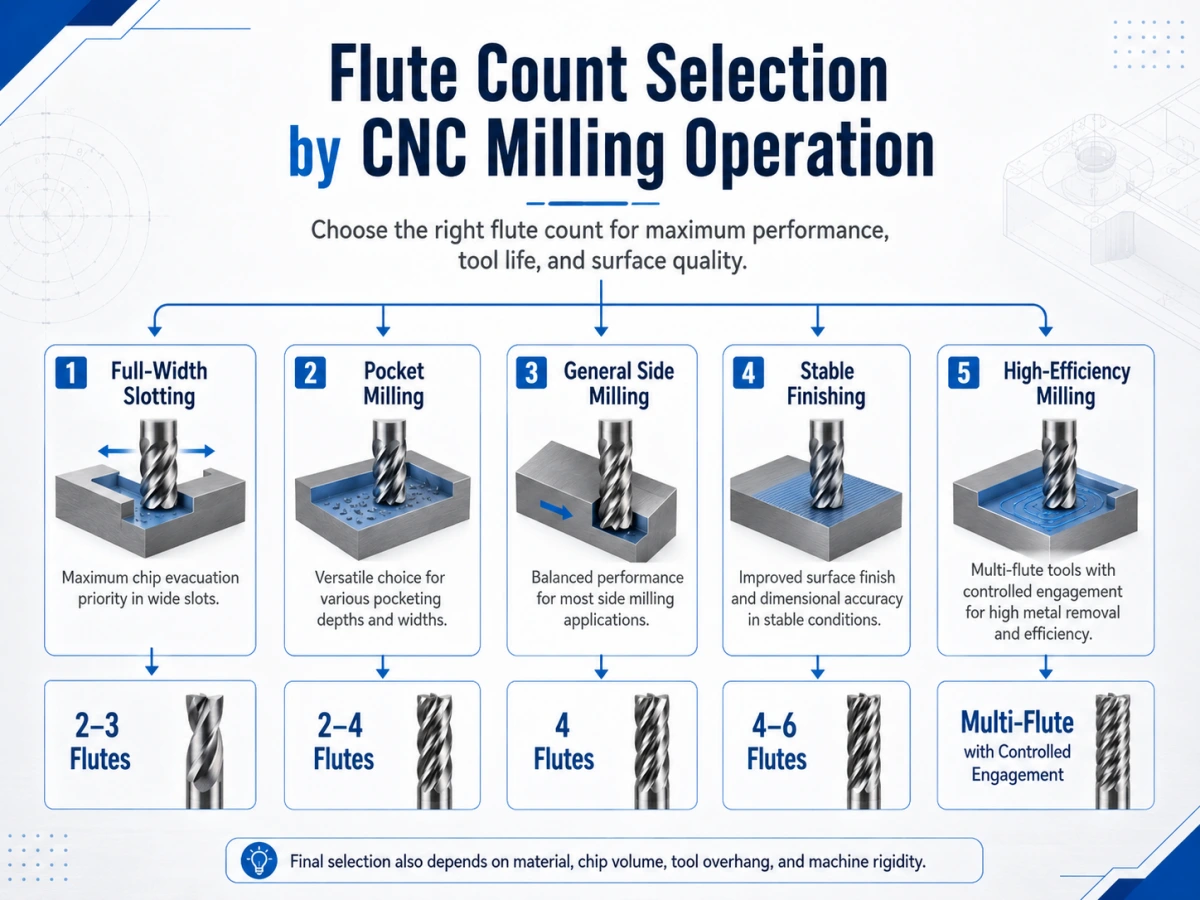
Quick Selection by Workpiece Material
| Workpiece and Operation | Suggested Direction | Основная причина |
|---|---|---|
| Aluminum Slotting and Deep Pockets | 2 Флейты | Максимальное пространство для чипа |
| General Aluminum Milling | 2–3 флейты | Balance of chip evacuation and cutting contacts |
| Aluminum Side Milling or Light Finishing | 3–4 Flutes | More cutting contacts when chip flow is stable |
| General Steel Milling | 4 Флейты | Balance of chip space and cutting-edge count |
| Stainless Steel Slotting | 3–4 Flutes | More room for chips and heat control |
| Stainless Steel Side Milling | 4–6 флейт | More cutting contacts under controlled engagement |
| Hardened Steel Finishing | 4–6 флейт | Stable cutting and finishing potential |
| Plastics and Soft Materials | 1–2 Flutes | Easier chip evacuation |
Although this article focuses on 2-flute, 4-флейта, and 6-flute tools, other flute counts are also available.
Например, a 3-flute end mill is important in aluminum machining, while a single-flute O-flute cutter may suit certain plastics and soft materials.
Different operations on the same material may also require different flute counts. Stainless steel full-width slotting and stainless steel light side milling should not automatically use the same cutter.
Для детального выбора материала, читать как выбрать твердосплавную концевую фрезу.
Common Flute Count Selection Mistakes
Assuming More Flutes Are Always Better
More flutes provide more cutting edges, но они уменьшают пространство чипа.
A higher flute count works best when chip volume and engagement are controlled. It can cause chip packing during deep pockets and full-width slotting.
Assuming More Flutes Allow Proportionally More Feed
More flutes increase the calculated feed rate when RPM and chip load per tooth remain unchanged.
Однако, the actual feed increase is limited by:
- Chip space
- Режущая нагрузка
- Spindle power
- Жесткость машины
- Точность держателя
- Workpiece stability
Do not increase the feed only by multiplying the flute-count ratio. Begin with parameters recommended for the specific tool and adjust them according to chip formation, нагрузка шпинделя, sound, качество поверхности, and tool wear.
Using 6 Flutes for Heavy Slotting
A 6-flute tool has less space for chips than 2-flute and 4-flute designs.
During heavy full-width slotting, chips may remain inside the groove and cause re-cutting, нагревать, повреждение края, или поломка инструмента.
Using 4 Flutes for Chip-Heavy Aluminum Pockets
A 4-flute cutter can machine aluminum, but it may not provide enough chip space for deep pockets or full-width slots.
Выбирать 2 или 3 flutes when chip evacuation is difficult.
Selecting Only by Workpiece Material
Материал важен, but the operation also changes the correct choice.
A 4-flute tool may suit steel side milling, while a lower flute count may be better for a deep steel slot.
Ignoring Tool Overhang and Runout
Чрезмерный вылет снижает жесткость. Runout causes uneven loading between cutting edges.
A 6-flute tool cannot provide stable finishing if one cutting edge carries most of the cutting load.
Assuming Every 2-Flute End Mill Is Center Cutting
Flute count does not confirm center-cutting capability.
Check the end geometry before using a cutter for plunging, нарастание, или винтовой вход.
Вопросы и ответы
Может ли 4-зубая концевая фреза резать алюминий??
Да. A 4-flute end mill can machine aluminum during side milling or light finishing when the tool has sharp cutting edges, гладкие поверхности канавок, and reliable chip evacuation.
For deep pockets and full-width slotting, a 2-flute or 3-flute cutter normally provides more chip space.
When Should I Choose 3 Flutes Instead of 2 Flutes for Aluminum?
Choose three flutes when chip evacuation remains reliable and you need more cutting contacts, greater rigidity, higher feed-rate potential, or improved finishing performance.
Choose two flutes when chip volume is high, the pocket or slot is deep, or chip evacuation is difficult.
Is a 6-Flute End Mill Only for Finishing?
No. A 6-flute end mill can also perform controlled side milling, профилирование, получистовая обработка, and certain high-efficiency milling operations.
Однако, it is normally not the first choice for heavy roughing or deep full-width slotting because chip space is limited.
Which Flute Count Is Best for Full-Width Slotting?
Use a lower flute count when full-width slotting creates a high chip volume.
Two or three flutes are common for aluminum. Steel slotting may use two, три, or four flutes depending on slot depth, диаметр фрезы, жесткость машины, and coolant delivery.
Does a Higher Flute Count Allow a Higher Feed Rate?
При той же скорости шпинделя и нагрузке стружки на зуб, a higher flute count increases the calculated feed rate.
The actual feed rate still depends on chip evacuation, режущая нагрузка, spindle power, точность держателя, геометрия инструмента, и жесткость машины.
Can a 2-Flute End Mill Plunge?
Some 2-flute end mills support ramping, винтовой вход, или ограниченное погружение.
The cutter must have suitable center-cutting geometry, and the programmed entry method must match the tool design and workpiece material.
Related End Mill Guides
For more detailed comparisons and selection information, visit:
End mill flute selection guide
2 флейта концевая фреза против 4 флейта
4 флейта против 6 концевая фреза с канавками
Как выбрать твердосплавную концевую фрезу
Need Help Choosing the Right Flute Count?
Отправьте нам свой рисунок, модель инструмента, материал заготовки, or current machining problem. С 16 многолетний опыт производства режущего инструмента, we can review the available information and help confirm a suitable standard or custom end mill direction.
Посмотрите наши стандартные и индивидуальные Страница продукта для концевой фрезы
Чтобы обсудить вашу заявку, напишите нам по адресу sales@cutterbest.com.