 Прецизионные фрезы,Режущие инструменты для обработки любого материала с ЧПУ

A 2 flute end mill is commonly used for aluminum machining, прорезь на всю ширину, карманное фрезерование, боковое фрезерование, and light roughing. It is also suitable for copper, brass, selected plastics, and other applications where chip evacuation is a priority.
The two cutting edges leave relatively wide flute grooves. Поэтому, the cutter provides more space for chips than many higher-flute-count tools. This can help reduce chip packing during closed or high-chip-volume operations.
Однако, two flutes are not automatically the best choice for every job. The correct tool still depends on the workpiece material, операция резки, включение инструмента, требуемая отделка, жесткость машины, и метод удаления стружки.
Быстрый ответ
Что такое 2 концевая фреза с флейтой, используемая для?
Типичное использование включает в себя:
- Aluminum slotting
- Карманное фрезерование
- Full-width slot cutting
- Side milling in non-ferrous materials
- Легкая черновая обработка
- Copper and brass machining
- Selected plastic machining
- Operations where chips are difficult to remove
A two-flute cutter is especially useful when flute space and chip evacuation matter more than increasing the number of cutting edges. В отличие, a higher flute count may be preferred when greater core strength, more cutting contacts, or a fine surface finish is the main requirement.
What Is a 2-Flute End Mill?
A two-flute end mill has two helical cutting edges and two flute grooves along the cutter body. These grooves form part of the cutting edge and also provide space for chips to leave the cutting zone.
Compared with many four-flute or six-flute tools of the same diameter, a two-flute design normally provides more flute space. Как результат, it is often considered for materials that produce large chips and for operations where the cutter is surrounded by the workpiece.
Flute count is only one part of the tool design. Диаметр фрезы, длина канавки, основная сила, угол спирали, подготовка кромок, покрытие, and end geometry also affect performance.
Best Uses of a 2-Flute End Mill at a Glance
| Приложение | Why Two Flutes Can Help | Важное условие |
|---|---|---|
| Aluminum slotting | Provides more chip space | Sharp geometry and reliable chip removal |
| Полная ширина пазов | Helps clear a high chip volume | Suitable cutting depth and coolant or air delivery |
| Карманное фрезерование | Reduces the risk of chip packing | Pocket depth and entry method must be considered |
| Медь и латунь | Supports chip clearance | Alloy grade and burr requirements affect selection |
| Пластмассы | Provides space for chip removal | Plastic type and heat control are important |
| Боковое фрезерование | Can suit many non-ferrous applications | Radial engagement and surface finish must be checked |
| Легкая черновая обработка | Supports chip-heavy material removal | Machine rigidity and tool reach remain important |
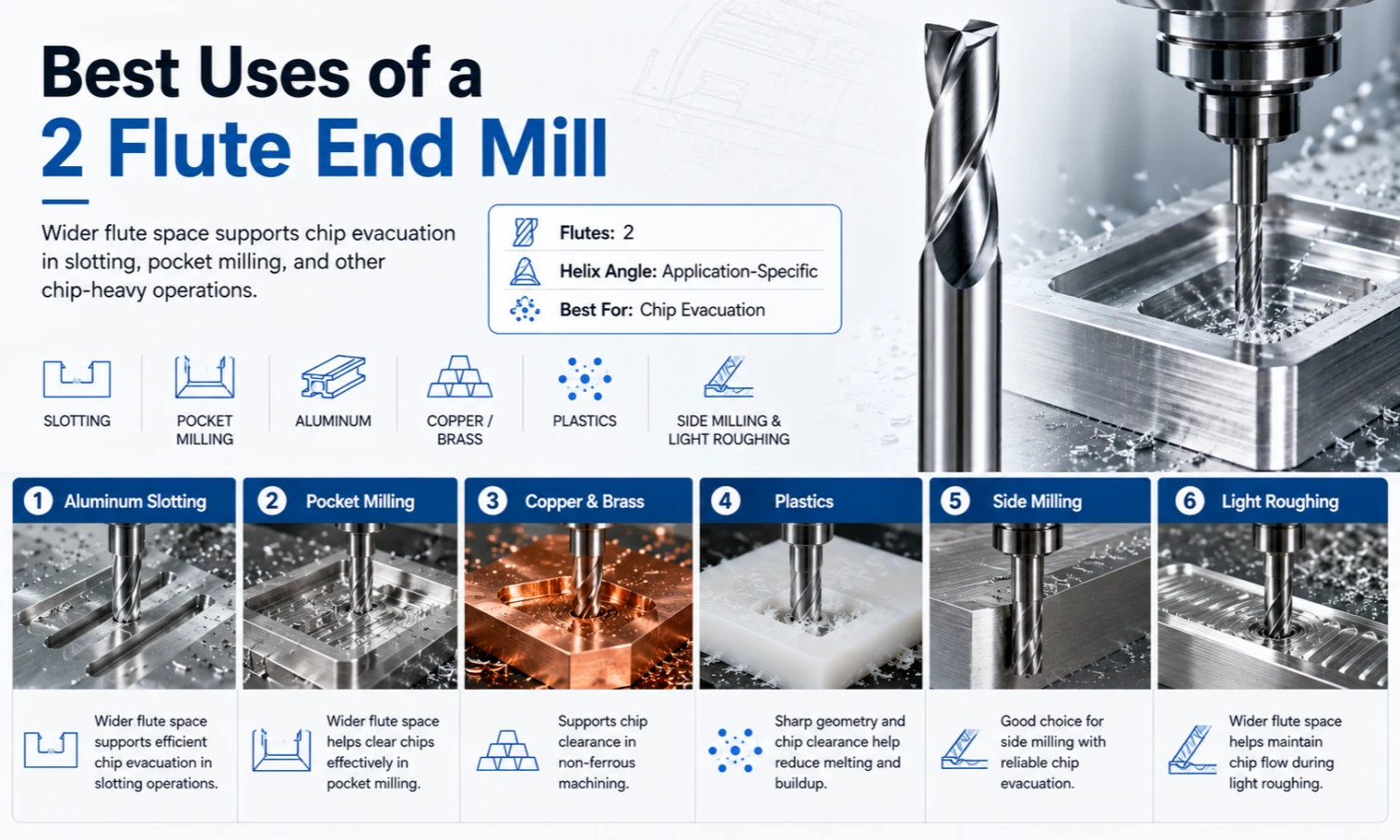
Main Uses of a 2-Flute End Mill
Обработка алюминия
Aluminum machining is one of the most common applications for a 2 концевая фреза с канавками.
Многие алюминиевые сплавы образуют относительно большую или сплошную стружку.. If those chips remain inside a slot or pocket, they may be re-cut or compressed against the workpiece. This can increase heat, cause built-up edge, and reduce cutting stability.
A suitable aluminum cutter often uses:
- Острые режущие кромки
- Гладкие или полированные поверхности канавок.
- Adequate flute space
- An uncoated design or a suitable low-friction coating
- An application-specific helix angle
- Надежный воздух, туман, или подача охлаждающей жидкости
Two flutes provide useful chip space, but flute count alone does not guarantee good aluminum performance. The complete tool geometry should match the alloy, диаметр инструмента, глубина резания, состояние машины, и необходимая отделка.
Полная ширина прорезей
Прорезание пазов на всю ширину создает большой объем стружки, поскольку фреза захватывает материал по всему диаметру..
Кроме того, the slot walls restrict the paths available for chip evacuation. Chips can remain below or around the cutter, especially during deeper cuts.
A two-flute tool can help because the wider flute grooves provide more space for chips. Тем не менее, stable slotting also depends on:
- Глубина слота
- Диаметр фрезы
- Длина канавки
- Вылет инструмента
- Coolant or air access
- Жесткость машины
- Зажим заготовки
- Параметры резки
For deep slots, use only the flute length and overall reach required by the feature. Excessive tool extension can increase deflection and chatter.
Карманное фрезерование
Pocket milling combines material removal with restricted chip flow. Поэтому, the tool must cut efficiently while chips leave the enclosed area.
A two-flute cutter is often considered for aluminum pockets, черновая обработка карманов, and other applications where chip packing creates problems.
Однако, pocket depth and entry method also affect tool selection. A shallow open pocket creates different conditions from a deep closed pocket. Так же, side engagement after entry may require a different strategy from the initial pocket start.
When chips remain inside the pocket, improve air or coolant delivery before increasing the cutting load.
Медь и латунь
Copper and brass are both non-ferrous materials, but they do not machine in the same way.
Pure copper can be ductile and may produce long chips or burrs. Meanwhile, different brass alloys may produce shorter chips and require different edge preparation.
Для этих материалов, a two-flute cutter can support chip clearance. Однако, the exact tool should also reflect:
- Марка материала
- Burr requirements
- Surface-finish target
- Tool engagement
- Диаметр фрезы
- Coolant or lubrication method
Sharp cutting geometry is especially important when rubbing or material adhesion is a concern.
Пластмассы и отдельные композиционные материалы
Two-flute cutters are also used for selected engineering plastics because the flute space helps remove chips from the cutting zone.
Plastic machining may create problems such as:
- Melting
- Rubbing
- Chip wrapping
- Edge tearing
- Burr formation
- Material deformation
The correct geometry depends on whether the plastic is soft, rigid, filled, усиленный, or heat sensitive. Поэтому, one general cutter should not be treated as suitable for every plastic.
Application-specific tool geometry may also be used for selected composite materials. Однако, composites vary widely, and some require specialized compression, diamond-cut, с покрытием, or abrasive-resistant cutters.
Side Milling and Light Roughing
A 2 flute end mill can perform side milling, профилирование, and light roughing when the tool matches the material and engagement.
При боковом фрезеровании, chips usually have more space to leave than during full-width slotting. Поэтому, flute space may be less restrictive. Tool rigidity, радиальное зацепление, точность размеров, and surface finish may become more important.
For light roughing in aluminum or other non-ferrous materials, a two-flute design can support efficient chip removal. Однако, heavy roughing may require a dedicated roughing geometry, chipbreaker profile, or another flute count.
Do not select the cutter only because the operation is described as “roughing.” Review the chip volume, глубина резания, мощность машины, досягаемость инструмента, and required material-removal rate.
Why Two Flutes Work Well in Chip-Heavy Operations
More Flute Space
Фреза имеет ограниченное пространство между режущими кромками и сердечником..
When the number of flutes increases, the available flute grooves normally become smaller unless the complete tool geometry is changed. С двумя флейтами, more space can be allocated to chip formation and evacuation.
This is useful during:
- Полная ширина пазов
- Deep pocket machining
- Обработка алюминия
- Plastic cutting
- Другие операции с большим объемом чипов
Однако, more flute space can also mean a different core structure. Поэтому, the required rigidity should be considered together with chip evacuation.
Chip Evacuation and Built-Up Edge
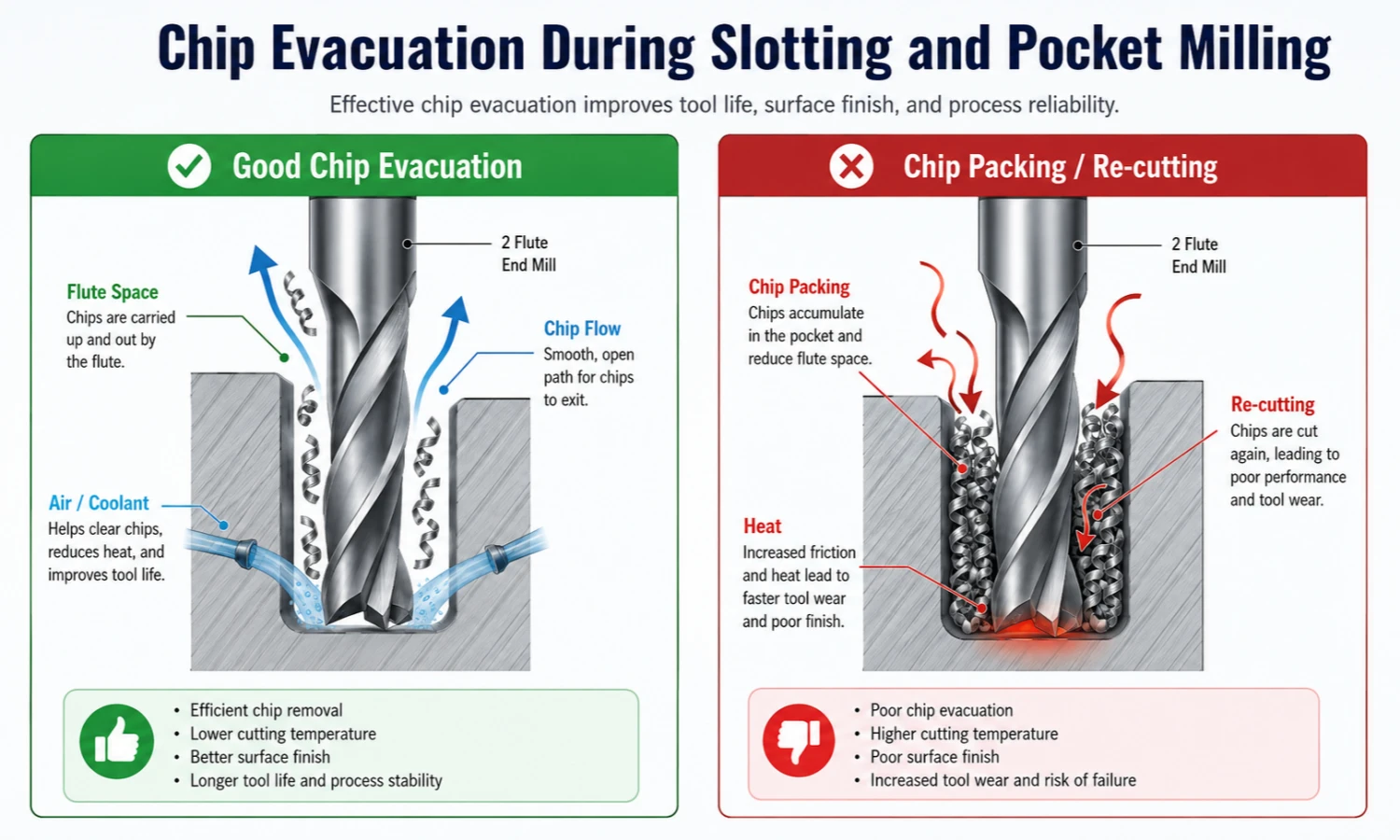
Good chip evacuation helps prevent chips from being cut repeatedly.
Re-cutting can increase:
- Температура резки
- Tool wear
- Ультрасовременный урон
- Отметины на поверхности
- Стружечная сварка
- Застроенный край
- Machine load
Aluminum and other ductile materials may adhere to the cutting edge when heat, трение, or lubrication conditions are unsuitable.
A sharp cutter with suitable flute surfaces can help. Кроме того, correctly directed air, туман, or coolant can remove chips before they collect inside the feature.
What Flute Count Cannot Tell You
Flute count does not independently determine:
- Режущая нагрузка
- Tool rigidity
- Plunge capability
- Maximum cutting depth
- Suitable workpiece material
- Требуемая обработка поверхности
- Safe spindle speed
- Скорость подачи
- Tool life
Например, two tools with the same flute count may have different core diameters, углы спирали, end geometries, покрытия, и марки твердого сплава.
For a broader explanation of flute geometry and selection, прочитайте наш end mill flute design and chip evacuation guide.
Can a 2-Flute End Mill Plunge?
Some center-cutting two-flute end mills support ramping, винтовой вход, карманный старт, or controlled plunge entry.
Однако, two flutes do not automatically mean that the cutter can plunge vertically. The end cutting edges must reach the tool center, and the entry method must suit the material and cutter design.
Straight plunging also creates different cutting loads and chip-flow conditions from side milling. Поэтому, нарастание, винтовой вход, or pre-drilling may provide better control in deeper or more demanding applications.
Для подробного руководства, читать может ли 2 флейта концевой фрезы погружение.
When Is a 2-Flute End Mill Not the First Choice?
Fine Finishing With Light Engagement
During light finishing, chip volume may be low. In that situation, large flute grooves may be less important than the number of cutting contacts and the stability of the cutter.
A higher-flute-count tool may support a finer or more consistent finish in some applications. Однако, the result still depends on runout, геометрия инструмента, жесткость машины, радиальное зацепление, и параметры резки.
A two-flute cutter can still produce a good surface when the tool and process are correctly controlled.
Applications Requiring Greater Core Strength
Deep features, long overhangs, high cutting pressure, or unstable setups may require greater tool rigidity.
A cutter with a stronger core may reduce deflection. Однако, increasing the flute count is not the only solution. Диаметр фрезы, глубина канавки, длина канавки, инструментальный материал, состояние держателя, and machine rigidity also affect strength.
Steel and Heat-Resistant Materials
A two-flute tool is not limited to aluminum or plastics. Some steel slotting applications may also use two or three flutes when chip evacuation is difficult.
Однако, steel side milling, получистовая обработка, or finishing may use four or more flutes when chip space is sufficient and additional cutting contacts are useful.
Stainless steel and heat-resistant materials also require careful control of heat, закалка, включение инструмента, покрытие, и прочность кромки.
For a focused comparison, читать 2 флейта концевая фреза против 4 флейта.
How to Decide Whether Two Flutes Fit the Operation
Before selecting a two-flute cutter, review the complete machining condition.
Ask the following questions:
- Does the operation create a high chip volume?
- Is the cutter performing full-width slotting?
- Карман глубокий или закрытый??
- Is chip evacuation limited?
- Does the material tend to form built-up edge?
- Is the required finish more important than flute space?
- Is the tool overhang longer than necessary?
- Является ли установка станка и приспособления жесткой??
- Can air, туман, or coolant reach the cutting zone?
- Требует ли операция центральнорежущей геометрии??
Choose two flutes when chip space is a major requirement and the cutter structure suits the operation.
Choose another flute count when chip evacuation is already stable and the process needs more cutting contacts, greater core strength, or a different balance between roughing and finishing.
For broader selection guidance, читать сравнивать 2, 4, и 6 флейтовые концевые фрезы.
Часто задаваемые вопросы О нас 2 Использование концевых фрез с флейтой
Is a 2-Flute End Mill Only for Aluminum?
No. Aluminum is a common application, but two-flute cutters are also used for copper, brass, selected plastics, боковое фрезерование, долбление, карманничество, and other operations where chip evacuation is important.
The exact tool geometry should match the workpiece and cutting conditions.
Is a 2-Flute End Mill Suitable for Full-Width Slotting?
Да, a suitable two-flute cutter is commonly used for full-width slotting, особенно в алюминии и других цветных металлах.
The wider flute grooves provide space for chips. Однако, глубина паза, подача охлаждающей жидкости, досягаемость инструмента, and machine rigidity must also be considered.
Can a 2-Flute End Mill Be Used for Side Milling?
Да. A two-flute tool can perform side milling and profiling.
При боковом фрезеровании, радиальное зацепление, жесткость инструмента, required accuracy, and surface finish may become more important than maximum flute space.
Can a 2-Flute End Mill Machine Steel?
Да, some two-flute end mills can machine steel, particularly during slotting or other operations where chip evacuation is restricted.
Однако, the correct choice depends on the steel grade, глубина резания, геометрия фрезы, покрытие, жесткость машины, и метод подачи охлаждающей жидкости.
Can a 2-Flute End Mill Plunge?
Some center-cutting two-flute cutters can support controlled plunging, нарастание, или винтовой вход.
Always confirm the end geometry before programming axial entry.
Does a 2-Flute Cutter Always Produce a Rougher Finish?
No. Surface finish depends on more than flute count.
Биение инструмента, cutting-edge quality, корм на зуб, радиальное зацепление, устойчивость машины, material condition, and toolpath all affect the finished surface.
When Should I Choose Three or Four Flutes Instead?
Consider three or four flutes when chip evacuation remains stable and the operation needs more cutting contacts, greater rigidity, or higher finishing potential.
Three flutes may provide a balance between chip space and edge count. Four flutes may suit some steel machining, боковое фрезерование, и отделочные операции.
Связанные руководства
For additional product and application information, visit:
Твердый сплав 2 концевая фреза с канавками
Может ли 2 флейта концевой фрезы погружение?
2 флейта концевая фреза против 4 флейта
Сравнивать 2, 4, и 6 флейтовые концевые фрезы
Конструкция и выбор канавок концевой фрезы
Нужен 2 Концевая фреза с канавками для вашего применения?
Отправьте нам материал заготовки, операция механической обработки, required cutter size, рисунок, эталонная модель, текущая информация об инструменте, и количество при наличии. We will review the known requirements and help confirm a suitable standard or custom tool direction.
Посмотрите наши стандартные и индивидуальные твердый сплав 2 концевая фреза с канавками параметры.
Электронная почта: sales@cutterbest.com