 Прецизионные фрезы,Режущие инструменты для обработки любого материала с ЧПУ

A 6 flute end mill is mainly used for controlled side milling, профильное фрезерование, контурное фрезерование, получистовая обработка, и отделка. Its six cutting edges provide frequent cutting contact, which can support good tool rigidity, stable wall machining, and a smoother finishing pass.
Однако, more flutes leave less space for chip evacuation. Поэтому, a standard six-flute cutter is usually not the best choice for deep full-width slotting, тяжелая черновая обработка, or aggressive cutting in materials that produce large chips.
На практике, a six-flute tool works best when surface quality and cutting stability matter more than maximum material removal.
Что такое 6 Флейта концевая фреза?
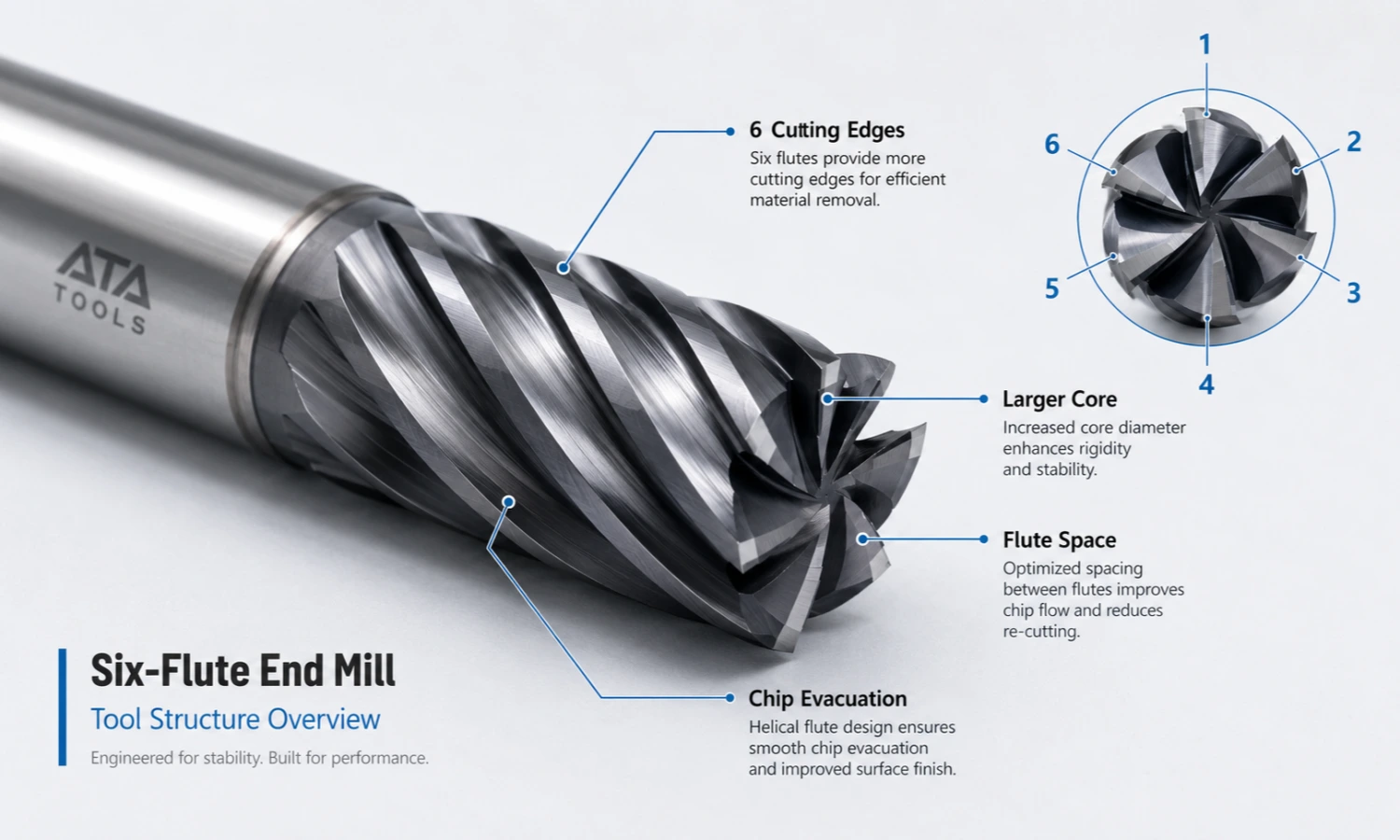
A 6 flute end mill has six cutting edges around its cutting section. Each spindle revolution brings six cutting edges into contact with the workpiece.
Compared with a cutter that has two or four flutes, a six-flute design normally has a larger tool core and smaller flute spaces. The larger core can support tool rigidity, while the additional cutting edges can spread the cutting action across more teeth.
The main trade-off is chip evacuation. Smaller flute spaces hold fewer chips, so the cutter needs controlled engagement and a clear path for chips to leave the cutting area.
For that reason, six-flute tools usually perform better in side cutting and finishing than in deep slotting or heavy roughing.
For a general explanation of milling cutter types and structures, прочитайте наш end mill cutter guide.
Основное использование 6 Флейта концевая фреза
The best applications involve controlled chip volume, stable machine conditions, and a need for good wall quality or surface finish.
Боковое и профильное фрезерование
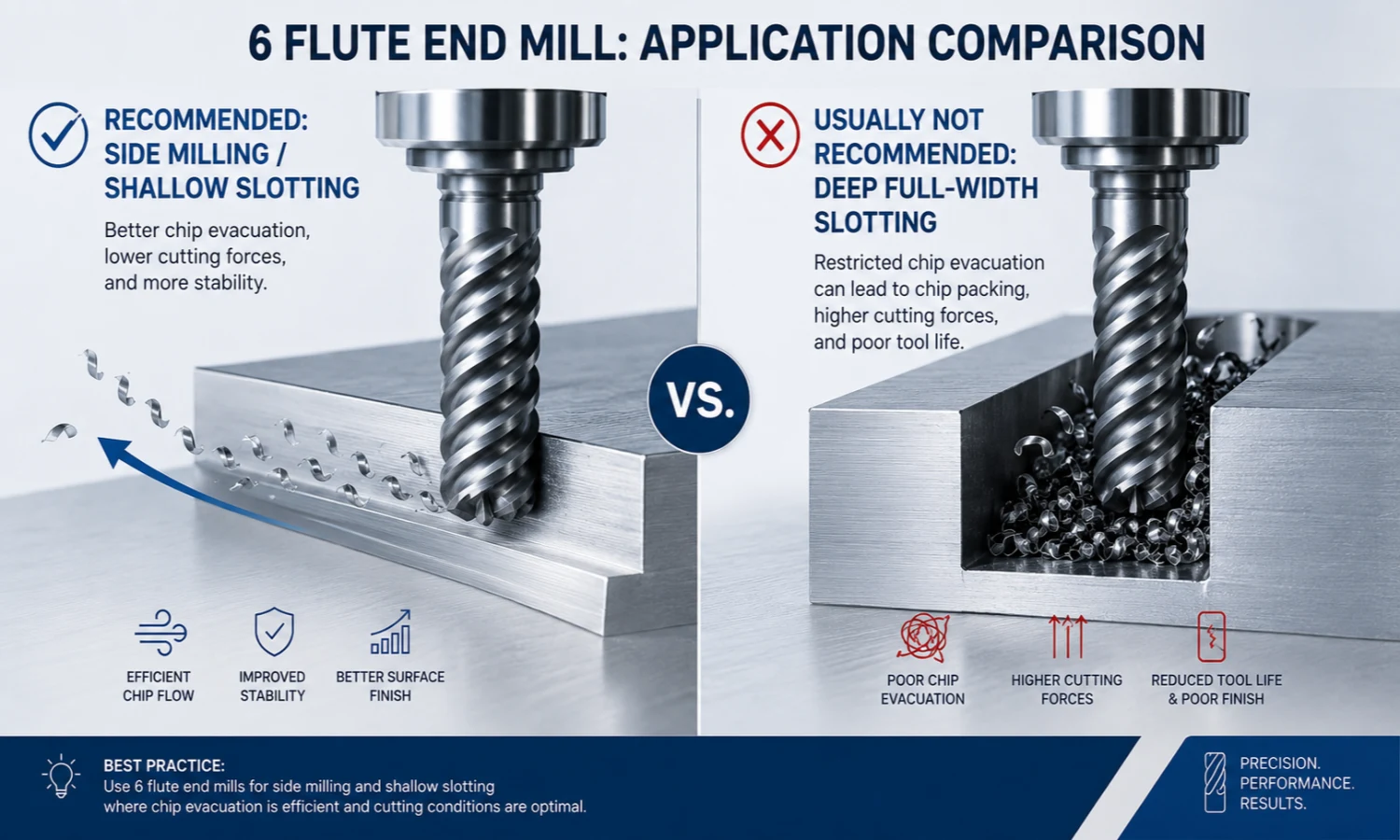
A six-flute cutter works well for side milling because only part of the tool diameter normally engages with the workpiece. This leaves more room for chips to escape than full-width slotting does.
Typical uses include straight side walls, плечи, внешние профили, and precision component features. The extra cutting edges can also support stable tool contact when the radial cutting width remains controlled.
Все еще, the result depends on more than flute count. Биение инструмента, состояние держателя, жесткость машины, ширина резки, and tool overhang all affect side-wall quality.
Контурное фрезерование
Contour milling involves following a curved or irregular workpiece profile. A rigid six-flute tool can support consistent contact as it moves along the contour.
This makes the design useful for mold components, детали оснастки, компоненты машин, and other precision profiles. Однако, a long tool overhang or unstable holder can still create vibration.
Поэтому, the tool should remain as short as the application allows, especially when machining steep or deep contours.
Получистовая обработка
Semi-finishing removes the material left after roughing and prepares the surface for the final pass.
A six-flute tool suits this stage when the remaining stock is controlled. The additional cutting edges can distribute the cutting action and help maintain consistent wall geometry.
Before using six flutes, make sure that the roughing operation has not left an uneven or excessive allowance. Large and irregular stock can overload individual cutting edges.
Отделка
Finishing is one of the most common 6 Применение концевых фрез с канавками.
More cutting edges can leave finer cutting marks when the speed, кормить, траектория инструмента, and machine setup match the material. Как результат, six-flute cutters are often selected for finishing straight walls, профили, плечи, and precision surfaces.
Однако, flute count alone does not guarantee a specific surface roughness. Точность держателя, биение инструмента, состояние машины, workpiece stability, параметры резки, and tool wear also influence the final surface.
Shallow Slotting and High-Speed Machining
A six-flute cutter can machine shallow slots when the chips can leave the cutting area effectively. Light slotting may work well, especially when the axial depth and chip volume remain low.
Deep full-width slotting is different. В этом случае, the cutter stays surrounded by material, while the smaller flute spaces must carry all chips out of the slot. Chip packing and heat can then increase quickly.
Six-flute tools can also support high-speed machining, but high spindle speed alone is not enough. The full setup must control heat, закончиться, вибрация, и эвакуация стружки.
Quick Application Guide
| Операция обработки | General Suitability | Основное соображение |
|---|---|---|
| Боковое фрезерование | Рекомендованный | Use controlled radial engagement |
| Профильное фрезерование | Рекомендованный | Check holder accuracy and tool overhang |
| Контурное фрезерование | Рекомендованный | Maintain a rigid setup |
| Получистовая обработка | Рекомендованный | Keep the remaining stock consistent |
| Отделка | Рекомендованный | Control runout and cutting parameters |
| Shallow Slotting | Conditional | Make sure chips can leave the slot |
| Deep Full-Width Slotting | Usually Not Recommended | Limited flute space restricts chip evacuation |
| Тяжелая черновая обработка | Usually Not Recommended | Lower flute counts provide more chip space |
Which Materials Are Suitable for a 6 Флейта концевая фреза?
The correct choice depends on the workpiece material, твердость, операция резки, жесткость машины, состояние охлаждающей жидкости, и конструкция инструмента.
A tool made for steel should not automatically be used for aluminum or titanium. Even when the flute count stays the same, the cutting-edge geometry and other tool features may need to change.
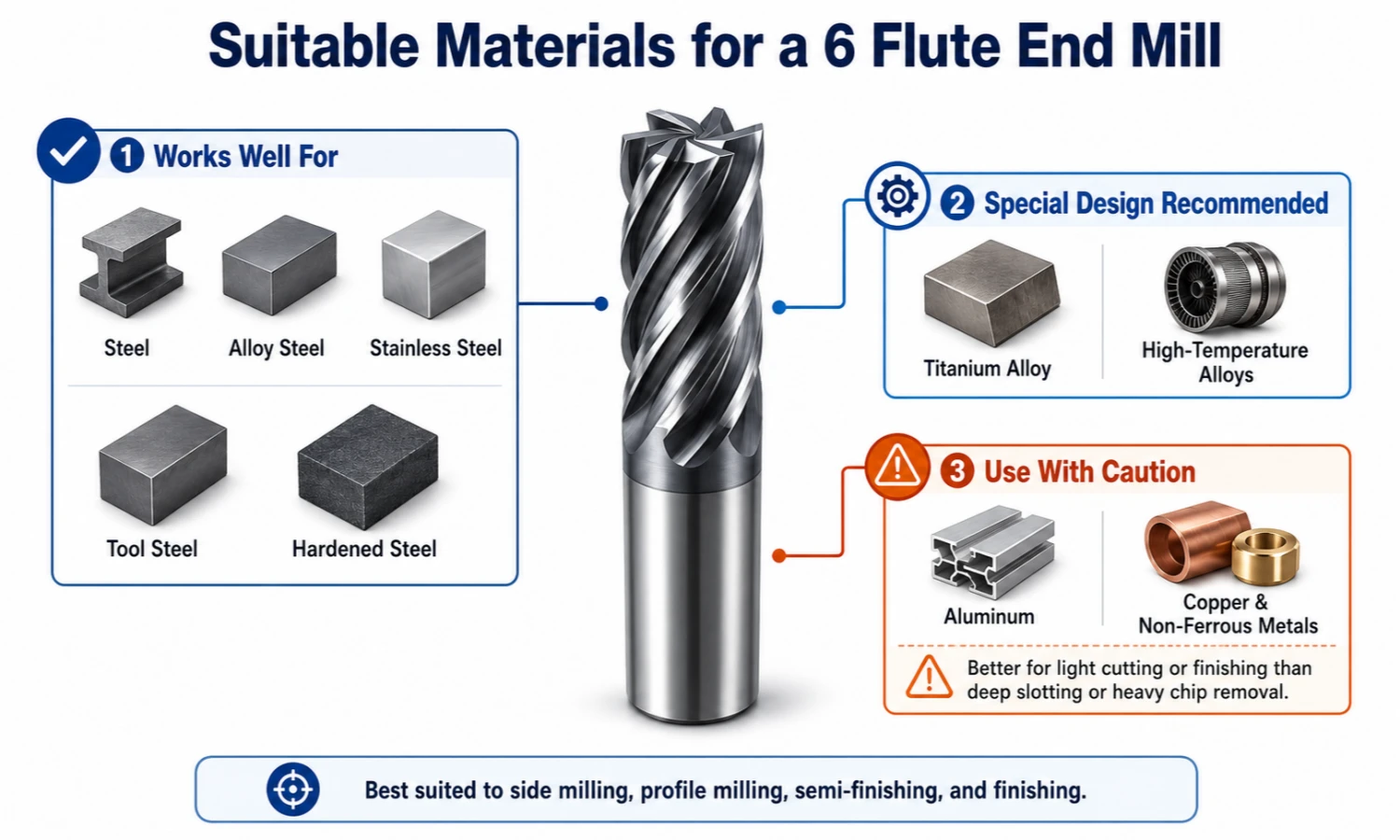
Сталь и легированная сталь
Steel and alloy steel are common application areas for six-flute tools.
The cutter can handle controlled side milling, профильное фрезерование, получистовая обработка, and finishing when its carbide grade, геометрия резки, and coating match the material hardness.
Six flutes are especially useful when the operation requires stable walls or a clean finishing pass. В отличие, heavy roughing generally needs more chip space.
Нержавеющая сталь
A six-flute cutter can machine 304, 316, and other stainless steel grades. Однако, stainless steel can generate heat and may work-harden if the cutting action becomes unstable.
Поэтому, the cutter must maintain a consistent cut. The cutting geometry, покрытие, охлаждающая жидкость, скорость, and feed should all match the stainless steel grade and machining operation.
A six-flute design usually makes more sense for controlled side cutting and finishing than for deep slotting in stainless steel.
Tool Steel and Hardened Steel
Six-flute tools can also machine tool steel, предварительно закаленная сталь, and hardened steel when the tool series matches the material hardness.
Harder materials need suitable carbide grades, прочность кромки, покрытия, and cutting geometry. Как результат, one standard cutter should not be treated as a universal solution for every hardness range.
For hardened materials, stable machine conditions and low tool runout become even more important.
Titanium and Difficult-to-Machine Materials
A specially designed six-flute tool may suit titanium and other difficult-to-machine materials.
Однако, контроль тепла, режущая нагрузка, прочность кромки, подача охлаждающей жидкости, and tool overhang require careful attention. Standard steel-cutting geometry may not provide the best result.
Прежде чем выбрать фрезу, review the exact titanium grade, операция механической обработки, глубина резания, метод подачи охлаждающей жидкости, и состояние машины.
Может ли 6 Флейта Концевая фреза, алюминий?
Да, but only when the cutter uses a suitable geometry for aluminum and the operation does not create excessive chip volume.
Aluminum often produces larger and more adhesive chips than steel. Поэтому, deep slots and heavy roughing usually work better with two or three flutes because they provide larger flute spaces.
A six-flute tool may still suit light side milling or finishing in aluminum when it has sharp cutting edges, effective chip control, and enough space to evacuate chips.
When Should You Choose a 6 Флейта концевая фреза?
Choose a six-flute cutter when most of the following conditions apply:
- Surface finish matters more than maximum material removal.
- The operation involves side milling, профилирование, получистовая обработка, или отделка.
- Станок и держатель обеспечивают хорошую жесткость..
- The radial cutting width remains controlled.
- The tool overhang stays reasonably short.
- Chips can leave the cutting area effectively.
- The cutter design matches the workpiece material and hardness.
These conditions help the tool use its main strengths: жесткость, frequent cutting contact, and consistent wall machining.
Когда 6 Флейта концевая фреза не лучший выбор?
More cutting edges do not make a cutter suitable for every operation. В некоторых приложениях, the reduced flute space becomes a greater concern than tool rigidity.
Deep Full-Width Slotting
During full-width slotting, the cutter engages material across its full diameter. Chips must travel through the flute spaces and out of the slot.
Because a six-flute design has smaller flute spaces, chips may collect inside a deep slot. This can increase heat, режущая нагрузка, and the risk of edge damage.
For deep slots, a lower flute count usually provides safer chip evacuation.
Тяжелая черновая обработка
Heavy roughing removes a large amount of material. Как результат, it produces more chips and places higher loads on the cutter.
A two-flute, three-flute, four-flute, or dedicated roughing tool often provides more space for chip flow. The best choice depends on the material and roughing strategy.
Materials That Produce Large Chips
Soft materials such as aluminum can produce large or adhesive chips during aggressive cutting.
In these conditions, a high-flute-count cutter may pack chips inside the flutes. A lower flute count normally handles heavy aluminum cutting more effectively.
Unstable Setups and Long Tool Overhang
A six-flute design can provide good core rigidity, but it cannot correct every setup problem.
Длинный свес, worn holders, high runout, weak workholding, or an unstable machine can still cause vibration and cutting marks. In severe cases, they may also contribute to edge chipping.
Поэтому, reduce the overhang and check the complete setup before changing flute count.
What Is the Main Disadvantage of a High-Flute-Count End Mill?
The main disadvantage of a high-flute-count end mill is reduced flute space.
As flute count increases, each flute usually has less room to carry chips. This can make chip evacuation more difficult, especially during deep slotting, тяжелая черновая обработка, or high material removal.
If chips cannot leave the cutting area, they may be cut again or packed between the tool and workpiece. Как результат, heat and cutting pressure can increase.
The correct flute count must balance three factors:
- Эвакуация стружки
- Tool rigidity
- Качество поверхности
A six-flute tool may provide better rigidity and finishing stability, while a lower-flute cutter may handle large chip volumes more effectively.
4 Флейта или 6 Флейта концевая фреза?
A four-flute end mill is usually the more versatile option. It offers a practical balance between chip space, жесткость инструмента, и качество поверхности.
A six-flute tool is more specialized. It normally suits controlled side milling, получистовая обработка, and finishing when stable contact and wall quality matter more than maximum chip evacuation.
The final choice depends on the workpiece material, глубина резания, радиальное зацепление, жесткость машины, и цель обработки.
For a detailed two-tool comparison, читать 4 флейта против 6 концевая фреза с канавками.
For a broader flute-count overview, читать 2 флейта против 4 флейта против 6 концевая фреза с канавками.
Часто задаваемые вопросы
Does “6 Flute” Mean a 6 mm Cutting Diameter?
Нет. “6 flute” refers to the number of cutting edges.
The cutting diameter is a separate tool dimension. A six-flute cutter can have many different cutting diameters.
Может ли 6 Flute End Mill Be Used for Deep Slotting?
A standard six-flute cutter is usually not the first choice for deep full-width slotting.
Its smaller flute spaces can restrict chip evacuation. A lower-flute cutter normally provides more room for chips to leave the slot.
Это 6 Flute End Mill Good for Stainless Steel?
Да, especially for controlled side milling, профильное фрезерование, получистовая обработка, и отделка.
Однако, the cutter geometry, покрытие, охлаждающая жидкость, скорость, and feed must match the stainless steel grade and machining operation.
Заключение
Что такое 6 концевая фреза с флейтой, используемая для? It is mainly used for controlled side milling, профильное фрезерование, контурное фрезерование, получистовая обработка, и отделка.
Its main strengths are tool rigidity, stable cutting contact, качество стен, and finishing performance. Its main limitation is reduced chip space.
Поэтому, avoid treating six flutes as the best option for every job. Deep full-width slotting, тяжелая черновая обработка, unstable setups, and large-chip operations usually benefit from fewer flutes.
For standard and custom tool options, просмотреть наш 6 Концевая фреза из твердого сплава канавок.