 Precision Milling Cutters,Cutting Tools for CNC Machining Every Material

In a face mill vs end mill comparison, a face mill is generally the better choice for a broad, open, accessible flat surface because its wider cutting coverage can reduce the number of lateral toolpaths. An end mill is usually more flexible when the machining area is small, access is limited, or the same part also requires slots, pockets, profiles, or contours.
The choice is not simply “large part = face mill” and “small part = end mill.”
Surface size, cutter access, usable cutter diameter, machine rigidity, workholding, surrounding features, and the overall machining plan all affect the final decision.
This guide compares face mill vs end mill selection from a practical CNC machining perspective and explains when each tool makes more sense.
Face Mill vs End Mill: Quick Comparison
Both tools can machine flat surfaces, but they are designed around different priorities.
A face mill focuses on efficient planar machining. An end mill provides broader toolpath flexibility and can machine both local flat areas and more complex features.
| Comparison Factor | Face Mill | End Mill |
|---|---|---|
| Main purpose | Broad planar and facing operations | General-purpose feature machining |
| Primary cutting action | Mainly optimized for face cutting across a flat surface | Uses end and peripheral cutting edges depending on the operation |
| Typical geometry | Comparatively large cutting diameter; many designs use multiple inserts | More compact cylindrical tool with end and side cutting edges |
| Surface coverage | Generally wider | Generally narrower |
| Open flat surfaces | Usually the more direct choice for broad, accessible faces | Suitable for small or local flat areas |
| Small or restricted flat surfaces | May be limited by cutter clearance | Often easier to access |
| Slots, pockets, profiles | Not the primary purpose | Usually more versatile |
| Lateral passes on a wide face | May require fewer passes when usable cutter coverage is wider | Often requires more adjacent toolpaths on the same wide surface |
| Toolpath flexibility | More specialized | Higher |
| Machine and access considerations | Larger cutter size may require more clearance and suitable machine/setup capability | Compact size often suits restricted areas |
| Tool-change trade-off | Adds a dedicated facing tool | May handle facing plus other features with one tool |
| Typical selection rule | Broad, open, accessible planar work | Small, restricted, or mixed-feature machining |
The key point is that capability and suitability are different. An end mill may be capable of machining a flat face, but that does not automatically make it the preferred tool for a wide, open, repeated facing operation.
What Is a Face Mill?
A face mill is a milling cutter primarily designed to machine flat surfaces with the cutter axis generally perpendicular to the machined face.
Compared with a typical end mill, a face mill usually offers a larger effective cutting area. Many face milling cutters also use multiple replaceable cutting inserts arranged around the cutter body.
Its main advantage is not simply its physical diameter. The practical advantage comes from how much of the target surface the cutter can cover during each pass.
Primary Cutting Action and Typical Tool Design
A face mill engages the workpiece mainly through cutting edges positioned for planar machining.
Because the cutter can provide relatively wide usable coverage when access and setup allow, it can be useful when machining:
- Large top faces
- Open planar surfaces
- Stock requiring surface leveling
- Reference or datum faces
- Repeated facing operations
Face mills are available in different geometries and entering angles. For example, 45° face mills commonly suit general face milling, while 90° cutters can be useful when the operation also requires access close to a square shoulder.
However, this article does not treat every face mill as interchangeable. Cutter geometry still needs to match the actual workpiece and machining requirement.
Where a Face Mill Makes the Most Sense
A face mill generally makes the most sense when the target surface is:
- Broad
- Open
- Accessible
- Suitable for a comparatively large cutter diameter
This matters because cutter coverage can reduce the number of adjacent lateral toolpaths.
For example, if a wide plate can accept a suitable face mill without interference from clamps, walls, bosses, or other features, the larger usable cutting width may cover the face with fewer passes than a smaller end mill.
That does not guarantee a specific cycle-time improvement. Actual productivity still depends on the machine, workholding, cutting conditions, toolpath, workpiece material, and setup.
What Is an End Mill?
An end mill is a more versatile milling tool that can use cutting edges at the tool end and around its circumference.
That geometry allows an end mill to machine much more than a flat top surface.
In this comparison, “end mill” mainly refers to tools commonly used for general flat-surface, slotting, pocketing, profiling, and contouring work. Exact capability depends on the end style and cutting geometry, so not every type of end mill should be treated as interchangeable.
End and Peripheral Cutting Capability
The combination of end and peripheral cutting edges gives an end mill greater flexibility in toolpath direction and feature access.
Depending on the specific tool design and operation, an end mill can machine:
- Local flat surfaces
- Slots
- Pockets
- Side walls
- Profiles
- Contours
- Mixed geometric features
This flexibility is one reason an end mill may remain the practical choice even when a dedicated face mill could machine one of the flat surfaces more efficiently.
Where an End Mill Makes the Most Sense
An end mill is usually more practical when:
- The flat surface is relatively small
- The machining area is inside or near a pocket
- Walls, clamps, fixtures, or other features restrict cutter access
- The same part also needs slots, pockets, profiles, or contours
- One tool can complete several features and avoid an additional tool change
So, an end mill vs face mill decision should consider the entire machining task rather than one surface in isolation.
Key Differences Between a Face Mill and an End Mill
The difference between face milling vs end milling becomes clearer when we look at why the tools behave differently, rather than simply listing their applications.
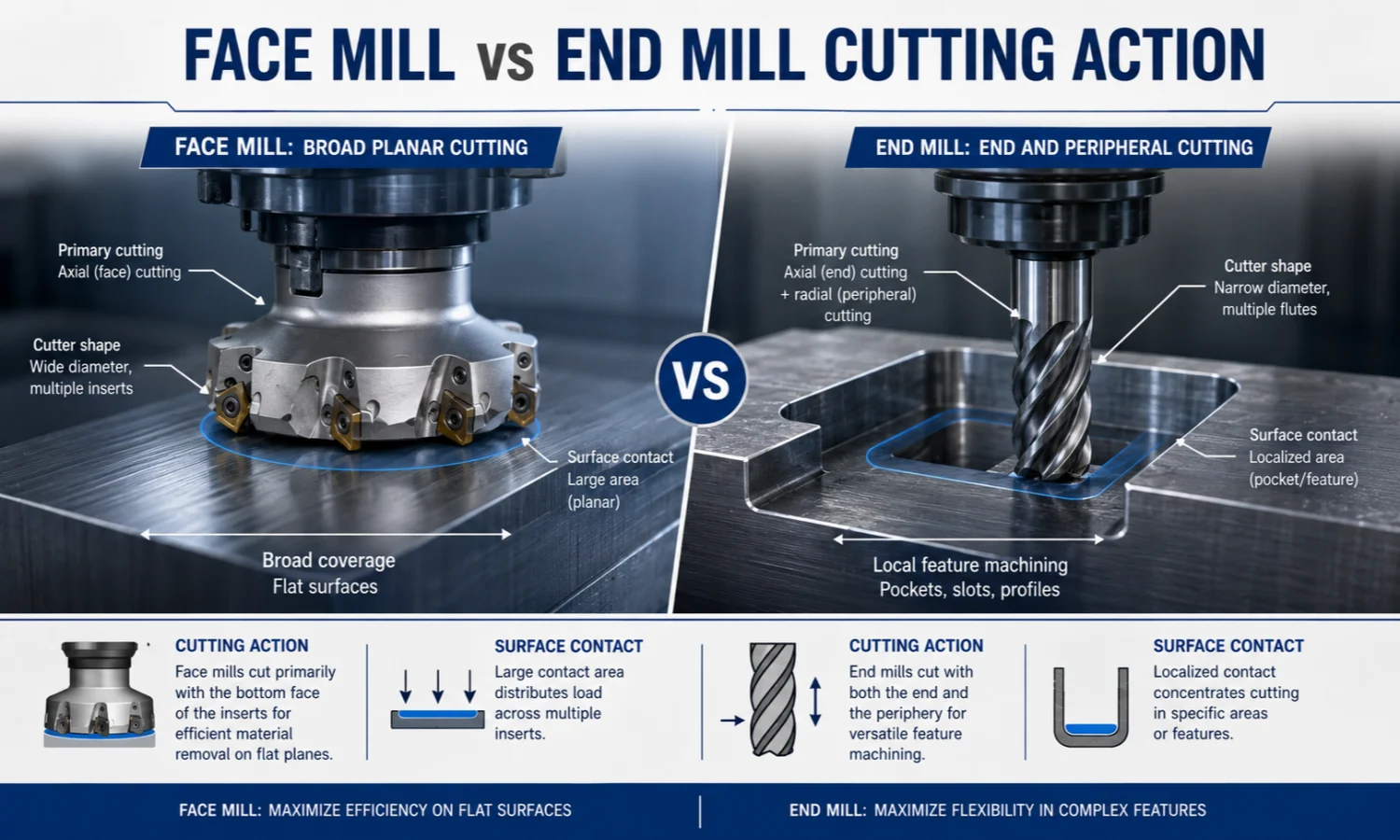
Primary Cutting Action and Tool Geometry
A face mill is primarily optimized to sweep across a planar surface.
An end mill combines end-cutting and peripheral-cutting capability, which gives it more freedom to enter local areas and machine features in different directions.
This leads to the main practical difference:
A face mill specializes in planar coverage, while an end mill emphasizes geometric flexibility.
That distinction also explains why the two tools can overlap in some operations without becoming direct substitutes for every application.
Surface Coverage, Flat-Surface Size, and Number of Passes
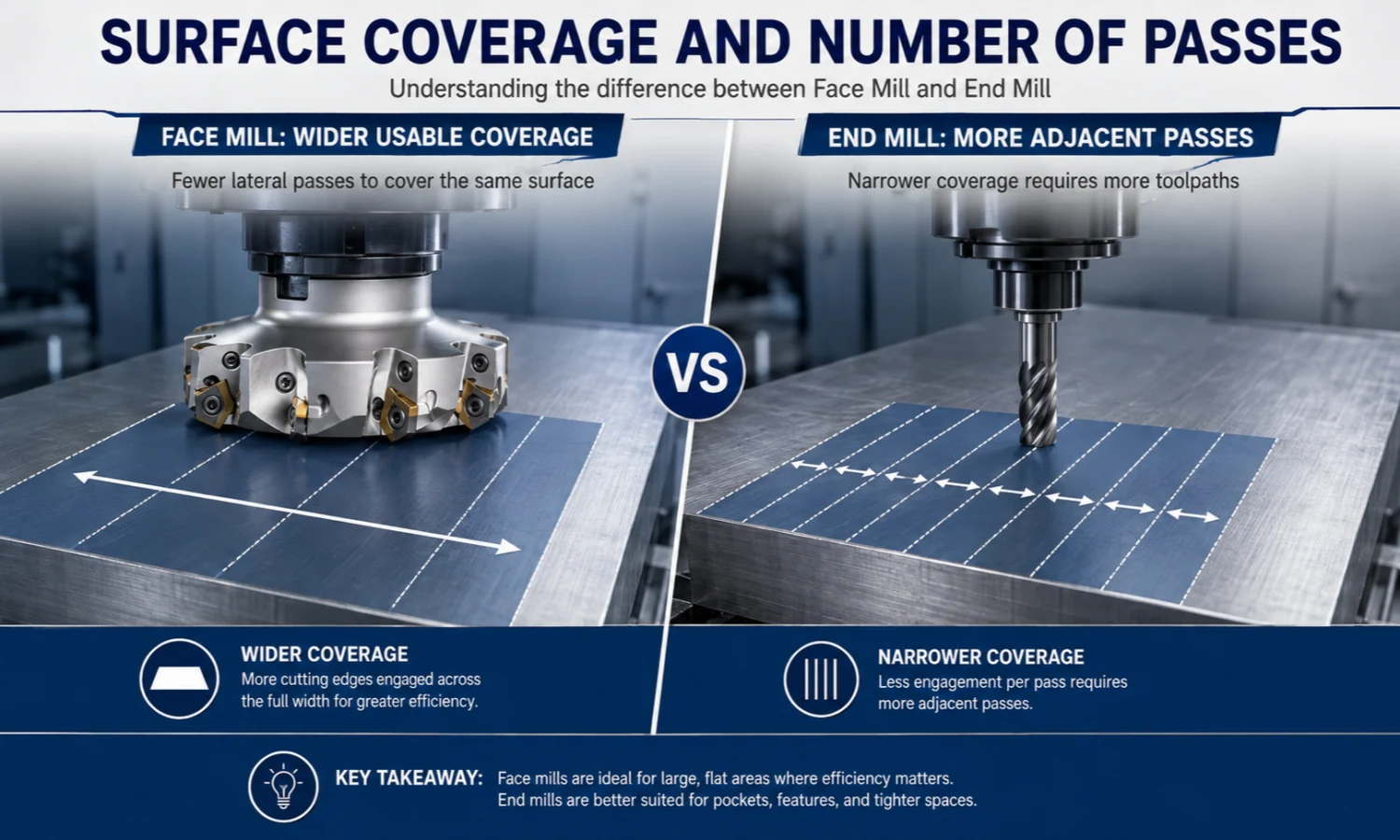
This is one of the most important factors when choosing a face mill or end mill.
A wider surface does not automatically require a face mill. The important relationship is:
Surface size → usable cutter coverage → number of lateral toolpaths
Suppose two cutters can both reach the surface.
A comparatively large face mill may cover a greater width during each pass. Therefore, it can often reduce the number of adjacent toolpaths required to machine a broad open face.
A smaller end mill may need more passes to cover the same area.
However, cutter diameter alone does not decide the result.
The usable cutter coverage may be limited by:
- Clamps
- Fixtures
- Nearby walls
- Holes
- Bosses
- Steps
- Part edges
- Tool approach
- Available machine clearance
Therefore, “large surface” should not be treated as a fixed dimensional threshold. It is large relative to the cutter that can practically reach and machine it.
Surface Finish and Flatness: What Tool Choice Can and Cannot Decide
A face mill can be a very suitable tool for creating a consistent finish across a broad planar surface because its geometry and coverage are designed around facing operations.
However, tool type alone does not determine surface finish or flatness.
Actual results can also depend on:
- Cutter runout
- Cutting-edge or insert geometry
- Tool condition
- Feed conditions
- Workpiece material
- Machine condition
- Workholding stability
- Toolpath strategy
- Setup accuracy
An end mill can also produce a suitable finish on a smaller or localized flat surface.
Therefore, it is not technically accurate to say that a face mill always produces a better surface finish than an end mill.
The more useful question is:
Which tool is better suited to the size, openness, accessibility, and overall machining requirement of this particular surface?
Why End Mills Are Usually Better for Slots, Pockets, and Profiles
When the part includes slots, pockets, profiles, contours, or localized side features, an end mill generally provides more flexibility than a face mill.
The end and peripheral cutting edges allow the tool to follow:
- Internal paths
- Pocket boundaries
- Profile geometry
- Narrower machining zones
- Areas that a larger cutter cannot easily access
Shoulder machining requires more careful consideration. Some 90° face milling cutters can approach or machine square-shoulder features, so “shoulder = end mill” is not a universal rule.
If your main decision is specifically between a dedicated side cutter and an end mill for grooves or side-oriented machining, see our guide to Side Milling Cutter vs End Mill.
For a broader comparison of face-oriented and side-oriented milling operations, see Side Milling vs Face Milling.
Machine, Workholding, and Tool-Access Limits
The theoretically most productive cutter is not useful if the setup cannot support it.
Before selecting a larger face mill, consider:
- Available cutter clearance
- Spindle and toolholder capability
- Machine rigidity
- Workholding stability
- Clamp position
- Nearby walls or fixtures
- Approach direction
A broad surface may appear ideal for face milling, but a fixture or nearby feature can prevent a large cutter from reaching the full area.
In that case, a smaller end mill may provide the more practical solution.
When Fewer Tool Changes Favor an End Mill
Tool productivity should not be judged only by the width of one cutting pass.
Consider a small component that needs:
- A top face machined
- A pocket
- A slot
- A profile
A face mill may be better at machining the top face by itself. However, if an end mill can machine the top face and then continue with the pocket, slot, and profile, using the end mill may reduce unnecessary tool changes.
This does not mean an end mill is always more productive.
Instead, it shows why tool selection should consider the complete process rather than one operation in isolation.
Can You Face Mill With an End Mill?
Yes, an end mill can be used for facing in suitable conditions.
But capability does not equal preferred choice.
An end mill may work very well for a small or restricted flat surface. On a wide, open surface, however, a dedicated face mill may provide more useful surface coverage and reduce the number of lateral passes.
The correct choice depends on the geometry of the end mill, the target surface, accessibility, machine setup, and the other features that must be machined.
When an End Mill Is Reasonable for Facing
Using an end mill for facing may make sense when:
- The flat surface is small
- The surface lies inside a pocket
- A large cutter cannot clear nearby walls or fixtures
- Clamps restrict face-mill access
- The same end mill is already required for other features
- Avoiding an additional tool change improves the overall process
The end mill must also have suitable end geometry for the intended cutting direction and surface requirement.
Therefore, “an end mill can face” should never be interpreted as “every end mill is equally suitable for facing.”
When a Dedicated Face Mill Makes More Sense
A dedicated face mill generally becomes more attractive when:
- The target is a broad, open surface
- The cutter can access most or all of the face
- Useful cutter coverage is significantly wider than the available end mill
- The operation requires repeated facing
- Reducing adjacent lateral toolpaths matters
- Planar machining is the main purpose of the operation
For these applications, you can review our face milling cutters.
If you are unsure about cutter diameter, entering angle, insert style, or the suitability of a face mill for your workpiece, the final selection should be based on the actual part geometry and machining conditions rather than a generic rule.
How to Choose Between a Face Mill and an End Mill
The easiest way to choose is to start with the geometry of the machining task.
Do not begin with: Which tool is more powerful?
Instead ask: What surface or feature must I machine, how accessible is it, and what other operations must the same setup complete?
Choose a Face Mill When…
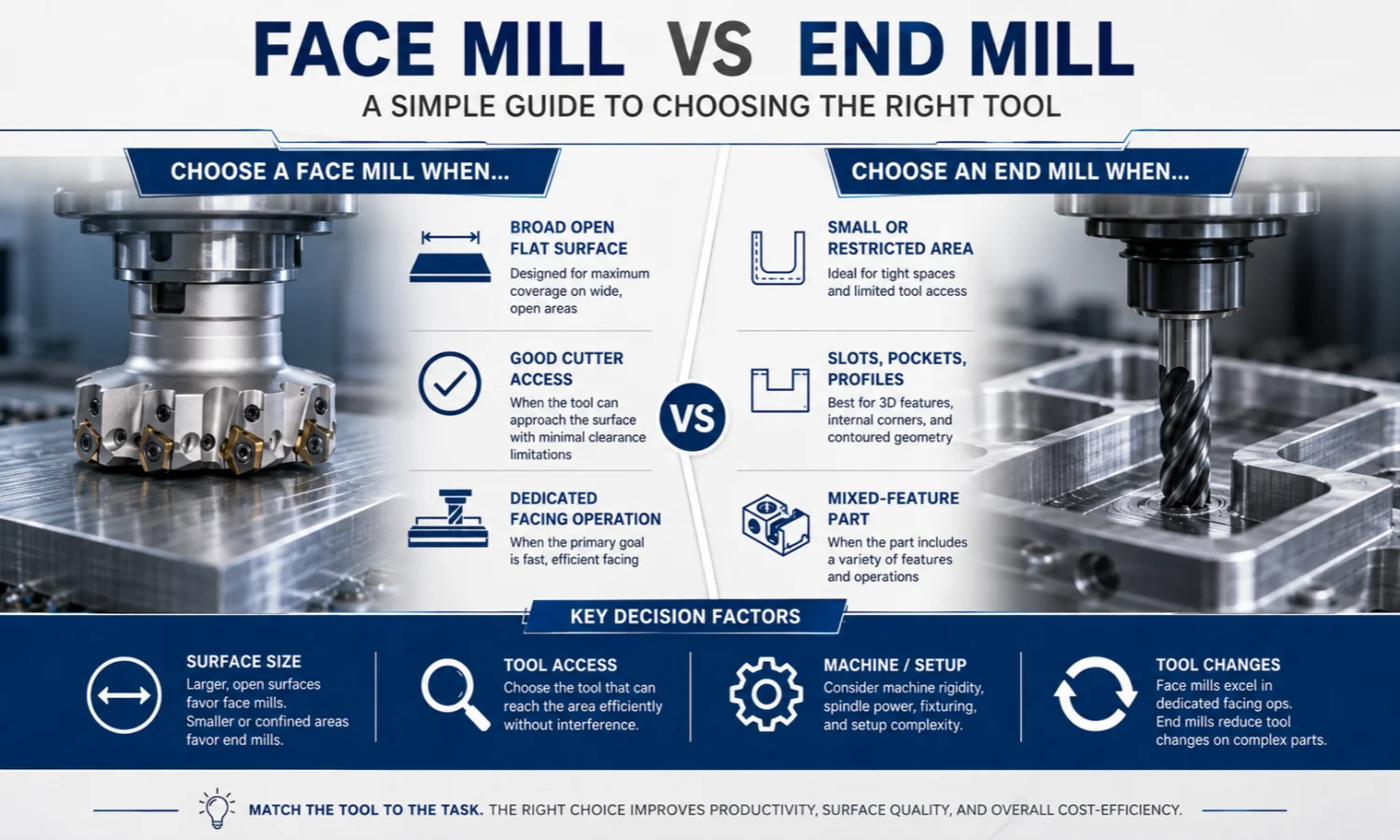
A face mill is generally the stronger candidate when:
- The target is a broad, open, accessible flat surface
- Cutter clearance allows useful surface coverage
- The machine and toolholder can support the cutter
- The workholding is stable
- Facing is repeated enough to justify a dedicated tool
- Reducing lateral toolpaths is valuable
- Planar machining is the main objective
This is why face mills are widely used for large open surfaces, top faces, leveling operations, and other dedicated planar machining tasks.
Choose an End Mill When…
An end mill may be the better choice when:
- The flat area is relatively small
- The surface is localized
- Access is limited
- The surface lies inside or near another feature
- The part also needs slots, pockets, profiles, or contours
- A larger face mill cannot clear walls, fixtures, or clamps
- One end mill can complete several operations and reduce unnecessary tool changes
In other words, the end mill often wins when flexibility matters more than broad-area coverage.
Three Part-Geometry Selection Scenarios
Scenario 1: Broad open plate face
The part has a large, accessible top surface with enough clearance around the machining area.
A face mill will generally be the more direct choice because its wider usable coverage may reduce the number of adjacent passes.
Typical direction: Face Mill
Scenario 2: Small part with a top face, pocket, and slot
The top surface needs light facing, but the same component also requires a pocket and slot.
If a suitable end mill can complete all three operations, keeping one tool in the machining sequence may be more practical than adding a dedicated face mill.
Typical direction: End Mill may be more practical
Scenario 3: Flat area limited by clamps or nearby features
The target surface is flat, but walls, fixtures, clamps, or nearby geometry restrict the approach of a large-diameter cutter.
Even if a face mill would normally suit the surface size, inadequate clearance may make a smaller end mill the more workable option.
Typical direction: Depends on tool access; End Mill may be more practical
Face Mill vs End Mill FAQs
Can You Use an End Mill as a Face Mill?
Yes. A suitable end mill can machine flat surfaces, especially small or localized areas.
However, a dedicated face mill often makes more sense for broad, open surfaces because wider cutter coverage can reduce adjacent lateral toolpaths when the setup allows.
What Is the Main Difference Between Face Milling and End Milling?
Face milling primarily focuses on machining planar surfaces with a cutter optimized for broad face contact and coverage.
End milling uses end and peripheral cutting capability to machine a wider range of features, including local flat surfaces, slots, pockets, profiles, and contours.
Which Tool Is Better for Large Flat Surfaces?
For a broad, open, accessible flat surface, a face mill is generally the more suitable choice.
Its larger usable cutting coverage can often reduce the number of lateral passes compared with a smaller end mill.
However, clamps, fixtures, machine capability, nearby features, and cutter access can change the final selection.
Which Tool Is Usually Better for Slots, Pockets, and Profiles?
An end mill is generally more versatile for slots, pockets, profiles, and contours because it can use both end and peripheral cutting edges.
The exact tool still depends on the feature geometry, required dimensions, workpiece material, tool access, and machining conditions.
Does a Face Mill Always Produce a Better Surface Finish Than an End Mill?
No.
A face mill can be well suited to producing a consistent finish on a broad flat surface, but surface quality also depends on tool condition, runout, cutting-edge geometry, workholding, machine condition, material, toolpath, and cutting parameters.
A properly selected end mill can also produce a suitable finish on smaller or localized flat surfaces.
Need Help Choosing a Face Mill or End Mill?
The best face mill vs end mill choice depends on more than tool diameter. Surface size, openness, access, workholding, machine capability, and the other features on the part all influence the decision.
If your main requirement is broad planar machining, explore our face milling cutter options for different planar machining requirements:
For a new or non-standard application, send us your workpiece drawing or a simple sketch together with the workpiece material and machining requirement.
We can review the application and help determine whether a face mill or end mill is the more suitable starting point for the machining task.