 Fraise de précision,Outils de coupe pour l’usinage CNC de chaque matériau

A 2 La fraise à cannelure est couramment utilisée pour l'usinage de l'aluminium., fente pleine largeur, fraisage de poche, fraisage latéral, et ébauche légère. Il convient également au cuivre, brass, plastiques sélectionnés, et autres applications où l'évacuation des copeaux est une priorité.
Les deux bords tranchants laissent des rainures relativement larges.. Donc, le couteau offre plus d'espace pour les copeaux que de nombreux outils à plus grand nombre de cannelures. Cela peut contribuer à réduire l'encombrement des copeaux lors d'opérations fermées ou à volume de copeaux élevé..
Cependant, deux flûtes ne sont pas automatiquement le meilleur choix pour chaque travail. Le bon outil dépend toujours du matériau de la pièce à usiner, opération de coupe, engagement de l'outil, finition requise, rigidité de la machine, et procédé d'élimination des copeaux.
Réponse rapide
Qu'est-ce qu'un 2 fraise en bout de cannelure utilisée pour?
Les utilisations typiques incluent:
- Rainure en aluminium
- Fraisage de poche
- Découpe de fentes sur toute la largeur
- Fraisage latéral dans des matériaux non ferreux
- Ebauche légère
- Usinage du cuivre et du laiton
- Usinage plastique sélectionné
- Opérations où les copeaux sont difficiles à éliminer
Une fraise à deux goujures est particulièrement utile lorsque l'espace des goujures et l'évacuation des copeaux comptent plus que l'augmentation du nombre d'arêtes de coupe.. En revanche, un nombre de cannelures plus élevé peut être préféré lorsqu'une plus grande résistance du noyau, plus de contacts coupants, ou une finition de surface fine est la principale exigence.
Qu'est-ce qu'une fraise à 2 cannelures?
Une fraise à deux cannelures possède deux arêtes de coupe hélicoïdales et deux rainures de cannelure le long du corps de la fraise.. Ces rainures font partie du tranchant et offrent également un espace permettant aux copeaux de quitter la zone de coupe..
Comparé à de nombreux outils à quatre ou six cannelures du même diamètre, une conception à deux cannelures offre normalement plus d'espace pour les flûtes. Par conséquent, il est souvent envisagé pour les matériaux produisant de gros copeaux et pour les opérations où la fraise est entourée par la pièce à usiner..
Le nombre de flûtes n'est qu'une partie de la conception de l'outil. Diamètre de coupe, longueur de flûte, force de base, angle d'hélice, préparation des bords, revêtement, et la géométrie des extrémités affectent également les performances.
Aperçu des meilleures utilisations d'une fraise à 2 cannelures
| Application | Pourquoi deux flûtes peuvent aider | Condition importante |
|---|---|---|
| Rainure en aluminium | Fournit plus d'espace pour la puce | Géométrie pointue et évacuation fiable des copeaux |
| Fentes pleine largeur | Aide à éliminer un volume de copeaux élevé | Profondeur de coupe appropriée et débit de liquide de refroidissement ou d'air |
| Fraisage de poche | Réduit le risque d’emballage de copeaux | La profondeur de la poche et la méthode d'entrée doivent être prises en compte |
| Cuivre et laiton | Prend en charge le dégagement des puces | Les exigences en matière de qualité d'alliage et de bavures affectent la sélection |
| Plastiques | Fournit de l'espace pour le retrait des copeaux | Le type de plastique et le contrôle de la chaleur sont importants |
| Fraisage latéral | Peut convenir à de nombreuses applications non ferreuses | L'engagement radial et l'état de surface doivent être vérifiés |
| Ebauche légère | Prend en charge l'enlèvement de matériaux lourds en copeaux | La rigidité de la machine et la portée des outils restent importantes |
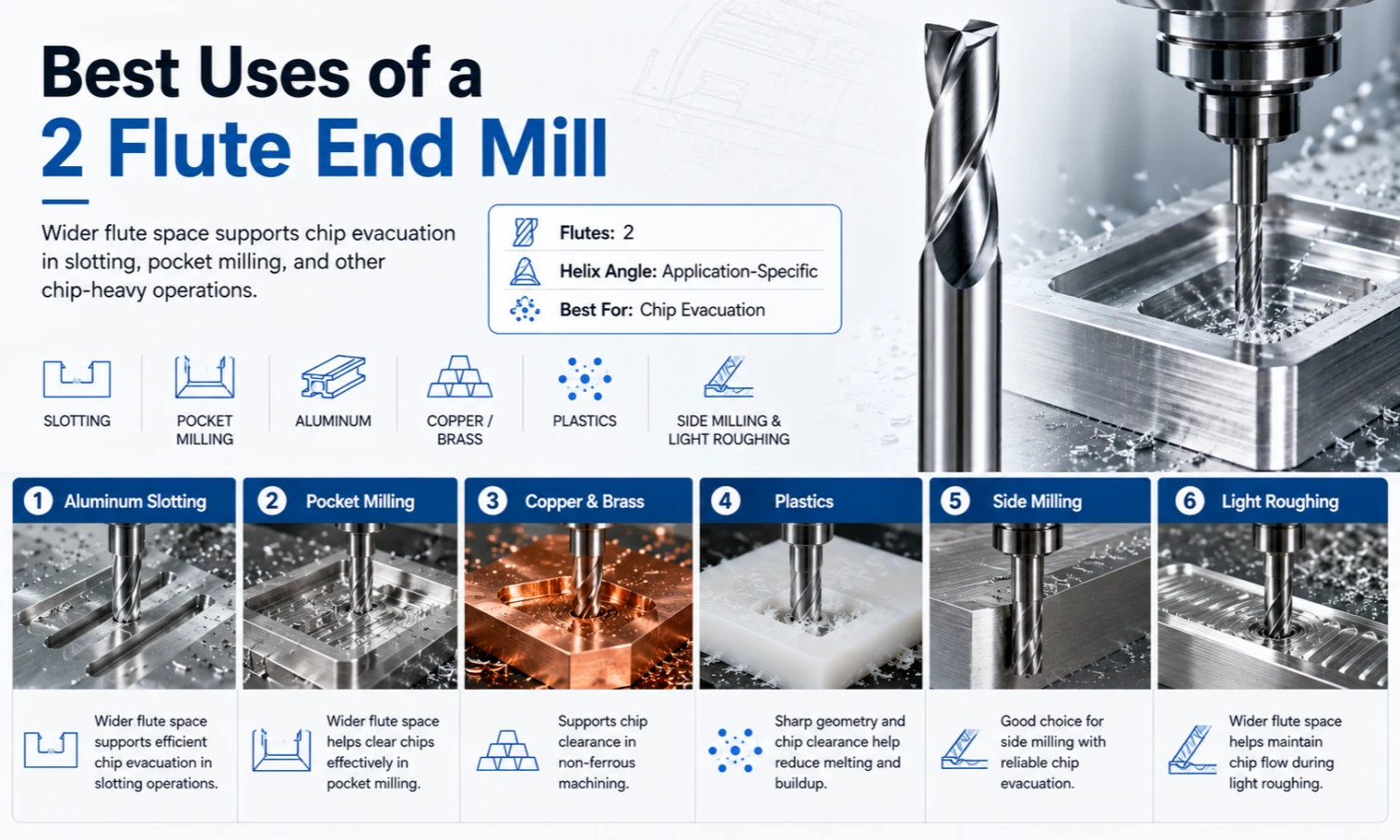
Principales utilisations d'une fraise en bout à 2 cannelures
Usinage de l'aluminium
L'usinage de l'aluminium est l'une des applications les plus courantes pour un 2 fraise à cannelure.
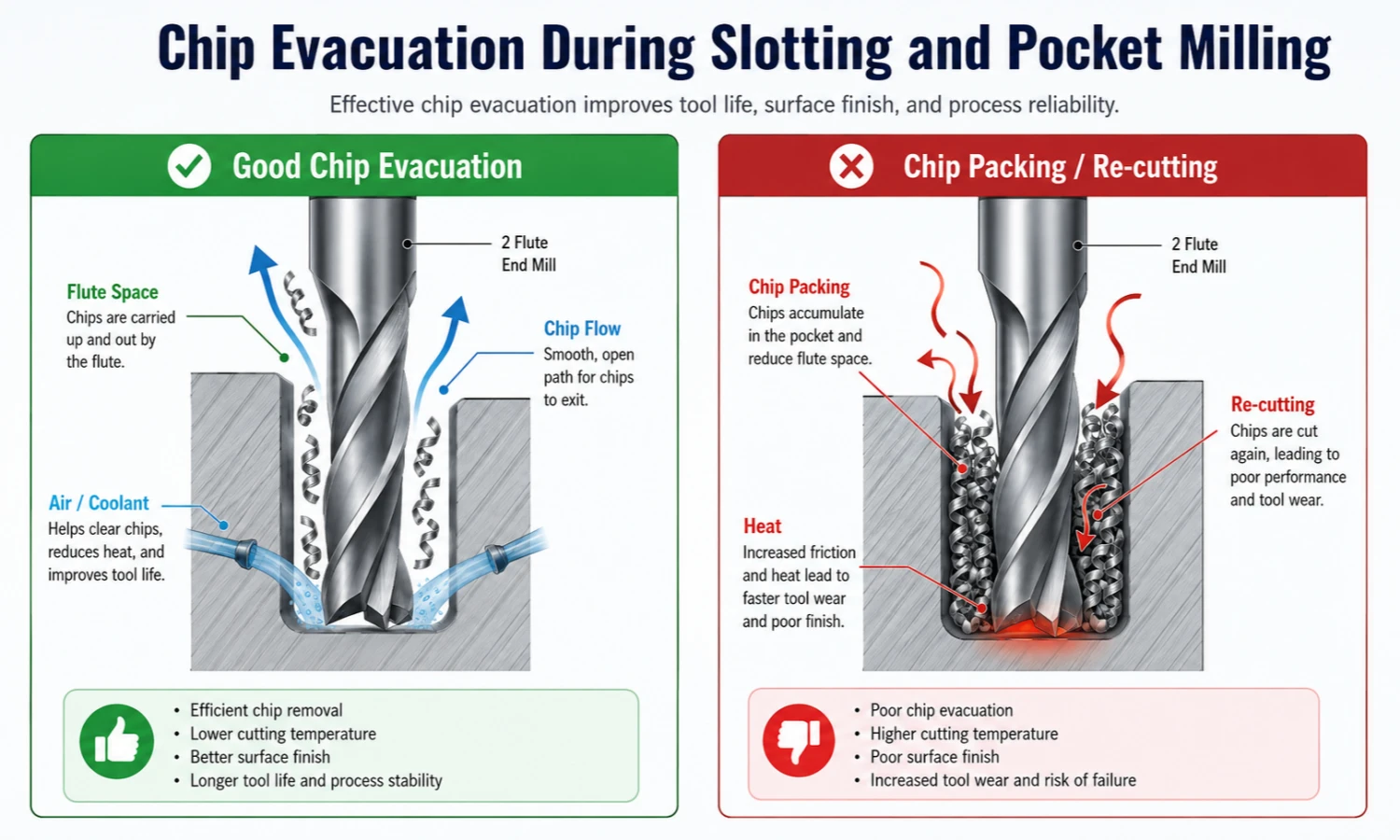
De nombreux alliages d'aluminium produisent des copeaux relativement gros ou continus. Si ces jetons restent dans une fente ou une poche, ils peuvent être recoupés ou comprimés contre la pièce. Cela peut augmenter la chaleur, provoquer un bord accumulé, et réduire la stabilité de coupe.
Un coupe-aluminium approprié utilise souvent:
- Arêtes de coupe tranchantes
- Surfaces de flûtes lisses ou polies
- Espace de flûte adéquat
- Une conception non revêtue ou un revêtement approprié à faible friction
- Un angle d'hélice spécifique à l'application
- Un air fiable, brume, ou livraison de liquide de refroidissement
Deux cannelures offrent un espace utile pour les puces, mais le nombre de flûtes à lui seul ne garantit pas de bonnes performances en aluminium. La géométrie complète de l'outil doit correspondre à l'alliage, diamètre de l'outil, profondeur de coupe, état de la machine, et finition souhaitée.
Fentes pleine largeur
La fente sur toute la largeur crée un volume de copeaux élevé car la fraise engage le matériau sur tout son diamètre.
En outre, les parois des fentes limitent les chemins disponibles pour l'évacuation des copeaux. Les copeaux peuvent rester en dessous ou autour du couteau, surtout lors de coupes plus profondes.
Un outil à deux cannelures peut être utile car les rainures plus larges offrent plus d'espace pour les copeaux.. Néanmoins, le placement stable dépend également de:
- Profondeur de fente
- Diamètre de coupe
- Longueur de flûte
- Porte-à-faux d'outil
- Accès au liquide de refroidissement ou à l'air
- Rigidité des machines
- Serrage de la pièce
- Paramètres de coupe
Pour les fentes profondes, utilisez uniquement la longueur de flûte et la portée globale requises par la fonctionnalité. Une extension excessive de l'outil peut augmenter la déviation et le broutage.
Fraisage de poche
Le fraisage de poches combine l'enlèvement de matière avec un flux de copeaux limité. Donc, l'outil doit couper efficacement tandis que les copeaux quittent la zone fermée.
Une fraise à deux cannelures est souvent envisagée pour les poches en aluminium, usinage de poche grossière, et d'autres applications où le conditionnement des puces crée des problèmes.
Cependant, la profondeur de la poche et la méthode d'entrée affectent également la sélection de l'outil. Une poche ouverte peu profonde crée des conditions différentes d’une poche fermée et profonde. De même, l'engagement latéral après l'entrée peut nécessiter une stratégie différente de celle du départ de poche initial.
Quand les jetons restent dans la poche, améliorer l'apport d'air ou de liquide de refroidissement avant d'augmenter la charge de coupe.
Cuivre et Laiton
Le cuivre et le laiton sont tous deux des matériaux non ferreux, mais ils ne s'usinent pas de la même manière.
Le cuivre pur peut être ductile et produire de longs copeaux ou bavures. Meanwhile, différents alliages de laiton peuvent produire des copeaux plus courts et nécessiter une préparation de bord différente.
Pour ces matériaux, une fraise à deux cannelures peut prendre en charge le dégagement des copeaux. Cependant, l'outil exact doit également refléter:
- Qualité du matériau
- Exigences en matière de bavures
- Cible de finition de surface
- Engagement des outils
- Diamètre de coupe
- Méthode de refroidissement ou de lubrification
Une géométrie de coupe nette est particulièrement importante lorsque le frottement ou l'adhérence du matériau est un problème.
Plastiques et matériaux composites sélectionnés
Les fraises à deux cannelures sont également utilisées pour certains plastiques techniques, car l'espace des cannelures aide à éliminer les copeaux de la zone de coupe..
L'usinage du plastique peut créer des problèmes tels que:
- Fusion
- Frottement
- Emballage de copeaux
- Déchirure des bords
- Formation de bavures
- Déformation du matériau
La géométrie correcte dépend si le plastique est mou, rigide, rempli, renforcé, ou sensible à la chaleur. Donc, un cutter général ne doit pas être considéré comme adapté à chaque plastique.
La géométrie de l'outil spécifique à l'application peut également être utilisée pour certains matériaux composites. Cependant, les composites varient considérablement, et certains nécessitent une compression spécialisée, taille diamant, recouvert, ou des couteaux résistants à l'abrasif.
Fraisage latéral et ébauche légère
A 2 La fraise à cannelure peut effectuer un fraisage latéral, profilage, et ébauche légère lorsque l'outil correspond au matériau et à l'engagement.
Pendant le fraisage latéral, les puces ont généralement plus d'espace à laisser que lors d'un slot pleine largeur. Donc, l'espace de la flûte peut être moins restrictif. Rigidité de l'outil, engagement radial, précision dimensionnelle, et la finition de surface peut devenir plus importante.
Pour l'ébauche légère dans l'aluminium ou d'autres matériaux non ferreux, une conception à deux cannelures peut permettre une élimination efficace des copeaux. Cependant, l'ébauche lourde peut nécessiter une géométrie d'ébauche dédiée, profil brise-copeaux, ou un autre compte de flûte.
Ne sélectionnez pas la fraise uniquement parce que l’opération est décrite comme « ébauche ». Vérifier le volume des jetons, profondeur de coupe, puissance de la machine, portée de l'outil, et taux d'enlèvement de matière requis.
Pourquoi deux cannelures fonctionnent bien dans les opérations gourmandes en copeaux
Plus d'espace pour la flûte
Un couteau a un espace limité entre ses arêtes de coupe et son noyau.
Quand le nombre de flûtes augmente, les rainures de flûte disponibles deviennent normalement plus petites à moins que la géométrie complète de l'outil ne soit modifiée. Avec deux flûtes, plus d'espace peut être alloué à la formation et à l'évacuation des copeaux.
Ceci est utile pendant:
- Fentes pleine largeur
- Usinage de poches profondes
- Usinage de l'aluminium
- Découpe de plastique
- Autres opérations à grand volume de copeaux
Cependant, plus d'espace pour la flûte peut également signifier une structure de base différente. Donc, la rigidité requise doit être prise en compte en même temps que l'évacuation des copeaux.
Évacuation des copeaux et bords accumulés
Une bonne évacuation des copeaux permet d'éviter que les copeaux ne soient coupés à plusieurs reprises.
Les recoupes peuvent augmenter:
- Température de coupe
- Usure des outils
- Des dégâts de pointe
- Marques de surface
- Soudage des copeaux
- Bord accumulé
- Charge de la machine
L'aluminium et d'autres matériaux ductiles peuvent adhérer au tranchant lorsque la chaleur, friction, ou les conditions de lubrification ne sont pas adaptées.
Un couteau bien aiguisé avec des surfaces de flûte appropriées peut aider. En outre, air correctement dirigé, brume, ou le liquide de refroidissement peut éliminer les copeaux avant qu'ils ne s'accumulent à l'intérieur de la fonction.
Ce que le nombre de flûtes ne peut pas vous dire
Le nombre de flûtes ne détermine pas indépendamment:
- Charge de coupe
- Rigidité de l'outil
- Capacité de plongée
- Profondeur de coupe maximale
- Matériau de pièce approprié
- Finition de surface requise
- Vitesse de broche sûre
- Vitesse d'alimentation
- Durée de vie de l'outil
Par exemple, deux outils avec le même nombre de cannelures peuvent avoir des diamètres de noyau différents, angles d'hélice, géométries d'extrémité, revêtements, et nuances de carbure.
Pour une explication plus large de la géométrie et de la sélection des flûtes, lisez notre conception des cannelures de la fraise en bout et guide d'évacuation des copeaux.
Une fraise en bout à 2 cannelures peut-elle plonger?
Certaines fraises à deux cannelures à coupe centrale prennent en charge la rampe, entrée hélicoïdale, démarrage de la poche, ou entrée en plongée contrôlée.
Cependant, deux cannelures ne signifient pas automatiquement que la fraise peut plonger verticalement. Les arêtes de coupe d'extrémité doivent atteindre le centre de l'outil, et la méthode de saisie doit être adaptée au matériau et à la conception du couteau.
La plongée droite crée également différentes charges de coupe et conditions d'écoulement des copeaux lors du fraisage latéral.. Donc, rampe, entrée hélicoïdale, ou le pré-perçage peut fournir un meilleur contrôle dans les applications plus profondes ou plus exigeantes.
Pour des conseils détaillés, lire un 2 fraise à cannelure plongeante.
Quand une fraise à 2 cannelures n'est-elle pas le premier choix ??
Finition fine avec engagement léger
Pendant la finition légère, le volume des copeaux peut être faible. Dans cette situation, les grandes rainures de cannelure peuvent être moins importantes que le nombre de contacts de coupe et la stabilité de la fraise.
Un outil comportant un nombre de cannelures plus élevé peut permettre une finition plus fine ou plus cohérente dans certaines applications.. Cependant, le résultat dépend toujours du faux-rond, géométrie de l'outil, rigidité de la machine, engagement radial, et paramètres de coupe.
Une fraise à deux cannelures peut toujours produire une bonne surface lorsque l'outil et le processus sont correctement contrôlés..
Applications nécessitant une plus grande force de base
Fonctionnalités approfondies, longs surplombs, pression de coupe élevée, ou des configurations instables peuvent nécessiter une plus grande rigidité de l'outil.
Une fraise avec un noyau plus solide peut réduire la déflexion. Cependant, augmenter le nombre de flûtes n'est pas la seule solution. Diamètre de coupe, profondeur de la flûte, longueur de flûte, matériau de l'outil, état du titulaire, et la rigidité de la machine affecte également la résistance.
Acier et matériaux résistants à la chaleur
Un outil à deux cannelures ne se limite pas à l'aluminium ou aux plastiques. Certaines applications de rainurage d'acier peuvent également utiliser deux ou trois cannelures lorsque l'évacuation des copeaux est difficile.
Cependant, fraisage latéral en acier, semi-finition, ou la finition peut utiliser quatre cannelures ou plus lorsque l'espace pour les copeaux est suffisant et que des contacts de coupe supplémentaires sont utiles.
L'acier inoxydable et les matériaux résistants à la chaleur nécessitent également un contrôle minutieux de la chaleur., écrouissage, engagement de l'outil, revêtement, et la force des bords.
Pour une comparaison ciblée, lire 2 fraise à flûte vs 4 flûte.
Comment décider si deux flûtes conviennent à l'opération
Avant de sélectionner une fraise à deux cannelures, revoir l'état complet de l'usinage.
Posez les questions suivantes:
- L'opération crée-t-elle un volume de copeaux élevé?
- La fraise effectue-t-elle un rainurage sur toute la largeur?
- La poche est-elle profonde ou fermée?
- L'évacuation des copeaux est-elle limitée?
- Le matériau a-t-il tendance à former des bords rapportés?
- La finition requise est-elle plus importante que l'espace de la flûte?
- Le porte-à-faux de l'outil est-il plus long que nécessaire?
- La configuration de la machine et des accessoires est-elle rigide ??
- Peut aérer, brume, ou le liquide de refroidissement atteint la zone de coupe?
- L'opération nécessite-t-elle une géométrie de coupe centrale?
Choisissez deux cannelures lorsque l'espace pour les copeaux est une exigence majeure et que la structure de la fraise convient à l'opération..
Choisissez un autre nombre de cannelures lorsque l'évacuation des copeaux est déjà stable et que le processus nécessite davantage de contacts de coupe., une plus grande force de base, ou un équilibre différent entre ébauche et finition.
Pour des conseils de sélection plus larges, lire comparer 2, 4, et 6 fraises à cannelure.
FAQ À propos 2 Utilisations de la fraise en bout à cannelure
Une fraise à 2 cannelures est-elle uniquement pour l'aluminium?
No. L'aluminium est une application courante, mais les fraises à deux cannelures sont également utilisées pour le cuivre, brass, plastiques sélectionnés, fraisage latéral, rainurage, empocher, et autres opérations où l'évacuation des copeaux est importante.
La géométrie exacte de l'outil doit correspondre à la pièce à usiner et aux conditions de coupe.
Une fraise en bout à 2 cannelures est-elle adaptée au rainurage pleine largeur?
Oui, une fraise à deux cannelures appropriée est couramment utilisée pour le rainurage sur toute la largeur, notamment en aluminium et autres matériaux non ferreux.
Les rainures plus larges offrent de l'espace pour les copeaux. Cependant, profondeur de fente, livraison de liquide de refroidissement, portée de l'outil, et la rigidité de la machine doit également être prise en compte.
Une fraise en bout à 2 cannelures peut-elle être utilisée pour le fraisage latéral?
Oui. Un outil à deux cannelures peut effectuer un fraisage latéral et un profilage.
Pendant le fraisage latéral, engagement radial, rigidité de l'outil, précision requise, et la finition de surface peut devenir plus importante que l'espace maximum des flûtes.
Une fraise en bout à 2 cannelures peut-elle être en acier?
Oui, certaines fraises à deux cannelures peuvent usiner l'acier, en particulier lors du rainurage ou d'autres opérations où l'évacuation des copeaux est restreinte.
Cependant, le bon choix dépend de la qualité de l'acier, profondeur de coupe, géométrie de la fraise, revêtement, rigidité de la machine, et méthode de refroidissement.
Une fraise en bout à 2 cannelures peut-elle plonger?
Certaines fraises à deux cannelures à coupe centrale peuvent prendre en charge une plongée contrôlée, rampe, ou entrée hélicoïdale.
Vérifiez toujours la géométrie finale avant de programmer l'entrée axiale..
Un cutter à 2 cannelures produit-il toujours une finition plus rugueuse?
No. La finition de la surface ne dépend pas seulement du nombre de cannelures.
Faux-rond de l'outil, qualité de pointe, alimentation par dent, engagement radial, stabilité de la machine, état matériel, et le parcours d'outil affectent tous la surface finie.
Quand devrais-je plutôt choisir trois ou quatre flûtes ??
Envisagez trois ou quatre cannelures lorsque l'évacuation des copeaux reste stable et que l'opération nécessite davantage de contacts de coupe., une plus grande rigidité, ou potentiel de finition supérieur.
Trois cannelures peuvent fournir un équilibre entre l'espace des copeaux et le nombre de bords. Quatre cannelures peuvent convenir à certains usinages d'acier, fraisage latéral, et opérations de finition.
Guides connexes
Pour plus d’informations sur les produits et les applications, visite:
Carbure monobloc 2 fraise à cannelure
Un 2 fraise à cannelure plongeante?
Comparer 2, 4, et 6 fraises à cannelure
Conception et sélection de flûtes de fraises en bout
Besoin d'un 2 Fraise à flûte pour votre application?
Envoyez-nous votre matière à usiner, opération d'usinage, taille de coupe requise, dessin, modèle de référence, informations actuelles sur l'outil, et quantité lorsque disponible. Nous examinerons les exigences connues et aiderons à confirmer une direction d'outil standard ou personnalisée appropriée..
Consultez nos standards et nos personnalisés carbure monobloc 2 fraise à cannelure choix.
E-mail: sales@cutterbest.com