 Fraise de précision,Outils de coupe pour l’usinage CNC de chaque matériau

Quelle est la meilleure fraise en bout pour l'acier inoxydable?
Choisir le meilleure fraise pour l'acier inoxydable n'est pas aussi simple que de sélectionner un nombre de flûtes, revêtement, ou forme de coupe. Le bon outil dépend de la qualité de l'acier inoxydable, opération d'usinage, géométrie de la pièce, rigidité de la machine, évacuation des copeaux, porte-à-faux de l'outil, et finition de surface requise.
De nombreux aciers inoxydables, nuances austénitiques particulièrement courantes, ont une conductivité thermique relativement faible et une tendance à l'écrouissage pendant l'usinage. La chaleur et une coupe instable peuvent donc imposer des exigences supplémentaires au tranchant., revêtement, géométrie de l'outil, et configuration de la machine.
Il n'existe pas de fraise unique qui soit la meilleure pour chaque application en acier inoxydable..
Pour de nombreuses opérations de fraisage CNC, un fraise en carbure monobloc est un point de départ courant car le carbure offre une grande rigidité, résistance à l'usure, et une stabilité de pointe dans des conditions d'usinage adaptées. Cependant, la fraise finale doit encore correspondre à la pièce à usiner et au fonctionnement réels.
Guide de sélection rapide des fraises en bout en acier inoxydable
| Exigence d'usinage | Type d'outil à considérer | Principale préoccupation de sélection |
|---|---|---|
| Surfaces planes et fraisage latéral | Fraise à bout plat | Stabilité, contrôle des copeaux, et la force des bords |
| Surfaces courbes ou 3D | Fraise à bout sphérique | Précision des contours et état de surface |
| Coins R internes ou externes | Fraise en bout à rayon d'angle | Résistance des coins et réduction des dégâts sur les bords |
| Enlèvement de matériaux lourds | Fraise d'ébauche | Évacuation des copeaux, rigidité, et charge de coupe |
| Profilage général | Fraise en carbure monobloc | Nombre de flûtes, revêtement, géométrie, et stabilité |
| Fraisage plus performant | Des conceptions à hélice/pas variables peuvent être envisagées | Contrôle des vibrations et stabilité d’usinage |
Utilisez ce tableau comme point de départ plutôt que comme règle fixe. Le couteau préféré peut changer lorsque la qualité de l'acier inoxydable, profondeur de coupe, fiançailles, état de la machine, ou modifications de la géométrie de la pièce.
Si vous connaissez déjà vos besoins en usinage et souhaitez consulter les options standard et personnalisées disponibles, voir notre Fraises en bout pour acier inoxydable.
Choisissez le type de fraise en bout par opération d'usinage
Notre usine ne traite pas l'usinage de l'acier inoxydable comme une seule application de coupe fixe.. Fraises plates, fraises à bout sphérique, fraises en bout à rayon de coin, et les fraises d'ébauche servent à différents objectifs d'usinage.
Donc, la caractéristique d'usinage doit généralement être identifiée avant de sélectionner le nombre de cannelures ou le revêtement..
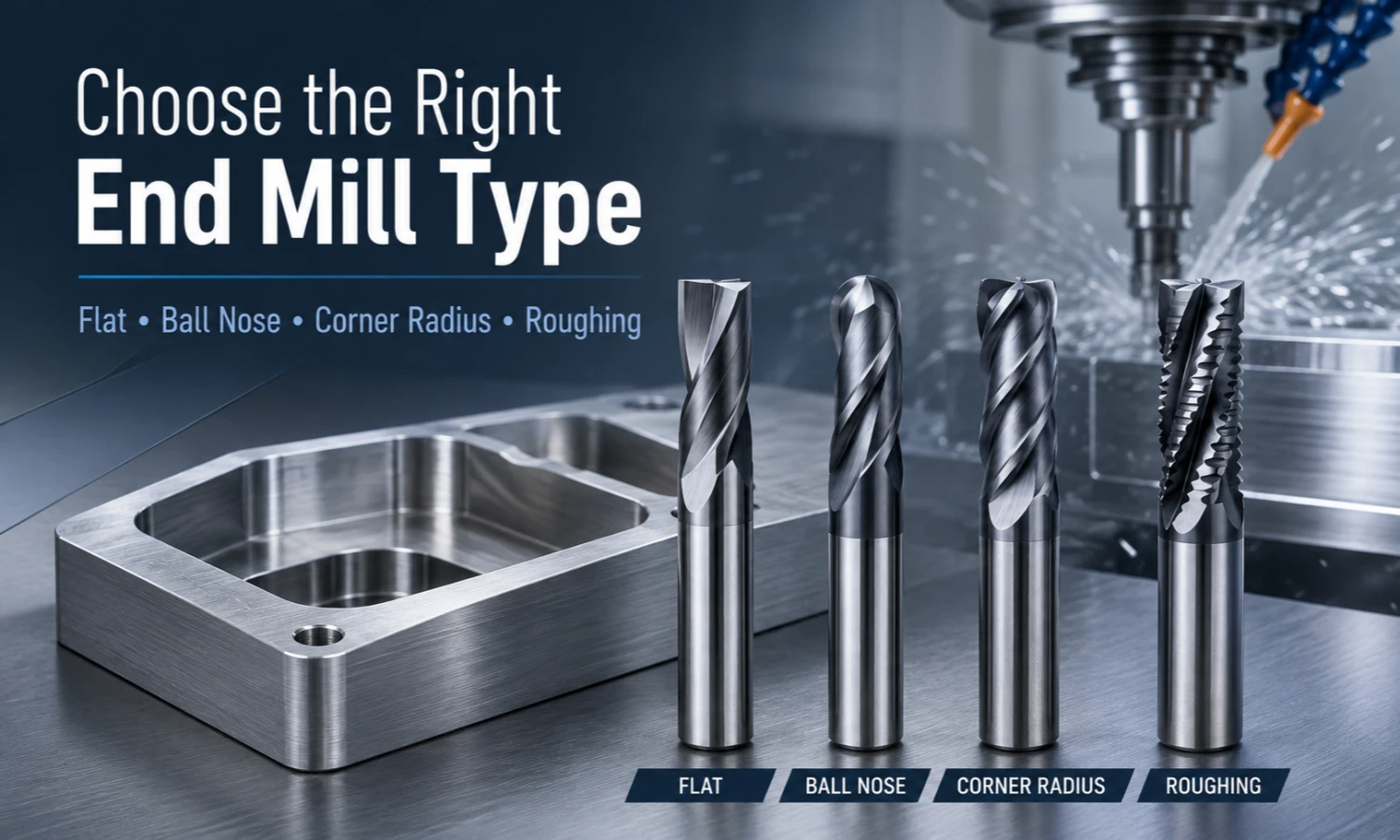
Fraises à bout plat pour surfaces planes et fraisage latéral
Une fraise à bout plat est généralement envisagée pour:
- Fraisage latéral
- Fraisage d'épaulement
- Usinage à fond plat
- Profilage
- Opérations de rainurage adaptées
Si la pièce nécessite des parois droites, fonds plats, ou épaules carrées, une extrémité coupante plate est généralement plus appropriée qu'une géométrie à nez sphérique.
Pour les spécifications et les options disponibles, voir notre Fraise à bout plat.
Fraises à bout sphérique pour surfaces courbes et 3D
Les fraises à bout sphérique sont principalement utilisées lorsque la fraise doit suivre une géométrie courbe ou tridimensionnelle..
Les applications typiques incluent les moules, cavités courbes, 3Profilage D, finition des contours, et surfaces complexes.
L'extrémité de coupe arrondie suit les angles de surface changeants plus naturellement qu'une fraise à extrémité plate. Cependant, lors de l'usinage de l'acier inoxydable, la forme finale n'est qu'une partie de la sélection. Rigidité de l'outil, revêtement, conception de flûte, longueur de coupe, et la finition requise doit encore être prise en compte.
Pour les options d'usinage de surfaces courbes, voir notre Fraises à bout sphérique.
Fraises en bout à rayon d'angle pour coins R et bords de coupe plus solides
Une fraise en bout à rayon de coin, également communément appelée fraise à nez arrondi, combine une extrémité coupante plate avec un rayon au coin extérieur.
Le rayon peut renforcer le coin coupant par rapport à un coin pointu à 90 degrés. Cela convient également lorsque le dessin de la pièce spécifie un rayon R interne..
Pour les applications exigeantes en acier inoxydable, le rayon réel, diamètre de coupe, charge de coupe, et la stratégie d'usinage doivent être évaluées ensemble.
Pour les options de rayon et de géométrie personnalisée, voir notre Fraise à nez arrondi.
Fraises d'ébauche pour l'enlèvement de matériaux lourds
Lorsque l’objectif principal est d’enlever de plus grandes quantités de matière plutôt que de produire la finition de surface finale, une fraise d'ébauche peut être envisagée.
Les fraises d'ébauche se concentrent sur l'enlèvement de matière, formation de copeaux, gestion des charges de coupe, et stabilité du processus. La conception appropriée dépend toujours de la qualité de l'acier inoxydable, surépaisseur d'usinage, diamètre de coupe, profondeur de coupe, évacuation des copeaux, et la rigidité de la machine. Pour les applications lourdes d'enlèvement de matière, voir notre Fraises d'ébauche.
Pourquoi le carbure solide est couramment utilisé pour l'acier inoxydable
A fraise en carbure pour acier inoxydable est courant dans l'usinage CNC moderne car le carbure monobloc offre des propriétés utiles dans des conditions de coupe exigeantes.
Le carbure monobloc peut offrir:
- Haute rigidité
- Bonne résistance à l'usure
- Stabilité de pointe
- Résistance aux températures de coupe élevées
- Compatibilité avec différentes géométries de coupe et systèmes de revêtement
Ces caractéristiques sont utiles car l'acier inoxydable peut générer une chaleur considérable et peut durcir lorsque la coupe devient instable ou que le bord commence à frotter au lieu de couper efficacement..
Cependant, la sélection du carbure monobloc ne termine pas le processus de sélection de l'outil. Diamètre de coupe, longueur de coupe, nombre de flûtes, revêtement, géométrie, porte-à-faux de l'outil, état de la machine, et l'opération d'usinage doivent encore être évaluées ensemble.
Pour les options d'outillage en carbure disponibles, voir notre Fraise en bout de carbure.
Pour un processus de sélection d'outils en carbure plus large, lire Comment choisir une fraise en bout de carbure.
Comment choisir le nombre de flûtes: Évacuation des copeaux vs rigidité
Une question de recherche courante est: Combien de cannelures doit avoir une fraise en bout pour l'acier inoxydable?
Il n'y a pas de réponse universelle.
Le nombre de cannelures modifie à la fois le nombre d'arêtes de coupe et l'espace disponible pour les copeaux.. Un nombre inférieur de flûtes fournit généralement plus d'espace pour les puces, tandis que le nombre de cannelures plus élevé fournit plus de contacts de coupe et utilise souvent un noyau relativement plus solide..
Le bon équilibre dépend de l'opération, diamètre de coupe, fiançailles, volume de copeaux, rigidité de la machine, et finition souhaitée.
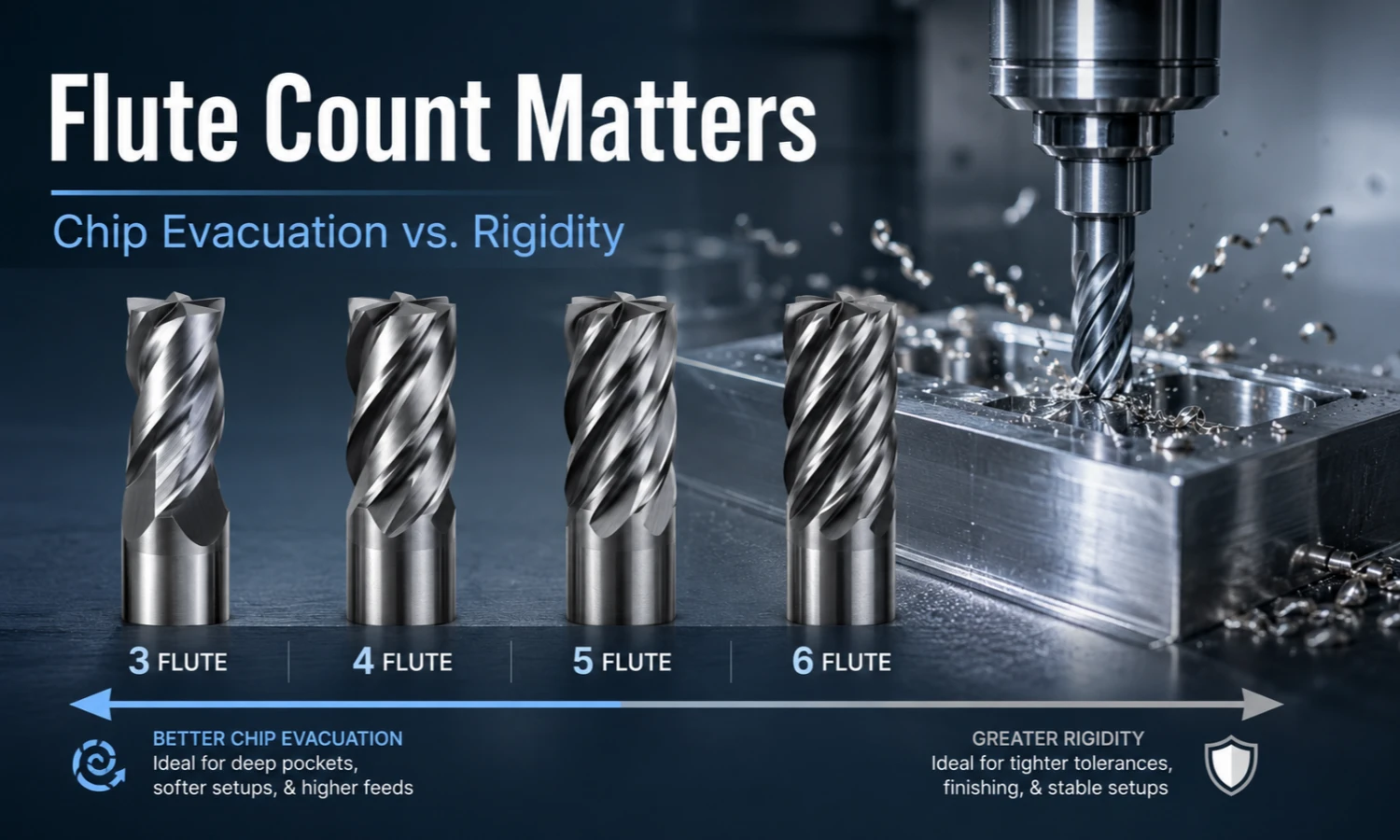
3-Fraises à flûte
Les conceptions à trois cannelures offrent un espace de goujure relativement généreux et peuvent être envisagées lorsque l'évacuation des copeaux constitue une partie importante de l'application..
Cependant, le nombre de flûtes à lui seul ne détermine pas les performances. Géométrie de l'hélice, conception de base, engagement radial, profondeur de coupe, et le diamètre de la fraise doivent également être pris en compte.
4-Fraises à flûte
équilibre entre le nombre de pointe, force de base, espace de puce, et polyvalence générale d'usinage.
Ils peuvent être envisagés pour le fraisage latéral, profilage, fraisage d'épaulements, et autres opérations CNC lorsque la géométrie et la configuration de l'outil sont adaptées.
Voir notre 4 Fraise en bout de cannelure pour les spécifications disponibles et les options d’application.
5-Fraises à flûte
Les fraises à cinq dents apparaissent fréquemment dans les applications hautes performances en acier inoxydable, car l'arête de coupe supplémentaire peut être utile lorsque l'engagement est contrôlé et que l'évacuation des copeaux reste adéquate..
Cependant, l'augmentation du nombre de flûtes réduit également l'espace disponible pour les jetons.
Donc, une conception à 5 cannelures ne doit pas être sélectionnée uniquement parce que la pièce est en acier inoxydable. Rainurage profond, volume de copeaux élevé, évacuation limitée, diamètre de coupe, et la rigidité de la machine peut modifier le nombre de cannelures préféré.
6-Fraises à flûte
Des fraises en bout à six cannelures peuvent être envisagées pour un fraisage latéral stable, profilage, semi-finition, et applications de finition où l'évacuation des copeaux est gérable et où davantage de contacts de coupe sont bénéfiques.
Ils ne doivent pas être traités comme des couteaux de finition uniquement ou comme un choix automatique pour les matériaux plus durs.. La conception complète de la fraise et la stratégie d’usinage restent importantes.
Pour une comparaison plus large du nombre de flûtes, lire 2 Flûte vs 4 Flûte vs 6 Fraise en bout de cannelure.
Quel revêtement convient aux fraises en acier inoxydable?
Le revêtement est un autre élément important dans la sélection fraises en bout pour acier inoxydable.
L'outillage industriel pour l'acier inoxydable utilise généralement des systèmes de revêtement résistants à la chaleur et à l'usure tels que:
- Or
- AlCrN
- TiAlN
- TiSiN ou TiAlSiN dans certaines applications plus performantes
En fonction du système de revêtement et de l'application, ces revêtements peuvent offrir des avantages liés à la résistance à la chaleur, résistance à l'oxydation, résistance à l'usure, contrôle du frottement, et une protection de pointe.
Cependant, aucun revêtement ne doit automatiquement être décrit comme le meilleur pour chaque application en acier inoxydable.
Le choix du revêtement dépend également de:
- Nuance d'acier inoxydable
- Température de coupe
- Usinage humide ou sec
- Substrat en carbure
- Géométrie de pointe
- Engagement de coupe
- Stratégie d'usinage
Pour cette raison, le revêtement doit être sélectionné dans le cadre du système de coupe complet plutôt que par le nom du revêtement uniquement.
Une comparaison plus approfondie entre AlTiN, AlCrN, TiAlN, et d'autres options de revêtement sont mieux réservées à un spécialiste dédié Meilleur revêtement de fraise en bout pour l'acier inoxydable guide.
Hélice variable, Angle d'hélice, Pas variable, Rigidité et bavardage
Le angle d'hélice de fraise en bout pour acier inoxydable affecte l’engagement de pointe, direction de la force de coupe, flux de copeaux, et comportement d'usinage. Cependant, il n’existe pas d’angle d’hélice unique qui devrait être considéré comme universellement le meilleur pour chaque application en acier inoxydable.
Les géométries à hélice variable et à pas variable sont également fréquemment utilisées dans les fraises en bout hautes performances..
Au lieu de permettre à chaque arête de coupe d'engager la pièce exactement au même intervalle répété, Les conceptions à hélice variable ou à pas inégal modifient le timing des forces de coupe. Dans des applications appropriées, cela peut aider à réduire les vibrations et les bavardages répétitifs.
Néanmoins, la géométrie ne peut pas corriger toutes les configurations d'usinage instables.
Quand le bavardage se produit, le système complet doit être évalué, y compris:
- Porte-à-faux d'outil
- Etat du porte-outil
- Rigidité de la broche
- Tenue de travail
- Diamètre de coupe
- Engagement axial
- Engagement radial
- Géométrie de pointe
Donc, considérer l'hélice variable ou le pas variable comme une partie du système d'usinage complet plutôt que comme une solution autonome.
Faites correspondre la fraise en bout aux nuances d'acier inoxydable courantes
« L'acier inoxydable » comprend des matériaux ayant un comportement d'usinage différent.
Un concept de coupe similaire peut fonctionner sur plusieurs qualités, mais la géométrie appropriée, revêtement, nombre de flûtes, et la stratégie d'usinage peut encore changer.
| Catégorie d'acier inoxydable | Caractéristique d'usinage typique | Considération de sélection de fraise en bout |
|---|---|---|
| 303 | Généralement plus facile à usiner que de nombreuses nuances austénitiques | Géométrie de la fraise d'équilibrage, finition, et productivité |
| 304 | Grade commun avec tendance à travailler dur | Coupe stable, arêtes de coupe efficaces, et formation constante de copeaux |
| 316 | Matériau résistant pouvant générer une chaleur considérable | Stabilité de l'outil, contrôle de la chaleur, et la résistance à l'usure deviennent importantes |
| 17-4 PH | Le comportement d'usinage change avec les conditions de traitement thermique | Considérez la dureté réelle, rigidité de l'outil, et charge de coupe |
Il s'agit de considérations générales de sélection plutôt que de paramètres de coupe fixes..
Par exemple, deux composants fabriqués à partir de 304 l'acier inoxydable peut nécessiter des fraises différentes si l'une nécessite des rainures profondes tandis que l'autre ne nécessite qu'une finition latérale légère.
De même, un 17-4 Le composant PH ne doit pas être évalué uniquement par le nom du matériau. Son état de traitement thermique et sa dureté réelle peuvent également influencer le choix de la fraise..
Liste de contrôle pratique de sélection de fraises en bout pour l'acier inoxydable
Avant de sélectionner une fraise ou de demander un devis, confirmer les informations suivantes.

1. Catégorie d'acier inoxydable
Fournir la note exacte dans la mesure du possible, tel que 303, 304, 316, 17-4 PH, ou un autre alliage inoxydable spécifié.
Décrire la pièce uniquement comme « acier inoxydable » peut ne pas fournir suffisamment d'informations pour une évaluation précise de l'outil..
2. Opération d'usinage
Confirmez si le couteau sera utilisé pour le rainurage, fraisage latéral, profilage, ébauche, finition, empocher, ou contour 3D.
3. Géométrie de la pièce
Identifiez si la fonctionnalité est plate, courbé, une épaule, un coin R, une cavité profonde, ou un autre contour interne ou externe.
Cela permet de déterminer si Flat, Nez de boule, Rayon de coin, ou une autre géométrie de coupe doit être envisagée.
4. Dimensions de l'outil requis
Les dimensions utiles incluent:
- Diamètre de coupe
- Longueur de flûte
- Longueur totale
- Diamètre de la tige
- Rayon d'angle, si nécessaire
Pour les applications non standards, un dessin est souvent plus utile qu'une longue description écrite.
5. Ebauche ou Finition
Un outil sélectionné pour un enlèvement de matière efficace peut ne pas être le même outil que celui utilisé pour produire la finition de surface finale..
6. Rigidité de la machine et de l'installation
État de la machine, broche, porte-outil, porte-à-faux de l'outil, porte-pièce, et la stabilité de la pièce peuvent tous affecter les performances de la fraise.
Une fraise en carbure rigide ne peut pas compenser le mouvement du support ou de la pièce à usiner..
7. Évacuation des copeaux
L'évacuation des copeaux devient particulièrement importante dans les fentes profondes, poches, zones d'usinage fermées, et opérations avec un engagement plus élevé.
Le nombre de flûtes doit donc être sélectionné en même temps que les exigences en matière d'élimination des copeaux..
8. Exigence de finition de surface
Une opération d'ébauche et une passe de finition finale peuvent nécessiter des conceptions de fraises différentes, même lors de l'usinage de la même nuance d'acier inoxydable..
Foire aux questions
Quelle est la meilleure fraise en bout pour l'acier inoxydable?
Il n'existe pas de fraise idéale pour chaque application en acier inoxydable.. Le carbure monobloc est un choix courant, mais le coupeur final doit être sélectionné en fonction de la qualité de l'acier inoxydable, opération d'usinage, géométrie de la pièce, nombre de flûtes, revêtement, rigidité de la machine, évacuation des copeaux, et finition souhaitée.
Une fraise en carbure monobloc coupera-t-elle l'acier inoxydable?
Oui. Les fraises en carbure monobloc sont largement utilisées pour l'usinage de l'acier inoxydable car le carbure offre une rigidité élevée., résistance à l'usure, et une stabilité de pointe. La géométrie de la fraise, revêtement, conception de flûte, et les conditions d'usinage doivent toujours correspondre à l'application.
Combien de flûtes dois-je utiliser pour l'acier inoxydable?
Cela dépend de l'opération. Moins de cannelures offrent généralement plus d'espace pour les puces, tandis que davantage de cannelures fournissent des arêtes de coupe supplémentaires et peuvent améliorer la rigidité ou les performances de finition dans des conditions appropriées.. Diamètre de coupe, fiançailles, volume de copeaux, opération d'usinage, et la rigidité de la machine doivent tous être pris en compte.
Quel revêtement est le meilleur pour les fraises en bout en acier inoxydable?
Il n’existe pas de meilleur revêtement universel. Or, AlCrN, TiAlN, et d'autres systèmes de revêtement résistant à la chaleur sont couramment envisagés pour les applications en acier inoxydable.. Le revêtement approprié dépend de la qualité de l'acier inoxydable, température de coupe, géométrie de la fraise, substrat, stratégie d'usinage, et conditions du liquide de refroidissement.
Une fraise à 4 ou 5 cannelures est-elle meilleure pour l'acier inoxydable ??
Ni l'un ni l'autre n'est automatiquement meilleur.
Pour les opérations qui créent plus de volume de copeaux, l'espace de flûte supplémentaire disponible dans une fraise à 4 cannelures par rapport à une conception similaire à 5 cannelures peut être utile. Lorsque l’engagement radial est contrôlé et que l’évacuation des copeaux est fiable, une conception à 5 cannelures peut fournir plus de contacts coupants.
Le choix final dépend toujours du diamètre de la fraise, géométrie de la flûte, fiançailles, rigidité de la machine, et l'opération spécifique.
La même fraise en bout peut-elle usiner les deux 304 et 316 stainless steel?
Un cutter peut convenir aux deux matériaux, mais cela ne signifie pas que les mêmes conditions d'usinage ou la même configuration de fraise seront toujours optimales.. La candidature complète, y compris le comportement des matériaux, géométrie, engagement de l'outil, génération de chaleur, et configuration de la machine, devrait être évalué.
Besoin d'aide pour choisir une fraise en bout pour l'acier inoxydable?
Pour l'évaluation des outils, veuillez fournir:
- Nuance d'acier inoxydable
- Dessin de la pièce
- Opération d'usinage
- Diamètre de coupe requis
- Longueur de flûte
- Longueur totale
- Diamètre de tige si spécifié
- Exigence d'ébauche ou de finition
- Rayon de coin ou géométrie spéciale
- Tout problème d’usinage actuel ou exigence particulière
Notre usine peut examiner les exigences de la pièce à usiner et de l'usinage et aider à évaluer si un fraise à bout plat, fraise à bout sphérique, fraise en bout à rayon de coin, fraise d'ébauche, Fraise en carbure de bois, ou outil de coupe personnalisé est plus approprié pour l'application.
Pour les exigences non standards, les dimensions et la géométrie finales de la fraise peuvent être confirmées selon le dessin, matériau de la pièce à usiner, et conditions d'usinage.