 Precision Milling Cutters,Cutting Tools for CNC Machining Every Material

In a 2 flute vs 4 flute end mill comparison, the main decision is how to balance chip evacuation, cutting-edge count, tool support, and the required machining result.
A two-flute cutter is often preferred when chip removal is the main challenge. Typical examples include full-width slotting, enclosed pockets, and high-chip-volume machining in aluminum or other non-ferrous materials.
A four-flute cutter is often selected when chips can leave the cutting zone reliably and the operation benefits from more cutting contacts, greater core support, or stable side milling and finishing.
However, flute count is not the only selection factor. Cutter diameter, flute depth, tool reach, workpiece material, coating, engagement, machine rigidity, and coolant delivery also affect the result.
Quick Answer
Use a 2-flute end mill when the operation creates a high chip volume or restricts chip evacuation. It is a common starting direction for full-width slotting, deep pockets, aluminum machining, and other chip-heavy cuts.
Use a 4-flute end mill when chip space is sufficient and the process benefits from more cutting edges. It is commonly considered for side milling, profiling, semi-finishing, finishing, and many steel applications.
Neither design is automatically better for every job. The correct choice depends on where the cutter is engaged, how chips leave the cut, and whether chip space, rigidity, productivity, or finish is the main priority.
2 Flute vs 4 Flute End Mill at a Glance
| Factor | 2-Flute Direction | 4-Flute Direction |
|---|---|---|
| Cutting Edges | Two cutting edges | Four cutting edges |
| Flute Space | More space for chips | Less space between cutting edges |
| Chip Evacuation | Often useful in closed or chip-heavy cuts | Suitable when chips can leave the cut reliably |
| Core Support | Depends on flute depth and geometry | Often allows more core support |
| Full-Width Slotting | Common when chip volume is high | Requires adequate chip clearance |
| Side Milling | Suitable when chip evacuation remains important | Often useful with lighter radial engagement |
| Surface Finish | Can produce a good finish under stable conditions | More cutting contacts may support finishing |
| Material Direction | Common in aluminum and non-ferrous cuts | Common in many steel and finishing applications |
| Main Selection Focus | Chip space and evacuation | Cutting-edge count and tool support |
 How Flute Count Changes Cutting Performance
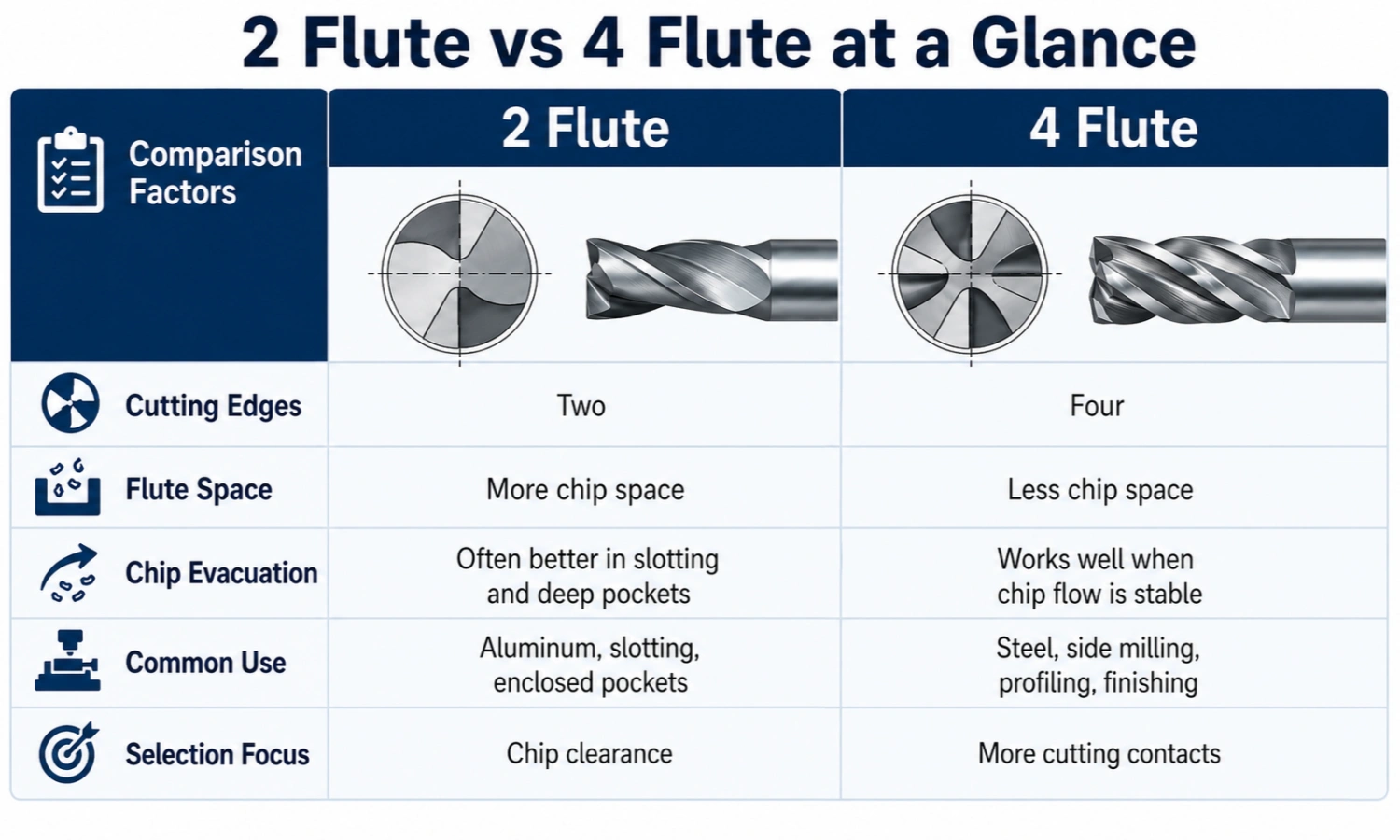
Flute Space and Chip Evacuation
A cutter has limited space between its cutting edges and core.
With two flutes, more of the cutter diameter can normally be allocated to the flute grooves. Therefore, chips have more space to form and move away from the cutting zone.
This can be useful during:
- Full-width slotting
- Deep or enclosed pocket milling
- Aluminum machining
- Plastic machining
- Other high-chip-volume operations
A four-flute cutter has more cutting edges within the same diameter. As a result, the individual flute grooves are often smaller.
This does not mean that a four-flute tool cannot evacuate chips. Instead, it means that the application must provide enough space, coolant, air, or toolpath movement for chips to leave the cut.
Cutting Edges and Feed Capacity
A two-flute cutter has two cutting contacts per revolution, while a four-flute cutter has four.
At the same spindle speed and chip load per tooth, the four-flute tool would require a higher programmed feed because more cutting edges enter the material during each revolution.
However, this higher feed is only practical when:
- Chip evacuation remains stable
- Machine power is sufficient
- Tool engagement is suitable
- Cutting heat is controlled
- The workpiece and holder are rigid
- The cutter geometry matches the material
Therefore, four flutes do not automatically mean faster machining. Likewise, two flutes do not automatically mean lower productivity.
The usable feed depends on the overall machining conditions.
Core Support and Tool Rigidity
A four-flute design often allows more material to remain near the tool core. This can provide greater core support in some cutter designs.
However, actual rigidity also depends on:
- Cutter diameter
- Flute depth
- Flute length
- Overall tool length
- Tool overhang
- Helix angle
- Carbide grade
- Holder condition
A short two-flute cutter may be more stable than a long four-flute cutter of the same diameter. For this reason, flute count should not be used as the only measure of tool rigidity.
Surface Finish and Cutting Stability
More cutting edges can provide more frequent cutting contacts. Therefore, a four-flute cutter may support a consistent finish during suitable side milling and finishing operations.
Nevertheless, surface finish also depends on:
- Tool runout
- Cutting-edge quality
- Feed per tooth
- Radial engagement
- Tool deflection
- Machine stability
- Workpiece clamping
- Toolpath strategy
A well-selected two-flute cutter can still produce a good finished surface, especially in aluminum and other non-ferrous materials.
For a broader explanation of flute space, core diameter, helix angle, and flute-count selection, read our end mill flute design and selection guide.
When to Use a 2-Flute End Mill
Full-Width Slotting
Full-width slotting engages the cutter across its full diameter. Consequently, the operation produces a high chip volume while the slot walls restrict the available chip-exit paths.
A two-flute end mill is often considered because its wider flute grooves provide more chip space.
Stable slotting also depends on:
- Slot depth
- Cutter diameter
- Flute length
- Tool overhang
- Air or coolant delivery
- Machine rigidity
- Cutting parameters
A shallow slot and a deep slot do not create the same cutting conditions. Therefore, the tool and cutting strategy should match the actual feature.
Deep or Enclosed Pockets
Chips may remain inside a deep or enclosed pocket instead of leaving the cutting zone.
When chips are re-cut, cutting heat and tool load can increase. Surface marks, built-up edge, and early edge damage may also develop.
A two-flute cutter can provide useful chip clearance in these applications. However, pocket depth, entry method, side engagement, tool reach, and coolant access must still be reviewed.
Aluminum and Non-Ferrous Machining
Many aluminum alloys produce relatively large or continuous chips. Copper, brass, and selected plastics can also require reliable chip clearance.
For these materials, a two-flute tool may use:
- Sharp cutting edges
- Smooth or polished flute surfaces
- Suitable flute space
- Application-specific edge preparation
- Reliable air, mist, or coolant delivery
A two-flute design is not the only option for aluminum. Three-flute and application-specific four-flute cutters may also work well in certain side-milling or finishing conditions.
The selection should be based on the operation rather than the material name alone.
Other Chip-Heavy Operations
Two-flute tools can also support light roughing and selected steel slotting applications when chip evacuation is difficult.
The key question is:
Does the operation create more chips than the available flute space can remove reliably?
If the answer is yes, a lower flute count may provide a useful starting direction.
For detailed examples of two-flute applications, read what a 2 flute end mill is used for.
View our standard and custom solid carbide 2 flute end mill options.
When to Use a 4-Flute End Mill
Side Milling and Profiling
During side milling, only part of the cutter diameter may engage the workpiece. Chips usually have more open space to leave than during full-width slotting.
In this situation, a four-flute tool may provide:
- More cutting contacts
- Greater core support in many designs
- Stable radial cutting
- Consistent profiling
- Improved productivity under suitable conditions
However, radial engagement must remain appropriate. Heavy side engagement can still create heat, deflection, and chip-control problems.
Semi-Finishing and Finishing
Four-flute cutters are commonly used for semi-finishing and finishing because the operation often creates a lower chip volume than full-width roughing.
More cutting contacts may support:
- Consistent wall finishing
- Stable contour milling
- Smoother profiling
- Higher programmed feed under suitable conditions
Still, a four-flute tool does not guarantee a better surface.
Runout, feed per tooth, edge quality, toolpath, radial engagement, and machine rigidity remain important.
Steel and Stainless Steel Applications
Four-flute end mills are widely used for many steel and stainless steel machining operations.
In these materials, the tool may benefit from:
- Greater core support
- More cutting edges
- Suitable coating
- Controlled radial engagement
- Stable machine and fixture conditions
However, the material category alone does not determine the flute count.
For example, full-width slotting in steel may still require two or three flutes when chip evacuation is limited. Stainless steel also requires careful control of cutting heat, work hardening, coating, and edge strength.
Operations With Stable Chip Evacuation
A four-flute cutter becomes more practical when chips can leave the cutting zone without packing around the tool.
This may occur during:
- Side milling
- Shallow profiling
- Open-pocket finishing
- Semi-finishing
- Light radial cuts
- Operations with effective coolant or air delivery
When chip space is no longer the main limitation, cutting-edge count and tool support can receive greater priority.
2 Flute vs 4 Flute by Workpiece Material
The following table shows common starting directions rather than fixed rules.
| Material | Common Starting Direction | What May Change the Choice |
|---|---|---|
| Aluminum | Two or three flutes for chip-heavy cuts | Side milling, finishing, alloy grade and coolant |
| Copper | Two flutes for chip clearance | Copper grade, burr control and finish |
| Brass | Two or more flutes may work | Brass grade, chip form and machining operation |
| Plastics | One or two flutes are common | Plastic type, cutting heat and edge requirements |
| Steel | Four flutes are common | Full slotting, tool diameter, coating and depth |
| Stainless Steel | Four flutes suit many operations | Work hardening, engagement, coolant and edge strength |
| Cast Iron | Several flute counts may work | Abrasiveness, dry cutting, dust and operation |
| Selected Composites | Application-specific cutter required | Material structure, abrasiveness and edge quality |
This table should be used as an initial guide. The final decision should also reflect tool diameter, depth of cut, machine condition, and required finish.
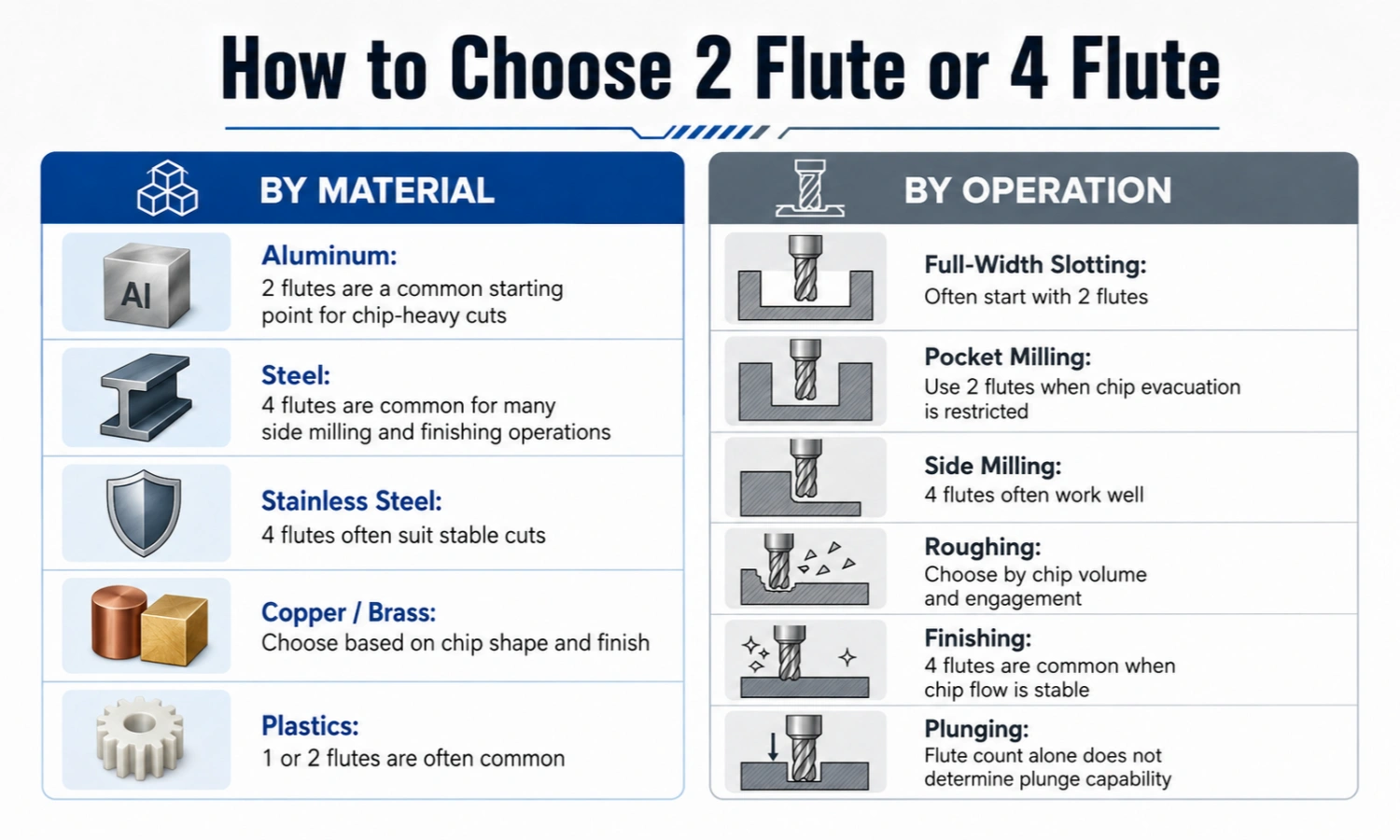
2 Flute vs 4 Flute by CNC Operation
Slotting
For full-width slotting, two flutes are often a practical starting point because the operation produces a high chip volume and restricts chip movement.
A four-flute cutter may still perform shallow or controlled slotting when:
- The slot is not deep
- Chip evacuation is reliable
- The material produces manageable chips
- Cutting parameters are adjusted correctly
The deeper and more enclosed the slot becomes, the more important flute space usually becomes.
Pocket Milling
Pocket milling includes both the entry move and the subsequent material-removal path.
A two-flute cutter may suit deep or enclosed pockets where chip packing is a concern. A four-flute cutter may suit side engagement or finishing after the main pocket has been opened.
Therefore, one pocket can involve different flute-count requirements during different stages of the operation.
Side Milling and Profiling
For side milling, chip evacuation is often less restricted than in full-width slotting.
Four flutes may support more cutting contacts and stable profiling. However, two flutes can still work well when machining aluminum, plastics, or other materials that benefit from additional chip space.
The selection should reflect radial engagement, required finish, and tool rigidity.
Roughing
Roughing does not automatically mean that two flutes are required.
Full-width or high-chip-volume roughing may benefit from fewer flutes. In contrast, side roughing with controlled radial engagement may use three, four, or more cutting edges.
Dedicated roughing end mills may also use chipbreaker or serrated geometry. Therefore, they should not be selected by flute count alone.
Finishing
Four-flute cutters are common in finishing because chip volume is often lower and more cutting contacts may improve machining continuity.
However, flute count cannot compensate for:
- Excessive runout
- Unstable clamping
- Incorrect feed per tooth
- Long tool overhang
- Poor toolpath
- Worn cutting edges
A two-flute cutter can also produce a good surface finish when it matches the material and cutting conditions.
Plunging and Ramping
Flute count does not determine whether an end mill can plunge.
Both two-flute and four-flute cutters may be manufactured with center-cutting or non-center-cutting geometry. Before programming straight plunging, ramping, or helical entry, confirm that the end cutting edges and tool design support the required movement.
For detailed guidance, read can you plunge with an end mill.
Quick Selection Checklist
Before choosing between two and four flutes, confirm:
- What material are you machining?
- Is the operation full-width slotting or side milling?
- How much chip volume will be produced?
- Is chip evacuation restricted?
- Is the pocket deep or enclosed?
- Is surface finish more important than flute space?
- How long is the tool overhang?
- Is the machine and fixture setup rigid?
- Can coolant or air reach the cutting zone?
- Does the operation require center-cutting geometry?
- Is the cutter intended for roughing, semi-finishing, or finishing?
Choose two flutes when chip space is the main limitation.
Choose four flutes when chip evacuation is stable and the process benefits from more cutting contacts or greater core support.
For a broader flute-count comparison, read compare 2, 4, and 6 flute end mills.
FAQ About 2 Flute vs 4 Flute End Mills
What Is the Main Difference Between 2 and 4 Flute End Mills?
The main difference is the balance between flute space and cutting-edge count.
A two-flute cutter normally provides more space for chips. A four-flute cutter provides more cutting edges and often allows greater core support.
Actual performance still depends on the complete tool geometry and machining conditions.
Is 2 Flute or 4 Flute Better for Aluminum?
Two flutes are a common choice for aluminum slotting, pocketing, and other high-chip-volume cuts.
However, a four-flute aluminum cutter may work well during side milling or finishing when its geometry provides adequate chip clearance.
The operation is as important as the material.
Is a 4-Flute End Mill Good for Steel?
Yes. Four-flute end mills are commonly used for side milling, semi-finishing, and finishing in steel.
However, full-width slotting or deep cuts may require fewer flutes when chip evacuation becomes difficult.
Coating, cutter geometry, rigidity, and cutting conditions must also match the steel grade.
Can a 4-Flute End Mill Cut Aluminum?
Yes. A four-flute cutter can machine aluminum when its flute geometry, edge preparation, and cutting conditions suit the material.
It may be useful for lighter side milling or finishing. For deep slotting or heavy chip removal, fewer flutes are often easier to manage.
Which Flute Count Is Better for Full-Width Slotting?
Two flutes are often preferred because full-width slotting produces a high chip volume and limits chip-exit paths.
Nevertheless, a four-flute cutter may work in shallow slots when chip evacuation remains stable and the cutting parameters are suitable.
Which Is Better for Side Milling?
Four flutes are often useful for side milling because chips have more open space to leave, while the additional cutting edges can support productivity and finishing.
However, two flutes may still be preferred in aluminum, plastics, or other applications where chip clearance remains important.
Does a 4-Flute End Mill Always Give a Better Finish?
No. More cutting edges may help in some finishing operations, but they do not guarantee a better surface.
Runout, edge quality, feed per tooth, radial engagement, tool deflection, machine stability, and toolpath also affect the result.
Can a 2-Flute End Mill Machine Stainless Steel?
Some two-flute cutters can machine stainless steel, particularly during slotting or operations where chip evacuation is restricted.
However, stainless steel also requires a suitable carbide grade, coating, edge strength, coolant strategy, and control of work hardening.
The exact application must be reviewed.
Does Flute Count Determine Plunge Capability?
No. Plunge capability depends on the end geometry, especially whether the cutter has center-cutting edges.
A two-flute or four-flute tool may be either center cutting or non-center cutting.
Always confirm the tool specification before axial entry.
Related Guides
For more information, read:
Solid carbide 2 flute end mill
What is a 2 flute end mill used for?
Can you plunge with an end mill?
Compare 2, 4, and 6 flute end mills
End mill flute design and selection
Need Help Choosing 2 or 4 Flutes?
Send us your workpiece material, machining operation, cutter size, cutting depth, tool reach, drawing, reference model, and required quantity when available.
We will review the information and help identify whether chip space, cutting-edge count, tool support, or surface requirements should receive greater priority.
Email: sales@cutterbest.com