 Precision Milling Cutters,Cutting Tools for CNC Machining Every Material

Choosing the right end mill matters in CNC machining because flute count affects chip evacuation, cutting load, and surface finish. Among the common options, the 2 flute end mill is widely used in applications where smooth chip removal and stable cutting are the priority.
So, what is a 2 flute end mill used for?
In simple terms, a 2 flute end mill is mainly used for aluminum machining, slotting, pocket milling, roughing, and cutting other soft materials. Because it has fewer cutting edges and larger flute space, it can clear chips more easily than many higher-flute tools in soft-material applications.
If you are choosing a cutter for non-ferrous materials, slotting, or light plunge entry, you can also view our carbide 2 flute end mill product page for more details.
What Is a 2 Flute End Mill?
A 2 flute end mill is a milling cutter with two cutting edges. Compared with 3 flute, 4 flute, or 6 flute tools, it offers more space for chips to leave the cutting zone.
Because of this structure, a 2 flute cutter is often preferred when the material produces larger chips or when chip packing may reduce cutting stability. Therefore, it is commonly used in soft materials, slotting operations, and roughing applications where chip evacuation is critical.
In addition, many machinists choose a 2 flute end mill when they want lower cutting resistance and smoother entry in aluminum and similar materials.
Main Uses of a 2 Flute End Mill
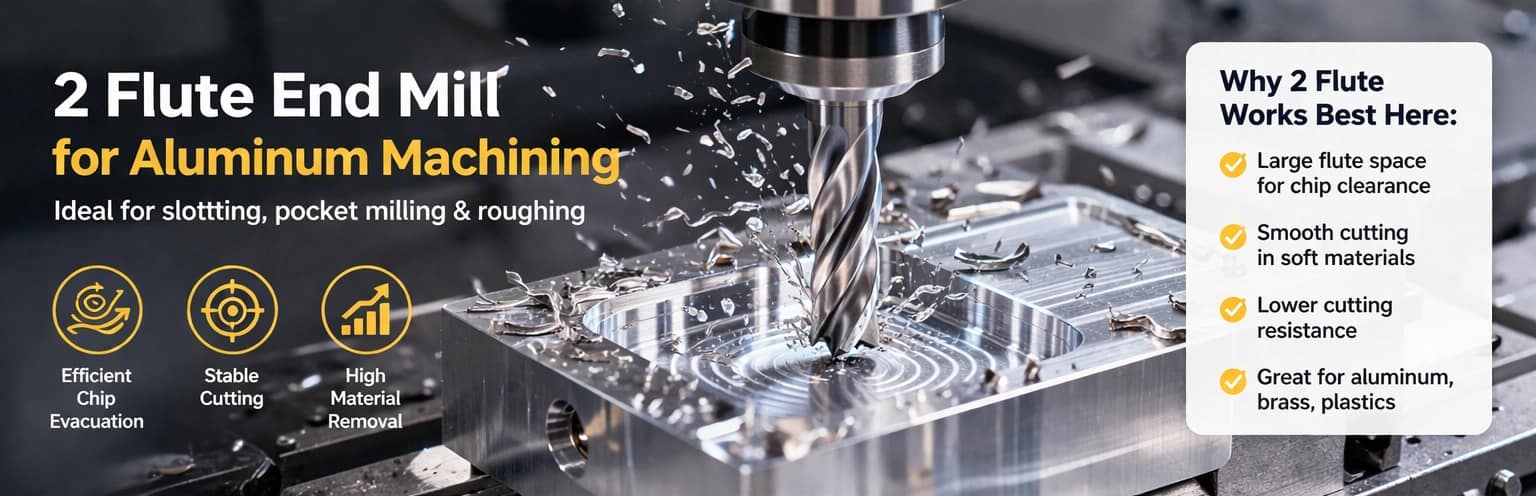
A 2 flute end mill is commonly used for several practical machining tasks. Below are the most common applications.
Aluminum Machining
One of the most common uses of a 2 flute end mill is aluminum machining. Aluminum often produces larger chips, so a tool with larger flute space helps reduce chip buildup and improve cutting stability.
For this reason, 2 flute cutters are widely used for aluminum parts in CNC milling, especially when the process requires smooth chip flow and efficient material removal.
Slotting and Pocket Milling
A 2 flute end mill is also a strong choice for slotting and pocket milling. In these operations, chips stay in the cutting zone more easily than in open side milling. As a result, chip evacuation becomes more important.
Because a 2 flute cutter has more chip room, it is often used for:
- full slot cutting
- shallow slot starts
- pocket entry
- rough pocket machining
Roughing in Soft Materials
When the goal is faster material removal rather than fine finishing, a 2 flute end mill can be a practical solution. It is often used in roughing operations involving aluminum, brass, copper, plastics, and similar soft materials.
In these situations, the key advantage is better chip flow and lower risk of chip clogging.
Plastics, Brass, and Copper
A 2 flute end mill is not limited to aluminum. It is also commonly used for:
- brass
- copper
- plastics
- composites
- other soft non-ferrous materials
These materials often benefit from a cutter design that allows chips to clear more easily.
Light Plunge Entry
Some 2 flute end mills can also be used for light plunge cutting, especially when they have center-cutting geometry. However, this depends on tool design, cutting parameters, and material type.
For more details, you can also read our can you plunge with a 2 flute end mill guide.
Quick Table: Best Uses of a 2 Flute End Mill
| Application | Good Choice? | Main Reason |
|---|---|---|
| Aluminum machining | Yes | Better chip evacuation |
| Slotting | Yes | More room for chips in the slot |
| Pocket milling | Yes | Helps reduce chip packing |
| Roughing soft materials | Yes | Lower cutting resistance and smoother chip flow |
| Brass and copper | Yes | Good for non-ferrous materials |
| Plastics | Yes | Helps clear chips more efficiently |
| Hardened steel | Usually no | Higher rigidity is often needed |
| Fine finishing in hard materials | Usually no | Surface finish and tool rigidity become more important |
When Is a 2 Flute End Mill Not the Best Choice?
Although a 2 flute end mill is useful in many situations, it is not always the best option.
It may not be the ideal choice when:
- machining hardened steel
- cutting stainless steel with high heat buildup
- requiring very fine surface finish
- performing finishing cuts where rigidity matters most
- machining difficult materials with higher cutting pressure
In these applications, a 4 flute end mill for steel and stainless steel or a higher-flute tool may be more suitable.
2 Flute vs 4 Flute End Mill: Quick Selection Guide
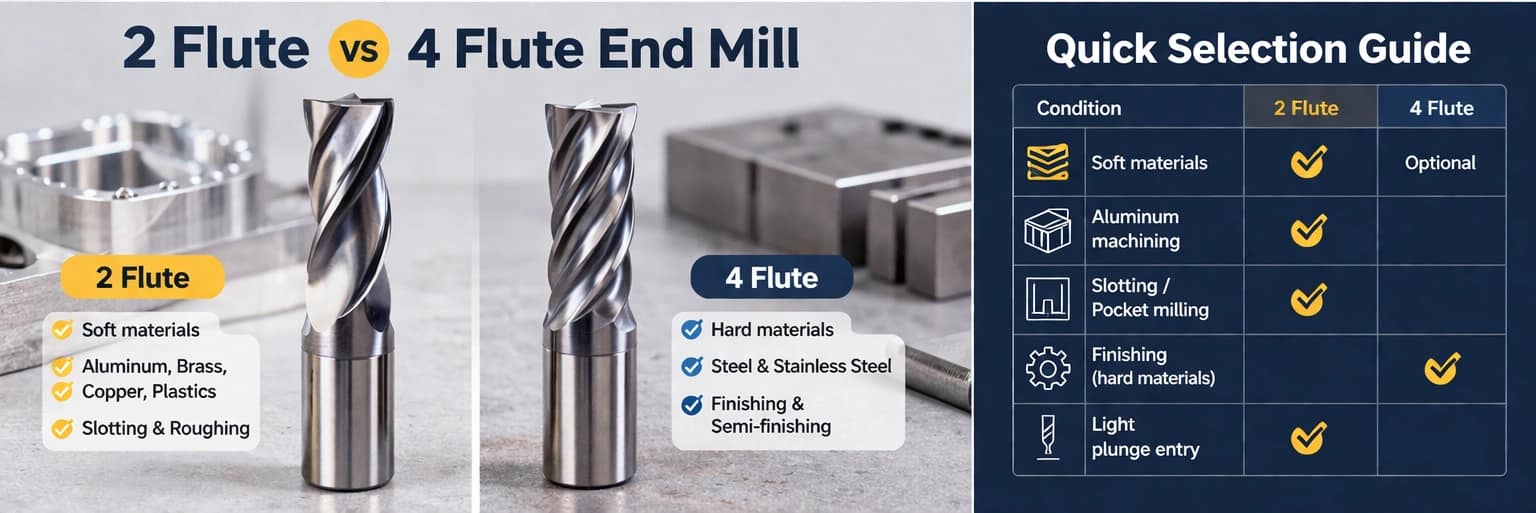
A common question is whether to choose a 2 flute or 4 flute end mill.
In general, a 2 flute end mill is better when:
- the material is soft
- chip evacuation is the priority
- the job involves slotting or roughing
- aluminum machining is the main application
A 4 flute end mill is better when:
- the material is harder
- more rigidity is needed
- surface finish is more important
- the operation is closer to semi-finishing or finishing
For a more detailed comparison, you can also read our 2 flute vs 4 flute end mill guide.
How to Choose the Right 2 Flute End Mill
When selecting a 2 flute end mill, you should consider several factors.
Material Type
First, look at the workpiece material. If you are machining aluminum, brass, copper, or plastics, a 2 flute cutter is often a practical choice.
Cutting Operation
Next, consider the operation. A 2 flute end mill is commonly used for slotting, pocket milling, roughing, and some light plunge entry applications.
Chip Evacuation Requirement
If chip evacuation is a major concern, a 2 flute design may work better than a higher-flute tool in the same soft-material setup.
Surface Finish Requirement
However, if your main goal is a finer surface finish in harder materials, a 4 flute or higher-flute tool may be more appropriate.
FAQ
What material is best for a 2 flute end mill?
A 2 flute end mill is most commonly used for aluminum, brass, copper, plastics, and other soft non-ferrous materials.
Is a 2 flute end mill only for aluminum?
No. Although it is widely used for aluminum, it is also suitable for brass, copper, plastics, composites, and other soft materials.
Is a 2 flute end mill good for slotting?
Yes. A 2 flute end mill is often a good choice for slotting because it provides better chip space and smoother chip evacuation.
Is a 2 flute end mill better than a 4 flute end mill?
Not always. A 2 flute tool is often better for soft materials and chip evacuation, while a 4 flute tool is often better for harder materials and finer finishing.
Conclusion
So, what is a 2 flute end mill used for?
A 2 flute end mill is mainly used for aluminum machining, slotting, pocket milling, roughing, and cutting soft non-ferrous materials. Its main advantage is larger flute space, which helps improve chip evacuation and supports smoother cutting in many CNC applications.
Although it is not always the best choice for hard materials or fine finishing, it remains one of the most practical cutter types for aluminum and soft material machining. The key is to match the flute design to the material, operation, and cutting conditions.
CTA
If you need a cutter for aluminum slotting, roughing, or soft material CNC machining, you can check our carbide 2 flute end mill product page for more details and custom options.