 Precision Milling Cutters,Cutting Tools for CNC Machining Every Material

A 2 flute end mill is commonly used for aluminum machining, full-width slotting, pocket milling, side milling, and light roughing. It is also suitable for copper, brass, selected plastics, and other applications where chip evacuation is a priority.
The two cutting edges leave relatively wide flute grooves. Therefore, the cutter provides more space for chips than many higher-flute-count tools. This can help reduce chip packing during closed or high-chip-volume operations.
However, two flutes are not automatically the best choice for every job. The correct tool still depends on the workpiece material, cutting operation, tool engagement, required finish, machine rigidity, and chip-removal method.
Quick Answer
What is a 2 flute end mill used for?
Typical uses include:
- Aluminum slotting
- Pocket milling
- Full-width slot cutting
- Side milling in non-ferrous materials
- Light roughing
- Copper and brass machining
- Selected plastic machining
- Operations where chips are difficult to remove
A two-flute cutter is especially useful when flute space and chip evacuation matter more than increasing the number of cutting edges. In contrast, a higher flute count may be preferred when greater core strength, more cutting contacts, or a fine surface finish is the main requirement.
What Is a 2-Flute End Mill?
A two-flute end mill has two helical cutting edges and two flute grooves along the cutter body. These grooves form part of the cutting edge and also provide space for chips to leave the cutting zone.
Compared with many four-flute or six-flute tools of the same diameter, a two-flute design normally provides more flute space. As a result, it is often considered for materials that produce large chips and for operations where the cutter is surrounded by the workpiece.
Flute count is only one part of the tool design. Cutter diameter, flute length, core strength, helix angle, edge preparation, coating, and end geometry also affect performance.
Best Uses of a 2-Flute End Mill at a Glance
| Application | Why Two Flutes Can Help | Important Condition |
|---|---|---|
| Aluminum slotting | Provides more chip space | Sharp geometry and reliable chip removal |
| Full-width slotting | Helps clear a high chip volume | Suitable cutting depth and coolant or air delivery |
| Pocket milling | Reduces the risk of chip packing | Pocket depth and entry method must be considered |
| Copper and brass | Supports chip clearance | Alloy grade and burr requirements affect selection |
| Plastics | Provides space for chip removal | Plastic type and heat control are important |
| Side milling | Can suit many non-ferrous applications | Radial engagement and surface finish must be checked |
| Light roughing | Supports chip-heavy material removal | Machine rigidity and tool reach remain important |
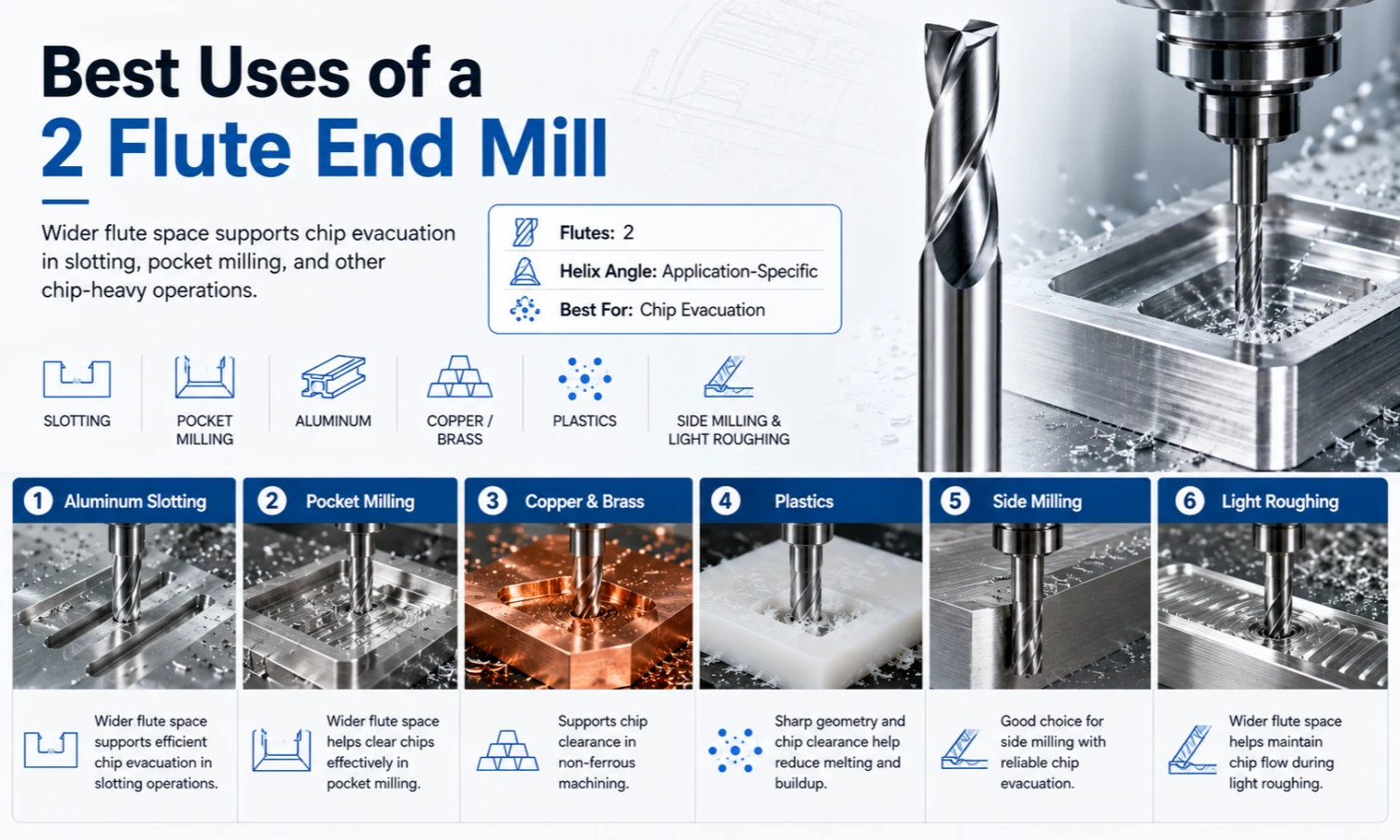
Main Uses of a 2-Flute End Mill
Aluminum Machining
Aluminum machining is one of the most common applications for a 2 flute end mill.
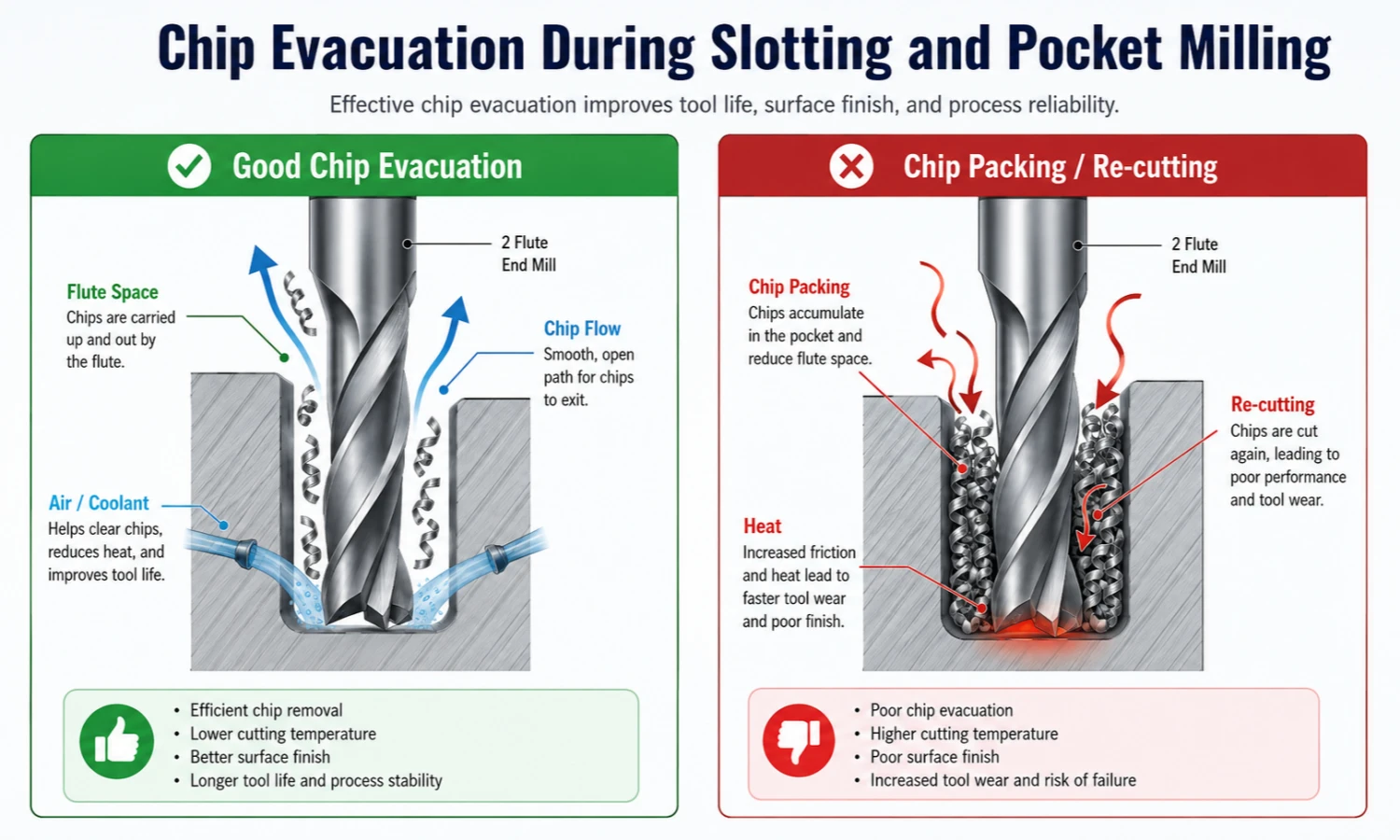
Many aluminum alloys produce relatively large or continuous chips. If those chips remain inside a slot or pocket, they may be re-cut or compressed against the workpiece. This can increase heat, cause built-up edge, and reduce cutting stability.
A suitable aluminum cutter often uses:
- Sharp cutting edges
- Smooth or polished flute surfaces
- Adequate flute space
- An uncoated design or a suitable low-friction coating
- An application-specific helix angle
- Reliable air, mist, or coolant delivery
Two flutes provide useful chip space, but flute count alone does not guarantee good aluminum performance. The complete tool geometry should match the alloy, tool diameter, cutting depth, machine condition, and required finish.
Full-Width Slotting
Full-width slotting creates a high chip volume because the cutter engages the material across its full diameter.
In addition, the slot walls restrict the paths available for chip evacuation. Chips can remain below or around the cutter, especially during deeper cuts.
A two-flute tool can help because the wider flute grooves provide more space for chips. Nevertheless, stable slotting also depends on:
- Slot depth
- Cutter diameter
- Flute length
- Tool overhang
- Coolant or air access
- Machine rigidity
- Workpiece clamping
- Cutting parameters
For deep slots, use only the flute length and overall reach required by the feature. Excessive tool extension can increase deflection and chatter.
Pocket Milling
Pocket milling combines material removal with restricted chip flow. Therefore, the tool must cut efficiently while chips leave the enclosed area.
A two-flute cutter is often considered for aluminum pockets, rough pocket machining, and other applications where chip packing creates problems.
However, pocket depth and entry method also affect tool selection. A shallow open pocket creates different conditions from a deep closed pocket. Likewise, side engagement after entry may require a different strategy from the initial pocket start.
When chips remain inside the pocket, improve air or coolant delivery before increasing the cutting load.
Copper and Brass
Copper and brass are both non-ferrous materials, but they do not machine in the same way.
Pure copper can be ductile and may produce long chips or burrs. Meanwhile, different brass alloys may produce shorter chips and require different edge preparation.
For these materials, a two-flute cutter can support chip clearance. However, the exact tool should also reflect:
- Material grade
- Burr requirements
- Surface-finish target
- Tool engagement
- Cutter diameter
- Coolant or lubrication method
Sharp cutting geometry is especially important when rubbing or material adhesion is a concern.
Plastics and Selected Composite Materials
Two-flute cutters are also used for selected engineering plastics because the flute space helps remove chips from the cutting zone.
Plastic machining may create problems such as:
- Melting
- Rubbing
- Chip wrapping
- Edge tearing
- Burr formation
- Material deformation
The correct geometry depends on whether the plastic is soft, rigid, filled, reinforced, or heat sensitive. Therefore, one general cutter should not be treated as suitable for every plastic.
Application-specific tool geometry may also be used for selected composite materials. However, composites vary widely, and some require specialized compression, diamond-cut, coated, or abrasive-resistant cutters.
Side Milling and Light Roughing
A 2 flute end mill can perform side milling, profiling, and light roughing when the tool matches the material and engagement.
During side milling, chips usually have more space to leave than during full-width slotting. Therefore, flute space may be less restrictive. Tool rigidity, radial engagement, dimensional accuracy, and surface finish may become more important.
For light roughing in aluminum or other non-ferrous materials, a two-flute design can support efficient chip removal. However, heavy roughing may require a dedicated roughing geometry, chipbreaker profile, or another flute count.
Do not select the cutter only because the operation is described as “roughing.” Review the chip volume, cutting depth, machine power, tool reach, and required material-removal rate.
Why Two Flutes Work Well in Chip-Heavy Operations
More Flute Space
A cutter has limited space between its cutting edges and core.
When the number of flutes increases, the available flute grooves normally become smaller unless the complete tool geometry is changed. With two flutes, more space can be allocated to chip formation and evacuation.
This is useful during:
- Full-width slotting
- Deep pocket machining
- Aluminum machining
- Plastic cutting
- Other high-chip-volume operations
However, more flute space can also mean a different core structure. Therefore, the required rigidity should be considered together with chip evacuation.
Chip Evacuation and Built-Up Edge
Good chip evacuation helps prevent chips from being cut repeatedly.
Re-cutting can increase:
- Cutting temperature
- Tool wear
- Cutting-edge damage
- Surface marks
- Chip welding
- Built-up edge
- Machine load
Aluminum and other ductile materials may adhere to the cutting edge when heat, friction, or lubrication conditions are unsuitable.
A sharp cutter with suitable flute surfaces can help. In addition, correctly directed air, mist, or coolant can remove chips before they collect inside the feature.
What Flute Count Cannot Tell You
Flute count does not independently determine:
- Cutting load
- Tool rigidity
- Plunge capability
- Maximum cutting depth
- Suitable workpiece material
- Required surface finish
- Safe spindle speed
- Feed rate
- Tool life
For example, two tools with the same flute count may have different core diameters, helix angles, end geometries, coatings, and carbide grades.
For a broader explanation of flute geometry and selection, read our end mill flute design and chip evacuation guide.
Can a 2-Flute End Mill Plunge?
Some center-cutting two-flute end mills support ramping, helical entry, pocket starting, or controlled plunge entry.
However, two flutes do not automatically mean that the cutter can plunge vertically. The end cutting edges must reach the tool center, and the entry method must suit the material and cutter design.
Straight plunging also creates different cutting loads and chip-flow conditions from side milling. Therefore, ramping, helical entry, or pre-drilling may provide better control in deeper or more demanding applications.
For detailed guidance, read can a 2 flute end mill plunge.
When Is a 2-Flute End Mill Not the First Choice?
Fine Finishing With Light Engagement
During light finishing, chip volume may be low. In that situation, large flute grooves may be less important than the number of cutting contacts and the stability of the cutter.
A higher-flute-count tool may support a finer or more consistent finish in some applications. However, the result still depends on runout, tool geometry, machine rigidity, radial engagement, and cutting parameters.
A two-flute cutter can still produce a good surface when the tool and process are correctly controlled.
Applications Requiring Greater Core Strength
Deep features, long overhangs, high cutting pressure, or unstable setups may require greater tool rigidity.
A cutter with a stronger core may reduce deflection. However, increasing the flute count is not the only solution. Cutter diameter, flute depth, flute length, tool material, holder condition, and machine rigidity also affect strength.
Steel and Heat-Resistant Materials
A two-flute tool is not limited to aluminum or plastics. Some steel slotting applications may also use two or three flutes when chip evacuation is difficult.
However, steel side milling, semi-finishing, or finishing may use four or more flutes when chip space is sufficient and additional cutting contacts are useful.
Stainless steel and heat-resistant materials also require careful control of heat, work hardening, tool engagement, coating, and edge strength.
For a focused comparison, read 2 flute end mill vs 4 flute.
How to Decide Whether Two Flutes Fit the Operation
Before selecting a two-flute cutter, review the complete machining condition.
Ask the following questions:
- Does the operation create a high chip volume?
- Is the cutter performing full-width slotting?
- Is the pocket deep or enclosed?
- Is chip evacuation limited?
- Does the material tend to form built-up edge?
- Is the required finish more important than flute space?
- Is the tool overhang longer than necessary?
- Is the machine and fixture setup rigid?
- Can air, mist, or coolant reach the cutting zone?
- Does the operation require center-cutting geometry?
Choose two flutes when chip space is a major requirement and the cutter structure suits the operation.
Choose another flute count when chip evacuation is already stable and the process needs more cutting contacts, greater core strength, or a different balance between roughing and finishing.
For broader selection guidance, read compare 2, 4, and 6 flute end mills.
FAQ About 2 Flute End Mill Uses
Is a 2-Flute End Mill Only for Aluminum?
No. Aluminum is a common application, but two-flute cutters are also used for copper, brass, selected plastics, side milling, slotting, pocketing, and other operations where chip evacuation is important.
The exact tool geometry should match the workpiece and cutting conditions.
Is a 2-Flute End Mill Suitable for Full-Width Slotting?
Yes, a suitable two-flute cutter is commonly used for full-width slotting, especially in aluminum and other non-ferrous materials.
The wider flute grooves provide space for chips. However, slot depth, coolant delivery, tool reach, and machine rigidity must also be considered.
Can a 2-Flute End Mill Be Used for Side Milling?
Yes. A two-flute tool can perform side milling and profiling.
During side milling, radial engagement, tool rigidity, required accuracy, and surface finish may become more important than maximum flute space.
Can a 2-Flute End Mill Machine Steel?
Yes, some two-flute end mills can machine steel, particularly during slotting or other operations where chip evacuation is restricted.
However, the correct choice depends on the steel grade, cutting depth, cutter geometry, coating, machine rigidity, and coolant method.
Can a 2-Flute End Mill Plunge?
Some center-cutting two-flute cutters can support controlled plunging, ramping, or helical entry.
Always confirm the end geometry before programming axial entry.
Does a 2-Flute Cutter Always Produce a Rougher Finish?
No. Surface finish depends on more than flute count.
Tool runout, cutting-edge quality, feed per tooth, radial engagement, machine stability, material condition, and toolpath all affect the finished surface.
When Should I Choose Three or Four Flutes Instead?
Consider three or four flutes when chip evacuation remains stable and the operation needs more cutting contacts, greater rigidity, or higher finishing potential.
Three flutes may provide a balance between chip space and edge count. Four flutes may suit some steel machining, side milling, and finishing operations.
Related Guides
For additional product and application information, visit:
Solid carbide 2 flute end mill
Can a 2 flute end mill plunge?
Compare 2, 4, and 6 flute end mills
End mill flute design and selection
Need a 2 Flute End Mill for Your Application?
Send us your workpiece material, machining operation, required cutter size, drawing, reference model, current tool information, and quantity when available. We will review the known requirements and help confirm a suitable standard or custom tool direction.
View our standard and custom solid carbide 2 flute end mill options.
Email: sales@cutterbest.com